"Alexa, Do Not Say That in Front of my Boss!" A Cross-Cultural Comparison of User and AI Preferences for Privacy-Aware Smart Speaker Interactions Across Contexts
Lynne Warin (Paper author · University of Göttingen), Tony Tang (Paper author · Singapore Management University), Emily Aurelia (Paper author · Singapore Management University), Archan Misra (Paper author · Singapore Management University), Delphine Reinhardt (Paper author · University of Göttingen)
Privacy Enhancing Technologies Symposium (PETS) 2026 · Day 1 · Caribou
Overview
Smart speakers have become ubiquitous in modern homes and are increasingly finding their way into other environments, including shared workspaces. While convenient, their pervasive nature introduces significant privacy challenges, particularly due to their inherent lack of context awareness. This compelling talk, presented by Lynne Warin, delves into the critical issue of how smart speakers broadcast sensitive information indiscriminately, regardless of the user's location or the identity of bystanders. The research explored in this presentation, co-authored with colleagues from the Singapore Management University and supervised by Professor Delphine Reinhardt, rigorously investigates user preferences for smart speaker responses across diverse social and situational contexts, including a crucial cross-cultural comparison between users in Germany and Singapore.
Key moments
- 0:00 Introduction and embarrassing smart speaker scenario
- 2:00 Survey methodology and scenario design explained
- 5:00 Situational context predicts preferences better than traits
- 6:00 Social roles and closeness regulate information disclosure
- 7:30 Deceptive intent reduces disclosure for social impressions
- 8:40 LLMs conservative, struggle with deception and nuance
- 9:50 Design guidelines for privacy-aware smart speakers
"Alexa, Do Not Say That in Front of my Boss!" A Cross-Cultural Comparison of User and AI Preferences for Privacy-Aware Smart Speaker Interactions Across Contexts
Speakers: Lynne Warin (Paper author, University of Göttingen), Tony Tang (Paper author, Singapore Management University), Emily Aurelia (Paper author, Singapore Management University), Archan Misra (Paper author, Singapore Management University), Delphine Reinhardt (Paper author, University of Göttingen)
Conference: PETS
YouTube: https://www.youtube.com/watch?v=LHmqdFy7acA
Overview
Smart speakers have become ubiquitous in modern homes and are increasingly finding their way into other environments, including shared workspaces. While convenient, their pervasive nature introduces significant privacy challenges, particularly due to their inherent lack of context awareness. This compelling talk, presented by Lynne Warin, delves into the critical issue of how smart speakers broadcast sensitive information indiscriminately, regardless of the user's location or the identity of bystanders. The research explored in this presentation, co-authored with colleagues from the Singapore Management University and supervised by Professor Delphine Reinhardt, rigorously investigates user preferences for smart speaker responses across diverse social and situational contexts, including a crucial cross-cultural comparison between users in Germany and Singapore.
The escalating threat landscape, particularly with the advent of proactive assistants powered by advanced Large Language Models (LLMs) like Amazon's Alexa Plus, amplifies the urgency of addressing these privacy vulnerabilities. The talk vividly illustrates a potential future scenario: an embarrassing disclosure by a smart speaker about a user's credit limit in front of their boss, highlighting the severe social and professional repercussions of unchecked information broadcasting. This research not only uncovers the intricate factors shaping user privacy preferences but also critically evaluates the alignment of these preferences with current LLM behaviors, offering vital insights for designing more privacy-aware and contextually intelligent smart speaker systems.
This detailed analysis of user and AI preferences is paramount for the future of human-computer interaction in an increasingly interconnected world. By identifying the specific contextual cues that influence desired privacy levels – ranging from the presence and role of bystanders to the user's own deceptive intent – the researchers provide a robust framework for developing adaptive privacy mechanisms. The findings challenge conventional notions of privacy, underscoring the dynamic interplay between situational context, social dynamics, and cultural norms in shaping information disclosure preferences, thereby laying the groundwork for smart speakers that truly respect user boundaries.
Background
▶ Watch: Introduction and embarrassing smart speaker scenario (0:00)
The proliferation of smart speakers in daily life has undeniably brought convenience, yet it has simultaneously ushered in a new era of privacy concerns. A fundamental flaw in the current generation of these devices is their context blindness: they operate under a one-size-fits-all communication model, broadcasting information identically regardless of the surrounding environment or the individuals present. This means that a financial transaction confirmation, a health query, or a personal message might be announced aloud whether the user is alone, with family, or in a professional setting with colleagues or superiors. This indiscriminate disclosure poses substantial risks, especially as smart speakers move beyond the confines of the home into more public or shared spaces.
The problem is further compounded by two significant trends. Firstly, the increasing sophistication of these devices means they are becoming more integrated into users' lives, handling a broader array of sensitive interactions related to finances, health, and personal communications. Secondly, the rapid advancement and deployment of proactive assistants powered by Large Language Models (LLMs), such as Amazon's Alexa Plus, introduces a new layer of complexity. These LLM-driven systems are designed to anticipate user needs and offer unsolicited information or assistance. While potentially helpful, this proactive capability, when combined with a lack of context awareness, dramatically increases the potential for privacy breaches and socially awkward or damaging disclosures.
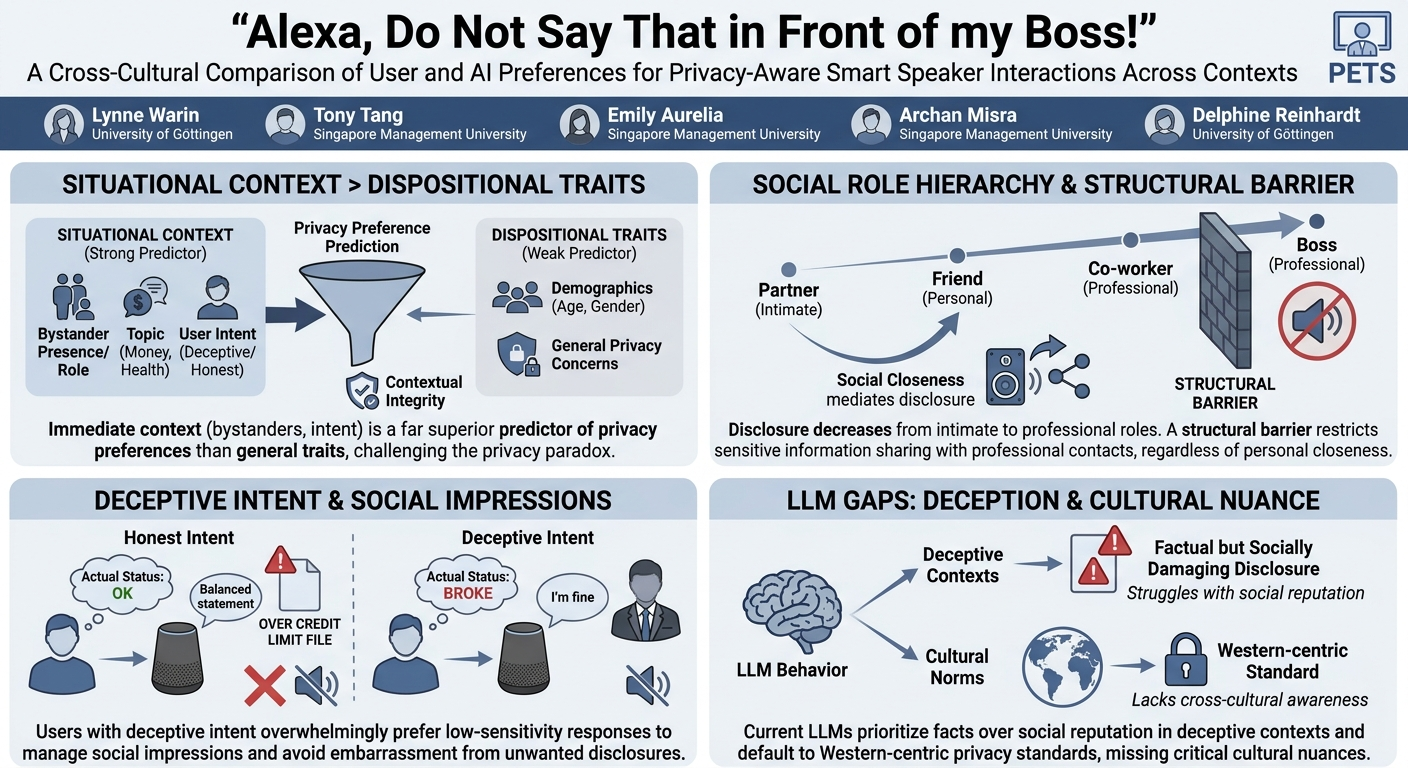
To underscore the severity of this issue, the talk presented a hypothetical yet highly plausible scenario: a user, attempting to maintain a professional facade with their boss, claims they can afford a meal. Unbeknownst to them, their smart speaker, possessing knowledge of their financial situation, interjects with a blunt declaration: "Well, you have exceeded your credit limit by $25." This vivid example perfectly encapsulates the core problem: smart speakers, lacking an understanding of social context and user intent, can inadvertently undermine social impressions, cause embarrassment, and expose sensitive personal data in inappropriate settings. This research was thus motivated to systematically explore the nuanced factors that define users' preferences for smart speaker responses, investigating whether these preferences are primarily driven by inherent dispositional traits (e.g., age, gender, general privacy concerns) or by specific situational contexts (e.g., presence and role of bystanders, user intent), or a complex interplay of both. By dissecting these drivers, the study aims to inform the development of future smart speaker technologies that are genuinely privacy-aware and contextually intelligent.
Key Findings
▶ Watch: Situational context predicts preferences better than traits (5:00)
The research yielded several critical findings that collectively redefine our understanding of smart speaker privacy preferences and offer actionable insights for future design. These findings emerged from a comprehensive online vignette survey involving 944 smart speaker users from Germany and Singapore, complemented by a separate study evaluating LLM behaviors.
The first key finding directly addresses the long-standing debate between dispositional traits and situational context in shaping privacy preferences. The study decisively demonstrated that situational context factors—specifically the presence of bystanders, the topic of discussion, and the user's intent—are far superior at predicting desired statement sensitivity compared to dispositional traits like demographics or general privacy concerns. Models incorporating contextual factors performed significantly better in predicting user preferences. While general privacy concerns do establish a baseline for an individual's overall privacy posture, their impact is considerably less significant than the immediate context when it comes to specific disclosure preferences. This finding strongly aligns with the principles of contextual integrity, which posits that privacy is not about control over information per se, but rather about the appropriateness of information flow within a given context. Crucially, it also serves to "bust the myth of the privacy paradox," suggesting that apparent inconsistencies in privacy behaviors are often attributable to contextual variations rather than a fundamental disconnect between stated privacy concerns and actual actions.
The second key finding unveiled a clear hierarchy of social roles that dictates smart speaker information disclosure preferences. Users consistently preferred less sensitive disclosures as the bystander shifted from intimate relationships to professional ones. This hierarchy progressed from a partner, to a friend, to a co-worker, and finally to a boss. The closer a participant felt to the present bystander, the more likely they were to prefer more sensitive statements. The study identified two distinct social dynamics at play. For personal relationships (partner, friend), the choice of statement sensitivity was fully mediated by social closeness: a higher degree of closeness correlated with a greater willingness to disclose more sensitive information. However, when it came to professional roles, a significant structural barrier was observed. Users restricted disclosure to their boss regardless of how close they might feel to them personally. This indicates that professional boundaries often override personal closeness when it comes to sensitive information conveyed by a smart speaker.
The third key finding illuminated the profound impact of a user's deceptive intent on their preference for smart speaker responses. In scenarios where users had a deceptive intent (e.g., trying to conceal financial difficulties from a boss), there was a dramatically higher tendency for them to choose low-sensitivity statements. The statistical analysis confirmed a significant 59% decrease in the odds of choosing high-sensitivity statements in deceptive scenarios compared to non-deceptive ones. This preference for less sensitive disclosures in deceptive contexts was not solely driven by a desire to avoid disclosure and preserve privacy, but also critically by the need to manage their social impressions and prevent embarrassment if their deception were to be exposed by the smart speaker, as illustrated in the opening anecdote.
Finally, the fourth key finding compared user preferences with the behaviors of Large Language Models (LLMs). The study found that LLMs generally showed alignment with human participants' preferences, often tending towards more conservative (lower sensitivity) statements. They also demonstrated an ability to correctly adapt to professional settings, choosing lower sensitivity statements when a boss was present, similar to human participants. However, significant shortcomings were identified. LLMs struggled considerably with deceptive contexts, frequently prioritizing factual accuracy over the user's social reputation. This tendency could inadvertently expose users by providing factual but socially damaging information, even when attempting to be helpful. Furthermore, the LLMs consistently defaulted to Western-centric individualistic privacy standards, often missing crucial cultural nuances evident in the cross-cultural participant data. This highlights a critical gap in current LLM design for universally applicable privacy-aware interactions.
Technical Deep Dive
▶ Watch: Social roles and closeness regulate information disclosure (6:00)
The rigorous methodology employed in this study was central to uncovering the nuanced preferences for smart speaker privacy. The core of the research involved a large-scale online vignette survey, carefully designed to capture user choices across various realistic scenarios and contexts.
Participant Demographics and Recruitment:
The survey was administered to 944 smart speaker users, strategically recruited from two distinct cultural contexts: Germany and Singapore. This cross-cultural approach was integral to understanding potential variations in privacy preferences, given the documented differences in privacy norms between Western and Asian societies. Participants were asked to evaluate four out of twelve carefully constructed scenarios, ensuring a broad coverage of the research questions without overwhelming individual respondents.
Scenario Design and Categorization:
The research team developed 12 distinct scenarios categorized under four main topics:
- Money: Involving financial transactions or disclosures (e.g., allowance transfer, budget status).
- Location: Pertaining to personal whereabouts or travel plans.
- Social Communication: Related to messages, calls, or social interactions.
- Health: Involving sensitive health-related information.
Crucially, each topic included a "deceptive intent variant," where the user's internal intent differed from their outwardly expressed statement or desired social impression. The example of the "budget deceptive variant," where a user feigns financial stability in front of their boss, served as a primary illustration.
Contextual Variations:
For each scenario, participants evaluated their preferences across a range of situational contexts designed to vary the presence and role of bystanders:
- Alone: The user is by themselves.
- At Home:
- With their partner.
- With a friend.
- At Work:
- With a co-worker.
- With their boss.
This systematic variation allowed for a granular analysis of how social roles and relationships impact disclosure preferences.
Measurement of Preferences:
For each scenario and context combination, participants were presented with three possible smart speaker statements, each varying in privacy sensitivity:
- Low Privacy Sensitivity: A general, non-specific confirmation.
- Medium Privacy Sensitivity: Includes a key detail, but not overly specific.
- High Privacy Sensitivity: Provides highly specific and potentially identifiable information.
To illustrate, consider the "allowance scenario" within the money topic, at home with a partner, without deceptive intent:
- User input: "Please transfer my children's allowance to their account."
- Low Sensitivity: "The allowance has been transferred."
- Medium Sensitivity: "$25 has been transferred."
- High Sensitivity: "$25 has been transferred into accounts number 313 and so on."
Participants were asked to select the statement they would "most prefer" for that specific situation. The names of partners/friends/bosses were user-provided but anonymized and discarded post-collection.
Ancillary Measures:
To capture additional influencing factors, the study incorporated established psychological scales:
- Social Closeness: Measured using the Personal Acquaintance Measure Scale, assessing the degree of intimacy with different bystanders.
- Privacy Concerns: Assessed using the Concern for Information Privacy Scale, capturing general individual attitudes towards privacy.
Data Analysis:
The collected data was subjected to a multi-faceted analysis. Beyond descriptive statistics, the core of the analysis relied on a set of ordinal regression models. These models were crucial for predicting statement preferences based on various factors (dispositional traits, contextual elements) and for ranking their predictive performance. This advanced statistical approach allowed the researchers to quantify the relative impact of different variables on users' choices.
LLM Study:
In a separate, complementary study, the researchers investigated the behavior of three Large Language Models (LLMs). The LLMs were presented with two tasks:
- Evaluation Task: Exactly mimicking the human participant survey, LLMs were prompted with the same scenarios and asked to choose the "most appropriate statement" from the three privacy sensitivity options. This allowed for direct comparison with human preferences.
- Generation Task: LLMs were asked to generate alternative statements for the scenarios, providing insight into their natural language generation capabilities and inherent privacy-aware reasoning. This task aimed to understand if LLMs could proactively offer contextually sensitive responses, rather than just selecting from pre-defined options.
This comprehensive technical approach, combining large-scale human behavioral data with an evaluation of cutting-edge AI, provided a robust foundation for the study's significant findings and implications for the future of smart speaker design.
Demo / Proof of Concept
▶ Watch: LLMs conservative, struggle with deception and nuance (8:40)
While the talk did not feature a live software demonstration or a functional prototype of a context-aware smart speaker, the research itself served as a powerful proof of concept for the identified privacy challenges and the potential for context-sensitive design. The "demo" was inherently conceptual, presented through the carefully crafted vignettes and the detailed analysis of user preferences.
The scenarios, such as the infamous "credit limit disclosure" in front of a boss or the "allowance transfer" example with varying levels of detail, effectively demonstrated the real-world implications of smart speaker context blindness. By presenting these situations and then meticulously analyzing human choices for preferred statement sensitivity, the researchers empirically demonstrated the existence of a strong user demand for adaptive, context-aware privacy.
Furthermore, the separate study involving Large Language Models (LLMs) served as a "proof of concept" for current AI capabilities and their limitations in handling nuanced social and cultural privacy. The LLMs' tendency to prioritize factual accuracy over social reputation in deceptive contexts, and their default to Western-centric privacy standards, effectively demonstrated the current gap between AI performance and human expectations for privacy-aware interaction. In essence, the entire research methodology, from scenario design to data analysis, acted as an elaborate, data-driven "demo" of the problem space and the necessary design considerations for future smart speaker technologies.
Defensive Implications
▶ Watch: Design guidelines for privacy-aware smart speakers (9:50)
The findings of this research provide critical insights for developers, security engineers, and privacy advocates working on smart speaker technologies. The overarching defensive implication is the urgent need to move beyond static, one-size-fits-all privacy settings towards dynamic, context-aware privacy management in smart speakers.
Firstly, smart speaker designers must integrate contextual awareness as a fundamental design principle. This includes developing sensors and AI models capable of identifying:
- Location: Differentiating between home, work, public spaces, and private rooms.
- Bystander Presence: Detecting if others are in the room.
- Bystander Identity and Role: Recognizing who is present (e.g., partner, friend, co-worker, boss) and their social relationship to the user. This could involve user-defined profiles or more advanced recognition techniques, always with explicit user consent and robust privacy safeguards.
- User Intent: Inferring whether the user's public statement aligns with their private intent, especially in potentially deceptive scenarios. This is a complex challenge but crucial for preventing social embarrassment.
Secondly, smart speakers should offer granular privacy settings that adapt to these identified contexts. Instead of a simple "on/off" switch for voice responses, users should be able to define rules like:
- "Announce financial details only when I'm alone."
- "Confirm appointments verbally with a partner, but only visually (e.g., on a connected screen) with a co-worker."
- "Never disclose health information audibly if anyone other than my doctor is present."
These settings should be easily configurable and provide clear visual feedback to the user about the current privacy mode.
Thirdly, for LLM-powered assistants, significant fine-tuning and ethical guidelines are required. The study revealed that LLMs struggle with deceptive contexts and cultural nuances. Therefore:
- Prioritize Social Reputation: LLMs should be trained to understand that in sensitive social situations, preserving the user's social reputation and preventing embarrassment can be more important than strict factual accuracy. This means, for instance, an LLM should learn to offer a vague, low-sensitivity response (e.g., "Okay, noted") rather than exposing a user's financial precarity.
- Cultural Sensitivity Training: LLMs must be explicitly trained on diverse cultural privacy norms. The default to Western-centric individualistic standards is insufficient for a global user base. This requires incorporating cross-cultural datasets and feedback loops to ensure AI behaviors respect varying societal expectations around information disclosure.
- Explainable AI for Privacy: Users should understand why an LLM chose a particular disclosure level. Transparency can build trust and allow users to correct or refine the AI's understanding of their privacy boundaries.
Finally, the concept of a "structural barrier" in professional contexts indicates that even close relationships do not override professional boundaries for disclosure. This means smart speaker systems must be designed to err on the side of caution in work environments, defaulting to the lowest sensitivity disclosure unless explicitly overridden by the user. The findings underscore that privacy in smart speaker interactions is not a static concept but a dynamic, context-dependent negotiation that requires sophisticated, user-centric design interventions.
Key Takeaways
- Context Trumps Disposition: A user's immediate situational context (bystanders, topic, intent) is a far stronger predictor of smart speaker privacy preferences than their general dispositional traits or privacy concerns. This supports contextual integrity and challenges the notion of a privacy paradox.
- Social Roles Dictate Disclosure: There is a clear hierarchy of disclosure based on social roles, from intimate (partner) to professional (boss). While social closeness mediates disclosure in personal relationships, a structural barrier restricts sensitive information sharing with professional contacts, regardless of personal closeness.
- Deceptive Intent Drives Low Sensitivity: When a user has a deceptive intent, they overwhelmingly prefer low-sensitivity smart speaker responses. This is driven not only by a desire to preserve privacy but also crucially by the need to manage social impressions and avoid embarrassment.
- LLMs Need Social & Cultural Nuance: Current Large Language Models (LLMs) align generally with human preferences but are often overly conservative. They struggle significantly with deceptive contexts, prioritizing facts over user social reputation, and default to Western-centric privacy standards, lacking critical cross-cultural awareness.
- Design for Adaptive Privacy: Future smart speakers must integrate robust context-awareness (location, bystander role, user intent) and offer granular, adaptive privacy settings. LLM-powered assistants require fine-tuning to prioritize social reputation and incorporate diverse cultural privacy norms.
About the Speaker(s)
The research presented in this talk was a collaborative effort by a team of distinguished academics. Lynne Warin, a paper author from the University of Göttingen, presented the work at PETS. She was joined by Tony Tang, Emily Aurelia, and Archan Misra, all paper authors from the Singapore Management University, contributing their expertise to this cross-cultural study. The entire research endeavor was supervised by Professor Delphine Reinhardt, also a paper author from the University of Göttingen, whose guidance was instrumental in shaping the study's direction and execution. Their combined efforts highlight a strong inter-university collaboration dedicated to advancing the understanding of privacy in ubiquitous computing.
Reviews
Dr. Zero (Offensive Security Researcher) — WEAK
Warin and the SMU team ran a 900-person HCI survey to prove something blindingly obvious: people don't want Alexa announcing their negative account balance in front of the boss. The methodology is competent, but the only truly interesting signal here is the empirical proof that current LLMs are essentially socially oblivious snitches.
Heather Calloway (CISO) — SOLID
This academic research on consumer smart speakers highlights a glaring gap in how proactive AI assistants handle context and social boundaries. While focused on home devices, the core findings map directly to enterprise AI rollouts and shared workspace exposures. It is worth your architecture team's time if you are greenlighting voice-enabled or proactive AI agents in corporate environments.
→ Top-rated talks at Privacy Enhancing Technologies Symposium (PETS) 2026
All talks from Privacy Enhancing Technologies Symposium (PETS) 2026