Precarious But Active: A Look At Privacy Behaviors in Chinese Transformative Fandom on a Censored and Surveilled Internet
Kelly Wang (Paper author · Northeastern University), Ruochen Liu (Paper author · Northeastern University), Ada Lerner (Paper author · Northeastern University), Abigail Marsh (Paper author · Macalester College), Tianshi Li (Paper author · Northeastern University)
Privacy Enhancing Technologies Symposium (PETS) 2026 · Day 1 · Caribou
Overview
This article delves into the critical research presented by Kelly Wang and her co-authors at PETS, exploring the intricate privacy behaviors within Chinese transformative fandom. The talk, titled "Precarious But Active," sheds light on how communities engaged in creating fan fiction, fan art, and other derivative works navigate a heavily censored and surveilled internet in China. This space is particularly noteworthy as a predominantly female-dominated creative sphere, where marginalized voices often find expression for non-normative or stigmatized content, such as queer themes or explicit material.
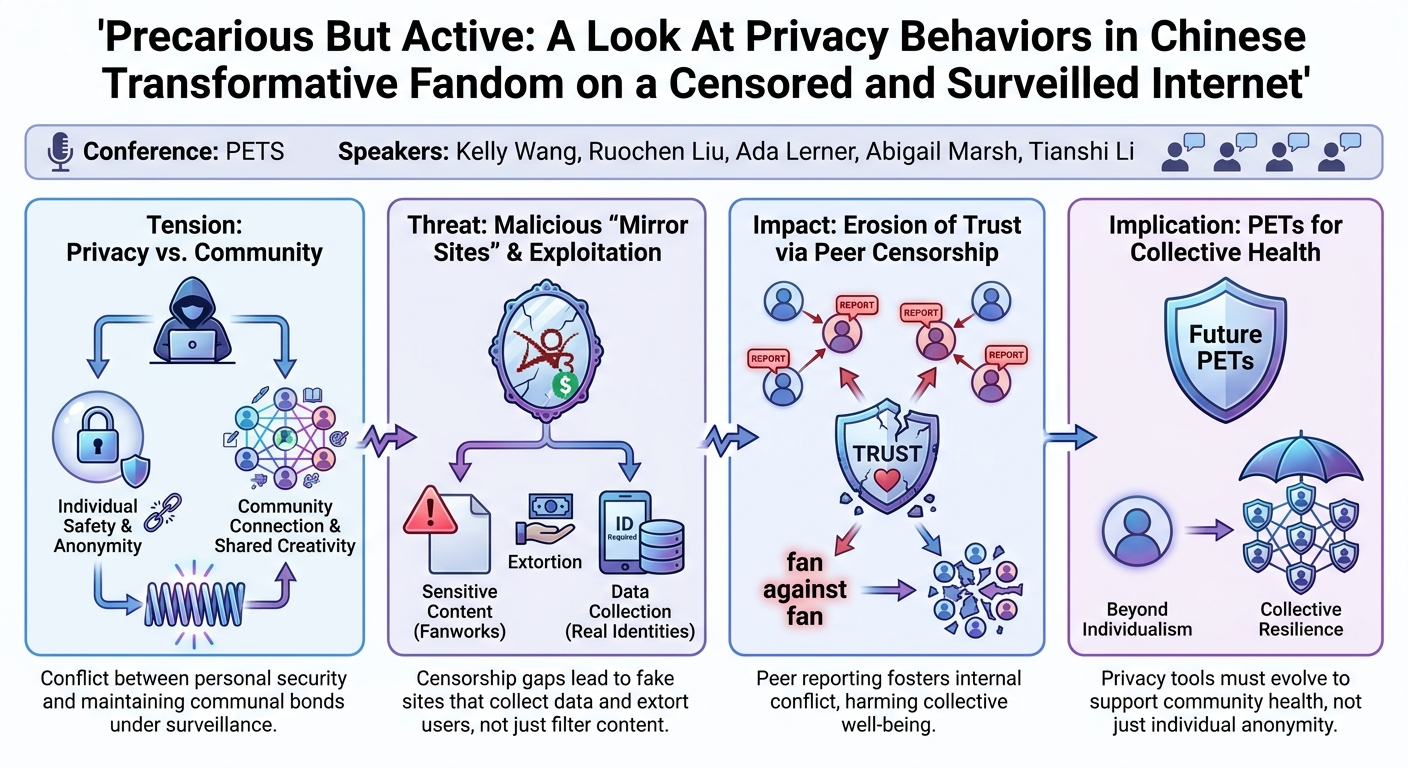
Key moments
- 0:20 Transformative fandom definition and censorship context
- 3:00 Fans struggle accessing uncensored community platforms
- 5:00 Dangers of fake 'mirror sites' (AO3 apps)
- 6:15 Tension: balancing personal safety with community reach
- 8:00 Peer censorship's negative impact on community health
- 10:00 PETs implications: resisting community health erosion
Precarious But Active: A Look At Privacy Behaviors in Chinese Transformative Fandom on a Censored and Surveilled Internet
Speakers: Kelly Wang (Paper author, Northeastern University); Ruochen Liu (Paper author, Northeastern University); Ada Lerner (Paper author, Northeastern University); Abigail Marsh (Paper author, Macalester College); Tianshi Li (Paper author, Northeastern University)
Conference: PETS
YouTube: https://www.youtube.com/watch?v=nY6O3PPajDs
Overview
This article delves into the critical research presented by Kelly Wang and her co-authors at PETS, exploring the intricate privacy behaviors within Chinese transformative fandom. The talk, titled "Precarious But Active," sheds light on how communities engaged in creating fan fiction, fan art, and other derivative works navigate a heavily censored and surveilled internet in China. This space is particularly noteworthy as a predominantly female-dominated creative sphere, where marginalized voices often find expression for non-normative or stigmatized content, such as queer themes or explicit material.
The research highlights a unique tension: while individual privacy and safety are paramount in a surveilled environment, the very essence of transformative fandom lies in its vibrant, collaborative community. Unlike political dissidents whose primary goal might be to evade state detection, these fans prioritize maintaining their communal bonds and shared creative spaces. The authors investigate the profound impact of censorship on these communities, revealing the complex choices fans make between personal security and the imperative to connect and share.
The findings underscore the urgent need for privacy-enhancing technologies (PETs) to consider not just individual user goals but also the collective health and resilience of communities facing oppressive digital environments. The study offers crucial insights into how censorship erodes trust, fosters peer-on-peer reporting, and pushes users towards risky workarounds, ultimately shaping the very fabric of online social interaction. This work is vital for understanding the broader implications of state surveillance on cultural expression and for designing more effective and socially aware privacy solutions.
Background
▶ Watch: Transformative fandom definition and censorship context (0:20)
Transformative fandom encompasses communities of fans dedicated to creating new works—such as fan fiction or fan art—that build upon and modify existing media. This creative engagement is a significant aspect of contemporary digital culture, providing platforms for self-expression and community building. Critically, these spaces are often female-dominated and serve as havens for voices that may be marginalized in mainstream society, allowing for the creation and sharing of non-normative or stigmatized content, including explicit or queer themes. The communal aspect is central to this form of fandom, fostering shared creativity and social interaction.
However, Chinese transformative fandom operates under severe constraints due to the country's pervasive internet censorship and surveillance regime. The Chinese government actively restricts access to and content related to explicit and queer themes, leading to the blocking of platforms and the filtering of content. This censorship presents a unique challenge for fan communities, whose very purpose often involves the creation and dissemination of such content. Unlike political dissidents who might prioritize anonymity to evade state repercussions for political speech, fans in this context are primarily driven by the desire to engage with their community and share their creative works. This distinction is crucial, as their privacy goals are often intertwined with, and sometimes in tension with, their community goals.
The research aimed to understand how this community is impacted by a censored and surveilled internet and what this means for the design and adoption of PETs when community is a core value. To investigate this, the researchers employed a mixed-methods approach. They conducted interviews with 10 members of Chinese transformative fandom, ensuring these interviews took place outside of China to protect participants who might share sensitive information. To augment these qualitative insights, they manually collected and analyzed 153 social media posts and comments from popular Chinese platforms like Weibo and Xiaohongshu, focusing on discussions related to privacy and transformative fandom. This dual approach allowed for a rich understanding of both individual experiences and broader community discourse within the highly controlled Chinese digital landscape.
Key Findings
▶ Watch: Dangers of fake 'mirror sites' (AO3 apps) (5:00)
The study revealed several critical insights into the privacy behaviors and challenges faced by Chinese transformative fandom. A primary finding was the significant difficulty fans encountered in accessing uncensored community content, a problem extending beyond mere digital literacy. While many fans continued to engage on domestic Chinese platforms, they resorted to coded language and innocuous-sounding substitutions for censored terms, relying on their audience's shared understanding to convey true meanings. This persistence on domestic platforms was partly due to the challenge of migrating entire fandoms, as new users would logically discover communities within China's dominant social media ecosystem.
Moving to overseas platforms, where censorship is less prevalent, presented substantial hurdles. Fans struggled with knowing where to go, often referring to the popular fanwork hosting site AO3 (Archive of Our Own) as the "red and white website" rather than its actual URL. This reliance on coded, non-explicit identifiers hindered discoverability and access. Similarly, there was limited mention or understanding of tools like VPNs (Virtual Private Networks), which are essential for bypassing China's Great Firewall. This suggested either limited knowledge of these tools or a reluctance to explicitly discuss them due to censorship risks.
Compounding these issues, many fans inadvertently landed on mirror sites or fake AO3 applications. These malicious sites, often based in China, scraped content from the legitimate AO3 but reinstituted censorship, collected uniquely identifying information (such as phone numbers instead of emails), and, critically, demanded payment for fanworks—a practice antithetical to AO3's principles. These mirror sites exposed fans to risks of extortion and increased surveillance. The overall lesson here was that effective movement to uncensored spaces required coordination and legible communication, which was severely hampered by censorship. Some fans, facing these steep digital obstacles, even considered physically printing and distributing their works, a highly prohibited activity known to result in arrests.
Another key finding was the profound tension between individual safety and the desire for free community engagement. While overseas participants could access AO3 freely, many expressed concern for fans still within China. This led to varied behaviors: some users meticulously separated their domestic and overseas accounts for safety, while others intentionally tied them together (e.g., using the same username) to maintain existing community connections. This seemingly risky behavior highlighted a deep investment in community, where the prospect of starting over anonymously on a new platform felt too isolating. The community itself also served as a source of safety, with fans actively discussing risk theories and mitigation strategies amongst themselves.
Finally, the study identified peer censorship as a significant factor eroding community health. On social media, it was common knowledge that other fans were frequently the perpetrators of reports against posts or websites deemed to violate state directives. This created a "fan against fan" environment, worsening the overall experience of community. Social media data even hinted at a past where conflicts were resolved through less intense practices, such as private forums, suggesting that increasing censorship features, particularly those enabling peer reporting, have exacerbated internal threats and undermined communal trust.
Technical Deep Dive
▶ Watch: Tension: balancing personal safety with community reach (6:15)
The technical landscape for Chinese transformative fandom is defined by the pervasive and sophisticated censorship mechanisms employed by the Chinese government, often referred to as the Great Firewall. This infrastructure actively blocks access to foreign websites and services, including popular fanwork platforms like AO3, which was blocked in China in 2020. Beyond simple blocking, domestic platforms like Weibo and Xiaohongshu employ automated and manual content filtering, targeting keywords, images, and themes deemed politically or socially sensitive, including explicit or queer content.
In response to this, fans have developed various circumvention techniques, though their effectiveness and adoption vary. Coded language is a primary method for discussing censored topics on domestic platforms. This involves using euphemisms, substituting innocuous terms for sensitive ones, or employing highly contextual slang that only initiated community members can understand. For example, instead of directly naming AO3, fans might refer to it as the "red and white website." While this allows for continued, albeit hidden, communication, it inherently limits broader discoverability and explicit instruction.
The lack of widespread and explicit communication regarding VPNs represents a significant technical barrier. VPNs are essential privacy-enhancing technologies (PETs) that encrypt internet traffic and route it through servers outside China, effectively bypassing the Great Firewall. However, the study found limited persistent communication or knowledge of VPNs within the fandom, suggesting either a lack of technical literacy, fear of discussing prohibited tools, or both. This absence leaves many fans unable to access legitimate overseas platforms.
A particularly insidious technical threat identified are the mirror sites masquerading as legitimate overseas platforms. These are not merely copies but actively malicious entities. They technically function by scraping content directly from sites like AO3, mirroring it onto servers hosted within China or jurisdictions subject to Chinese legal pressures. While superficially offering access to fanworks, these sites reintroduce censorship, often filtering content that the original AO3 would host freely. From a data security and privacy perspective, these mirror sites are highly problematic:
- Data Collection: Unlike AO3, which primarily uses email for account creation, mirror sites often demand phone numbers. In China, phone numbers are tied to real-name registration, making them uniquely identifying and easily traceable back to individuals. This dramatically increases the surveillance risk for users.
- Monetization and Extortion: These sites frequently introduce a paywall, charging users to access fanworks that are freely available on the original AO3. This practice not only violates the ethos of transformative fandom but also opens users to financial exploitation and potential extortion. Once users have paid, the mirror site operators possess financial transaction data linked to their real identities, potentially creating leverage for threats or further surveillance.
- Lack of Community Features: Users on mirror sites are unable to post, comment, or interact with the original AO3 community, isolating them within a censored and surveilled replica. This undermines the core community aspect that fans highly value.
The interplay of state censorship, user circumvention, and malicious exploitation creates a technically precarious environment. While fans employ semantic obfuscation (coded language) to bypass content filters, the broader technical solutions like VPNs remain underexploited due to knowledge gaps and communication constraints. The emergence of mirror sites demonstrates a sophisticated attack vector that exploits these gaps, turning a desire for uncensored content into a significant privacy and security liability for users.
Demo / Proof of Concept
▶ Watch: Peer censorship's negative impact on community health (8:00)
The talk "Precarious But Active" focused on presenting the findings from extensive qualitative interviews and social media data analysis. As such, it did not include a live technical demonstration or a proof of concept of a specific tool or exploit. Instead, the 'proof' of the research's claims was derived from the empirical evidence gathered through the detailed accounts of interviewees and the patterns observed in the collected social media posts, illustrating real-world behaviors and the impact of censorship on fan communities.
Defensive Implications
▶ Watch: PETs implications: resisting community health erosion (10:00)
The research offers crucial insights for both privacy tool developers and the broader security community, particularly concerning users operating under state-level censorship and surveillance. A fundamental defensive implication is the need to shift focus beyond individual privacy to encompass community health and collective privacy goals. PETs designed solely for individual anonymity might inadvertently fragment communities, as seen with users choosing to remain on less secure domestic platforms to preserve social ties.
For developers of PETs and secure communication tools, the findings highlight several points:
- Facilitate Legible Communication: Tools should consider how to enable secure and explicit communication about their existence and usage, especially in environments where discussing such tools is censored. This might involve building in features for safe knowledge sharing or designing onboarding processes that account for censorship-induced information gaps.
- Counter Mirror Sites: Security researchers and platform administrators (like AO3) should actively track and warn users about malicious mirror sites. This includes educating users about the risks of providing personal data (e.g., phone numbers) and making payments on unofficial platforms. Technical solutions might involve better detection of scraping activities or legal actions against operators of these sites.
- Address Adoption Challenges: Usability is not the only barrier to PET adoption. The research shows that social factors, such as the fear of community fragmentation or the desire to maintain existing social capital, heavily influence user choices. Future PETs should consider features that allow for pseudonymity while still fostering recognizable community engagement, or provide clear pathways for community migration.
- Support for Circumvention: Given the pervasive nature of censorship, tools that support and enhance existing circumvention strategies, such as providing secure platforms for developing and sharing coded language, could be valuable.
For defenders and users within censored environments:
- Awareness and Education: There is a strong need for educational campaigns within fan communities about the risks of mirror sites, the importance of using legitimate platforms, and the safe methods for accessing tools like VPNs. This information needs to be disseminated through secure channels that are resistant to censorship.
- Community-Led Risk Mitigation: Fostering spaces where fans can openly and securely discuss risk theories and mitigation strategies is vital. This can empower communities to collectively develop safer practices and identify emerging threats.
- Combat Peer Censorship: Strategies to mitigate the "fan against fan" dynamic are critical. This might involve community guidelines, moderation practices that de-emphasize reporting, or the creation of private, trusted forums for conflict resolution, mirroring past practices.
- Strategic Pseudonymity: Users must be advised on how to manage their digital identities strategically. While complete anonymity might be ideal for individual safety, pseudonymity that allows for recognizable community engagement (e.g., using consistent but non-identifying usernames across platforms) could be a viable compromise.
Ultimately, the defensive implications underscore that effective privacy and security in censored environments require a holistic approach that integrates technical solutions with a deep understanding of social dynamics, community needs, and the psychological impact of surveillance.
Key Takeaways
- Censorship's Unique Impact on Fandom: Chinese transformative fandom faces severe censorship of explicit and queer content, presenting unique privacy challenges where community engagement often conflicts with individual safety goals.
- Knowledge Gaps and Malicious Exploitation: Many fans lack explicit knowledge of crucial circumvention tools like VPNs and struggle to identify legitimate overseas platforms like AO3, making them vulnerable to malicious "mirror sites" that reintroduce censorship, collect identifying data (phone numbers), and engage in financial extortion.
- The Power of Community vs. Individual Safety: A significant tension exists between the desire to maintain strong community ties and the need for individual privacy and safety. Fans often engage in risky behaviors, such as tying together domestic and overseas accounts, to preserve communal bonds, even rejecting safer, more isolated solutions.
- Erosion of Community Health by Peer Censorship: The pervasive environment of censorship fosters "peer censorship," where fans report each other's content, leading to a "fan against fan" dynamic that erodes trust, worsens community experiences, and undermines collective well-being.
- PETs Must Evolve Beyond Individualism: Privacy-enhancing technologies and research must expand beyond individualistic privacy goals to consider the complex social dynamics and community-level challenges in censored environments, prioritizing factors like legible communication and community health.
- Holistic Security Approach: Effective defense requires a multi-faceted approach, combining technical solutions (e.g., combating mirror sites, facilitating VPN access) with social strategies (e.g., community education, fostering secure discussion spaces, mitigating peer censorship) to empower users in precarious digital landscapes.
About the Speaker(s)
The research presented was a collaborative effort by Kelly Wang, Ruochen Liu, Ada Lerner, Tianshi Li from Northeastern University, and Abigail Marsh from Macalester College. Kelly Wang, the presenter, is a third-year PhD student and recently a candidate at Northeastern University, where she is engaged in research concerning privacy and security. The co-authors are also affiliated with their respective universities, contributing to the academic discourse around privacy behaviors in complex online environments.
Reviews
Dr. Zero (Offensive Security Researcher) — SOLID
This is human factors research, not an exploit drop. The Northeastern crew interviewed a handful of Chinese AO3 users to figure out why fandoms keep getting popped by the Great Firewall, revealing that users will actively sabotage their own OPSEC because the social capital of their pseudonym matters more to them than dodging state surveillance.
Heather Calloway (CISO) — SOLID
This is academic research on how Chinese citizens bypass state censorship, but it serves as a direct case study in user behavior under extreme restriction. It is a solid, niche presentation. Worth a look if your leadership team needs a reminder of why heavy-handed blocking strategies usually backfire.
→ Top-rated talks at Privacy Enhancing Technologies Symposium (PETS) 2026
All talks from Privacy Enhancing Technologies Symposium (PETS) 2026