Sensor Privacy as a Spectrum: Quantifying Privacy in Edge and Multimodal Systems through Games
Jainta Paul (Paper author · University of Utah), Miles Bovero (Paper author · University of Utah), Swapnil Saha (Paper author · STMicroelectronics Inc.), Mahesh Chowdhary (Paper author · STMicroelectronics Inc.), Pratik Soni (Paper author · University of Utah), Luis Garcia (Paper author · University of Utah)
Privacy Enhancing Technologies Symposium (PETS) 2026 · Day 1 · Moose
Overview
In an era dominated by pervasive sensing and artificial intelligence, the promise of on-device processing for privacy often creates a dangerous blind spot. This talk, presented by Jainta Paul from the University of Utah, along with collaborators from the University of Utah and STMicroelectronics Inc., delves into this critical issue. Titled "Sensor Privacy as a Spectrum: Quantifying Privacy in Edge and Multimodal Systems through Games," the research challenges the conventional wisdom that keeping raw sensor data on the device is sufficient for privacy. Instead, it posits that privacy is not a binary state but a quantifiable spectrum, heavily dependent on the nature and context of the interface – the processed information that ultimately leaves the device.
Key moments
- 0:00 Introduction and the Strava privacy breach example.
- 1:50 Overlooked privacy blind spot in edge AI systems.
- 2:35 Our framework: five questions modeled as a game.
- 4:48 Temporal context significantly increases adversary inference accuracy.
- 6:00 Leakage is universal, not an artifact of a dataset.
- 7:00 Cross-modal bridge enables inference from low-fidelity data.
- 8:30 Key takeaways: privacy as a spectrum, audit the interface.
Sensor Privacy as a Spectrum: Quantifying Privacy in Edge and Multimodal Systems through Games
Speakers: Jainta Paul, PhD Student, University of Utah; Miles Bovero, Paper author, University of Utah; Swapnil Saha, Paper author, STMicroelectronics Inc.; Mahesh Chowdhary, Paper author, STMicroelectronics Inc.; Pratik Soni, Paper author, University of Utah; Luis Garcia, Paper author, University of Utah
Conference: PETS
YouTube: https://www.youtube.com/watch?v=Rrp4FegRKHY
Overview
In an era dominated by pervasive sensing and artificial intelligence, the promise of on-device processing for privacy often creates a dangerous blind spot. This talk, presented by Jainta Paul from the University of Utah, along with collaborators from the University of Utah and STMicroelectronics Inc., delves into this critical issue. Titled "Sensor Privacy as a Spectrum: Quantifying Privacy in Edge and Multimodal Systems through Games," the research challenges the conventional wisdom that keeping raw sensor data on the device is sufficient for privacy. Instead, it posits that privacy is not a binary state but a quantifiable spectrum, heavily dependent on the nature and context of the interface – the processed information that ultimately leaves the device.
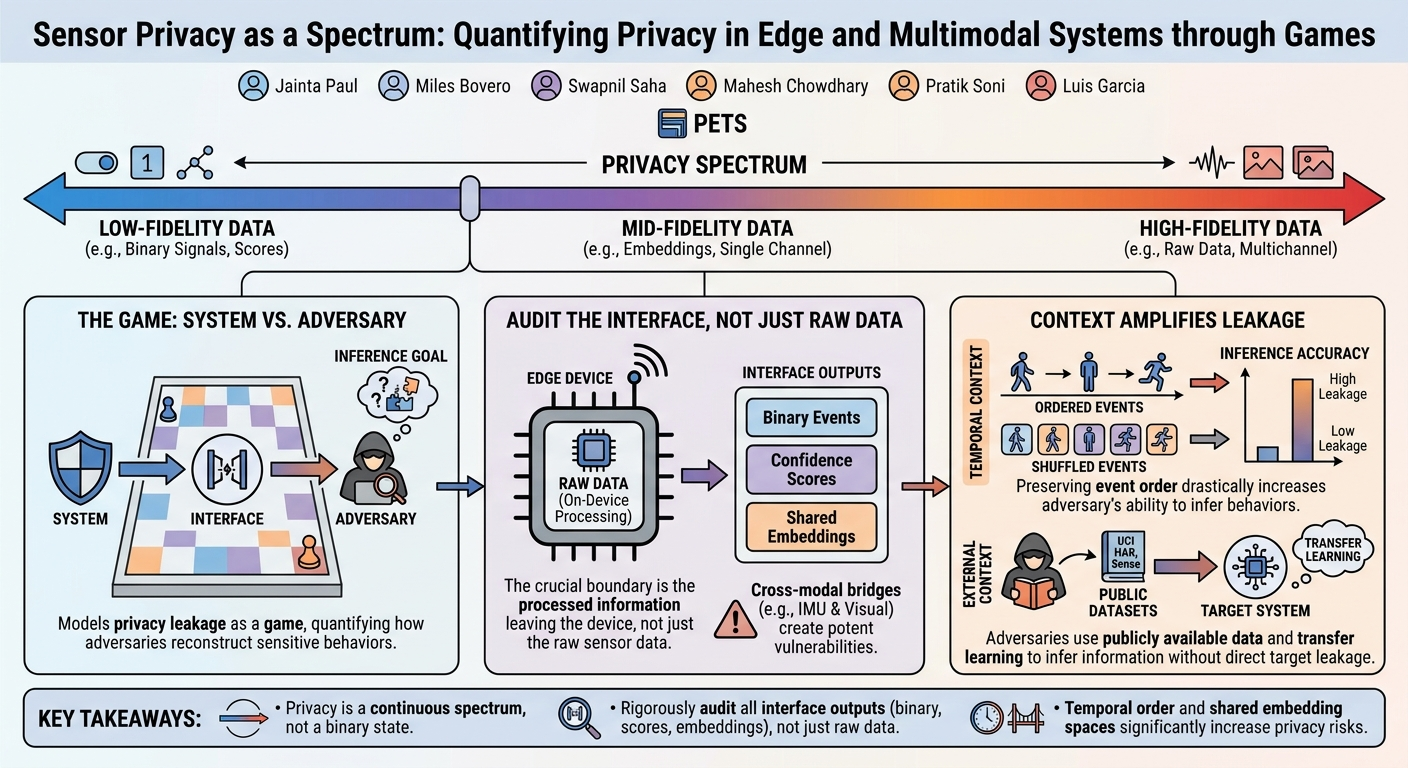
The core of this work is a novel framework that models privacy leakage as a game between a system and an adversary. By instantiating this framework across various scenarios, the researchers rigorously quantify how even seemingly innocuous, low-fidelity outputs (like binary motion signals or shared embeddings) can be exploited to reconstruct highly sensitive user behaviors. This presentation is crucial for anyone involved in the design, deployment, or security of edge AI and multimodal systems, highlighting the often-overlooked avenues of privacy compromise that exist beyond the raw data.
The talk underscores the importance of auditing not just the raw data handling, but specifically the interfaces and processed outputs that are exposed. It provides a sobering reminder that sophisticated adversaries, armed with contextual information and publicly available datasets, can infer a wealth of private information from minimal, aggregated, or transformed signals. The implications are profound, urging a paradigm shift in how privacy is conceptualized and engineered in modern intelligent systems.
Background
▶ Watch: Introduction and the Strava privacy breach example. (0:00)
The rapid proliferation of edge AI devices – from smartwatches to smart home assistants – has brought with it a significant push for enhanced privacy. A central tenet of this push is the "edge AI privacy promise": the assurance that raw sensor data (e.g., accelerometer, gyroscope, microphone feeds) never leaves the device. Instead, computationally intensive processing, such as activity recognition or anomaly detection, occurs directly on the device. This approach is widely hailed as a major improvement over cloud-centric processing, primarily because it dramatically reduces the attack surface associated with transmitting sensitive raw data over networks.
However, as highlighted by the speaker, this promise often overlooks a critical blind spot: while raw data may remain on-device, something invariably leaves the device. This "something" can take various forms: a simple binary event (e.g., "person is static" or "person is shaking"), a feature embedding, a confidence score, or even aggregated statistics. The problem, as the research articulates, is that this output – the interface between the device's internal processing and the external world – often becomes the de facto privacy boundary, yet its privacy implications are rarely scrutinized with the same rigor as raw data.
A potent real-world example illustrating this risk is the 2018 Strava fitness app incident. Public workout traces, comprised of seemingly benign GPS coordinates, were aggregated over time to reveal sensitive information about military bases and personnel movements. This wasn't about private messages or diary entries; it was about "tiny motion traces" that, when collected and analyzed, unveiled significant patterns: where people were going, what they were doing, and when. This incident serves as a powerful analogy for the potential privacy leakage in edge AI: even if a smartwatch only emits a binary motion signal, could an adversary reconstruct detailed visual behavior from it? The research presented in this talk directly addresses this question, demonstrating how such seemingly harmless data can indeed be weaponized for privacy invasion. The fundamental challenge, therefore, lies in understanding and quantifying this leakage when the traditional privacy boundary (raw data) is no longer the sole concern.
Key Findings
▶ Watch: Our framework: five questions modeled as a game. (2:35)
The research presented by Jainta Paul and his team yielded several critical findings that fundamentally redefine our understanding of sensor privacy in edge and multimodal systems:
- Privacy as a Spectrum, Not a Binary: A central thesis of the paper is that privacy is not a simple "yes" or "no" property. Instead, it exists on a continuous spectrum, influenced by a multitude of factors. This perspective necessitates a more nuanced approach to privacy engineering, moving beyond simplistic "on-device processing" assurances.
- The Interface is the True Privacy Boundary: The traditional focus on preventing raw sensor data from leaving the device is insufficient. The actual privacy boundary is defined by what information leaves the device – be it binary events, confidence scores, or embeddings. This interface, often overlooked, is the primary vector for privacy leakage.
- Temporal Context Amplifies Leakage from Low-Fidelity Data: Even extremely low-fidelity, seemingly harmless data, such as a binary "static/shaking" signal, can lead to significant privacy breaches. Crucially, the presence of temporal context (the order in which events occur) drastically increases an adversary's ability to infer sensitive human behaviors. Without temporal order, inference accuracy was low (35%), but with it, it jumped to 67%.
- Richer Interfaces Lead to Near-Complete Inference: As the richness of the data exposed through the interface increases – from binary signals to single sensor channels (accelerometer or gyroscope) to multiple sensor channels – the adversary's ability to infer human activities rapidly approaches 100%. This progression vividly illustrates the spectrum of privacy.
- Universal Leakage Across Datasets: The leakage is not an artifact of a specific dataset or scenario. The research demonstrated that adversaries can successfully infer activities on a target dataset (Utah STM HAR) using only publicly available source datasets (UCI HAR, Motion Sense), even when no direct "binary" or "raw" data from the target dataset is leaked. This highlights the power of transfer learning and contextual knowledge for adversaries.
- Cross-Modal Bridges are Significant Vulnerabilities: In modern multimodal systems, data from different modalities (e.g., IMU and RGB video) are often mapped into a shared embedding space. This "cross-modal bridge," while facilitating system functionality, creates a potent privacy vulnerability. Adversaries can leverage this shared space to infer about higher-fidelity, hidden modalities (like visual behavior) using only lower-fidelity, visible modalities (like IMU data). Even with 0% direct alignment, 55% prediction accuracy was achieved, increasing with stronger alignment.
In essence, the key findings underscore that privacy in edge and multimodal AI systems is a complex, dynamic challenge that demands a holistic understanding of data flow, context, and adversary capabilities, rather than a simplistic reliance on on-device processing.
Technical Deep Dive
▶ Watch: Temporal context significantly increases adversary inference accuracy. (4:48)
The core of this research is a meticulously designed privacy framework centered around the local world of an edge device, such as a smartwatch. This framework aims to systematically quantify privacy leakage by modeling the interaction between the system and an adversary as a game. The researchers propose five fundamental questions that guide this quantification:
- What leaves the device? This defines the interface, which can range from raw data (though the premise is that raw data stays on-device) to highly processed, low-fidelity signals like binary events, embeddings, or confidence scores.
- What context is available to the adversary? This includes any external information the adversary can leverage, such as publicly available datasets, common human activity patterns, or temporal relationships between events.
- What are we trying to protect in our system? This establishes the semantic target – the specific private information (e.g., specific human activities, locations, health states) that the system is designed to keep confidential.
- What can the adversary do with the available information? This defines the adversary's capabilities, specifically how they can combine the interface data with their available context to infer the semantic target.
- How much advantage can the adversary gain over the system? This is the ultimate quantification of privacy leakage, often measured in terms of inference accuracy or information gain.
To instantiate this framework, the researchers designed and executed four major privacy games, each progressively increasing the richness of the interface data available to the adversary, thereby demonstrating privacy as a spectrum.
Game 1: Binary Motion Signal Leakage
In the weakest scenario, the adversary is given access only to a binary motion signal, indicating whether a person is "static" or "shaking."
- Initially, the data is shuffled, meaning no temporal context is available. In this scenario, the adversary's ability to infer human behavior is limited, achieving only 35% accuracy.
- However, when the temporal order is restored, providing the adversary with the sequence of static/shaking events, the inference accuracy significantly jumps to 67%. This clearly demonstrates the critical role of temporal context in amplifying privacy leakage, even from minimal data.
Game 2: Additional Sensor Channel Access
Building on Game 1, the adversary is now given access to an additional sensor channel, either the accelerometer or the gyroscope data, in addition to the binary signal. With this richer interface, the adversary's inference accuracy further increases to 88%.
Game 3: All Sensor Channels Access
In this game, the adversary has access to all available sensor channels (both accelerometer and gyroscope) as well as the binary signal. Under these conditions, the adversary is able to infer human activities with almost 100% accuracy. This progression from 35% to nearly 100% vividly illustrates how increased interface richness directly correlates with diminished privacy.
Universal Leakage Test:
Beyond these games, the researchers investigated whether the observed leakage is a universal phenomenon or specific to a particular dataset. They tested whether an adversary could successfully infer activities on a target dataset without leaking any data directly from it, instead using publicly available source datasets for training.
- Using the UCI HAR dataset as a source, the adversary was able to infer activities on the Utah STM HAR dataset (their newly collected dataset) with 48% to 53% accuracy.
- When using the Motion Sense dataset as a source, the adversary achieved approximately 60% accuracy on the Utah STM HAR dataset.
This finding is particularly alarming, as it suggests that even if a system leaks nothing directly, an adversary can still build powerful inference models using external, publicly available data, posing a significant threat through transfer learning and contextual inference.
Game 4: Cross-Modal Bridge Leakage
This final game explores privacy in multimodal systems, where different sensor modalities (e.g., Inertial Measurement Unit (IMU) data like accelerometer/gyroscope, and RGB video/image data) are often processed together. Modern multimodal systems frequently map these diverse data streams into a shared embedding space – a common representational format. While beneficial for system functionality, this shared space can become a critical vulnerability.
- The scenario involves the adversary having access to the lower-fidelity modalities (IMU data) but not the higher-fidelity modalities (RGB video/image), which are hidden.
- The research asked: Can the adversary use the shared embedding space (the "cross-modal bridge") to infer about activities associated with the hidden higher-fidelity modalities?
- The results were conclusive: even with 0% alignment (meaning the IMU and RGB embeddings are not perfectly correlated in the shared space), the adversary could predict activities with 55% accuracy.
- As the bridge strength (alignment between modalities in the shared embedding space) increased, the inference accuracy also increased, demonstrating that greater semantic alignment in the embedding space directly leads to more semantic leakage from the IMU alone about the hidden visual data.
Datasets Used:
To evaluate their framework, the researchers utilized a combination of publicly available and newly collected datasets:
- UCI HAR dataset: A widely used public dataset for human activity recognition.
- Motion Sense dataset: Another public dataset focusing on human motion.
- UT M-Health multimodal dataset: A public dataset featuring multiple health-related sensor modalities.
- Utah STM HAR dataset: A novel dataset collected specifically for this research, grounded in real sensing scenarios. It was gathered using a SensorTile Box Pro, an edge device equipped with on-device processing capabilities. This dataset included data from 11 subjects, across five different placements on the body, capturing accelerometer and gyroscope modalities. This custom dataset was crucial for validating findings in a controlled, real-world-like environment.
The technical depth of this research lies in its systematic approach to defining, modeling, and quantifying privacy leakage across various levels of interface richness and contextual information, culminating in a clear demonstration of privacy as a dynamic spectrum.
Demo / Proof of Concept
▶ Watch: Cross-modal bridge enables inference from low-fidelity data. (7:00)
While the talk did not feature a live, interactive demonstration of a tool or exploit in real-time, the entire research framework constitutes a rigorous proof of concept for the presented ideas. The "games" described in the technical deep dive serve as the empirical demonstration of how different levels of interface information and contextual knowledge enable an adversary to infer sensitive behaviors.
Each "game" was an experimental setup designed to simulate an adversarial attack scenario, where the researchers, acting as the adversary, attempted to reconstruct human activities from progressively richer or more complex forms of leaked data. The quantitative results – such as the jump from 35% to 67% accuracy with temporal context, or the 55% inference accuracy from cross-modal embeddings – are direct evidence that the proposed privacy vulnerabilities are not merely theoretical but practically exploitable. The use of publicly available datasets like UCI HAR and Motion Sense, alongside their custom Utah STM HAR dataset collected with a SensorTile Box Pro, further grounds these demonstrations in realistic, verifiable scenarios. Therefore, the "games" themselves, with their detailed methodologies and measurable outcomes, collectively function as the comprehensive proof of concept for the paper's central thesis: sensor privacy is a spectrum, and the interface, not just raw data, is the critical boundary to audit.
Defensive Implications
▶ Watch: Key takeaways: privacy as a spectrum, audit the interface. (8:30)
The findings from this research offer crucial insights for developers, security architects, and privacy engineers working on edge AI and multimodal systems. The traditional approach of simply ensuring "raw data never leaves the device" is demonstrably insufficient. Defenders must adopt a more sophisticated, spectrum-based view of privacy.
- Audit the Interface Rigorously: The most critical implication is the urgent need to audit the interface – whatever information does leave the device. This includes binary events, confidence scores, embeddings, or any aggregated statistics. Developers must scrutinize these outputs as potential privacy vectors, asking: "What can an adversary infer from this specific output, even if it seems harmless?"
- Principle of Least Privilege for Data Leakage: Systems should be designed to leak only the absolute minimum information required for a specific task. If a binary "static/shaking" signal is sufficient for an application, then richer sensor data should never be exposed. This means adopting a privacy-by-design approach where data minimization is applied not just to raw data but to all processed outputs.
- Beware of Temporal Context: Even simple, low-fidelity signals become highly informative when their temporal order is preserved. Defenders must consider whether the sequence of events needs to be preserved for the task at hand. If not, techniques like shuffling or aggregating events over longer, randomized intervals could be employed to disrupt temporal patterns and reduce inference accuracy.
- Scrutinize Cross-Modal Bridges: In multimodal systems, the creation of shared embedding spaces represents a significant privacy risk. Architects must understand that these bridges can inadvertently leak information about hidden, higher-fidelity modalities even when only lower-fidelity data is exposed. Strategies to mitigate this could include:
- Differential privacy applied to the embedding space.
- De-correlation techniques to reduce semantic alignment between sensitive and non-sensitive modalities within the shared space.
- Careful design of the embedding function to ensure only task-relevant, privacy-preserving information is encoded.
- Assume Adversary Access to External Context: Defenders cannot assume that adversaries operate in a vacuum. The research demonstrated that publicly available datasets can be used to infer information about target systems, even without direct leakage from the target. This means that even if a system is perfectly contained, an adversary might still succeed using transfer learning. Robust defenses must account for this external context, perhaps by designing outputs that are inherently difficult to correlate with common patterns found in public datasets.
- Embrace Privacy as a Spectrum for Risk Management: Moving away from a binary "private/not private" mindset, security teams should adopt a spectrum-based risk assessment. This involves quantifying the degree of privacy leakage for different interfaces and contexts, allowing for more informed trade-offs between utility and privacy. This quantification can help prioritize defensive measures where the leakage risk is highest.
- Continuous Auditing and Red Teaming: Given the dynamic nature of adversarial techniques and the evolving capabilities of AI, continuous auditing and red teaming exercises are essential. Simulating the "privacy games" described in this research against deployed systems can help identify unforeseen leakage vectors and validate the effectiveness of defensive measures.
In summary, the defensive implications call for a comprehensive re-evaluation of privacy strategies in edge and multimodal AI. The focus must shift from simply securing raw data to meticulously controlling and quantifying what leaves the device, considering temporal context, cross-modal interactions, and the adversary's capacity to leverage external information.
Key Takeaways
- Privacy is a Spectrum, Not Binary: The core message is that privacy in edge AI and multimodal systems is a continuous property that can be quantified and managed, rather than a simple on/off switch.
- Audit the Interface, Not Just Raw Data: The true privacy boundary is defined by what processed information (binary events, embeddings, scores) leaves the device, not merely whether raw sensor data stays on-device. This interface must be rigorously audited for leakage.
- Temporal Context is a Major Leakage Amplifier: Even seemingly harmless, low-fidelity data can become highly sensitive when its temporal order is preserved, allowing adversaries to infer complex human behaviors with significant accuracy.
- Cross-Modal Bridges in Multimodal Systems Pose Unique Risks: Shared embedding spaces, designed to integrate different sensor modalities, can inadvertently become vectors for leakage, allowing adversaries to infer about hidden, high-fidelity modalities from visible, low-fidelity ones.
- Adversaries Leverage External Context: Defenders must assume that adversaries will utilize publicly available datasets and contextual knowledge to train inference models, even if the target system itself leaks minimal data.
- Design for Minimal Leakage: Implement privacy-by-design principles to ensure that systems only expose the absolute minimum information necessary for their intended task, thereby limiting the attack surface for privacy breaches.
About the Speaker(s)
The lead presenter for this talk was Jainta Paul, a PhD student at the University of Utah. His research expertise lies at the intersection of cybersecurity and privacy, specifically focusing on sensing edge AI and multimodal systems.
This paper is a collaborative effort, reflecting contributions from both academia and industry. The co-authors from the University of Utah include Miles Bovero, Pratik Soni, and Luis Garcia, who provided technical guidance and research expertise. From STMicroelectronics Inc., Swapnil Saha and Mahesh Chowdhary contributed valuable technical insights throughout the project, highlighting a successful collaboration between a research institution and a semiconductor company on a critical security and privacy issue.
Reviews
Dr. Zero (Offensive Security Researcher) — SOLID
Vendors love screaming that 'Edge AI' solves privacy because the raw sensor data stays on-device. This paper proves that's a complete lie. Pal and his team show exactly how much state you bleed through low-fidelity interfaces and shared embedding spaces, giving us the math to prove temporal context ruins the 'anonymized output' defense.
Heather Calloway (CISO) — STRONG ACCEPT
This research dismantles the vendor promise that 'on-device AI processing' guarantees privacy. By proving that low-fidelity metadata and temporal context can reconstruct sensitive behavior, it gives security leaders the exact math needed to challenge edge AI claims. This is required reading for your privacy engineers and a necessary update to your third-party risk assessments.
→ Top-rated talks at Privacy Enhancing Technologies Symposium (PETS) 2026
All talks from Privacy Enhancing Technologies Symposium (PETS) 2026