Privacy Attacks on Matrix Profiles based on Reconstruction Techniques
Haoying Zhang (Paper author · Insa-CVL), Nicolas Anciaux (Paper author · Inria), Benjamin Nguyen (Paper author · Insa-CVL), Fabien Girard (Paper author · ENSTA Paris), Jose Maria de Fuentes (Paper author · UC3M), Adrien Boiret (Paper author · Insa-CVL)
Privacy Enhancing Technologies Symposium (PETS) 2026 · Day 1 · Moose
Overview
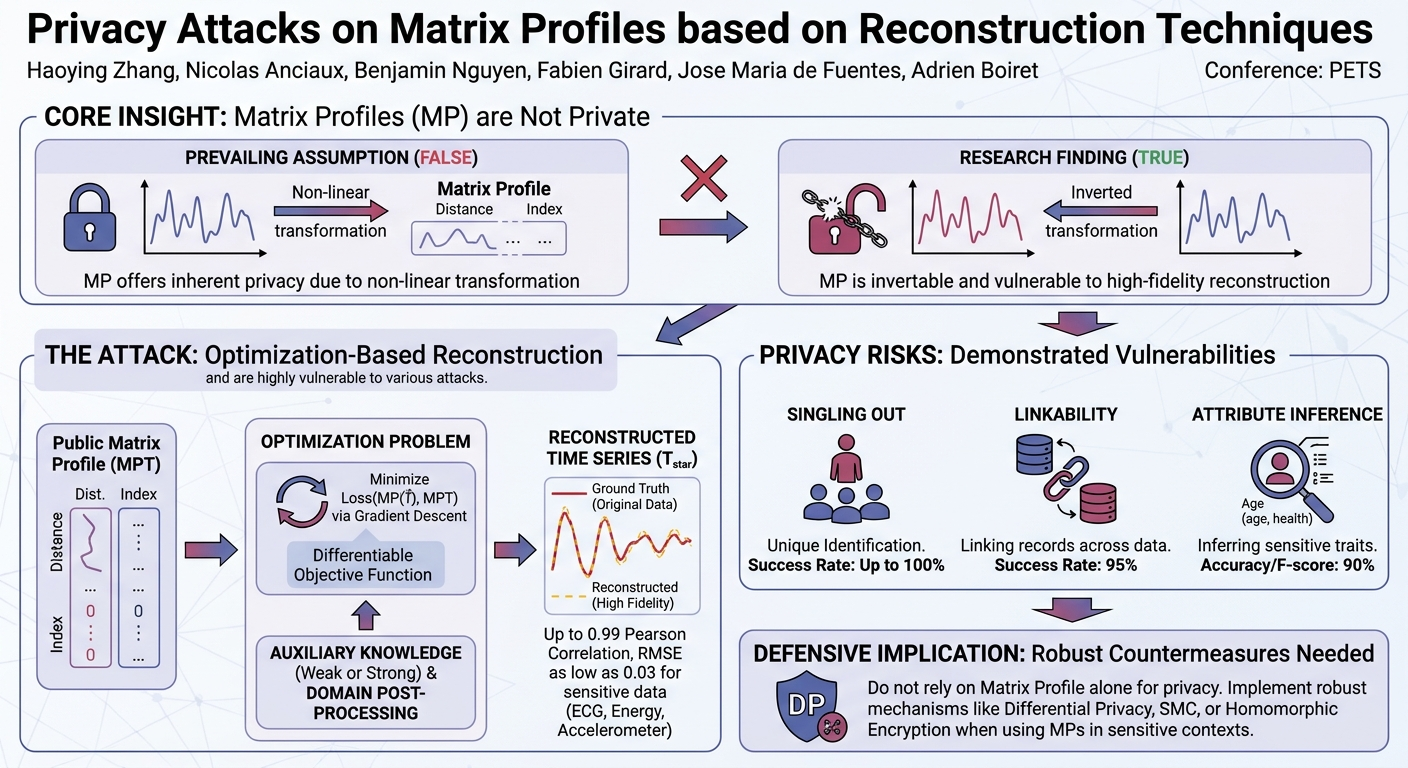
In this insightful talk from PETS, Haoying Zhang, a PhD student from Inria Sophia, along with collaborators from Inria Paris and University of Carlos III, presented groundbreaking research titled "Privacy Attacks on Matrix Profiles based on Reconstruction Techniques." The presentation challenged a prevailing assumption within the time series mining community: that the Matrix Profile (MP) inherently offers privacy protection due to its non-linear transformation properties. The research rigorously demonstrated that, contrary to prior claims, the Matrix Profile is not private and is, in fact, invertible and highly vulnerable to various privacy attacks.
Key moments
- 0:00 Introduction and Matrix Profile definition
- 2:00 Matrix Profile proposed as a privacy-enhancing technology
- 3:15 Key contributions: formulating privacy risks and reconstruction attack
- 4:30 Reconstruction attack based on an optimization problem
- 6:00 Addressing non-injectivity and improving reconstruction quality
- 8:00 Devastating results: Matrix Profile is not private
- 9:00 Future work and designing countermeasures for Matrix Profile
Privacy Attacks on Matrix Profiles based on Reconstruction Techniques
Speakers: Haoying Zhang (Paper author, Insa-CVL); Nicolas Anciaux (Paper author, Inria); Benjamin Nguyen (Paper author, Insa-CVL); Fabien GIRARD (Paper author, ENSTA Paris); Jose Maria de Fuentes (Paper author, UC3M); Adrien Boiret (Paper author, Insa-CVL)
Conference: PETS
YouTube: https://www.youtube.com/watch?v=UPUKxzFhVmk
Overview
In this insightful talk from PETS, Haoying Zhang, a PhD student from Inria Sophia, along with collaborators from Inria Paris and University of Carlos III, presented groundbreaking research titled "Privacy Attacks on Matrix Profiles based on Reconstruction Techniques." The presentation challenged a prevailing assumption within the time series mining community: that the Matrix Profile (MP) inherently offers privacy protection due to its non-linear transformation properties. The research rigorously demonstrated that, contrary to prior claims, the Matrix Profile is not private and is, in fact, invertible and highly vulnerable to various privacy attacks.
The core contribution of this work is the development and evaluation of a novel reconstruction technique, framed as an optimization problem, which can effectively reverse the Matrix Profile transformation to recover the original time series data. This reconstruction primitive then serves as a foundation for launching more sophisticated privacy attacks, including singling out, linkability, and sensitive attribute inference. The findings from this research have significant implications for how Matrix Profiles are perceived and utilized, particularly in contexts where sensitive time series data (e.g., physiological signals, energy consumption) is processed or shared.
The talk underscored the critical need for systematic privacy evaluations of technologies often proposed as privacy-enhancing. By exposing the vulnerabilities of the Matrix Profile, the researchers highlighted that reliance on transformation alone, even non-linear ones, is insufficient to guarantee privacy. This work serves as a crucial wake-up call for practitioners and researchers to adopt more robust privacy-preserving mechanisms, such as differential privacy, when dealing with Matrix Profiles and similar data transformations in sensitive applications.
Background
▶ Watch: Introduction and Matrix Profile definition (0:00)
The Matrix Profile (MP) is a powerful and increasingly popular time series mining structure. It was introduced as a highly efficient tool for a wide array of time series analysis tasks. Formally, a Matrix Profile stores the distance between every subsequence within a given time series and its nearest neighbor. To understand its construction, consider a time series as an ordered vector of length n. This vector is then partitioned into smaller, overlapping subsequences, each of a fixed length m (where m is much smaller than n). For every subsequence, its Euclidean distance (or other chosen distance metric) is computed against all other subsequences in the time series. These distances are then compiled into a distance matrix. From this matrix, two key vectors are derived: the Matrix Profile Distance vector, which stores the minimum distance for each subsequence to its nearest neighbor, and the Matrix Profile Index vector, which stores the index of that nearest neighbor. Together, these two vectors constitute the Matrix Profile.
The utility of the Matrix Profile is vast. As demonstrated in the talk with an ECG data example, the Matrix Profile can effectively highlight anomalies. Peaks in the Matrix Profile distance vector often correspond to unusual patterns in the original time series, such as heartbeat anomalies. This makes it exceptionally useful for tasks like anomaly detection in regular pattern time series, similarity discovery in irregular pattern time series, and time series annotation. Its ease of use and broad applicability have rapidly propelled its popularity within the time series mining community.
More recently, the Matrix Profile has garnered attention as a potential Privacy-Enhancing Technology (PET). This perception stems from several characteristics: it is a transformation of the original time series, and its computation involves non-linear functions such as minimum (min) and argument of the minimum (argmin). Crucially, it has been observed to preserve good utility in downstream applications, meaning that tasks performed on the Matrix Profile often yield results comparable to those performed on the original data. Examples of its proposed use as a PET include generating synthetic time series that preserve the Matrix Profile's characteristics, developing privacy-aware Matrix Profiles to guard against pattern inference, and employing Matrix Profile features in machine learning pipelines for sensitive tasks like continuous authentication.
However, despite these various applications and the growing interest in its privacy-enhancing potential, a significant gap existed: there had been no systematic privacy evaluations of the Matrix Profile. This lack of rigorous assessment meant that a fundamental question remained unanswered: does publishing a Matrix Profile truly satisfy the privacy criteria mandated by data protection regulations? The research presented in this talk aimed to fill this critical void, challenging the assumption of inherent privacy and providing the first systematic evaluation of the Matrix Profile's privacy posture.
Key Findings
▶ Watch: Key contributions: formulating privacy risks and reconstruction attack (3:15)
The research presented by Haoying Zhang and their team delivered a series of critical findings that fundamentally redefine the privacy characteristics of the Matrix Profile. The overarching conclusion, directly contradicting prior claims in the literature, is that the Matrix Profile is not private; it is invertible and highly vulnerable to privacy attacks. This revelation has profound implications for its use in sensitive data contexts.
The key contributions and findings include:
- Formalization of Privacy Risks: The researchers systematically formulated the privacy risks associated with Matrix Profile sharing. These risks fall into three primary categories:
- Singling out: The ability to uniquely identify an individual's record from a published Matrix Profile.
- Linkability: The capacity to link multiple records belonging to the same individual or across different datasets using their Matrix Profiles.
- Inference: The possibility of inferring sensitive attributes (e.g., age, sex, health status) from an individual's Matrix Profile.
- Novel Reconstruction Technique: A central contribution is the development of a reconstruction technique based on an optimization problem. This technique serves as the primary attack primitive, capable of recovering the original time series from its corresponding Matrix Profile. This ability to reverse the transformation is the cornerstone for all subsequent privacy breaches.
- Empirical Evaluation on Sensitive Datasets: The proposed reconstruction technique and subsequent privacy attacks were rigorously evaluated on three distinct and sensitive datasets:
- ECG data: Physiological data representing heartbeats.
- Energy consumption data: Reflecting individual usage patterns.
- Smartphone accelerometer data: Capturing movement and activity.
- High-Fidelity Reconstruction: The reconstruction technique demonstrated remarkable success. Statistically, it achieved a Pearson correlation coefficient of up to 0.99 between the reconstructed and original time series, with a Root Mean Square Error (RMSE) as low as 0.03. This indicates an extremely high degree of fidelity in recovering the original data, rendering the transformation effectively transparent.
- Devastating Privacy Attack Success Rates: Leveraging the high-fidelity reconstruction, the researchers demonstrated devastating success rates for various privacy attacks:
- Singling out: Achieved up to 100% success rate.
- Linkability: Achieved 95% success rate.
- Sensitive attribute inference: Achieved 90% accuracy and F-score.
These results unequivocally break the prior claims that the Matrix Profile, being non-invertible, inherently preserves privacy. The clear message conveyed by the research is that Matrix Profile is not private and should not be adopted as a standalone Privacy-Enhancing Technology. Its vulnerability to reconstruction and subsequent privacy attacks necessitates a re-evaluation of its deployment in any scenario involving sensitive time series data.
Technical Deep Dive
▶ Watch: Reconstruction attack based on an optimization problem (4:30)
The core of the privacy attacks presented in the talk lies in a sophisticated reconstruction technique designed to reverse the Matrix Profile transformation. This technique is grounded in an optimization problem and operates under various assumptions regarding the attacker's auxiliary knowledge.
Threat Model
The research considers a flexible threat model where the attacker's auxiliary knowledge can range significantly:
- Weak Knowledge: The attacker might only know the generic type or shape of the time series (e.g., "this is ECG data," or "this is energy consumption data"). This is a realistic scenario where an attacker has general domain knowledge but no specific individual data.
- Strong Knowledge: At the other end of the spectrum, a strong attacker might possess full time series of some individuals, which could be used to refine their attacks or training models.
While a strong attacker might be able to perform some naive attacks, these become severely limited when the attacker's auxiliary knowledge is weak. This limitation highlights the necessity of a robust reconstruction method that can operate effectively even with minimal prior information. The reconstruction technique itself constitutes an original value inference attack and also serves as a crucial building block for other privacy attacks like singling out, linkability, and attribute inference.
Reconstruction as an Optimization Problem
The objective of the reconstruction attack is to recover the original time series T_star given its Matrix Profile MPT. The attacker is assumed to know how to compute the Matrix Profile function. The problem is formulated as finding T_star that minimizes a loss function comparing the Matrix Profile of a candidate time series T_hat with the target MPT.
Mathematically, the goal is to find T_star such that:
T_star = argmin(T_hat) [Loss(MP(T_hat), MPT)]
To make this optimization problem tractable and efficient, the researchers utilized a differentiable objective function. This allows for the use of gradient-based optimization solvers. The loss function incorporates two main components:
- Squared Error: This component measures the discrepancy between the Matrix Profile of the candidate
T_hatand the targetMPT. It encodes the equality constraints, aiming forMP(T_hat)to be as close as possible toMPT. - ReLU Function: This is used to penalize violations of inequality constraints. While the talk doesn't explicitly detail all inequality constraints, such constraints often relate to the inherent properties of time series data or the Matrix Profile itself (e.g., distances must be non-negative).
The general algorithm for reconstruction proceeds as follows:
- Initialization: A set of "fuzzy" candidate time series
T_hatis initialized. These could be random series or series with a generic shape known to the attacker. - Refinement: A solver (e.g., gradient descent-based optimizer) is then used to iteratively refine
T_hat, minimizing the discrepancy betweenMP(T_hat)and the targetMPTaccording to the defined differentiable loss function.
Challenges of Matrix Profile Non-Injectivity
A significant technical challenge arises from the nature of the Matrix Profile function itself: it is not injective. This means that multiple distinct input time series can potentially map to the same, or very nearly the same, Matrix Profile. A classic example mentioned is that two symmetric time series will yield identical Matrix Profiles.
This non-injectivity has several implications for the reconstruction process:
- Non-Deterministic Convergence: The optimization problem may not converge to a unique solution. It can fall into different local minima, which may not always correspond precisely to the real original input time series.
- Accuracy Limitations: Without additional mechanisms, the reconstructed time series might be similar in terms of its Matrix Profile but structurally different from the ground truth.
Mitigation Strategies for Improved Reconstruction
To address the challenges posed by non-injectivity and improve reconstruction quality, the researchers proposed two main strategies:
- Parameter Study and Subsequence Length: Through parameter studies, it was discovered that simply decreasing the subsequence length
mcan significantly mitigate the problem and improve the convergence of the optimization. A shortermeffectively means more detail is preserved or more unique patterns are captured in the Matrix Profile, making the inversion less ambiguous. - Domain-Specific Post-Processing: This strategy leverages ad hoc knowledge about the specific type of time series being reconstructed. For example, when dealing with ECG data, an attacker might know the characteristic zones of a heartbeat (P-wave, QRS complex, T-wave). After an initial reconstruction via the optimization problem, this domain knowledge can be applied:
- Zone Recognition: The attacker can recognize these specific zones within the reconstructed (yellow line) and ground truth (red line) ECG data.
- Ad Hoc Ratios/Rescaling: By applying domain-specific ratios or rescaling factors to different zones, the reconstructed signal can be further aligned with the expected characteristics of the physiological data, thereby improving the overall reconstruction quality. This technique was visually demonstrated, showing how such post-processing could significantly improve the overlap between the reconstructed and ground truth signals.
These technical details underscore the sophistication of the attack and its ability to leverage both generic optimization techniques and specific domain knowledge to achieve high-fidelity reconstruction, ultimately compromising the privacy of the original time series data.
Demo / Proof of Concept
▶ Watch: Devastating results: Matrix Profile is not private (8:00)
While the talk did not feature a live, interactive software demonstration or a specific tool release, the researchers presented compelling evidence of their attack's effectiveness through a rigorous evaluation and clear visual examples. The results themselves serve as a powerful proof of concept for the Matrix Profile reconstruction technique and the subsequent privacy attacks.
The evaluation was conducted on three diverse and sensitive datasets:
- ECG (Electrocardiogram) data: Representing physiological signals.
- Energy consumption data: Capturing individual utility usage patterns.
- Smartphone accelerometer data: Reflecting user activity and movement.
For evaluating the reconstruction quality, two primary metrics were employed:
- Pearson Correlation Coefficient: This metric measures the linear correlation between the reconstructed time series and the original ground truth. A value close to 1 indicates a strong positive linear relationship, signifying high reconstruction fidelity.
- Root Mean Square Error (RMSE): This metric quantifies the average magnitude of the errors between the reconstructed and original values. A lower RMSE indicates better reconstruction accuracy.
The results for reconstruction were remarkably successful. The researchers reported a Pearson correlation coefficient of up to 0.99, indicating an almost perfect linear relationship between the reconstructed and original time series. Complementing this, the RMSE was as low as 0.03, signifying minimal error in the reconstructed data. The talk visually illustrated this success with an example where the reconstructed "yellow lines" highly overlapped with the ground truth "red lines," demonstrating a "very successful reconstruction."
Beyond reconstruction, the research demonstrated the feasibility and high success rates of various privacy attacks enabled by this reconstruction primitive:
- For singling out attacks (identifying an individual's record), the success rate reached up to 100%. This means that, given a Matrix Profile, an attacker could reliably determine which individual it belonged to from a set of potential candidates.
- For linkability attacks (linking multiple records), a success rate of 95% was achieved. This implies that different Matrix Profiles belonging to the same entity could be linked with very high confidence.
- For sensitive attribute inference attacks (deducing personal attributes like age or sex), the accuracy and F-score reached 90%. This demonstrates a significant capability to infer sensitive information from the Matrix Profile, even without direct access to the original time series.
These quantitative results across multiple metrics and datasets, coupled with the clear visual representation of successful reconstruction, provide robust empirical evidence that the Matrix Profile is indeed vulnerable to privacy attacks and is not a privacy-preserving technology on its own.
Defensive Implications
▶ Watch: Future work and designing countermeasures for Matrix Profile (9:00)
The findings presented in "Privacy Attacks on Matrix Profiles based on Reconstruction Techniques" carry profound defensive implications for any organization or individual considering the use or sharing of Matrix Profiles, especially when derived from sensitive time series data. The central message for defenders is unambiguous: the Matrix Profile, when used in isolation, is not a privacy-enhancing technology and should not be relied upon to protect sensitive information.
Here are the key defensive implications:
- Re-evaluate Matrix Profile as a PET: Prior claims suggesting that Matrix Profile inherently preserves privacy due to its non-linear transformation have been decisively debunked. Defenders must immediately cease treating raw or minimally protected Matrix Profiles as private data. Any system that currently relies on the Matrix Profile alone for privacy guarantees needs urgent re-assessment.
- Assume Invertibility: The research demonstrates that time series data can be reconstructed from its Matrix Profile with very high fidelity. Therefore, defenders must assume that if a Matrix Profile is published or exposed, the original time series data is effectively recoverable by a motivated attacker, even with limited auxiliary knowledge.
- Risk of Re-identification and Attribute Inference: The demonstrated success rates for singling out, linkability, and attribute inference attacks mean that sharing Matrix Profiles can lead directly to the re-identification of individuals and the inference of their sensitive attributes (e.g., health status from ECG data, daily routines from energy consumption, or activity levels from accelerometer data). This directly violates privacy principles and data protection regulations like GDPR.
- Implement Robust Privacy-Preserving Mechanisms: If Matrix Profiles must be used in sensitive contexts, they must be combined with stronger, mathematically rigorous privacy-preserving techniques. The speaker explicitly mentioned Differential Privacy (DP) noise as a promising countermeasure in future work. Defenders should explore:
- Adding Differential Privacy (DP) noise: Applying DP mechanisms to the Matrix Profile itself before sharing, to ensure that individual contributions cannot be accurately reconstructed. This involves carefully calibrating the noise to balance privacy guarantees with utility preservation.
- Secure Multi-Party Computation (SMC): Utilizing SMC protocols if multiple parties need to compute or analyze Matrix Profiles without any party revealing their raw time series data.
- Homomorphic Encryption: Exploring the use of homomorphic encryption to perform computations on encrypted Matrix Profiles, though this can be computationally intensive.
- Data Minimization and Access Control: Beyond technical solutions, fundamental security principles like data minimization (only collecting and processing necessary data) and strict access control to Matrix Profiles should be enforced. If the Matrix Profile is not strictly required, it should not be generated or shared.
- Utility vs. Privacy Trade-off: Any application of privacy-enhancing techniques to the Matrix Profile will likely introduce some utility loss. Defenders need to conduct thorough evaluations to understand and manage this trade-off, ensuring that the privacy mechanisms do not render the Matrix Profile useless for its intended analytical tasks.
- Ongoing Vigilance: The field of privacy attacks is constantly evolving. Defenders should remain vigilant, keep abreast of new research, and continuously evaluate the privacy posture of all data transformations and aggregation techniques they employ.
In summary, the message is clear: the convenience and analytical power of the Matrix Profile come with a significant privacy cost if not properly secured. Defenders must proactively implement robust privacy measures to prevent the reconstruction of sensitive time series data and the subsequent privacy breaches.
Key Takeaways
- Matrix Profile is Not Inherently Private: Contrary to prior assumptions, the Matrix Profile (MP) alone does not preserve the privacy of original time series data and should not be considered a standalone Privacy-Enhancing Technology (PET).
- High-Fidelity Reconstruction is Feasible: Original time series can be reconstructed from their Matrix Profiles with extremely high fidelity (e.g., Pearson correlation up to 0.99, RMSE as low as 0.03) using optimization-based techniques.
- Reconstruction Enables Potent Privacy Attacks: The ability to reconstruct the original time series enables a range of devastating privacy attacks, including singling out (up to 100% success), linkability (95% success), and sensitive attribute inference (90% accuracy).
- Optimization-Based Attacks are Effective: The proposed reconstruction attack leverages a differentiable optimization problem, refining candidate time series to match the target Matrix Profile, even with limited auxiliary knowledge.
- Domain-Specific Knowledge Enhances Attacks: Incorporating domain-specific knowledge (e.g., characteristics of ECG data) through post-processing can significantly improve the quality and accuracy of the reconstructed time series.
- Robust Countermeasures are Essential: To use Matrix Profiles in sensitive contexts, they must be combined with stronger, mathematically rigorous privacy-preserving mechanisms, such as Differential Privacy, to mitigate the demonstrated reconstruction and inference risks.
About the Speaker(s)
The research presented was a collaborative effort involving multiple authors. The talk was delivered by Haoying Zhang, a PhD student affiliated with Inria Sophia and Inria. Haoying Zhang's work focuses on the intersection of time series analysis and privacy, specifically investigating the privacy implications of data transformations like the Matrix Profile. This joint work also included contributions from their supervisors and collaborators: Nicolas Anciaux (Inria), Benjamin Nguyen (Insa-CVL), Fabien GIRARD (ENSTA Paris), Jose Maria de Fuentes (UC3M), and Adrien Boiret (Insa-CVL). Their collective expertise spans data privacy, time series mining, and optimization, highlighting a multidisciplinary approach to addressing critical security challenges in data science.
Reviews
Dr. Zero (Offensive Security Researcher) — SOLID
The data science community convinced itself that Matrix Profiles were a privacy-enhancing technology just because they use non-linear functions. Zhang and the team just drove a truck through that assumption. They built an optimization-based reconstruction attack that reverses the MP transformation with a 0.99 Pearson correlation, proving your 'anonymized' ECG data is practically sitting in plaintext.
Heather Calloway (CISO) — SOLID
Data science teams often rely on mathematical transformations to anonymize sensitive telemetry before sharing it. This research proves that a popular technique—the Matrix Profile—is entirely invertible. If your business uses this to satisfy privacy requirements for health or behavioral data, you are currently operating with an open compliance exposure.
→ Top-rated talks at Privacy Enhancing Technologies Symposium (PETS) 2026
All talks from Privacy Enhancing Technologies Symposium (PETS) 2026