HyperVerITAS: Verifying Image Transformations at Scale on Boolean Hypercubes
Garrett Greiner (Paper author · University of Utah), Toshi Mowery (Paper author · University of Utah), Pratik Soni (Paper author · University of Utah)
Privacy Enhancing Technologies Symposium (PETS) 2026 · Day 3 · Alpaca
Overview
In an era increasingly saturated with digital imagery, distinguishing authentic content from manipulated or AI-generated fakes has become a pervasive challenge. The talk "HyperVerITAS: Verifying Image Transformations at Scale on Boolean Hypercubes" by Garrett Greiner, Toshi Mowery, and Pratik Soni from the University of Utah addresses this critical issue of image provenance. The presentation introduces a novel system, HyperVerITAS, designed to provide formal, probable guarantees about the authenticity and history of digital images, even after they have undergone various transformations.
Key moments
- 0:00 Introduction to HyperVerITAS and image provenance
- 1:09 The C2PA standard for image authenticity
- 2:30 C2PA's challenge: image transformations invalidate signatures
- 4:00 Our solution: ZK-SNARKs for image provenance
- 5:00 Prior work limitations and the scalability challenge
- 7:00 HyperVerITAS insight: efficient hash pre-image proofs
- 8:00 HyperVerITAS insight: efficient image transformation proofs
- 9:00 Performance results and comparison with prior solutions
HyperVerITAS: Verifying Image Transformations at Scale on Boolean Hypercubes
Speakers: Garrett Greiner (Paper author, PhD Student, University of Utah); Toshi Mowery (Paper author, University of Utah); Pratik Soni (Paper author, University of Utah)
Conference: PETS
YouTube: https://www.youtube.com/watch?v=h-3ReJz_-H4
Overview
In an era increasingly saturated with digital imagery, distinguishing authentic content from manipulated or AI-generated fakes has become a pervasive challenge. The talk "HyperVerITAS: Verifying Image Transformations at Scale on Boolean Hypercubes" by Garrett Greiner, Toshi Mowery, and Pratik Soni from the University of Utah addresses this critical issue of image provenance. The presentation introduces a novel system, HyperVerITAS, designed to provide formal, probable guarantees about the authenticity and history of digital images, even after they have undergone various transformations.
The core problem HyperVerITAS tackles lies in the limitations of existing provenance standards, such as C2PA (Coalition for Content Provenance and Authenticity), which struggle to maintain signature validity once an image is edited. While C2PA proposes cryptographic signing at the point of creation, any subsequent modification, from simple cropping to complex artistic filters or privacy-driven blurring, invalidates the original signature. HyperVerITAS leverages Zero-Knowledge Proofs (ZKPs), specifically ZK-SNARKs, to overcome this hurdle, enabling verifiers to cryptographically confirm that an edited image is indeed the result of applying a specified sequence of transformations to an originally signed image.
The significance of HyperVerITAS lies in its ability to scale this complex cryptographic verification to large, high-resolution images on commodity hardware, a feat that has historically been a major bottleneck for ZKP-based solutions. By introducing innovative techniques, including specialized kernels for hashing and viewing transformations as affine operations within a multilinear PCP framework, HyperVerITAS dramatically reduces the computational overhead and runtime. This advancement promises a future where the authenticity of digital media can be rigorously verified, even as images undergo common processing workflows, thus bolstering trust in visual information across news, social media, and other digital platforms.
Background
▶ Watch: Introduction to HyperVerITAS and image provenance (0:00)
The digital landscape is undergoing a profound transformation, largely driven by the rapid advancements in generative AI models. These models can produce incredibly photorealistic images, making it increasingly difficult for the average person to discern authenticity. This challenge extends to images encountered in news articles, social media feeds, and advertisements, eroding public trust in digital content. The need for robust image provenance – a verifiable record of an image's origin and history – has never been more urgent.
To address this, the C2PA standard was introduced, proposing an industry-wide approach where physical cameras and AI models embed cryptographic signing keys. When an image is captured or generated, it is signed along with relevant metadata (e.g., time, location). This allows verifiers to ascertain an image's authenticity and trace its initial creation by checking the digital signature. Major news organizations like the BBC, camera manufacturers such as Sony, and even AI companies like OpenAI (for images generated by ChatGPT) have begun integrating C2PA capabilities, signaling its broad industry adoption.
However, a critical limitation of the C2PA standard emerges when images undergo transformations. Digital images are rarely published in their raw, original state. Common processes include:
- Privacy blurring: As seen in Google Street View, where faces and license plates are obscured.
- Artistic edits: Applying color filters (e.g., grayscale), adjusting contrast, or other creative enhancements.
- Platform-specific adjustments: Cropping or resizing for social media platforms.
Any of these transformations, even minor ones, invalidate the original cryptographic signature. C2PA's proposed solution involves using trusted editing software that manages conditional cryptographic signing keys, allowing the software to re-sign the image after edits. This approach, however, introduces several undesirable complexities: it significantly expands the trust assumptions to include the editing software, and ensuring the security and integrity of such applications in practice is inherently difficult.
This dilemma highlights the need for a more robust method of verifying image provenance that can accommodate transformations without compromising cryptographic guarantees. This is where Zero-Knowledge Proofs (ZKPs), particularly ZK-SNARKs, offer a promising avenue. The goal is to construct a ZKP system where a prover can demonstrate two key facts to a verifier without revealing the original image or its exact transformation steps:
- The edited image is indeed the result of applying a specified list of transformations to an original image.
- The original image corresponds to a publicly known cryptographic hash, which was previously signed.
The challenge with ZKPs for image provenance lies primarily in scalability. Images are large data sets, and generating ZKPs for operations on such data is computationally intensive. Prior work in this domain has faced significant limitations:
- Approximately ten years ago, early attempts could only handle tiny 128x128 pixel images, with proof generation taking several minutes.
- Two years later, Digimarc scaled this to HD-sized images (approximately 1 million pixels), but required server-grade hardware and still took "many minutes" for proof generation.
- More recently, Vision Content Integrity achieved proofs for 33-megapixel (MP) images on commodity hardware (laptops), but at the cost of over 20 minutes of runtime. Another company managed to reduce this to 19 minutes for large images, but again, demanded server-grade hardware.
These prior efforts underscore the significant barrier to practical, efficient ZKP-based image provenance: the trade-off between image size, hardware requirements, and proof generation time. The goal of HyperVerITAS is to break this barrier, enabling efficient ZKP generation for large images on readily available commodity hardware.
Key Findings
▶ Watch: C2PA's challenge: image transformations invalidate signatures (2:30)
HyperVerITAS presents several groundbreaking findings that significantly advance the field of verifiable image provenance using Zero-Knowledge Proofs (ZKPs):
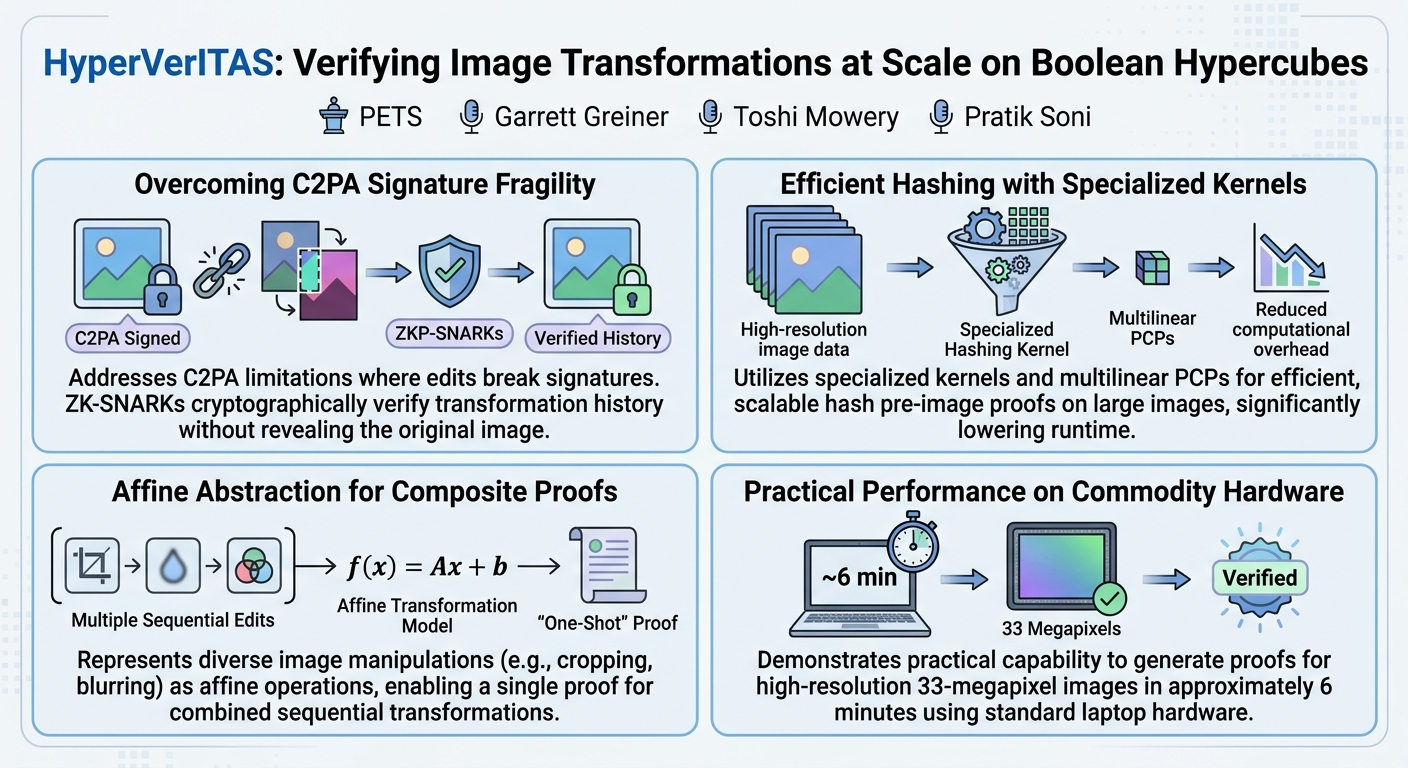
- Efficient ZKP Generation for Large Images on Commodity Hardware: The system successfully generates ZK-SNARKs for high-resolution images, specifically up to 33 megapixels, within practical timeframes (approximately 6 minutes) using standard laptop hardware. This dramatically overcomes the scalability limitations of prior ZKP-based image provenance solutions, which often required server-grade hardware or took prohibitively long for similar image sizes.
- Optimized Proofs for Image Hash Pre-image: HyperVerITAS introduces a specialized kernel designed for efficient hashing of image data within a ZKP context. This kernel leverages a matrix multiplication-like approach, optimizing resource consumption for low-norm image inputs and working across a wide spectrum of resolutions. The crucial innovation here is the shift from computationally expensive "polynomial interactive local proofs instantiated with universal PCPs" to more efficient multilinear PCPs and an unspecified "PC to deploy our proof," leading to substantial reductions in prover runtime and overhead.
- Novel Approach to Image Transformation Proofs: A core insight of HyperVerITAS is the representation of various image transformations (such as blurring, cropping, resizing, and color filters) as a special type of affine transformation. This mathematical abstraction allows for the generation of highly efficient proofs for these operations, again utilizing multilinear PCPs.
- Compositional Proofs for Multiple Transformations: Building on the affine transformation insight, HyperVerITAS demonstrates that compositions of these transformations also remain affine. This enables the system to prove multiple sequential image transformations (e.g., five or nine distinct edits) in a single, consolidated proof, rather than requiring separate, cumulative proofs for each step. This "one-shot" proof generation for composite transformations significantly boosts efficiency.
- Significant Performance Improvements: HyperVerITAS achieves remarkable speedups compared to existing ZKP solutions. Benchmarks indicate it is approximately four times faster than other polynomial solutions like Pinocchio and a striking sixteen times faster than older, less optimized polynomial proof systems. This performance gain is critical for making ZKP-based image provenance a practical reality.
Technical Deep Dive
▶ Watch: Prior work limitations and the scalability challenge (5:00)
The technical innovations behind HyperVerITAS are bifurcated into two primary areas: efficient proving of the original image's hash pre-image, and efficient proving of image transformations. Both leverage advancements in Zero-Knowledge Proofs (ZKPs) to achieve unprecedented scale and speed.
Efficient Hash Pre-image Proof
The first critical component addresses the challenge of proving that an original image corresponds to a pre-computed and signed cryptographic hash without revealing the image itself. Standard cryptographic hash functions like SHA-256 or Poseidon are notoriously inefficient when used within ZKP circuits, especially for large inputs like high-resolution images. HyperVerITAS tackles this by employing a specialized approach:
- Specialized Kernel for Hashing: Instead of relying on generic cryptographic hashes within a ZKP-friendly arithmetic circuit, HyperVerITAS utilizes a custom kernel. This kernel is described as performing operations akin to matrix multiplication on the image data. Specifically, it takes samples (pixels or blocks of pixels) from the image, arranges them into a matrix, and performs a computation that generates a hash for each channel of the image. This method is designed to be computationally less demanding within a ZKP context than a full cryptographic hash function. The speaker notes that this specialized hash structure is particularly efficient for "low normal image inputs," but works across a "wide spectrum of ranges of resolution." This implies an optimization for typical image data distributions while maintaining generality.
- Transition to Multilinear PCPs: A pivotal design choice for efficiency is the shift in the underlying proof system. Earlier ZKP approaches, including some prior work in image provenance, often relied on "polynomial interactive local proofs and instantiated with universal PCPs." While foundational, these methods involve computationally expensive operations. HyperVerITAS significantly reduces the prover runtime and overhead by switching to multilinear PCPs (Probabilistically Checkable Proofs) and a component referred to as "PC to deploy our proof." Multilinear PCPs offer a more efficient way to encode and verify computations, especially those involving large inputs, by operating on polynomials defined over boolean hypercubes. This allows for more compact representations and faster verification, eliminating the need for some of the more resource-intensive operations inherent in universal PCPs.
Efficient Image Transformation Proofs
The second major technical contribution of HyperVerITAS lies in its ability to efficiently prove that a series of transformations were correctly applied to an image. This is where the standard C2PA model breaks down, as any transformation invalidates the original signature.
- Affine Transformation Abstraction: The core insight for transformation proofs is to view a wide range of common image manipulations as a special type of affine transformation. An affine transformation is a linear mapping followed by a translation. Many common image operations fit this model or can be approximated by it:
- Scaling/Resizing: A linear scaling of coordinates.
- Translation/Cropping: A shift in coordinates.
- Rotation: A linear transformation.
- Color Adjustments (e.g., grayscale, brightness/contrast): Can often be represented as linear operations on pixel values across color channels.
- Blurring: While more complex, certain blurring kernels can be expressed or approximated within an affine framework or as a convolution, which can be efficiently handled in a multilinear context.
By representing these diverse transformations under a unified affine umbrella, HyperVerITAS can apply a consistent and optimized proof generation mechanism.
- Multilinear PCPs for Transformations: Similar to the hash pre-image proof, HyperVerITAS leverages multilinear PCPs for proving these affine transformations. The structure of multilinear PCPs is well-suited for proving computations that can be expressed as polynomial evaluations over boolean hypercubes, which is precisely what affine transformations and their compositions allow. This enables the system to efficiently encode the transformation logic and generate proofs that are compact and fast to verify.
- Compositional Proofs for Multiple Edits: A significant efficiency gain comes from the observation that the composition of affine transformations remains an affine transformation. If an image undergoes several sequential edits—say, a crop, then a resize, then a grayscale filter—the combined effect can still be represented as a single, composite affine transformation. This means that instead of generating separate ZKPs for each individual transformation and then combining them (which would be computationally expensive), HyperVerITAS can generate a single "one-shot" proof that covers the entire sequence of transformations. This drastically reduces the total prover runtime and overhead, making it practical to verify complex editing histories.
Performance and Resource Utilization
The combination of these technical innovations yields impressive performance results. HyperVerITAS can generate proofs for large, 33-megapixel images in approximately 6 minutes while consuming around 27 GB of RAM on commodity hardware, such as a laptop. This represents a significant leap compared to prior work, which either required server-grade hardware or took over 20 minutes for similar tasks. The speaker explicitly states that HyperVerITAS is four times faster than other polynomial solutions like Pinocchio and sixteen times faster than even older polynomial proof systems, highlighting the efficiency gains achieved through the use of multilinear PCPs and specialized kernels.
Demo / Proof of Concept
▶ Watch: HyperVerITAS insight: efficient hash pre-image proofs (7:00)
While the talk provided a high-level overview of the HyperVerITAS system and its performance metrics, it did not include a live demonstration or detailed walkthrough of a proof of concept during the presentation. The speaker invited attendees to a poster session to "see our results" and learn more about the specifics of the system and its outputs. This suggests that while a tangible implementation exists, a live, interactive demo was not part of the conference talk itself.
Defensive Implications
▶ Watch: Performance results and comparison with prior solutions (9:00)
The HyperVerITAS framework offers profound defensive implications for combating misinformation, enhancing digital trust, and securing content integrity in an increasingly complex media landscape.
- Robust Content Verification: For news organizations, social media platforms, and content archives, HyperVerITAS provides a cryptographically strong mechanism to verify the authenticity and provenance of images. Even if an image has been legitimately edited (e.g., blurred for privacy, cropped for layout), its history can be confirmed against an original, signed version. This moves beyond simple signature invalidation to a nuanced understanding of content transformations.
- Combating Deepfakes and Misinformation: By offering a verifiable chain of custody for digital images, HyperVerITAS can help distinguish genuinely sourced and edited content from malicious deepfakes or images fabricated to spread misinformation. If an image claims to be from a trusted source but lacks a valid HyperVerITAS proof (or a C2PA signature, where applicable), its veracity can be immediately questioned. This provides a crucial tool in the fight against synthetic media threats.
- Enhanced Transparency and Accountability: The ability to prove specific transformations were applied enables greater transparency. For example, a government agency publishing an image with redacted information could provide a HyperVerITAS proof that confirms the redaction was the only transformation applied to an originally signed document, without revealing the redacted content. This fosters public trust and accountability.
- Integration with C2PA and Other Standards: HyperVerITAS can act as a powerful complement to existing standards like C2PA. Where C2PA provides the initial cryptographic anchor, HyperVerITAS extends that trust through subsequent, verifiable transformations. This allows for a more comprehensive provenance solution that covers the entire lifecycle of an image, from creation to publication and beyond, accommodating real-world editing workflows.
- Forensic Analysis and Attribution: In legal or investigative contexts, HyperVerITAS proofs could serve as strong evidence. The ability to cryptographically link an edited image back to a specific original and confirm the exact transformations applied can be invaluable for digital forensics, helping to establish timelines and attribute manipulations.
- Secure Image Editing Workflows: Image editing software could integrate HyperVerITAS to automatically generate proofs alongside edits. This would allow content creators to maintain a verifiable history of their work, assuring consumers of the integrity of their content without requiring them to completely trust the editing software itself, as HyperVerITAS proofs are independently verifiable.
- Scalable and Practical Deployment: The key advancement of HyperVerITAS — its ability to operate efficiently on commodity hardware for large images — makes these defensive capabilities practical for widespread adoption. This scalability removes a major barrier that has historically hindered the deployment of ZKP-based solutions in content provenance.
Key Takeaways
- Image Provenance is Critical: The proliferation of generative AI and easy image manipulation necessitates robust methods to verify the origin and history of digital images to combat misinformation and maintain trust.
- C2PA Limitations Addressed: While C2PA provides a foundation for image provenance, its weakness in handling image transformations (which invalidate signatures) is a significant practical hurdle that HyperVerITAS directly resolves.
- ZKPs for Scalable Verification: HyperVerITAS leverages Zero-Knowledge Proofs (ZKPs) to enable cryptographic verification of image transformations and original image authenticity without revealing sensitive data.
- Efficiency Through Technical Innovation: The system achieves unprecedented efficiency for large-scale image provenance by employing specialized hashing kernels, transitioning to multilinear PCPs, and representing image transformations as affine operations.
- "One-Shot" Transformation Proofs: A key insight is that compositions of affine transformations remain affine, allowing HyperVerITAS to generate a single, efficient proof for multiple sequential edits, significantly reducing overhead.
- Practical Performance: HyperVerITAS demonstrates the ability to generate proofs for 33-megapixel images in approximately 6 minutes on commodity hardware, making ZKP-based image provenance a practical reality for the first time.
About the Speaker(s)
The talk was presented by Garrett Greiner, a second-year PhD student at the University of Utah. The work, HyperVerITAS, is a joint collaboration with his colleagues Toshi Mowery and Pratik Soni, also from the University of Utah. Their research focuses on advancing the field of image provenance through innovative cryptographic techniques, particularly leveraging Zero-Knowledge Proofs to address the challenges of verifying digital content authenticity at scale.
Reviews
Dr. Zero (Offensive Security Researcher) — SOLID
This is a serious swing at the fundamental fragility of C2PA: signatures dying the second you crop a JPEG. Dropping universal PCPs for multilinear PCPs to get 33MP image proofs down to six minutes on commodity hardware is real cryptographic heavy lifting, even if hiding the demo behind a poster session is a massive letdown.
Heather Calloway (CISO) — SOLID
The current standard for digital image provenance (C2PA) breaks the moment a photo is cropped or color-corrected. This academic research uses zero-knowledge proofs to maintain cryptographic chain-of-custody through standard edits, dropping the processing time to something manageable on commodity hardware. It's a vital preview of where digital forensics is heading, though it isn't ready for real-time enterprise deployment today.
→ Top-rated talks at Privacy Enhancing Technologies Symposium (PETS) 2026
All talks from Privacy Enhancing Technologies Symposium (PETS) 2026