Privacy Pass is Anamorphic: Practical Consequences and Attacks in the Black-box Model
Mirosław Kutyłowski (Paper author · NASK National Research Institute), Oliwer Sobolewski (Paper author · NASK National Research Institute)
Privacy Enhancing Technologies Symposium (PETS) 2026 · Day 1 · Alpaca
Overview
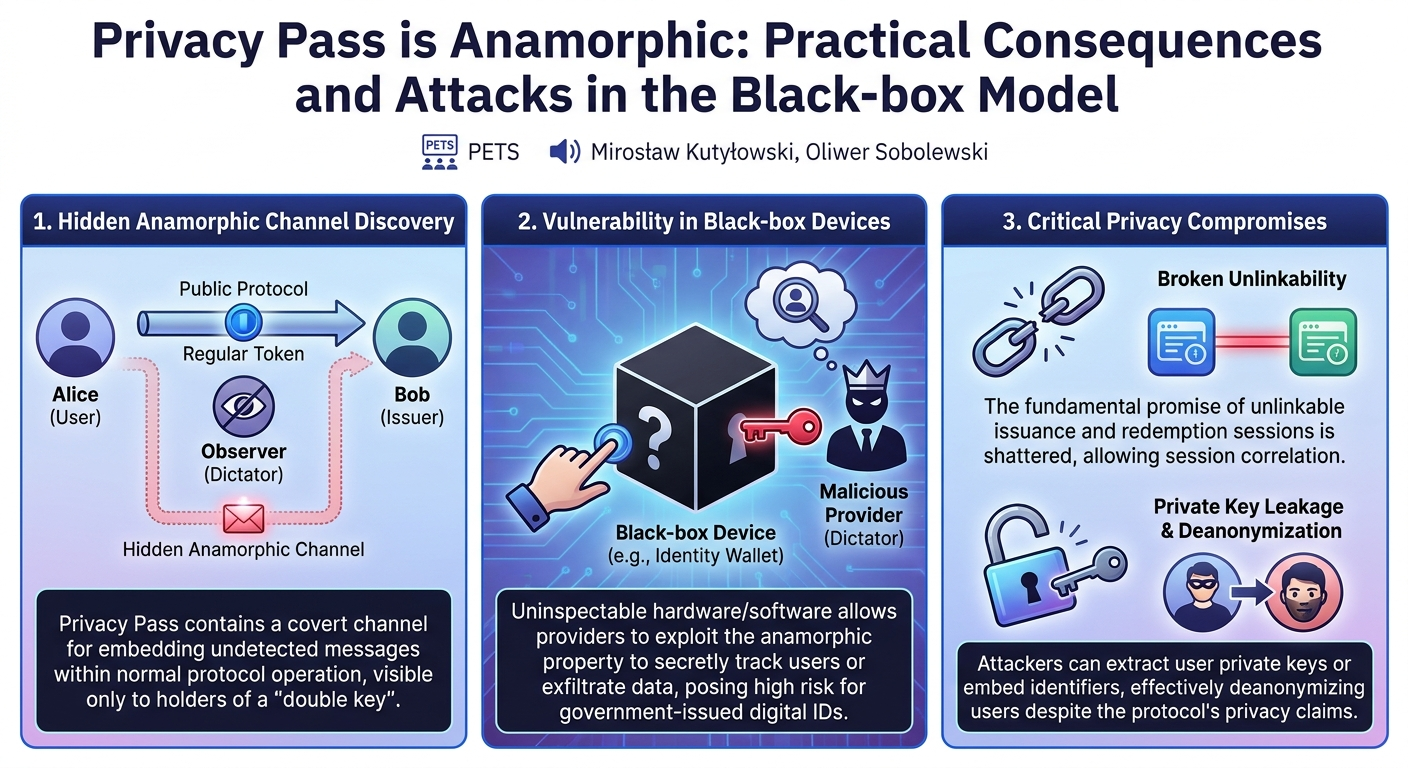
In this insightful talk at PETS, Oliwer Sobolewski, joined by co-author Professor Mirosław Kutyłowski, presented compelling research demonstrating that Privacy Pass, a widely adopted anonymous authorization scheme, is fundamentally anamorphic. This discovery reveals a covert communication channel within the protocol, allowing a sophisticated adversary to embed and extract hidden messages without detection by a passive observer. The implications of this finding are profound, particularly when Privacy Pass is deployed in black-box device models, where users interact with hardware or software they cannot fully inspect.
Key moments
- 0:24 Introduction to Privacy Pass and its variants
- 1:55 Privacy Pass's two phases: issuance and redemption
- 3:00 Defining anamorphic cryptography and its parties
- 4:50 Key properties of Anamorphic Privacy Pass schemes
- 7:00 Whistleblowing as a use case for anamorphic Privacy Pass
- 7:50 Black-box model attacks and anamorphism's implications
- 9:00 Anonymous attestation and traffic anonymization use cases
Privacy Pass is Anamorphic: Practical Consequences and Attacks in the Black-Box Model
Speakers: Oliwer Sobolewski, PhD Candidate, NASK National Research Institute; Mirosław Kutyłowski, Professor, NASK National Research Institute
Conference: PETS
YouTube: https://www.youtube.com/watch?v=8aAXVfpTCGo
Overview
In this insightful talk at PETS, Oliwer Sobolewski, joined by co-author Professor Mirosław Kutyłowski, presented compelling research demonstrating that Privacy Pass, a widely adopted anonymous authorization scheme, is fundamentally anamorphic. This discovery reveals a covert communication channel within the protocol, allowing a sophisticated adversary to embed and extract hidden messages without detection by a passive observer. The implications of this finding are profound, particularly when Privacy Pass is deployed in black-box device models, where users interact with hardware or software they cannot fully inspect.
The research highlights how this anamorphic property can be exploited for both benevolent and malicious purposes. While it could theoretically enable secure whistleblowing channels, it also poses a significant threat to user privacy in scenarios such as government-issued digital identity wallets, where the device provider could secretly track users. The presentation meticulously details the technical underpinnings of this anamorphic capability, its unique properties within the Privacy Pass framework, and the concrete attacks it enables, urging a critical re-evaluation of security assumptions for privacy-preserving protocols in untrusted environments.
Background
▶ Watch: Introduction to Privacy Pass and its variants (0:24)
Privacy Pass emerged as a lightweight, anonymous authorization scheme, initially conceived as a privacy-preserving replacement for traditional CAPTCHAs. First introduced by David Chaum at PETS 2018, it has since achieved significant standardization through IETF documents. Currently, there are two fully standardized variants: one based on verifiable oblivious transfer functions (VOT), which yields privately verifiable tokens, meaning only the issuer can confirm their validity; and another based on blind RSA, producing publicly verifiable tokens. An additional RFC draft, Anonymous Rating Credentials (ARC), proposes multiple-use privately verifiable tokens.
The operation of Privacy Pass unfolds in two distinct phases: the issuance phase and the redemption phase. In the issuance phase, a user sends a blinded token to an issuer. The issuer cryptographically signs this blinded token and returns it. The user then unblinds the signed token and stores it. Later, in the redemption phase, the user presents this signed token to a verifier (which could be the issuer or another party) to gain access or prove an attribute. The verifier uses either a private or public issuer key, depending on the Privacy Pass variant, to confirm the token's validity.
Central to Privacy Pass's security are three properties: correctness, ensuring valid tokens are always accepted; one-more-effort convertibility, which dictates that n issuance sessions should enable the redemption of at most n tokens; and, most critically for privacy, unlinkability. Unlinkability guarantees that it should be computationally impossible for the issuer to link a user's issuance session to their subsequent redemption session, thereby preserving user anonymity.
The concept of anamorphic cryptography provides the theoretical framework for the talk's findings. In an anamorphic cryptographic protocol, there are three primary parties: Alice (the anamorphic sender), Bob (the anamorphic receiver), and a dictator (the adversary). The protocol can operate in two modes: a regular mode and an anamorphic mode. The anamorphic mode introduces an additional pair of keys, referred to as double keys – a private receiver double key and a public sender double key – along with an anamorphic message. The core objective of an anamorphic execution is to secretly transmit this anamorphic message from Alice to Bob. Crucially, the regular and anamorphic executions must be indistinguishable to the dictator, even if the dictator possesses the private regular keys of the protocol. This hidden channel capability, while maintaining ostensible protocol integrity, forms the basis for the presented attacks on Privacy Pass.
Key Findings
▶ Watch: Defining anamorphic cryptography and its parties (3:00)
The central and most impactful finding of this research is the assertion that Privacy Pass is anamorphic. This means that despite its design for unlinkability and privacy, a hidden communication channel can be embedded within its standard operations. An anamorphic sender can transmit a secret message to the issuer (acting as the anamorphic receiver) in a way that appears indistinguishable from a regular Privacy Pass interaction to an external observer, termed the "dictator." This discovery fundamentally challenges the long-held assumption of robust unlinkability in Privacy Pass under certain adversary models.
To achieve anamorphism within Privacy Pass, the authors propose a generalized approach where the anamorphic sender leverages both the issuance and redemption phases to transmit the hidden message. The issuer, operating in anamorphic mode, subsequently retrieves this secret message as a function of the issuance session data, the signed token, and the receiver's double key. This construction leads to several newly identified properties for anamorphic Privacy Pass schemes:
- Indistinguishability: The regular and anamorphic execution modes remain indistinguishable to the dictator, ensuring the hidden channel operates covertly.
- Public Key Anamorphism: The anamorphic sender does not necessarily need prior knowledge of the sender's double key; it can either be derived from the regular public key or generated during protocol execution.
- Robustness: An anamorphic Privacy Pass scheme is robust if the issuer can successfully receive a valid anamorphic message under two specific conditions: first, when the sender is executing in regular mode while the issuer is in anamorphic mode; and second, when the issuer uses mismatched issuance session data and a signed token for decryption (i.e., data from different issuance sessions). Critically, the authors highlight that this robustness breaks or significantly complicates the one-more-effort convertibility property of Privacy Pass, as the issuer gains an unexpected mechanism to extract information that could influence token usage or link sessions beyond the user's control.
- Full Decryptability: This property ensures that regardless of the dictator's actions (even if they act as a Man-in-the-Middle), if Alice receives correctly signed and verifiable tokens, the anamorphic message can always be recovered by the receiver (issuer). This is crucial for maintaining the integrity of the hidden channel against active adversaries.
The research further reveals a direct implication: anamorphism inherently implies black-box model attacks. By simply relabeling the user as a "device" and the dictator as an "auditor" within the black-box-to-your-device model, the anamorphic capabilities translate into concrete attack vectors. This allows an auditor (or a malicious device provider) to demand users' private keys or embed user identifiers as anamorphic messages, effectively deanonymizing users or tracking their activities through what appears to be a privacy-preserving protocol. This connection underscores the profound practical consequences of Privacy Pass's anamorphic nature in real-world deployments.
Technical Deep Dive
▶ Watch: Key properties of Anamorphic Privacy Pass schemes (4:50)
The core technical contribution of this work lies in demonstrating how the principles of anamorphic cryptography can be instantiated within the Privacy Pass protocol. Given Privacy Pass's two-phase structure and its unlinkability guarantee, applying anamorphism is not straightforward. The authors adopted a general approach, allowing the anamorphic sender (Alice) to utilize both the issuance and redemption phases to transmit the hidden message.
In the anamorphic issuance phase, Alice sends a blinded token to the issuer. The issuer, operating in anamorphic mode, responds with a blinded signed token that implicitly encodes a part of the anamorphic message or facilitates its later extraction. Alice then unblinds this token. Later, in the anamorphic redemption phase, Alice sends the signed token to the issuer (now acting as the anamorphic receiver). The issuer, in this anamorphic mode, is able to retrieve the anamorphic message. This message is a specific function of the issuance session data, the signed token itself, and the receiver double key. This mechanism creates a covert channel that is indistinguishable from a regular Privacy Pass transaction to an external observer.
The authors define specific properties for their anamorphic Privacy Pass construction:
- Indistinguishability: This is paramount for any anamorphic scheme. It means that an adversary (the dictator) observing the network traffic or even having access to some private keys of the regular protocol cannot differentiate between a regular Privacy Pass execution and an anamorphic one. This ensures the covert nature of the hidden message transmission.
- Public Key Anamorphism: This property simplifies the sender's requirements. Alice, the anamorphic sender, does not need to pre-exist with a specific "sender double key." Instead, this key can either be derived deterministically from the regular public key of the protocol or generated dynamically during the protocol execution itself. This reduces setup overhead and increases flexibility for deploying anamorphic capabilities.
- Robustness: This is a critical property for practical attacks. A robust anamorphic scheme ensures that the issuer (anamorphic receiver) can successfully retrieve the hidden message even under specific non-ideal conditions. The first condition is when Alice (the sender) is actually running the regular Privacy Pass mode, but the issuer is configured in anamorphic mode. The second condition is when the issuer attempts decryption using mismatched issuance session data and a signed token – meaning the data and token originate from different issuance sessions. The authors explicitly state that this robustness property "breaks on invertibility also, right? Because you have to decrypt the homomorphic message." In the context of Privacy Pass, this "invertibility" likely refers to one-more-effort convertibility. By allowing the issuer to extract a message even from a "regular" token or mismatched data, robustness grants the issuer a powerful mechanism to bypass the user's expected control over token consumption and unlinkability. The ability to decrypt a message consistently, regardless of the sender's mode or token origin, fundamentally undermines the user's privacy guarantees associated with token management.
- Full Decryptability: This property addresses a more active adversary model where the dictator might act as a Man-in-the-Middle (MiTM). Full decryptability ensures that if Alice successfully receives a correctly signed token that verifies, then the anamorphic message can always be recovered by the receiver (issuer). This means even if a MiTM dictator tries to tamper with the communication, the hidden channel remains resilient for message extraction as long as the core Privacy Pass protocol succeeds from Alice's perspective.
The talk then pivots to the black-box-to-your-device model, a common paradigm in cryptographic attacks. In this model, users do not directly execute protocol steps; instead, a "device" (which is a black box to the user) performs these operations. Users only have oracle access – they provide inputs, receive outputs, and can observe the execution, but they cannot inspect the device's internal workings. The device might claim to implement protocol pi, but in reality, it could be implementing pi', which is indistinguishable from pi externally but possesses additional, often malicious, cryptographic properties. In this model, the user might also act as a MiTM, and an "auditor" can request private keys from the device for audit purposes.
The authors directly link anamorphism to this black-box model: anamorphous cryptography implies black-box model attacks. This connection is established by a simple relabeling: the "user" becomes the "device," and the "dictator" becomes the "auditor." In this transformed context, the auditor (who often represents a powerful entity like a government or a device manufacturer) can exploit the anamorphic capabilities to demand the user's private keys or embed user identifiers directly as anamorphic messages.
This framework enables several potent cryptographic attacks:
- Deanonymization: By embedding user identifiers into the anamorphic message, the device provider can deanonymize users who believe they are using Privacy Pass anonymously.
- Private Key Leakage: The anamorphic channel can be used to exfiltrate a user's private keys from the black-box device without the user's knowledge.
- Attribute Tracking: In scenarios like anonymous attestation of attributes (e.g., in the proposed European identity wallet, where crypto operations are mandated to be carried out by "well-secured cryptographic devices" which are black boxes), the government (as the wallet solution provider) could use anamorphism to track users' attributes despite the protocol's privacy claims.
The speaker briefly mentions constructions for different Privacy Pass variants:
- For Verifiable Random Functions (VRFs): An anamorphic construction that is "classical fully decryptable."
- For Blind Signatures: An anamorphic construction that is "classical public key fully decryptable," where the anamorphism can be "closed" by the user randomizing query messages.
- For Anonymous Rating Credentials (ARC): An anamorphic construction that is also "classical public key fully decryptable."
While detailed cryptographic constructions were not presented due to time constraints, their existence across different Privacy Pass variants underscores the generality of the anamorphic property.
Demo / Proof of Concept
▶ Watch: Black-box model attacks and anamorphism's implications (7:50)
The talk focused on the theoretical constructions and implications of anamorphic Privacy Pass. Due to time limitations, the speaker explicitly stated, "I will just quickly show the the construction because we don't have time," and then presented high-level properties of their constructions for VRFs, blind signatures, and ARC variants. No live demonstration or detailed proof of concept was shown during the presentation.
Defensive Implications
▶ Watch: Anonymous attestation and traffic anonymization use cases (9:00)
The discovery that Privacy Pass is anamorphic carries significant defensive implications, particularly for users, developers, and auditors of privacy-preserving systems. The core takeaway for defenders is that the "black-box-to-your-device" model, often assumed to be secure, becomes a critical vulnerability when anamorphic properties are present.
- Trust in Black-Box Devices: The most immediate implication is a severe erosion of trust in black-box implementations of Privacy Pass and potentially other privacy protocols. If a device provider (e.g., a government for an identity wallet, or a commercial entity for a secure browser component) controls the black-box device, they can leverage the anamorphic channel to subvert user privacy. Users must be highly skeptical of claims of anonymity when the underlying cryptographic operations are executed in a device they cannot inspect or audit.
- Auditing Requirements: There is an urgent need for more robust and intrusive auditing mechanisms for cryptographic devices. Traditional audits might focus on correct protocol execution, but they must now extend to detecting anamorphic capabilities. Auditors should be empowered to request full device introspection, including source code, hardware schematics, and cryptographic key management, to verify the absence of such hidden channels. This is especially relevant for critical infrastructure like national identity wallets, where the device provider (often the government) has a strong incentive to track citizens.
- Protocol Design and Implementation: Developers of Privacy Pass and similar anonymous authorization schemes must be aware of this anamorphic potential. Future iterations or new designs should actively seek to mitigate or prevent anamorphic embedding. This might involve designing protocols that are inherently resistant to such hidden channels or implementing rigorous checks within open-source components to ensure that no anamorphic modifications have been introduced.
- Whistleblowing Systems: While the primary focus is on malicious exploitation, the whistleblowing use case presented offers a dual perspective. If a news agency or secure platform intentionally implements anamorphic Privacy Pass, it could offer a secure, covert channel for whistleblowers to report sensitive information, circumventing censorship or surveillance. This highlights that anamorphism itself is a tool; its ethical implications depend on the actor and intent. However, even in this beneficial context, the anamorphic implementation must be transparently acknowledged and its security properties carefully analyzed to prevent misuse by other parties.
- User Awareness and Education: End-users, particularly those relying on privacy-preserving technologies for sensitive activities, need to be educated about the risks associated with black-box devices. They should understand that even if a protocol is theoretically private, its implementation in an untrusted device can compromise that privacy.
- Regulatory Scrutiny: Regulatory bodies, especially those overseeing digital identity and privacy (like those in the EU with the eIDAS regulation), should take note. Mandates for "well-secured cryptographic devices" must be accompanied by stringent requirements for transparency, auditability, and resistance to anamorphic subversion, particularly when governments are the providers of these devices. The ability for a government to track citizens through an "anonymous" identity wallet is a significant privacy violation that current regulations may not adequately address.
In essence, the talk serves as a stark warning: privacy-preserving protocols, however robust in theory, can be fundamentally compromised by the environment in which they are deployed, especially when that environment is a black-box device controlled by an incentivized adversary.
Key Takeaways
- Privacy Pass is Anamorphic: The research demonstrates that Privacy Pass, a standardized anonymous authorization scheme, inherently possesses anamorphic properties, allowing for the embedding of hidden communication channels.
- Hidden Channels Undermine Unlinkability: This anamorphic capability enables an issuer (or a malicious device) to extract secret messages from ostensibly unlinkable issuance and redemption sessions, thus compromising the fundamental privacy guarantee of unlinkability.
- Black-Box Devices are Vulnerable: The anamorphic nature of Privacy Pass poses a severe threat in the "black-box-to-your-device" model, where users interact with uninspectable hardware or software that can secretly track or deanonymize them.
- Robustness Breaks One-More-Effort Convertibility: The property of robustness in anamorphic Privacy Pass, which ensures message extraction even from regular or mismatched tokens, complicates or undermines the one-more-effort convertibility property, giving the issuer unexpected control over token usage.
- Real-World Attack Vectors: This research reveals concrete attack vectors, such as deanonymization in government-issued digital identity wallets and private key leakage from secure cryptographic devices.
- Urgent Need for Auditing and Design Review: The findings necessitate a critical re-evaluation of security assumptions for privacy-preserving protocols, emphasizing the need for rigorous auditing of black-box implementations and the design of anamorphism-resistant protocols.
About the Speaker(s)
Oliwer Sobolewski is a PhD candidate at the NASK National Research Institute in Poland. He presented this work, which is a significant contribution to the field of cryptographic security and privacy.
Professor Mirosław Kutyłowski is also affiliated with the NASK National Research Institute and is Oliwer Sobolewski's supervisor. He is a co-author of the presented paper and a recognized expert in cryptography, contributing to the academic rigor of this research.
Reviews
Dr. Zero (Offensive Security Researcher) — SOLID
Sobolewski and Kutyłowski take a sledgehammer to the unlinkability guarantees of Privacy Pass by proving the protocol is fundamentally anamorphic. They mathematically demonstrate that if you force this standard into a black-box hardware model—like the EU's upcoming digital identity wallets—the issuer can covertly track users without breaking the visible protocol execution.
Heather Calloway (CISO) — SOLID
This research breaks the anonymity guarantee of Privacy Pass, proving that hardware or software issuers can covertly track users through a supposedly private protocol. For leadership teams, it validates a hard truth: mathematical privacy guarantees are meaningless if you don't control the device executing them. It’s highly technical, but the architectural takeaway is essential for anyone evaluating hardware-backed identity wallets or third-party authenticators.
→ Top-rated talks at Privacy Enhancing Technologies Symposium (PETS) 2026
All talks from Privacy Enhancing Technologies Symposium (PETS) 2026