CoinJoin ecosystem insights for Wasabi 1.x, Wasabi 2.x and Whirlpool coordinator-based privacy mixers
Petr Svenda (Paper author · Masaryk University, CZ), Jiří Gavenda (Paper author · Masaryk University, CZ), Vasilios Mavroudis (Paper author · Turing Institute, UK), Chris Hicks (Paper author · Turing Institute, UK)
Privacy Enhancing Technologies Symposium (PETS) 2026 · Day 2 · Alpaca
Overview
In the realm of cryptocurrency, Bitcoin transactions are often perceived as anonymous, yet their public and immutable nature on the blockchain allows for sophisticated deanonymization techniques. The talk, "CoinJoin ecosystem insights for Wasabi 1.x, Wasabi 2.x and Whirlpool coordinator-based privacy mixers," delivered by Petr Svenda from Czech Technical University (Masaryk University) and collaborators from the Turing Institute, delves into CoinJoin, a crucial privacy-enhancing technology designed to combat these deanonymization efforts. The presentation highlights the critical role CoinJoin plays in protecting user privacy, noting that over 400,000 Bitcoins, valued at approximately $25 billion, have been mixed using this technique over time. Despite its significant adoption, the authors argue that the CoinJoin ecosystem remains "understudied," prompting their comprehensive analysis.
Key moments
- 0:00 Introduction to CoinJoin and Bitcoin privacy problems
- 2:00 Explaining the CoinJoin transaction mechanism
- 4:00 Key anonymity factors and CoinJoin ecosystem overview
- 6:00 Core research questions and data collection approach
- 7:00 Results: Identifying coordinators and user participation
- 9:00 Detecting large users' mixing patterns and overall trends
CoinJoin ecosystem insights for Wasabi 1.x, Wasabi 2.x and Whirlpool coordinator-based privacy mixers
Speakers: Petr Svenda (Paper author, Masaryk University, CZ), Jiří Gavenda (Paper author, Masaryk University, CZ), Vasilios Mavroudis (Paper author, Turing Institute, UK), Chris Hicks (Paper author, Turing Institute, UK)
Conference: PETS
YouTube: https://www.youtube.com/watch?v=ovREauEFK4E
Overview
In the realm of cryptocurrency, Bitcoin transactions are often perceived as anonymous, yet their public and immutable nature on the blockchain allows for sophisticated deanonymization techniques. The talk, "CoinJoin ecosystem insights for Wasabi 1.x, Wasabi 2.x and Whirlpool coordinator-based privacy mixers," delivered by Petr Svenda from Czech Technical University (Masaryk University) and collaborators from the Turing Institute, delves into CoinJoin, a crucial privacy-enhancing technology designed to combat these deanonymization efforts. The presentation highlights the critical role CoinJoin plays in protecting user privacy, noting that over 400,000 Bitcoins, valued at approximately $25 billion, have been mixed using this technique over time. Despite its significant adoption, the authors argue that the CoinJoin ecosystem remains "understudied," prompting their comprehensive analysis.
The research specifically focuses on coordinator-based CoinJoin protocols, including prominent implementations like Wasabi Wallet (versions 1.x and 2.x) and Samourai Wallet's Whirlpool. Unlike decentralized mixing solutions, these protocols rely on a central coordinator to facilitate the mixing process, introducing unique security and privacy considerations. The talk addresses three core questions: quantifying the total amount of mixed Bitcoins, analyzing the behavior of active users (especially large-volume mixers), and identifying both known and previously unknown CoinJoin coordinators. Through a combination of real-time monitoring, active participation, and extensive blockchain analysis, the researchers provide unprecedented insights into the operational dynamics and user base of these vital privacy tools.
This article dissects the methodologies, findings, and implications presented in Svenda's talk, offering a detailed technical perspective on the current state of CoinJoin privacy mixers. It underscores the ongoing challenges in achieving true anonymity on public blockchains and provides valuable intelligence for both users seeking to protect their privacy and researchers striving to understand the evolving landscape of cryptocurrency transactions. The work serves as a testament to the continuous cat-and-mouse game between privacy-enhancing technologies and the tools used for blockchain surveillance.
Background
▶ Watch: Introduction to CoinJoin and Bitcoin privacy problems (0:00)
Bitcoin, while often associated with anonymity, is more accurately described as pseudonymous. Every transaction is permanently recorded on a public ledger, the blockchain, detailing the sending and receiving addresses. While these addresses don't directly reveal real-world identities, they create a persistent transaction graph. Observers, such as blockchain analytics firms or law enforcement, often employ a heuristic known as the common input ownership heuristic (CIOH). This heuristic assumes that all inputs to a single transaction belong to the same entity. For example, if a user spends a large amount of Bitcoin and receives a smaller "change" output, an observer can link the change back to the original large input, thereby tracking the user's funds. This linkage can expose users to various risks, from targeted robbery if their holdings become known to government surveillance if they donate to sensitive causes.
The fundamental problem CoinJoin aims to solve is breaking this common input ownership heuristic. Instead of a single user creating a transaction with their inputs and outputs, CoinJoin brings together multiple users (typically 5 or more) to collaboratively create one large transaction. In a typical CoinJoin, multiple participants contribute their inputs, and the transaction is constructed such that all outputs have the same value. This design makes it significantly harder for an observer to determine which output belongs to which input. For instance, if five users contribute inputs and five outputs of equal value are created, there are 5! (120) possible ways to attribute inputs to outputs, dramatically increasing the anonymity set. The primary goal of a CoinJoin transaction is not to pay someone else, but rather to return funds to the original users in a way that obfuscates their ownership, effectively "mixing" their coins.
Several factors contribute to the effectiveness of a CoinJoin in enhancing anonymity. These include the number of users participating, the number of "packets" (distinct outputs that could be attributed to a user), the presence of same-value outputs, and the number of times a user repeats the mixing process. Conversely, the behavior of other participants can decrease anonymity; if all other users in a CoinJoin eventually disclose their identities, the remaining user's privacy is compromised.
The talk explicitly distinguishes its focus from JoinMarket, a decentralized CoinJoin implementation that has been active since 2015. Instead, the research concentrates on coordinator-based CoinJoin protocols, where a central server facilitates the mixing process. While these coordinators simplify the user experience, they also introduce a potential point of failure or compromise. The presentation recounts the history of several such services:
- Zcash/Zcoin (prior to Wasabi): Operated a coordinator-based design starting in 2018 but ceased operations in 2023, reportedly due to a lack of developers for their developer program.
- Samourai Wallet (Whirlpool): Developed a specific single-transaction mixing protocol. While Samourai Wallet's service was officially ceased by SBI (likely referring to the company behind it) following legal actions against its founders, the underlying software was open-source, leading to other entities operating their own Whirlpool coordinators.
- Wasabi Wallet (1.x and 2.x): A prominent example of a coordinator-based mixer, which has seen continuous development and use.
This historical context highlights the dynamic and often challenging environment in which privacy-enhancing technologies operate, marked by both technical evolution and external pressures.
Key Findings
▶ Watch: Key anonymity factors and CoinJoin ecosystem overview (4:00)
The research presented in the talk provides a comprehensive statistical and behavioral analysis of the coordinator-based CoinJoin ecosystem, yielding several significant findings that shed light on its scale, operational dynamics, and user characteristics.
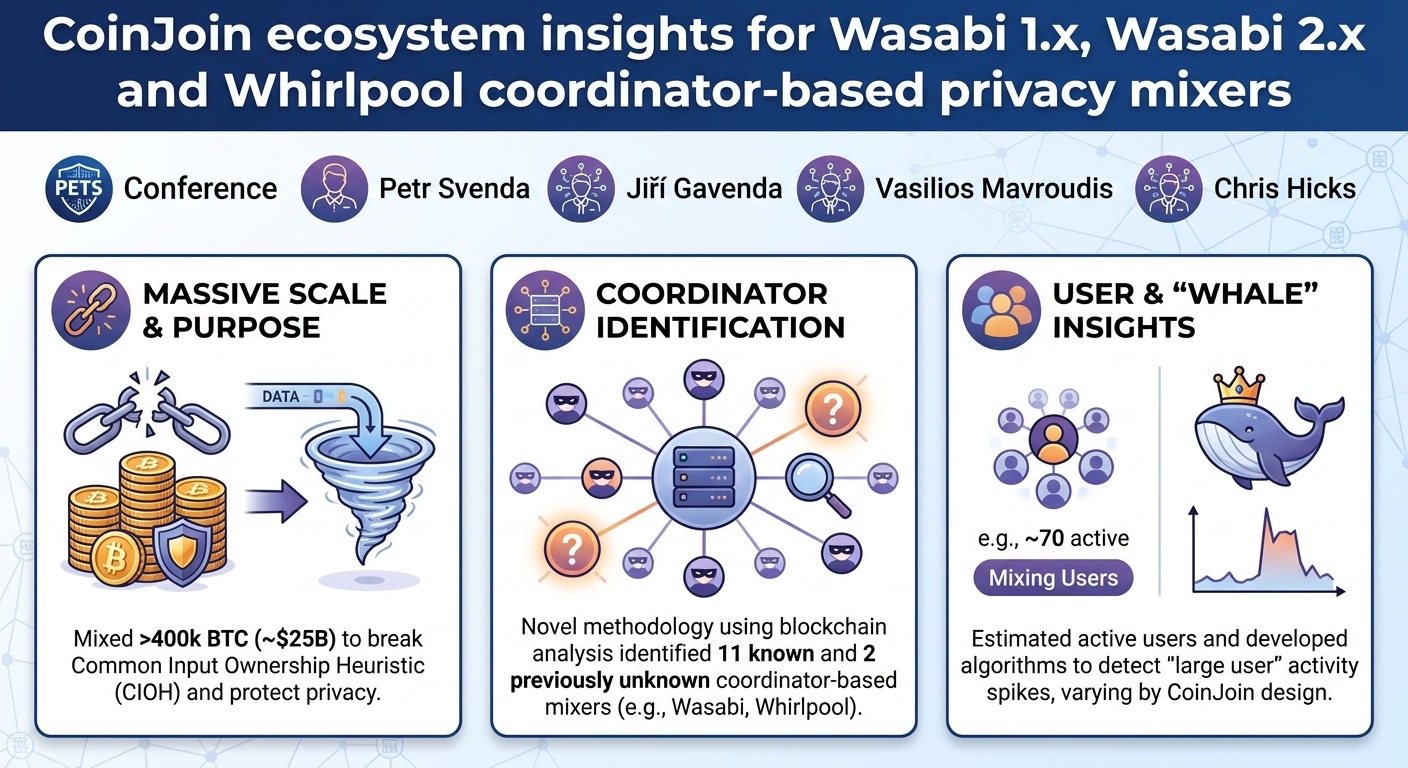
Firstly, the sheer scale of CoinJoin adoption is staggering. As mentioned, the cumulative amount of Bitcoin mixed using these techniques has surpassed 400,000 BTC, translating to an estimated $25 billion over time. This figure underscores CoinJoin's critical role as a widely utilized privacy tool within the Bitcoin ecosystem, despite its understudied nature. The researchers emphasized that this is not a niche activity but a substantial component of on-chain activity.
A primary objective of the study was to identify both known and previously unknown CoinJoin coordinators. By actively monitoring known coordinators in real-time and analyzing blockchain transaction patterns, the researchers developed a methodology to distinguish between transactions facilitated by known entities and those potentially originating from unannounced or clandestine coordinators. Their analysis revealed the existence of 11 publicly known coordinators and successfully identified two additional unknown coordinators through retrospective data analysis and clustering techniques. This capability to uncover hidden infrastructure is crucial for a complete understanding of the mixing landscape and for assessing the overall resilience and decentralization of the ecosystem.
The study also delved into quantifying user participation, a notoriously difficult metric to ascertain in privacy-focused systems. By analyzing the behavior statistics of users who participated in a large number of CoinJoins, the researchers developed an extrapolation method to estimate the total number of active users. For one specific, major coordinator (likely a past prominent one), they estimated approximately 60 external users at its peak. For a currently active large coordinator, identified as "Proof" (likely referring to a specific Whirlpool coordinator), the estimate stood at roughly 70 mixing users. The speaker acknowledged the inherent challenge in determining whether these are "real users" or automated bots, an open question that warrants further investigation. Nevertheless, these figures provide a valuable snapshot of active participation in the mixing process.
Furthermore, the research developed algorithms and visualizations to detect the behavior of "large users" or "whales"—entities mixing significantly more funds than the average participant. The visualizations showed distinct "spikes" in mixing activity, followed by subsequent declines, indicating periods when large amounts of funds were being processed. The talk noted that "different designs [of CoinJoin protocols] exhibit different behavior," suggesting that whale mixing patterns can vary depending on the specific implementation (e.g., Wasabi vs. Whirlpool). This ability to identify large-scale mixing events and characterize their patterns can help predict market dynamics and provides valuable insights for both privacy advocates and those involved in blockchain analytics.
Overall, the findings underscore the dynamic nature of the CoinJoin ecosystem, characterized by significant capital flow, evolving coordinator infrastructure, and distinct user behaviors. The methodologies developed in this research provide a robust framework for ongoing monitoring and analysis, offering a deeper understanding of privacy-enhancing technologies in practice.
Technical Deep Dive
▶ Watch: Core research questions and data collection approach (6:00)
The technical core of this research lies in its rigorous methodology for analyzing CoinJoin transactions on the Bitcoin blockchain, identifying coordinators, and characterizing user behavior. The foundational concept of CoinJoin as a privacy primitive is the creation of a single Bitcoin transaction with multiple inputs from different users and multiple outputs, often of the same value. This structure aims to break the common input ownership heuristic (CIOH). For example, a transaction with five inputs and five equal-value outputs makes it computationally difficult for an observer to link a specific input to a specific output, thus creating an anonymity set of 5. The number of possible input-output mappings (e.g., 24 options for a simple case, 3:00) directly contributes to the anonymity factor. Key design elements, such as the use of fixed-denomination outputs (e.g., 0.1 BTC, 0.01 BTC), are crucial for enhancing this ambiguity.
The researchers' data collection strategy was multi-pronged, combining active real-time monitoring with historical blockchain analysis:
- Real-time Coordinator Monitoring: The team actively contacted and monitored known CoinJoin coordinators, collecting "prime data" directly from their operations. This provided ground truth for identifying transactions associated with specific services like Wasabi or Whirlpool.
- Active Participation: To gain first-hand insights and collect data from within the ecosystem, the researchers ran their own Bitcoin wallets and actively participated in CoinJoin rounds. While "a little bit expensive," this approach, funded by a research grant, allowed them to observe the mixing process from a user's perspective and collect data on how real-world CoinJoins are constructed and executed.
- Blockchain Analysis: The entire Bitcoin blockchain, which is publicly downloadable, served as the primary data source for retrospective analysis. This allowed for the identification of historical CoinJoin transactions and the application of their analytical techniques across the entire history of these protocols.
A significant technical contribution is the methodology for identifying CoinJoin coordinators, including those not publicly announced. By observing transaction patterns, such as a consistent number of inputs/outputs or specific script characteristics that are unique to certain CoinJoin designs, the researchers could identify candidate CoinJoin transactions (e.g., "roughly 100 transactions per day" for a specific design, 7:30). Without additional information, these transactions are "unknown." However, by comparing the patterns of these unknown transactions with those actively monitored from known coordinators, they could infer the coordinating party. This process involved clustering analysis (7:50), grouping similar transaction structures and timing patterns to retrospectively map them to specific coordinators. This led to the identification of the 11 known and 2 additional unknown coordinators.
For estimating user participation, the researchers developed a novel approach. They focused on "users participating in a large number of CoinJoins" and analyzed their behavioral statistics. By observing the patterns and frequencies of mixing activity from these highly active participants, they could then extrapolate these findings to the broader CoinJoin ecosystem to "predict the number of users" (8:00). This method provided estimates like 60 external users for a large past coordinator and 70 mixing users for the current largest (Proof). The challenge of distinguishing between actual human users and automated bots (e.g., those run by exchanges or other services to mix large amounts of funds) remains an acknowledged limitation.
Finally, the detection of "large users" or "whales" involved designing specific algorithms and visualizations. These tools were capable of identifying "spikes" in mixing volume (8:50) that deviate significantly from typical activity. These spikes represent instances where a substantial amount of funds belonging to a single entity (or a coordinated group) undergoes mixing. The researchers observed that these "spikes and then going down" patterns varied between different CoinJoin designs, suggesting that the underlying protocol or coordinator implementation influences how large users interact with the mixer. This behavioral analysis is crucial for understanding the economic impact and potential market influence of major Bitcoin holders utilizing privacy tools.
The principles developed for analyzing these aspects—coordinator identification, user estimation, and whale detection—form the core technical contribution, providing a robust framework for future research into the privacy and security of cryptocurrency transactions.
Demo / Proof of Concept
▶ Watch: Results: Identifying coordinators and user participation (7:00)
The talk primarily focused on presenting the research methodology, analytical findings, and statistical insights derived from extensive blockchain analysis and active monitoring of CoinJoin ecosystems. While the speaker mentioned the development of "algorithms and visualizations" to detect large user behavior (8:50) and referenced "graphs" and "trends" (9:30) as well as the availability of "stuff together" via a QR code and posters (9:50), the presentation itself did not describe a live demonstration or a tangible proof of concept being actively run or showcased during the session. The emphasis was on the data-driven discoveries and the analytical framework developed by the researchers, rather than an interactive software demo.
Defensive Implications
▶ Watch: Detecting large users' mixing patterns and overall trends (9:00)
The detailed insights into the CoinJoin ecosystem provided by this research carry significant implications for various stakeholders, particularly those concerned with cybersecurity, privacy, and financial forensics.
For individual Bitcoin users, the research reinforces the necessity of employing robust privacy-enhancing techniques like CoinJoin to break the common input ownership heuristic. Users should understand that simply using new addresses does not guarantee anonymity; the transaction graph can still link their funds. The findings highlight the importance of choosing CoinJoin services with large and active user bases, as a larger anonymity set directly correlates with stronger privacy. Furthermore, users should be aware that "repeating this thing" (4:30), or participating in multiple rounds of CoinJoin, significantly enhances their privacy by increasing the complexity of tracing funds. The dynamic nature of coordinators (some stopping, new ones emerging) also suggests users should remain informed about the operational status and security reputation of their chosen mixer.
For defenders and network operators building privacy-preserving systems, the research offers valuable lessons. The ability to identify unknown coordinators retrospectively (7:30) suggests that even services attempting to operate covertly can be detected through sophisticated blockchain analysis. This implies that developers of new privacy tools must consider not only the cryptographic strength of their protocols but also the on-chain footprints they leave. Designing for maximum anonymity requires careful consideration of transaction structure, timing, and the aggregation of user inputs to prevent deanonymization via network-level or blockchain-level heuristics. The observation that "different designs are exhibiting different properties" (9:50) also indicates that there is no one-size-fits-all solution, and continuous research into new mixing techniques is vital.
For blockchain analysts and forensic investigators, the study provides advanced methodologies for understanding and potentially unraveling privacy-enhancing transactions. While CoinJoin aims to break linkages, the research demonstrates that patterns of activity, such as "spikes" from large users (8:50), can still offer clues about fund movements. The ability to identify coordinators, even unknown ones, allows for a more comprehensive mapping of the mixing landscape, which can be critical in investigations. However, it also underscores the increasing sophistication of privacy tools, necessitating more advanced analytical techniques beyond simple heuristic-based tracing. The "common input ownership heuristic" is effectively broken by CoinJoin, requiring investigators to adopt more complex clustering and behavioral analysis methods to track funds that have passed through mixers.
Finally, for regulators and policymakers, the research highlights the significant scale and persistent demand for privacy in cryptocurrency transactions. The mixing of billions of dollars worth of Bitcoin demonstrates that privacy is a core concern for a substantial segment of users. This understanding is crucial for developing informed regulations that balance financial transparency with individual privacy rights, recognizing that tools like CoinJoin will continue to evolve and be adopted regardless of regulatory stances. The ongoing "cat-and-mouse game" between privacy tools and deanonymization efforts means that the landscape is constantly shifting, requiring adaptive and nuanced approaches.
Key Takeaways
- CoinJoin is a Critical Privacy Tool: Over 400,000 Bitcoins, valued at approximately $25 billion, have been mixed using CoinJoin, underscoring its widespread adoption and importance in the cryptocurrency ecosystem for breaking the common input ownership heuristic.
- Coordinator-Based Mixers are Key: The research focused on centralized coordinator-based CoinJoin protocols (e.g., Wasabi Wallet, Samourai Wallet's Whirlpool), revealing their operational dynamics, user behavior, and the challenges they face (e.g., services stopping due to developer issues or legal pressure).
- Advanced Coordinator Identification: A novel methodology was developed to identify both known and previously unknown CoinJoin coordinators, successfully pinpointing 11 known and 2 additional unknown coordinators through real-time monitoring and blockchain clustering analysis.
- User Behavior and "Whale" Detection: Researchers estimated active mixing users (e.g., ~60-70 for the largest coordinators) and developed algorithms to detect "large users" or "whales" based on distinct "spikes" in mixing activity, noting that these patterns vary across different CoinJoin designs.
- Dynamic Ecosystem: The CoinJoin landscape is highly dynamic, with services emerging and ceasing operations. This constant evolution necessitates continuous research and adaptation for both users seeking privacy and analysts tracking funds.
- Privacy is an Ongoing Challenge: The study emphasizes that achieving true anonymity on public blockchains remains a complex and active area of research, requiring users to understand the nuances of privacy tools and for developers to continuously innovate.
About the Speaker(s)
The talk was presented by Petr Svenda, a paper author from Masaryk University in the Czech Republic. The research was a joint effort with Jiří Gavenda (also from Masaryk University) and Vasilios Mavroudis and Chris Hicks (both from the Turing Institute in the UK). Their collaborative work highlights an international academic effort to understand and analyze critical privacy-enhancing technologies in the cryptocurrency space.
Reviews
Dr. Zero (Offensive Security Researcher) — SOLID
Svenda and the Turing Institute crew did actual on-chain legwork to map out the Wasabi and Whirlpool coordinator ecosystems. They burned grant money to participate in the mixing, established ground truth, and used it to unmask hidden infrastructure. It's strong, practical surveillance research that proves these privacy pools are much smaller and noisier than wallet vendors want you to believe.
Heather Calloway (CISO) — PASS
This is academic blockchain forensics, not enterprise security. It unpacks how cryptocurrency mixers like CoinJoin obfuscate transaction graphs and how analysts can still detect their footprints. Worthwhile for law enforcement and crypto custodians, but largely irrelevant to a standard corporate risk register.
→ Top-rated talks at Privacy Enhancing Technologies Symposium (PETS) 2026
All talks from Privacy Enhancing Technologies Symposium (PETS) 2026