Access Granted, Privacy Lost: Formalizing & Quantifying the Hidden Anonymity Risks of Exclusive-Use Systems
Christopher Ellis (Paper author · Ohio State University), Zhiqiang Lin (Paper author · Ohio State University)
Privacy Enhancing Technologies Symposium (PETS) 2026 · Day 2 · Alpaca
Overview
In an era where digital communication underpins nearly all aspects of personal and professional life, the seemingly benign patterns of interaction within "exclusive-use systems" harbor profound, often overlooked, privacy implications. Christopher Ellis, a researcher from Northeastern University, presented groundbreaking work at PETS, shedding light on how these systems, characterized by trusted, one-to-one relationships between users and resources, inadvertently reveal sensitive information through simple binary signals. This research, co-authored with Professor George Cybenko and Zhiqiang Lin, formalizes the concept of "exclusive use linkage," providing a robust framework to quantify the resulting anonymity loss and demonstrate the tangible threat of user re-identification.
Key moments
- 0:00 Introduction: Hidden anonymity risks of exclusive-use systems
- 0:40 Key contributions: formalization, quantification, taxonomy, case study
- 2:10 Quantification framework: measuring privacy loss in bits
- 4:25 Microsoft Teams case study: identifying specific traffic patterns
- 7:40 High accuracy of user re-identification results
- 8:15 Call to researchers: protecting inherent anonymity of communication
Access Granted, Privacy Lost: Formalizing & Quantifying the Hidden Anonymity Risks of Exclusive-Use Systems
Speakers: Christopher Ellis (Paper author, Ohio State University), Zhiqiang Lin (Paper author, Ohio State University)
Conference: PETS
YouTube: https://www.youtube.com/watch?v=bmFlGIKpn0Q
Overview
In an era where digital communication underpins nearly all aspects of personal and professional life, the seemingly benign patterns of interaction within "exclusive-use systems" harbor profound, often overlooked, privacy implications. Christopher Ellis, a researcher from Northeastern University, presented groundbreaking work at PETS, shedding light on how these systems, characterized by trusted, one-to-one relationships between users and resources, inadvertently reveal sensitive information through simple binary signals. This research, co-authored with Professor George Cybenko and Zhiqiang Lin, formalizes the concept of "exclusive use linkage," providing a robust framework to quantify the resulting anonymity loss and demonstrate the tangible threat of user re-identification.
The talk introduces a novel quantification framework, leveraging complementary methods like Shannon entropy, to measure privacy loss in bits and assess attacker confidence. This analytical approach is complemented by an enhanced taxonomy that categorizes threats across dimensions of attacker capability and influence. The culmination of this research is a compelling case study on Microsoft Teams, where the team successfully demonstrated how distinct communication patterns, even within encrypted traffic, can be exploited to infer user behavior and ultimately re-identify individuals with alarmingly high accuracy. The findings underscore a critical challenge to user privacy, highlighting an "imposed consent" scenario where users have no meaningful way to opt out of such pervasive surveillance.
Background
▶ Watch: Introduction: Hidden anonymity risks of exclusive-use systems (0:00)
The concept of exclusive-use systems forms the bedrock of this research. These systems are defined by a unique relationship: a one-to-one mapping between users and specific resources, often involving communication between "trusted entities." Unlike public or untrusted communication channels, interactions within these systems frequently involve discrete, binary signals – simple indicators like "online/offline," "typing," or "message sent." While individually these signals may appear innocuous, the research posits that their collective observation can lead to "close to worst-case privacy" scenarios.
The problem stems from the inherent semantic richness embedded within these binary communication patterns. Even when the content of communications is encrypted, the metadata—specifically the timing, sequence, and packet sizes of these binary signals—can serve as a powerful identifier. Prior work has often focused on traffic analysis for broader network activity or content inference. However, this research zeroes in on the specific, often fixed, sequences and patterns that are characteristic of exclusive-use systems, revealing that they can enable sophisticated behavioral inference and qualitative inference, which directly support user re-identification. The motivation for this work arose from initial traffic analysis on Microsoft Teams, where distinct, repeatable patterns associated with specific user actions were observed, hinting at a deeper vulnerability.
Key Findings
▶ Watch: Quantification framework: measuring privacy loss in bits (2:10)
The central discovery of this research is the profound and quantifiable anonymity risk inherent in exclusive-use systems, even when communication content is encrypted. The talk formally establishes that the seemingly benign binary signals exchanged within these trusted environments can be leveraged to enable sophisticated behavioral inference and direct user re-identification, leading to a state of near "worst-case privacy."
A key contribution is the development of a quantification framework that provides complementary methods to precisely measure this anonymity loss. Using Shannon entropy, the framework can quantify privacy loss in bits, offering a concrete metric for evaluating the effectiveness of potential countermeasures. Furthermore, the framework introduces concepts like attacker confidence (derived from maximum posterior probabilities) and an indistinguishability game to assess the attacker's ability to differentiate users.
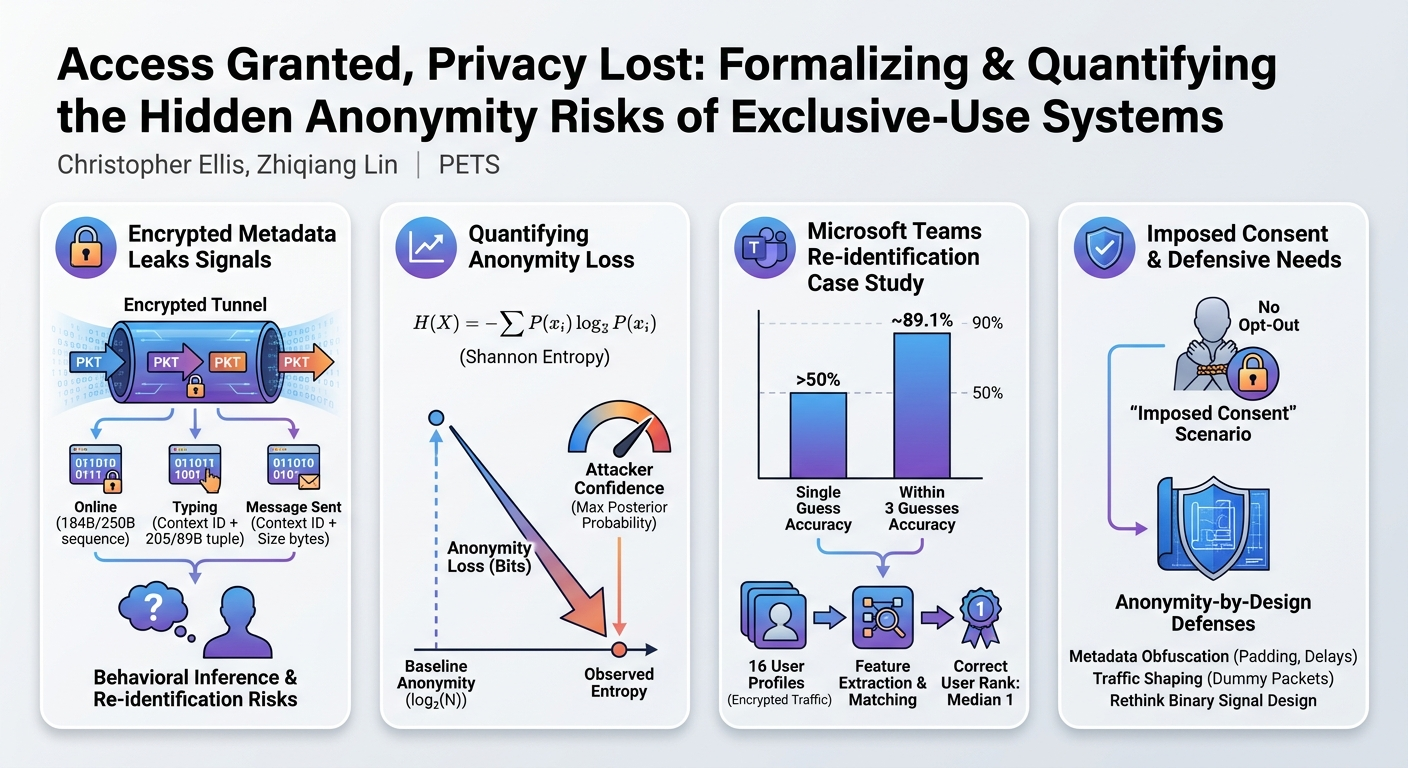
The practical implications of these findings are starkly illustrated through a case study on Microsoft Teams. By analyzing encrypted traffic patterns associated with basic user actions (presence, typing, message sending), the researchers demonstrated that users could be re-identified with alarming accuracy. In a simulation involving 16 users across various behavioral profiles, the system achieved over 50% re-identification accuracy on a single guess and an impressive 89.1% accuracy within three guesses across 160 runs. These results unequivocally demonstrate that the metadata generated by common user interactions in exclusive-use systems is a potent vector for privacy erosion, highlighting an urgent need for defensive strategies and greater awareness among users and system developers.
Technical Deep Dive
▶ Watch: Microsoft Teams case study: identifying specific traffic patterns (4:25)
The technical core of this research revolves around a multi-faceted approach encompassing formalization, quantification, and empirical validation.
Formalization of Exclusive-Use Linkage
The framework begins by formalizing the scenario of exclusive use. It models a one-to-one mapping between users and resources. For each user at a discrete time step T, a raw feature space is observed. These raw features are then fed into a digitization function that outputs a binary value (0 or 1) for each feature. This process transforms continuous or categorical raw data into a series of binary signals. The collection of these binary outputs for a user at a given time t forms a singular digitized information or a binary vector.
From a sequence of these binary vectors, more complex features can be extracted. The system then uses a question selector to identify relevant features, calculates the Euclidean distance between observed patterns and known behavioral profiles, and employs a tuning parameter to derive a likelihood function. This likelihood is subsequently normalized to calculate the posterior probability with four parameters, indicating the probability of a user exhibiting a certain behavior given the observed binary signals.
Quantification Framework for Anonymity Loss
To quantify the anonymity loss, the research leverages Shannon entropy, a fundamental concept in information theory. The core measure of privacy loss in bits is derived from a formulation that combines the previously calculated likelihood function with Shannon entropy.
The framework establishes a baseline anonymity (e.g., log2(N) for N users with uniform priors). The observed Shannon entropy is then compared against this baseline. The anonymity loss (L) is defined as the delta between the uniform baseline (or a previous prior baseline) and the observed Shannon entropy. A higher L signifies greater privacy loss.
The framework also introduces two complementary metrics:
- Attacker Confidence: This is quantified by the maximum posterior probability observed for a specific user or profile. For instance, if the maximum posterior is 0.70, the attacker has 70% confidence in identifying that user.
- Indistinguishability Game: This involves an evaluation between a pair of honest users to assess how easily an attacker can distinguish between them based on their binary signals.
As a practical example, consider four users with uniform priors (0.25 probability each), resulting in a baseline anonymity of 2 bits of entropy (log2(4)). If observed posteriors lead to an actual entropy of 1.32 bits, the anonymity loss is 0.68 bits (2 - 1.32). If the maximum posterior probability for one user is 70%, that represents the attacker's confidence.
Enhanced Taxonomy
The research also introduces an enhanced taxonomy across three critical dimensions:
- Attacker Capability: This dimension considers variables such as observation time (e.g., short vs. long), access level (e.g., local, privileged, mobile, mono-system), and scope (e.g., passive sniffing, active observation methods).
- Observation Methods: This distinguishes between passive (e.g., sniffing encrypted traffic) and active methods (e.g., injecting probes).
- Influence: This dimension characterizes the impact of an attack in terms of inferring user relationships and behaviors.
This taxonomy helps to characterize potential threats and provides a structured way for system defenders and the broader community to understand and address the identified vulnerabilities.
Microsoft Teams Traffic Analysis
The Microsoft Teams case study serves as the empirical validation of the theoretical framework. The researchers performed traffic analysis on encrypted Microsoft Teams communication to identify distinct binary signal patterns. Key patterns observed include:
- Presence Indicator: A fixed sequence of 184 bytes followed by 250 bytes reliably signals a user's presence or transition from inactive to active.
- Typing Indicator: A tuple consisting of a context/message ID (e.g., 2937) followed by specific bytes (e.g., 205 and 89). This sequence reappears if a user pauses and resumes typing, but the context ID changes when a new message is initiated.
- Message Sent Indicator: The same context/message ID (e.g., 2937) is observed, followed by a number of bytes corresponding to the sent message.
These identified patterns, even within encrypted traffic, enable feature extraction based on packet sizes and timings. These features are then used to construct the binary signal vector, which feeds into the posterior update mechanism, allowing for identity resolution, inference of presence, session attributes, and behavioral inference.
Demo / Proof of Concept
▶ Watch: High accuracy of user re-identification results (7:40)
The core demonstration and proof of concept for this research is the comprehensive case study evaluation of Microsoft Teams. This real-world application vividly illustrates how the theoretical framework translates into practical attacks on user anonymity.
The researchers simulated Microsoft Teams traffic under controlled conditions to generate diverse behavioral profiles. These profiles included:
- Collaborative: Users engaging frequently in back-and-forth communication.
- Low Engagement: Users with minimal interaction.
- High Frequency: Users sending many messages rapidly.
- Intermittent: Users with sporadic activity.
These profiles were informed by actual message platform analytics and even humorously, by the concept of a "reasonable working day" inspired by Dolly Parton's "9 to 5." The simulation involved 16 distinct users, with 10 runs conducted for each user profile, totaling 160 runs for evaluation.
The process involved capturing encrypted traffic and extracting features based on packet sizes and timings. The previously identified unique patterns for presence, typing, and message sending indicators were crucial for this feature extraction. These features were then used to construct the binary signal vector for each user's activity.
The evaluation yielded striking results in terms of pairwise privacy loss and overall re-identification accuracy:
- Pairwise Evaluation: For a pair of users, A versus B, a posterior probability of 0.85 was observed, indicating a high likelihood of distinguishing between them, accompanied by an anonymity loss of 0.42 bits. This was also extended to three-way comparisons and pairwise analyses across all 16 users. The baseline for a random guess among 16 users is 6.25% (1/16) probability or 4 bits of anonymity (
log2(16)). The observed posterior probabilities significantly exceeded this baseline for the vast majority of profiles.
- Pool Evaluation (All 16 Users): Considering all 16 users simultaneously, the average confidence interval for attacker confidence (posterior probability) across profiles A and C ranged from 0.19 to 0.29. The corresponding anonymity loss ranged from approximately 0.78 to 1 bit. For an outlier profile, D2, the detector confidence was as high as 0.71 (71%), leading to a substantial anonymity loss of 2.44 bits. This clearly shows that even in a larger pool, specific behavioral patterns lead to significant privacy erosion.
- True Rank Re-identification: This was the most impactful demonstration. Across all 160 runs, the system's ability to correctly re-identify users was measured:
- Over 50% accuracy on a single guess (top-one accuracy). This means that for more than half the users, the system correctly identified them on its first attempt.
- 89.1% accuracy within three guesses. This indicates that by allowing for a few top predictions, nearly 90% of users could be accurately re-identified.
- The median true rank was 1, further emphasizing the high precision of the re-identification.
These results unequivocally demonstrate that even seemingly low-level, encrypted metadata in exclusive-use systems like Microsoft Teams can be successfully exploited to infer user identity and behavior, posing a significant threat to anonymity.
Defensive Implications
▶ Watch: Call to researchers: protecting inherent anonymity of communication (8:15)
The findings from this research carry profound defensive implications for users, system developers, and the broader security community. The core message is that the inherent anonymity of communication in exclusive-use systems is severely compromised by the very nature of their operational design, leading to an "imposed consent" scenario where users have no meaningful way to opt out of this pervasive network traffic analysis.
For System Developers and Providers:
- Rethink Binary Signal Design: Developers of communication platforms (e.g., Microsoft Teams, Slack, Zoom) and other exclusive-use systems must re-evaluate how binary signals (presence, typing, read receipts, etc.) are transmitted. Aggregation, randomization, or rate limiting of these signals could make pattern matching more difficult.
- Metadata Obfuscation: Beyond content encryption, robust metadata obfuscation techniques are crucial. This could involve padding packet sizes, introducing artificial delays or jitter in transmission timings, or sending dummy traffic to obscure actual user activity patterns.
- Anonymity-by-Design: The principles of privacy and anonymity must be integrated into the design phase of new systems, rather than being treated as an afterthought. This includes considering the "inherent anonymity of communication" as a fundamental requirement.
- Evaluation Tools: The quantification framework presented in this research (using Shannon entropy, attacker confidence) provides a powerful tool for developers to evaluate the anonymity of their systems pre- and post-countermeasure deployment. This allows for data-driven decisions on privacy enhancements.
For Users:
- Awareness: Users should be aware that even in encrypted communication platforms, their activity patterns (when they are online, when they type, when they send messages) can be monitored and used to infer their identity and behavior.
- Limited Opt-Out: The research highlights the lack of meaningful opt-out mechanisms for this type of network traffic analysis. This underscores the need for system providers to implement better privacy controls.
For Researchers and the Security Community:
- Future Work: The talk explicitly calls for scoring metrics similar to ABFS privacy to further advance the field. This suggests a need for standardized benchmarks to assess and compare the anonymity levels of different systems.
- Broader Applicability: The principles extend beyond chat applications to other exclusive-use systems, including VPNs, APIs, and various smart applications. Any system where trusted entities exchange discrete signals could be vulnerable.
- Correlation and Inference: The research notes that additional information about user models and processing correlation can lead to even greater inference power. This implies that combining network traffic analysis with other data sources could exacerbate the privacy risks.
Ultimately, the defensive implications revolve around a paradigm shift: moving beyond content encryption to address the inherent anonymity risks posed by metadata patterns. This requires proactive design choices, robust evaluation metrics, and a commitment to protecting users from "imposed consent" in the digital realm.
Key Takeaways
- Hidden Anonymity Risks: Exclusive-use systems, characterized by trusted, one-to-one user-resource mappings, harbor significant and often overlooked anonymity risks due to the unique patterns of binary signals they transmit.
- Quantifiable Privacy Loss: A formal framework, leveraging Shannon entropy, provides a robust method to quantify privacy loss in bits and assess attacker confidence, enabling objective measurement of anonymity.
- Practical Re-identification: The Microsoft Teams case study demonstrated that even encrypted traffic metadata (packet sizes, timings) from basic user actions (presence, typing, sending messages) allows for highly accurate user re-identification (over 50% on a single guess, 89.1% within three guesses).
- Behavioral Inference: Attackers can infer not just identity, but also user presence, session attributes, and detailed behavioral patterns from these binary signals, even without decrypting message content.
- "Imposed Consent": The nature of this privacy vulnerability means users often lack meaningful ways to opt out of the inherent anonymity loss, highlighting a critical issue of "imposed consent" in digital communication.
- Call to Action for Defenders: There is an urgent need for system developers to implement anonymity-by-design principles, including metadata obfuscation and robust evaluation using the proposed framework, and for researchers to develop advanced countermeasures to protect users worldwide.
About the Speaker(s)
Christopher Ellis is a member of Sigmod at Northeastern University. He presented this research, which was conducted in collaboration with his advisor, Professor George Cybenko. The paper also lists Zhiqiang Lin from Ohio State University as a co-author. Ellis's work focuses on understanding and quantifying privacy risks in digital communication systems, particularly those involving exclusive-use patterns, with the goal of enhancing user anonymity.
Reviews
Dr. Zero (Offensive Security Researcher) — WEAK
Solid academic formalization of an old truth: encryption doesn't hide metadata. They built a mathematical framework using Shannon entropy to measure anonymity loss via MS Teams typing indicators, though the empirical validation was run on a laughably small dataset.
Heather Calloway (CISO) — MUST SEE
This research proves that network adversaries can accurately map user behavior and identities in Microsoft Teams without ever breaking encryption. It is a mandatory update to how we model corporate espionage and insider threats against executive communications.
→ Top-rated talks at Privacy Enhancing Technologies Symposium (PETS) 2026
All talks from Privacy Enhancing Technologies Symposium (PETS) 2026