A Year Under the DSA: Ad Transparency’s Uneven Landscape
Abir Benzaamia (Paper author · LIX, CNRS, Inria, École Polytechnique, IP Paris), Asmaa El fraihi (Paper author · LIX, CNRS, Inria, École Polytechnique, IP Paris), Ines Abdelaziz (Paper author · LIX, CNRS, Inria, École Polytechnique, IP Paris), Oana Goga (Paper author · LIX, CNRS, Inria, École Polytechnique, IP Paris)
Privacy Enhancing Technologies Symposium (PETS) 2026 · Day 1 · Alpaca
Overview
The proliferation of online advertising, deeply intertwined with the collection and algorithmic processing of vast amounts of user data, has long been a black box for individuals and regulators alike. This opacity has spurred legislative action, most notably in the European Union with the Digital Services Act (DSA). Enacted to foster a safer and more transparent online environment, the DSA mandates significant changes in how online platforms handle advertising, particularly concerning user understanding and public accountability. This talk, presented at PETS, delves into a critical evaluation of whether major advertising platforms are truly upholding the DSA's promise of enhanced ad transparency, a year into its applicability.
Key moments
- 0:00 Introduction to ad opacity and DSA transparency goals
- 1:12 Digital Services Act's two transparency mechanisms
- 2:37 Defining 'meaningful information' for user ad explanations
- 4:00 Evaluation results for user-facing transparency tools
- 6:00 DSA Article 39 requirements for ad repositories
- 6:50 Evaluation results for ad repository transparency
- 8:15 Conclusion: Platforms fail DSA transparency requirements
A Year Under the DSA: Ad Transparency’s Uneven Landscape
Speakers: Abir Benzaamia (Paper author, LIX, CNRS, Inria, École Polytechnique, IP Paris); Asmaa El fraihi (Paper author, LIX, CNRS, Inria, École Polytechnique, IP Paris); Ines Abdelaziz (Paper author, LIX, CNRS, Inria, École Polytechnique, IP Paris); Oana Goga (Paper author, LIX, CNRS, Inria, École Polytechnique, IP Paris)
Conference: PETS
YouTube: https://www.youtube.com/watch?v=AfxrNNf2zzM
Overview
The proliferation of online advertising, deeply intertwined with the collection and algorithmic processing of vast amounts of user data, has long been a black box for individuals and regulators alike. This opacity has spurred legislative action, most notably in the European Union with the Digital Services Act (DSA). Enacted to foster a safer and more transparent online environment, the DSA mandates significant changes in how online platforms handle advertising, particularly concerning user understanding and public accountability. This talk, presented at PETS, delves into a critical evaluation of whether major advertising platforms are truly upholding the DSA's promise of enhanced ad transparency, a year into its applicability.
The research presented by Abir Benzaamia and co-authors scrutinizes the implementation of the DSA's ad transparency requirements across four prominent platforms: Meta (Facebook), Google (YouTube), and X (formerly Twitter). The core objective was to assess if the transparency tools provided by these platforms sufficiently inform users about why specific ads are shown to them, and if ad repositories offer adequate data for independent system-level oversight and auditing. The findings reveal a landscape of uneven and often insufficient compliance, highlighting a significant gap between formal adherence to the DSA and the provision of genuinely meaningful transparency.
Ultimately, the talk concludes that despite the DSA's ambitious goals and the platforms' efforts to introduce transparency features, the current state of ad transparency falls short for both individual users seeking to understand their ad experience and for auditors attempting to provide independent oversight. The research meticulously dissects the shortcomings in granularity, attribution, data source disclosure, and accuracy, positing that platforms are meeting "formal compliance" without delivering "real transparency." This critical assessment underscores the ongoing challenges in regulating complex algorithmic systems and the need for clearer definitions and more robust enforcement mechanisms to achieve the DSA's intended impact.
Background
▶ Watch: Introduction to ad opacity and DSA transparency goals (0:00)
Online advertising operates on a sophisticated, data-driven model where platforms collect extensive user data—ranging from demographics and location to interests and behaviors—to construct detailed user profiles. Advertisers then leverage these profiles, selecting myriad criteria to target specific audiences. The ultimate decision of which ad reaches which user is a complex interplay between advertiser choices and the platform's proprietary algorithmic optimization. This intricate process, while efficient for ad delivery, inherently creates a high degree of opacity, making it difficult for users to understand why they see particular ads and challenging for regulators to ensure accountability.
Recognizing this opacity and its implications for user control and democratic processes, the European Union introduced the Digital Services Act (DSA). Applicable in Europe since early 2024, the DSA aims to establish greater transparency in online advertising through two primary mechanisms. The first mechanism focuses on individual users, stipulating that platforms must explain why an ad is shown to them and empower them to adjust their ad preferences. Platforms have implemented this mandate in various ways; for example, Meta provides two panels—one for advertiser-selected criteria and another for Meta's inferences—while Google offers a list of ad categories, and X presents a long paragraph of supposed reasons.
The second mechanism targets broader societal oversight, including regulators, scientists, and journalists. It requires platforms to maintain public archives or ad libraries that allow searching for all ads running on the platform. Crucially, these libraries must include "attributing details" to enable independent system-level oversight and auditing. Examples include the Meta Ads Library, Google Ads Transparency Center, and X Ads Repository, all designed to provide a searchable database of active ad campaigns. The research presented in this talk sought to evaluate whether these two pillars of the DSA—user-facing explanations and public repositories—are effectively delivering the promised transparency, particularly concerning how ads are targeted.
Key Findings
▶ Watch: Defining 'meaningful information' for user ad explanations (2:37)
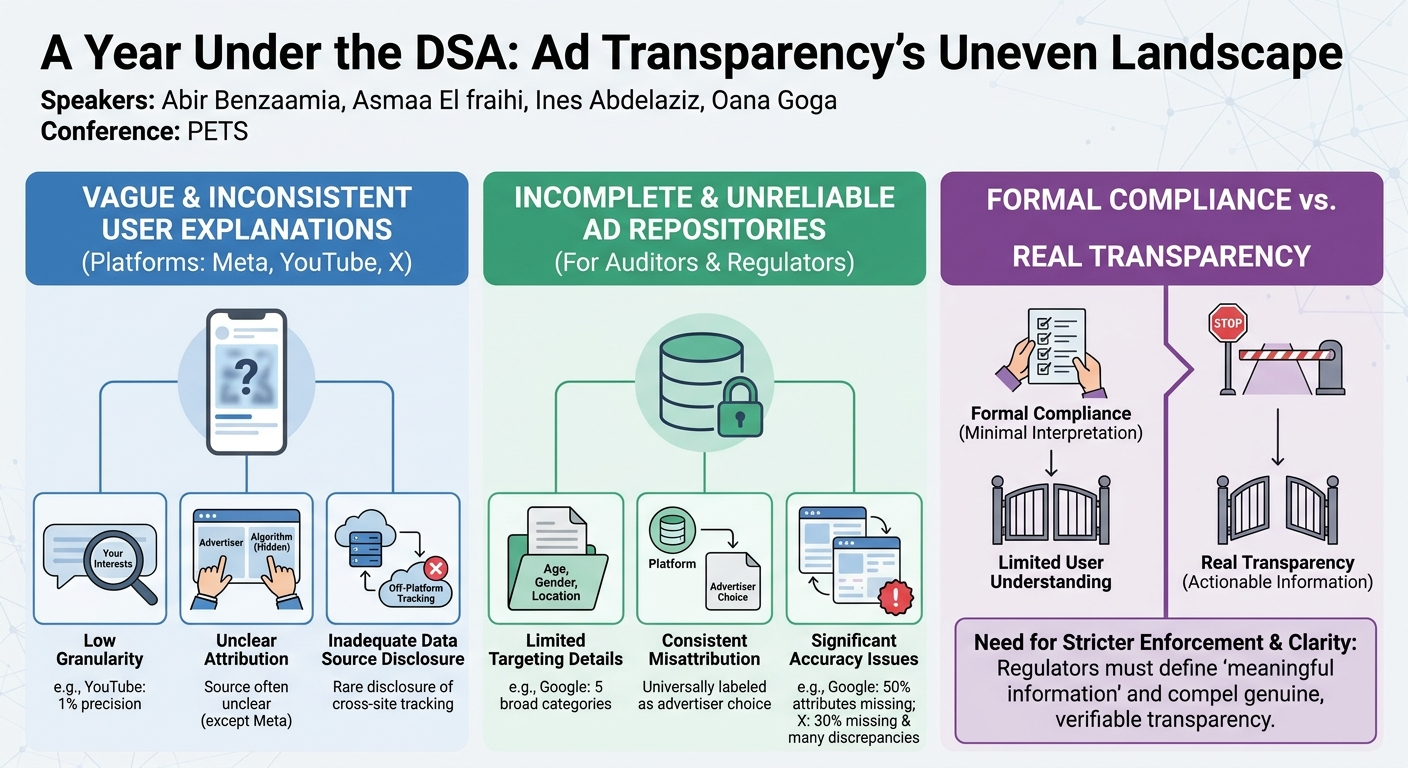
The comprehensive evaluation revealed a consistent pattern: despite the DSA's mandates, no platform is fully delivering the transparency it enforces, neither for users nor for auditors. The interpretations of "meaningful information" (Article 26) and "main parameters used to target" (Article 39) vary widely, leading to significant shortcomings across all assessed platforms.
For individual users, the study found that the DSA's "meaningful information" standard is interpreted disparately, resulting in formal compliance rather than genuine transparency:
- Granularity: While Meta provided precise ad explanations in most cases, YouTube offered precision in only 1% of explanations, typically using vague language like "your interests" without specifying which ones. X showed precision in most cases but occasionally resorted to vague terms like "your web activity."
- Attribution: Meta stood out as the only platform that clearly distinguished between advertiser choices and its own algorithmic inferences. On YouTube, the source of targeting choices often remained unclear, and on X, most targeting was attributed to advertiser choice, with X's algorithms rarely mentioned.
- Data Source: Meta primarily disclosed two data sources: user-provided data and on-site tracking. YouTube and X largely attributed ad explanations to "Meta data problems entirely," a vague and unhelpful categorization. A critical finding across all platforms was the rare disclosure of off-platform tracking, despite explicit statements in their terms of use about large-scale cross-site tracking activities.
- Accuracy: User-facing explanations often failed to reflect the actual targeting criteria used.
For regulators and auditors, the ad repositories mandated by Article 39 of the DSA were found to be incomplete by design, often misattributing responsibility, and ultimately unreliable:
- Granularity: The Meta Ads Library only displayed age, gender, and location targeting data. Google provided only five broad categories without clear meaning, and X presented a number of tokens without explaining their reference.
- Attribution: Across all repositories, targeting criteria were almost universally labeled as "advertiser choice," even when platform algorithms likely played a significant role.
- Accuracy (Missing Categories): On Google, nearly half (50%) of the targeting attributes shown to users were absent from the repository. On X, 30% of attributes were also missing from the repository compared to user explanations. Meta had "nothing to compare" due to its limited repository data.
- Accuracy (Discrepancy): While Meta showed consistency with only a "small allocation granularity gap," Google's repository was too vague for comparison. X exhibited numerous discrepancies, where user-facing explanations differed significantly from repository entries (e.g., "computer science" for users vs. "centers or laptops" in the repository).
In summary, the key finding is that despite the DSA's implementation, platforms are engaging in a form of "checkbox compliance" rather than providing the robust, actionable transparency envisioned by the regulation. This systemic failure undermines both user agency and the ability of independent auditors to scrutinize online advertising practices effectively.
Technical Deep Dive
▶ Watch: Evaluation results for user-facing transparency tools (4:00)
The research employed a rigorous methodology to evaluate ad transparency, focusing on both user-facing explanations and public ad repositories. The core of the user-centric evaluation relied on a dataset collected using the WhoTargetsMe browser extension. This extension gathers ad and ad explanation data directly from real users. For this study, the researchers utilized a dataset of 48,000 ad explanations collected from users in Germany, providing a substantial empirical basis for analysis across Meta (Facebook), YouTube (Google), and X.
To operationalize the DSA's requirement for "meaningful information" (Article 26) for users, the study defined four key measures:
- Granularity: This measure assessed the specificity of targeting attributes disclosed. For instance, whether an explanation stated "your interests" (vague) or "you are interested in pets" (precise).
- Meta: Most ad explanations were precise.
- YouTube: Only 1% were precise, typically using vague language.
- X: Most were precise, but some used vague terms like "your web activity."
- Attribution: This metric determined who selected the targeting criteria—the advertiser or the platform's algorithm.
- Meta: Uniquely separated advertiser choices from Meta's inferences.
- YouTube: Most explanations did not clarify the source of targeting choices.
- X: Most targeting was referred to as advertiser choice, with X algorithms rarely mentioned.
- Data Source: This identified the origin of the data used for targeting.
- Meta: Focused on user-provided data and on-site tracking.
- YouTube and X: Most explanations were vaguely attributed to "Meta data problems entirely" or similar broad statements.
- Cross-platform: A critical observation was that off-platform tracking (cross-site tracking), despite being explicitly mentioned in platforms' terms of use, was rarely disclosed in ad explanations across all platforms.
- Accuracy: This evaluated whether the disclosed information reflected the actual targeting criteria used.
For the assessment of ad repositories, mandated by Article 39 of the DSA for independent oversight, the researchers focused on three measures:
- Granularity: This examined whether the repositories provided the full set of targeting attributes used for an ad campaign.
- Meta Ads Library: Only displayed age, gender, and location.
- Google Ads Transparency Center: Provided only five broad categories with little specific meaning.
- X Ads Repository: Presented "a number of tokens" without clear explanations of their reference.
- Attribution: This assessed whether the repositories clearly indicated if criteria were selected by the advertiser or platform algorithms.
- Cross-platform: Universally, everything was labeled as "advertiser choice," omitting platform optimization algorithms.
- Accuracy: This was measured through two sub-criteria:
- Missing Categories: Where targeting criteria shown to users were absent from the repository.
- Google: Almost half (50%) of targeting attributes were missing.
- X: 30% of attributes were missing.
- Meta: No direct comparison possible due to limited repository data.
- Discrepancy: Where criteria appeared in both user explanations and the repository but with different values.
- Meta: Mostly consistent, with a small granularity gap.
- Google: Too vague to compare effectively.
- X: Many discrepancies, with user-facing descriptions (e.g., "computer science") differing significantly from repository tokens (e.g., "centers or laptops").
The consistent finding across this detailed technical evaluation was that platforms' interpretations of DSA requirements are minimalist, prioritizing formal compliance over the practical utility and completeness of information for both users and auditors. The lack of precise, attributable, and accurate data, particularly concerning off-platform tracking and algorithmic inferences, represents a fundamental failure to meet the spirit and intent of the Digital Services Act.
Demo / Proof of Concept
▶ Watch: Evaluation results for ad repository transparency (6:50)
While the talk did not feature a live, interactive demonstration in the traditional sense, the researchers conducted a crucial proof of concept that directly challenged the accuracy and attribution claims of the platforms. This involved running their own ad campaign to observe the discrepancies between intended targeting and platform-reported targeting.
Specifically, the research team initiated an ad campaign on Google where they explicitly selected only location as a targeting parameter. This controlled experiment was designed to isolate the impact of advertiser choice and verify how the platform would report this simple targeting strategy. However, upon reviewing the ad explanation provided by Google, they discovered that it listed "demographic" as an additional criterion used for targeting, even though the researchers had not selected this parameter themselves.
This finding is a powerful demonstration of the inaccuracies and misattributions prevalent in current ad transparency tools. It directly contradicts the notion that platforms accurately report advertiser choices or that their explanations fully reflect the actual targeting mechanisms in play. The inclusion of an unselected "demographic" criterion strongly suggests either:
- Google's algorithms automatically infer and apply additional targeting parameters beyond advertiser input, without clearly disclosing this to the advertiser or the user.
- The transparency tools themselves are inaccurate, misreporting the parameters actually used to deliver the ad.
In either scenario, this proof of concept highlights a critical flaw in the DSA's implementation, particularly concerning the accuracy and attribution measures. It underscores that what platforms claim is being used for targeting, even in a controlled environment, may not align with the reality of ad delivery, thereby undermining both user understanding and the potential for effective auditing. This self-run ad campaign serves as compelling evidence that platform-provided transparency information is unreliable, reinforcing the overall conclusion that "formal compliance" does not equate to "real transparency."
Defensive Implications
▶ Watch: Conclusion: Platforms fail DSA transparency requirements (8:15)
The findings from "A Year Under the DSA: Ad Transparency’s Uneven Landscape" carry significant defensive implications for various stakeholders, particularly users, regulators, and even the platforms themselves. The pervasive lack of meaningful transparency exposes systemic vulnerabilities in online advertising that require concerted action.
For individual users, the primary defensive implication is a reinforcement of the need for skepticism and digital literacy. Since ad explanations are often vague, incomplete, or inaccurate, users cannot reliably understand why they are targeted or effectively adjust their ad preferences. Defenders should advocate for and educate users on privacy-enhancing browser extensions, ad blockers, and tools that provide more granular insights into their online activity. Users should be encouraged to actively review and challenge the data platforms collect about them, understanding that the disclosed information is likely an incomplete picture.
For regulators and policymakers, the research provides critical empirical evidence that the DSA, in its current interpretation and enforcement, is falling short. The "meaningful information" and "main parameters" clauses are being interpreted too loosely by platforms. Defenders in the regulatory space must push for clearer, more prescriptive definitions of transparency, moving beyond formal compliance checkboxes. This includes explicit mandates for:
- Granular disclosure: Requiring platforms to specify exact interests, behaviors, and inferred attributes, not just broad categories.
- Clear attribution: Mandating clear separation of advertiser-selected criteria from platform-algorithmic inferences, with the latter's logic being more transparent.
- Comprehensive data source disclosure: Requiring explicit disclosure of all data sources, especially off-platform tracking, which is currently rarely acknowledged despite its prevalence.
- Auditable accuracy: Implementing mechanisms for independent verification of ad targeting accuracy, potentially through API access for auditors or standardized reporting formats that prevent discrepancies between user-facing and repository data.
Regulators also need to consider stricter enforcement mechanisms and penalties to compel genuine compliance, rather than allowing platforms to operate in this state of uneven and often misleading transparency.
For platforms, the defensive implications are two-fold. Firstly, continued minimal compliance risks further regulatory intervention, including potentially more stringent laws, larger fines, and public backlash. Investing in genuine transparency now could be a proactive defense against future regulatory pressures and reputational damage. Secondly, by failing to provide clear explanations, platforms inadvertently erode user trust. In an era of increasing privacy concerns, demonstrating a commitment to true transparency could be a competitive differentiator. Platforms should consider:
- Re-evaluating internal interpretations of DSA: Moving beyond the letter of the law to embrace its spirit.
- Developing standardized, machine-readable transparency APIs: Allowing independent researchers and auditors to programmatically access targeting data with consistent granularity and attribution.
- Improving internal data governance: Ensuring that the data used for targeting is accurately reflected in both user-facing explanations and public repositories.
- Addressing the "off-platform tracking" disclosure gap: Acknowledging and transparently communicating the extent of cross-site tracking.
In essence, the defensive posture for all stakeholders must shift from reacting to opacity to proactively demanding and building genuine, verifiable transparency. Without these changes, the foundational issues of accountability and user control in online advertising will persist, undermining the very goals of regulations like the DSA.
Key Takeaways
- DSA's Transparency Goals Undermined: Despite the Digital Services Act (DSA) mandating greater ad transparency, major platforms (Meta, Google, X) are not providing genuinely meaningful information to users or sufficient data for independent auditors.
- Vague and Inconsistent User Explanations: User-facing ad explanations suffer from low granularity (e.g., YouTube's 1% precision), unclear attribution (except Meta), and inadequate disclosure of data sources, especially concerning widespread off-platform tracking.
- Incomplete and Unreliable Ad Repositories: Public ad libraries are deficient, offering limited targeting details (e.g., Google's five broad categories), consistently misattributing all choices to advertisers, and exhibiting significant accuracy issues with missing or discrepant data (e.g., Google missing 50% of attributes, X showing 30% missing and many discrepancies).
- "Formal Compliance" vs. "Real Transparency": Platforms are interpreting DSA requirements minimally, achieving formal compliance without delivering the actionable transparency needed for user understanding or effective oversight.
- Need for Stricter Enforcement and Clarity: The findings highlight an urgent need for regulators to provide clearer definitions of "meaningful information" and "main parameters" and to implement more robust enforcement mechanisms to compel genuine, verifiable transparency from platforms.
About the Speaker(s)
The research presented in this talk was a collaborative effort by Abir Benzaamia, Asmaa El fraihi, Ines Abdelaziz, and Oana Goga, all credited as paper authors. They are affiliated with prominent European research institutions, including LIX, CNRS, Inria, École Polytechnique, and IP Paris. Their collective work focuses on critical areas of online privacy, algorithmic transparency, and the societal impact of digital platforms, contributing significantly to the academic discourse on regulatory effectiveness in the digital age. While the talk was presented by one of the authors, the comprehensive nature of the research reflects the expertise of the entire team in evaluating complex technical systems against regulatory frameworks.
Reviews
Dr. Zero (Offensive Security Researcher) — SOLID
These researchers didn't just read the DSA and write a think-piece; they instrumented browsers, pulled 48,000 ad explanations, and caught Google red-handed injecting unselected targeting criteria. It’s empirical, adversarial proof that Big Tech's 'transparency' under European law is pure compliance theater. Strong accept for bringing hard data to a policy fight.
Heather Calloway (CISO) — SOLID
This is a rigorous, evidence-based audit of how Meta, Google, and X are dodging the spirit of the EU’s Digital Services Act while maintaining the illusion of compliance. For any enterprise leader watching the incoming wave of EU tech regulation, it’s a required look at how platforms weaponize algorithmic opacity against regulators and advertisers alike.
→ Top-rated talks at Privacy Enhancing Technologies Symposium (PETS) 2026
All talks from Privacy Enhancing Technologies Symposium (PETS) 2026