Waterfall: A Capsule-Based Framework for Evaluating Traffic Watermarking in Anonymity Systems
Dimitri Mankowski (Paper author · Ruhr University Bochum), Eduard Marin (Paper author · Telefonica Research), Nuno Santos (Paper author · INESC-ID / Instituto Superior Técnico, University of Lisbon), Veelasha Moonsamy (Paper author · Ruhr University Bochum)
Privacy Enhancing Technologies Symposium (PETS) 2026 · Day 2 · Alpaca
Overview
In the realm of digital anonymity, systems like Tor and VPNs are designed to obscure the identity of users and the content of their communications. However, even with robust encryption, adversaries can still glean valuable information by observing traffic metadata, such as packet sizes, timing, and rates. This seemingly innocuous data can be exploited through traffic analysis attacks to link anonymous clients to their corresponding servers, thereby compromising privacy. This talk introduces "Waterfall," a novel, capsule-based framework designed to systematically evaluate traffic watermarking techniques, which are active attacks used to embed hidden signals within network traffic for deanonymization or tracking purposes.
Key moments
- 0:00 Challenges of evaluating traffic watermarking
- 2:00 Watermark mechanisms: dropping, reordering, delaying packets
- 3:20 Flow Group, Coordination, Perturbation metrics
- 3:55 Introducing Waterfall: a capsule-based evaluation framework
- 6:15 Reproducing and improving existing watermarking schemes
- 8:00 Using Waterfall to test attacks and defenses
Waterfall: A Capsule-Based Framework for Evaluating Traffic Watermarking in Anonymity Systems
Speakers: Dimitri Mankowski (Paper author, Ruhr University Bochum), Eduard Marin (Paper author, Telefonica Research), Nuno Santos (Paper author, INESC-ID / Instituto Superior Técnico, University of Lisbon), Veelasha Moonsamy (Paper author, Ruhr University Bochum)
Conference: PETS
YouTube: https://www.youtube.com/watch?v=P3Mv_0aqNmM
Overview
In the realm of digital anonymity, systems like Tor and VPNs are designed to obscure the identity of users and the content of their communications. However, even with robust encryption, adversaries can still glean valuable information by observing traffic metadata, such as packet sizes, timing, and rates. This seemingly innocuous data can be exploited through traffic analysis attacks to link anonymous clients to their corresponding servers, thereby compromising privacy. This talk introduces "Waterfall," a novel, capsule-based framework designed to systematically evaluate traffic watermarking techniques, which are active attacks used to embed hidden signals within network traffic for deanonymization or tracking purposes.
Presented by Dimitri Mankowski from Ruhr University Bochum, this research addresses a critical gap in the security community: the lack of a standardized, flexible, and comprehensive framework for testing the efficacy and resilience of traffic watermarks across diverse network conditions and anonymity protocols. Waterfall provides a much-needed tool for researchers and system designers to understand the real-world dangers posed by watermarking effects, move beyond idealized scenarios, and ultimately build more robust anonymity systems. By enabling the reproduction of existing attacks, adaptation to live traffic, testing on new protocols like Tor's Coral, and the development of effective defenses, Waterfall represents a significant contribution to the ongoing battle for online privacy.
Background
▶ Watch: Challenges of evaluating traffic watermarking (0:00)
The premise of traffic watermarking stems from the observable characteristics of network traffic, even when its content is fully encrypted. An observer, positioned at various points in the network (e.g., an ISP, a malicious exit node), can monitor metadata such as packet sizes, inter-packet delays, and overall traffic rates. These patterns, though seemingly abstract, can be unique enough to fingerprint connections. An active attacker takes this a step further by actively manipulating traffic to embed a covert signal, known as a watermark. This process involves an embedder injecting specific changes into the traffic stream on one side of an anonymity system, and a detector on the other side attempting to identify these changes to link the two ends.
Evaluating such watermarking attacks presents numerous challenges. Network traffic is inherently diverse, ranging from bulk downloads and streaming video to real-time voice communication, each with unique characteristics that can affect a watermark's detectability and resilience. The underlying network protocols introduce further complexity, including congestion control mechanisms that dynamically adjust traffic flow, multipath routing that splits connections across multiple paths, and the intricate designs of anonymity systems like Tor, which employ various techniques to obscure traffic patterns. Furthermore, prior research in this area often relies on private assumptions and evaluates schemes in narrow, idealized scenarios, failing to account for the dynamic and unpredictable nature of real-world networks. This often leads researchers and designers of anonymity systems to underestimate the true danger of watermarking effects.
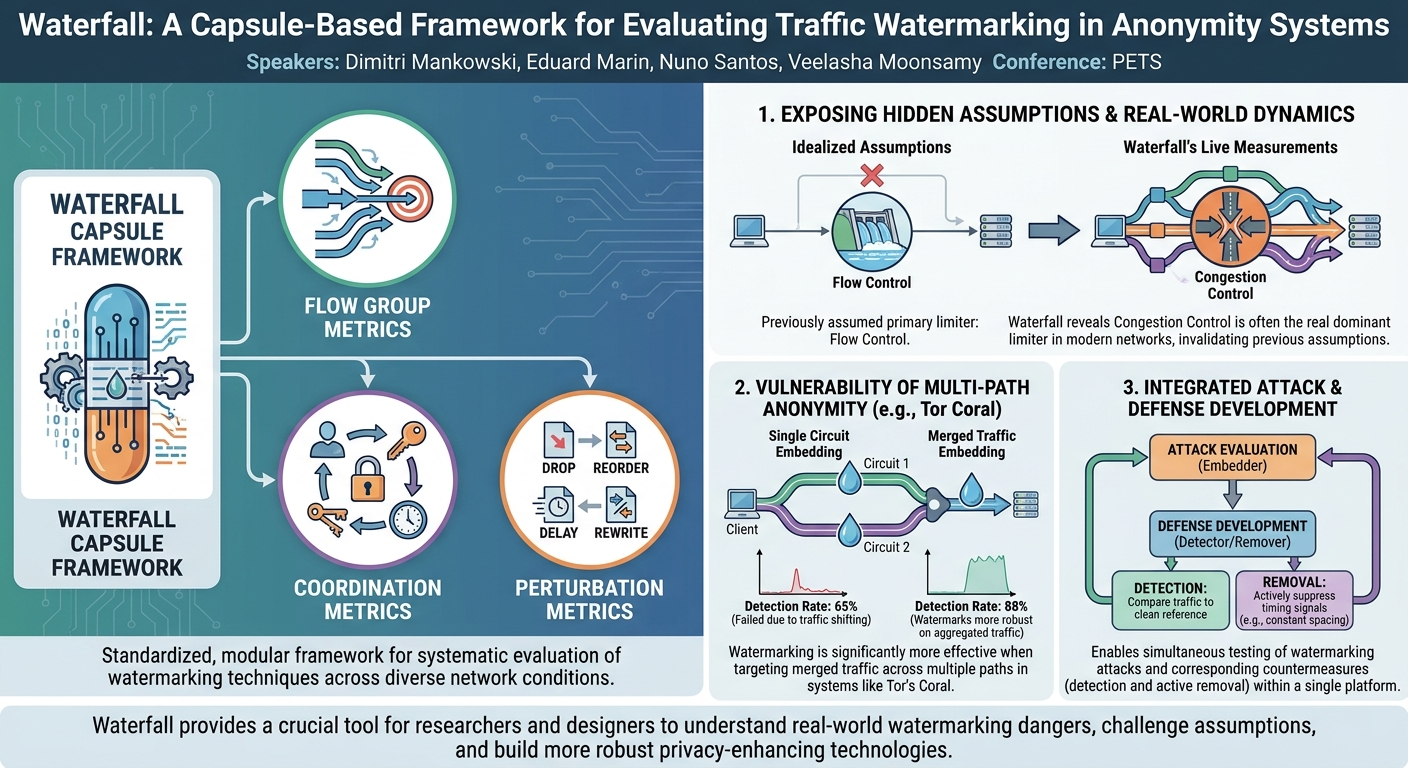
To address these complexities, the authors of Waterfall identified three crucial metrics necessary for designing and evaluating watermarking schemes:
- Flow Group Metrics: These define which specific network flows or subsets of traffic are being targeted for watermarking. This could involve filtering by protocol, destination, or other flow characteristics.
- Coordination Metrics: This encompasses the information exchanged between the embedder and the detector to ensure successful watermark embedding and extraction. Examples include shared secrets (e.g., cryptographic keys) or synchronized timing slots for embedding and detection.
- Perturbation Metrics: These specify precisely how the traffic is modified to embed the watermark. Common perturbation techniques include:
- Dropping packets: Intentionally discarding packets to create gaps or alter flow rates.
- Reordering packets: Changing the sequence of packets, which can affect timing and flow.
- Inserting delay: Artificially delaying packets, altering inter-packet arrival times.
- Rewriting packets: Modifying packet headers, such as TCP headers or TCP window sizes, to influence congestion control or other network behaviors.
By systematically categorizing these aspects, Waterfall provides a structured approach to analyze and compare different watermarking techniques, moving beyond the limitations of ad-hoc testing methodologies.
Key Findings
▶ Watch: Flow Group, Coordination, Perturbation metrics (3:20)
The Waterfall framework yielded several significant findings across its evaluation objectives, demonstrating its utility in both reproducing existing research and uncovering new insights into traffic watermarking:
Firstly, Waterfall proved highly effective in reproducing existing prior results. The framework successfully replicated the findings of two distinct watermarking schemes, validating its design and implementation. However, during the reproduction of a third scheme, the researchers uncovered a critical hidden assumption: the original scheme's effectiveness was predicated on flow control being the primary limiting factor in network traffic. Waterfall's live measurements revealed that in modern networks, congestion control is often the dominant limiting factor. This discovery highlighted how idealized assumptions can lead to flawed conclusions and underscored Waterfall's ability to expose such discrepancies in realistic network environments.
Secondly, the framework facilitated the adaptation and improvement of existing watermarking schemes for live traffic. Building on the insight regarding congestion control, the researchers improved the rate watermarking scheme that had previously failed reproduction. The original scheme lost its signal when employing fixed rates. By dynamically measuring the delay between the client and the estimated delay product and subsequently choosing random rates based on these live measurements, the researchers were able to restore the original watermarking scheme's efficacy and significantly improve its results. This demonstrates Waterfall's capacity not only to validate but also to enhance watermarking techniques by incorporating real-time network dynamics.
Thirdly, Waterfall enabled the evaluation of watermarking schemes in new and complex anonymity protocols, specifically Tor's Coral protocol. Coral is designed to split a single connection across two distinct circuits or links, adding another layer of complexity to traffic analysis. The evaluation revealed that embedding a watermark on only one of the LAN circuits (e.g., "LAN one") failed, as the effects of packet dropping were often shifted or compensated for by the other circuit. Crucially, when the watermark was embedded into the merged traffic (i.e., considering traffic across both circuits as a single stream for the embedder and detector), the detection rate dramatically increased from 65% to 88%. This significant improvement was attributed to the higher stability of the merged traffic, suggesting that watermarks are more robust when targeting aggregated traffic patterns rather than individual, potentially load-balanced, components within a multi-path anonymity system. This finding offers critical insights for both attackers and defenders operating within such advanced anonymity networks.
Finally, Waterfall demonstrated its capability to implement and evaluate both watermarking attacks and their corresponding defenses within the same framework. Researchers successfully developed a defense mechanism to detect watermarks by comparing suspected watermarked traffic with a clean traffic reference, enabling them to identify all watermarked flows. Furthermore, they explored methods to remove watermarks by actively delaying packets and applying a constant spacing technique, which effectively suppressed the embedded timing signal. This dual capability makes Waterfall an invaluable tool for security researchers to develop and test countermeasures against traffic watermarking in a systematic and reproducible manner.
Technical Deep Dive
▶ Watch: Introducing Waterfall: a capsule-based evaluation framework (3:55)
At the heart of the Waterfall framework lies the innovative concept of a capsule. A capsule is a self-contained, modular unit designed to encapsulate the logic for a specific watermarking scheme or defense mechanism. Its primary function is to abstract away the complexities of network interaction and allow researchers to focus on the core watermarking logic. During automatic execution, each capsule precisely implements the three crucial metrics identified for watermarking design:
- Flow Group Selection: The capsule defines which traffic flows it will monitor or modify. This could be based on source/destination IP, port, protocol, or more granular application-layer characteristics.
- Coordination Parameter Handling: It manages the necessary coordination data between the embedder and detector. This includes exchanging secret keys for cryptographic operations, synchronizing time slots for burst embedding, or negotiating other shared state.
- Traffic Perturbation Semantics: Most critically, the capsule specifies how traffic is to be perturbed. This involves defining the exact operations to be performed on packets, such as dropping specific packets, reordering them according to a predefined pattern, inserting calculated delays, or rewriting packet headers (e.g., manipulating TCP window sizes to influence flow control).
The design philosophy behind the capsule is to provide a standardized interface for diverse watermarking techniques. This standardization makes different schemes comparable and allows for their evaluation under consistent conditions.
Multiple capsules can run concurrently within the Waterfall runtime environment. This capability allows for the deployment and testing of multiple watermark instances simultaneously on a single network connection, or even the evaluation of one watermark against another, simulating more complex attack scenarios. A typical Waterfall deployment involves an embedding capsule running on one side of the network (e.g., near the client or source of traffic) and an extraction capsule running on the other side (e.g., near the server or destination).
The Waterfall runtime acts as the orchestrator, managing several critical functions:
- Traffic Matching and Actions: It intercepts and identifies relevant traffic flows based on the capsule's flow group metrics, then applies the specified perturbation actions (drop, reorder, delay, rewrite) as dictated by the perturbation metrics.
- Traffic Monitoring and Measurement: It continuously monitors the network traffic, collecting vital statistics such as packet rates, inter-packet delays, and flow characteristics. These live measurements are crucial for adaptive watermarking schemes and for evaluating the impact of perturbations.
- Communication between Instances and Capsules: The runtime facilitates secure and synchronized communication between the embedding and extraction Waterfall instances. This includes exchanging coordination parameters (e.g., shared keys, timing information) and transmitting live measurement data from the detector back to the embedder for adaptive adjustments. This closed-loop feedback mechanism is particularly important for improving watermarking schemes in dynamic network environments, as demonstrated by the improved rate watermarking technique.
The framework's ability to handle these complex interactions automatically and reproducibly is what sets it apart. By centralizing these functionalities, Waterfall significantly lowers the barrier to entry for researchers to develop, test, and compare sophisticated traffic watermarking techniques and their corresponding defenses. This robust architecture ensures that evaluations are not only comprehensive but also accurately reflect the challenges and intricacies of real-world anonymity systems.
Demo / Proof of Concept
▶ Watch: Reproducing and improving existing watermarking schemes (6:15)
While the talk did not feature a live, interactive demo, the comprehensive evaluation conducted using the Waterfall framework serves as its robust proof of concept. The researchers systematically applied Waterfall to address four key research questions, effectively demonstrating its capabilities in diverse scenarios.
The first validation involved reproducing existing watermarking schemes. Waterfall successfully replicated the results of two prior schemes, confirming its accuracy and fidelity to established research. This established a baseline of trust in the framework's ability to accurately model and execute watermarking logic. The subsequent discovery of a hidden assumption in a third scheme – where congestion control rather than flow control was the true limiting factor in modern networks – further underscored Waterfall's capacity to reveal critical, often overlooked, details that impact the real-world performance of watermarks. This finding was derived from Waterfall's ability to conduct live measurements and analyze actual network dynamics, a stark contrast to static, idealized simulation environments.
The framework's adaptability was showcased by improving an existing rate watermarking scheme. By leveraging Waterfall's live measurement capabilities, the researchers identified that using fixed rates caused the watermark signal to be lost. They then used the framework to implement an adaptive strategy: measuring the delay between the client and the estimated delay product and using this information to apply random rates. This dynamic adjustment, facilitated by Waterfall's feedback mechanisms between embedder and detector, successfully restored and significantly improved the watermarking scheme's detection capabilities in a more realistic network setting.
Perhaps the most compelling proof of concept came from evaluating watermarking in the context of Tor's Coral protocol. This advanced anonymity protocol splits connections across multiple circuits. Waterfall allowed the researchers to simulate embedding watermarks in different configurations. They observed that embedding on a single circuit failed due to traffic shifting, highlighting the resilience of multi-path routing against naive watermarking. However, when the watermarking logic was applied to the merged traffic across both circuits, Waterfall demonstrated a remarkable increase in detection rate from 65% to 88%. This finding is a direct testament to Waterfall's ability to model complex anonymity systems and provide actionable insights into their vulnerabilities and strengths against sophisticated traffic analysis attacks.
Finally, the framework's versatility was proven by its use in developing and testing defensive countermeasures. Waterfall enabled the researchers to detect watermarks by comparing perturbed traffic with clean references, effectively identifying all marked flows. Moreover, they demonstrated watermark removal by implementing techniques such as packet delaying and constant spacing, which successfully suppressed the embedded timing signals. These experiments, conducted entirely within the Waterfall framework, validate its utility not just for offensive research but also as a powerful tool for developing robust privacy-enhancing technologies.
Defensive Implications
▶ Watch: Using Waterfall to test attacks and defenses (8:00)
The research presented through the Waterfall framework offers critical insights and actionable strategies for defenders tasked with protecting anonymity systems from traffic watermarking attacks. The findings highlight several key areas where defensive efforts should be concentrated:
Firstly, the discovery of hidden assumptions in existing watermarking schemes, particularly concerning the dominance of congestion control over flow control in modern networks, is a crucial lesson for system designers. Defenders should be wary of relying on security evaluations conducted under idealized or outdated network models. Instead, they should prioritize testing their systems against traffic analysis attacks under realistic and dynamic network conditions, mirroring the capabilities of the Waterfall framework. This implies a need for continuous re-evaluation of assumptions as network infrastructure and protocols evolve.
Secondly, the success of adaptive watermarking techniques, such as those employing random rates based on live delay measurements, indicates that static defenses may be insufficient. Anonymity systems should consider implementing dynamic traffic shaping or obfuscation mechanisms that can adapt to changing network conditions and actively counter real-time perturbations. For instance, introducing controlled, randomized delays or padding into traffic streams could disrupt the timing signals that watermarks rely upon, making it harder for an attacker to embed and extract reliable information.
Thirdly, the evaluation on Tor's Coral protocol provides specific guidance for multi-path anonymity systems. The failure of watermarks embedded on single circuits, contrasted with their success on merged traffic, suggests that defenders should focus on anonymizing or obfuscating the aggregate traffic patterns rather than just individual paths. Strategies that make it difficult for an attacker to correlate traffic across multiple circuits, or that actively manipulate the combined flow characteristics, would be more effective. This could involve cross-path traffic mixing, synchronized padding across all paths, or techniques that actively desynchronize or re-randomize traffic patterns before merging, to prevent a clear aggregate signal from forming.
Finally, Waterfall's demonstration of watermark detection and removal within the same framework provides a blueprint for developing active defenses. Defenders could implement network monitoring tools that:
- Compare traffic patterns to clean baselines: Regularly analyze traffic for deviations that might indicate the presence of a watermark, similar to how Waterfall's detection defense identified marked flows. This could involve statistical analysis of packet sizes, inter-packet delays, and rate variations.
- Actively suppress timing signals: Inspired by the removal technique, anonymity systems could integrate mechanisms to introduce constant spacing between packets or randomized delays, effectively "scrubbing" the traffic of embedded timing-based watermarks. This would be a proactive defense rather than a reactive one.
- Integrate feedback loops: Just as adaptive watermarks use live measurements, defensive systems could employ similar feedback loops to detect anomalous traffic perturbations and dynamically adjust their obfuscation strategies in response.
In essence, Waterfall urges defenders to adopt a more dynamic, data-driven, and comprehensive approach to countering traffic watermarking. It underscores the necessity of testing defenses against realistic, adaptive attacks and considering the implications for both individual traffic flows and aggregated network patterns within complex anonymity architectures.
Key Takeaways
- Standardized Evaluation: Waterfall provides a crucial, capsule-based framework for systematically evaluating traffic watermarking schemes, making them comparable and reproducible across diverse network conditions.
- Exposure of Hidden Assumptions: Live measurements within Waterfall revealed that many prior watermarking studies relied on hidden assumptions (e.g., flow control as the limiting factor), underscoring the need for realistic testing environments.
- Improved Watermarking Techniques: The framework enabled the adaptation and significant improvement of existing watermarking schemes for live traffic by leveraging dynamic measurements and random rate adjustments.
- Insights into Advanced Anonymity: Waterfall demonstrated that multi-path anonymity systems like Tor's Coral are vulnerable to watermarks on merged traffic, with detection rates increasing from 65% to 88%, while single-path embedding often fails.
- Integrated Attack and Defense Testing: The framework supports the development and evaluation of both watermarking attacks and their corresponding defensive countermeasures, including detection and active removal strategies.
- Call for Dynamic Defenses: Defenders must move beyond static defenses, adopting dynamic, data-driven strategies to counter adaptive watermarks and focusing on aggregate traffic patterns in complex anonymity systems.
About the Speaker(s)
The talk "Waterfall: A Capsule-Based Framework for Evaluating Traffic Watermarking in Anonymity Systems" was presented by Dimitri Mankowski. Dimitri Mankowski is listed as a paper author from Ruhr University Bochum. He presented the collaborative work that also involved Eduard Marin from Telefonica Research, Nuno Santos from INESC-ID / Instituto Superior Técnico, University of Lisbon, and Veelasha Moonsamy, also from Ruhr University Bochum. Their collective expertise spans network security, anonymity systems, and traffic analysis, contributing to the development of this robust evaluation framework.
Reviews
Dr. Zero (Offensive Security Researcher) — STRONG ACCEPT
Mankowski and team built an actual, reproducible framework for traffic watermarking instead of just publishing another un-testable simulation. They used it to expose flawed assumptions in prior research and prove how multi-path Tor implementations like Coral still leak aggregate watermarks. Strong accept for bringing operational reality to an academic field that desperately needed it.
Heather Calloway (CISO) — WEAK
This is deep academic research aimed at the developers of anonymity networks like Tor, not enterprise security teams. However, for organizations whose threat models include protecting executives or researchers in hostile jurisdictions, it proves that multi-path routing is not a silver bullet against state-level deanonymization.
→ Top-rated talks at Privacy Enhancing Technologies Symposium (PETS) 2026
All talks from Privacy Enhancing Technologies Symposium (PETS) 2026