“I Just Press Allow”: Understanding Privacy Practices of New Internet Users in Urban India
Priyanka Chowdary Popuri (Paper author · BITS Pilani, Hyderabad), Srishti Sanghi (Paper author · The University of Sydney), Sri Lekha Mondreti (Paper author · BITS Pilani, Hyderabad), Dipanjan Chakraborty (Paper author · BITS Pilani, Hyderabad)
Privacy Enhancing Technologies Symposium (PETS) 2026 · Day 1 · Caribou
Overview
In an era of rapid digital transformation, understanding how new users interact with technology and perceive privacy is paramount. Priyanka Chowdary Popuri, a PhD scholar from BITS Pilani, Hyderabad, presented her research titled "I Just Press Allow": Understanding Privacy Practices of New Internet Users in Urban India at the Privacy Enhancing Technologies Symposium (PETS). This qualitative study, co-authored with Sreelekha Mondreti, Srishti Sanghi, and Professor Dipanjan Chakraborty, delves into the complex and often counter-intuitive ways that nascent internet users in urban and peri-urban India navigate digital privacy. The research moves beyond theoretical privacy policies to explore the lived experiences and practical negotiations of privacy as understood by individuals who may lack formal digital literacy or English language proficiency.
Key moments
- 0:30 Defining "new internet users" and study motivation
- 2:45 Three research gaps and questions guiding the study
- 5:10 "Resigned consent": pressing "allow" despite mistrust
- 6:40 Delegating digital decisions due to lack of understanding
- 7:40 Users' "tactical agency" through everyday privacy workarounds
- 8:50 Fear of exposure and harm shapes women's privacy behavior
- 10:30 Policy implications and "privacy is a relationship" takeaway
“I Just Press Allow”: Understanding Privacy Practices of New Internet Users in Urban India
Speakers: Priyanka Chowdary Popuri (Paper author, PhD Scholar, BITS Pilani, Hyderabad); Srishti Sanghi (Paper author, The University of Sydney); Sri Lekha Mondreti (Paper author, BITS Pilani, Hyderabad); Dipanjan Chakraborty (Paper author, BITS Pilani, Hyderabad)
Conference: PETS
YouTube: https://www.youtube.com/watch?v=rVq5WeEg250
Overview
In an era of rapid digital transformation, understanding how new users interact with technology and perceive privacy is paramount. Priyanka Chowdary Popuri, a PhD scholar from BITS Pilani, Hyderabad, presented her research titled "I Just Press Allow": Understanding Privacy Practices of New Internet Users in Urban India at the Privacy Enhancing Technologies Symposium (PETS). This qualitative study, co-authored with Sreelekha Mondreti, Srishti Sanghi, and Professor Dipanjan Chakraborty, delves into the complex and often counter-intuitive ways that nascent internet users in urban and peri-urban India navigate digital privacy. The research moves beyond theoretical privacy policies to explore the lived experiences and practical negotiations of privacy as understood by individuals who may lack formal digital literacy or English language proficiency.
The talk highlights a critical disconnect between the design assumptions of digital interfaces and the socio-cultural realities of a significant portion of the global internet population. As smartphone adoption surges in regions like India, a vast demographic of "new internet users" — defined as individuals with little to no formal digital training, unfamiliar with heavy text interfaces, and often not using English as their primary language — confronts privacy challenges designed for a more digitally literate, English-fluent audience. This study provides invaluable insights into their perceptions, coping mechanisms, and the broader implications for privacy policy, interface design, and digital literacy initiatives, asserting that privacy for these users is less about technical settings and more about intricate social relationships and personal safety.
The significance of this work lies in its user-centric approach, directly addressing a demographic often overlooked by policymakers and tech companies who typically focus on educated, technically proficient users. By uncovering the unique privacy concerns and informal strategies employed by these new users, the research not only exposes critical gaps in current privacy frameworks but also offers concrete recommendations for developing more inclusive and contextually appropriate digital environments. It underscores the urgent need for a paradigm shift in how privacy is conceived and implemented, particularly in rapidly digitizing societies where the digital divide extends beyond access to encompass understanding and agency.
Background
▶ Watch: Defining "new internet users" and study motivation (0:30)
The motivation for this study stems from the dramatic increase in smartphone adoption in India, which saw usage jump from 13% in 2014 to an projected 55% by 2025. This rapid growth has introduced millions of new users to the internet, many of whom do not fit the profile of the "literate and English-fluent individuals" for whom most digital interfaces and consent flows are designed. The researchers identify three compounding factors that exacerbate privacy challenges for this demographic: first, the interface and consent flows assume a high level of digital literacy and English proficiency, making privacy policies largely incomprehensible. Second, device sharing is common in Indian households, yet devices and apps are typically designed for single-user contexts, leading to privacy conflicts within families. Third, the prevalence of apps requesting sensitive data significantly increases the risk of data breaches and identity theft, a concern amplified for users with limited understanding of data handling.
These factors collectively expose three critical research gaps that motivated the study. The first is limited interpretability: prior work often focuses on technical aspects of consent mechanisms, failing to adequately examine how users understand privacy in practice. The second is under-explored trust networks: existing research frequently assumes individual decision-making, whereas this study reveals that privacy decisions are heavily influenced by family members and trusted individuals. The third gap is a lack of socio-cultural fit: current privacy frameworks emphasize technical robustness but often neglect the unique socio-cultural contexts and literacy levels of new internet users.
To address these gaps, the research posed several key questions:
- How do household relationships shape privacy decisions among new internet users?
- What informal workarounds do people employ to manage their privacy, and why?
- Why do users consent despite mistrust in digital platforms?
By investigating these questions through a qualitative lens, the study aimed to provide a nuanced understanding of privacy perceptions and practices, moving beyond theoretical models to capture the lived realities of a crucial and growing user base. It highlights that the prevailing assumption of individual, rational decision-making in privacy is often invalid in collectivist societies where digital literacy varies widely and trust networks play a dominant role.
Key Findings
▶ Watch: "Resigned consent": pressing "allow" despite mistrust (5:10)
The qualitative study, based on interviews with 50 participants, revealed five overarching themes that encapsulate the privacy experiences of new internet users in urban and peri-urban India. These themes, derived from 322 coding references, highlight a profound disconnect between intended privacy mechanisms and actual user comprehension and behavior.
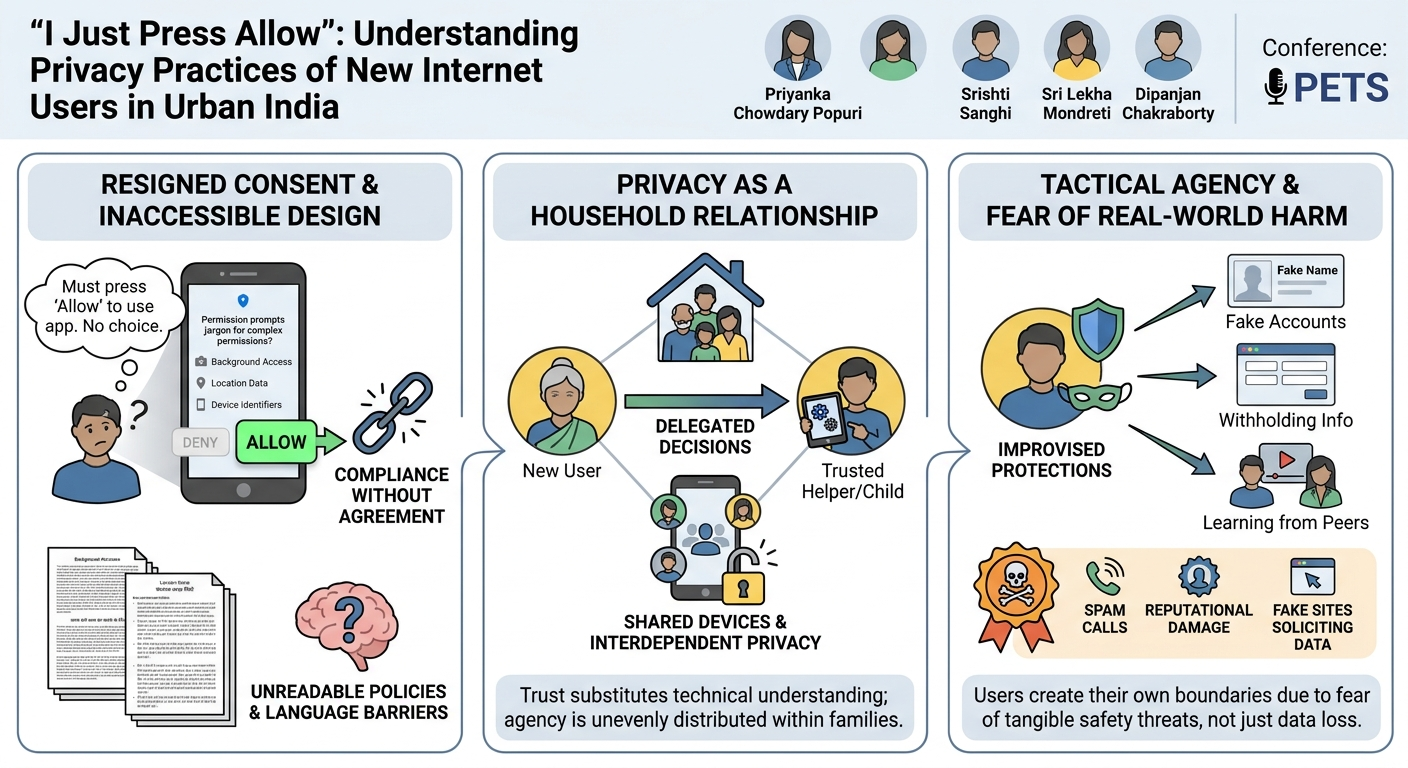
- Resigned Consent: This theme describes a scenario where users comply with permission prompts not out of understanding or agreement, but out of necessity. Participants frequently reported that permission prompts for camera, location, or other data access felt meaningless because refusing them would render the application unusable or severely limit its features. The implicit pressure to "allow" or "accept" conditions leaves users feeling they have no choice, leading to what the researchers term "compliance without agreement." A significant finding within this theme was the widespread belief among users that their data persists even after an app is uninstalled. They perceive this persistence not as a convenient feature, but as a "threat," particularly when reinstalling an app reveals their previous information still intact. This highlights a fundamental misunderstanding of data lifecycle and a deep-seated distrust.
- Actual of Terms and Policies: Far from indifference, users' avoidance of reading terms and conditions is a direct response to inaccessible design. Policies are typically presented in English or Hindi, often laden with technical jargon and lengthy, text-heavy interfaces. For a population where many speak only their native language and have varying levels of literacy, these policies are incomprehensible. The fear of "messing something up" by interacting with unfamiliar terms, such as "background access," often leads users to resort to a trial-and-error method or simply bypass reading altogether. One participant described two-page long terms and conditions as "meaningless" because no one would dedicate the time to read them. This behavior is not laziness but an adaptive strategy to interfaces that assume a literacy level users simply do not possess.
- Delegating Digital Decisions: In the absence of personal understanding, trust substitutes the understanding of technology. Users frequently delegate digital decisions, including privacy settings, to trusted family members, most commonly their children, nephews, or grandchildren. These individuals act as informal caregivers, guiding their relatives through app installations and permission grants. While providing a necessary workaround, this delegation also means that privacy understanding and agency are unevenly distributed within households, often concentrating decision-making power in the hands of a few. This reliance on trusted individuals, while pragmatic, can also inadvertently block users from exploring applications independently or developing their own digital literacy. The research reveals privacy as a "household condition," shaped by generational and gender hierarchies.
- Everyday Privacy Workarounds (Tactical Agency): Despite the systemic challenges, users are not passive. They exhibit tactical agency by developing their own "improvised protections." This theme, the largest in the dataset, demonstrates that users build privacy mechanisms that are meaningful to them, even if not technically sophisticated. Examples include creating fake accounts on platforms like Instagram to share content without alerting family members, or deliberately withholding personal details from certain apps. These workarounds are learned through informal channels like YouTube tutorials or peer advice, rather than formal digital literacy programs. This shows that users are actively negotiating their digital spaces, creating their own boundaries where the system fails to provide adequate privacy controls. For them, privacy is not merely about settings but about managing social visibility and personal narratives.
- Fear of Exposure and Harm: For many participants, particularly women, privacy is intrinsically linked to safety and dignity, not just data control. The sharing of personal information with services like food delivery apps or coaching centers often leads to spam calls, which are perceived as a significant threat. Community stories and the fear of reputational harm strongly influence their digital behavior. The existence of fake government sites that solicit Aadhaar details and phone numbers further amplifies these fears, leading users to instinctively withhold information rather than engaging with complex technical knowledge. This highlights a crucial aspect: for many new users, privacy breaches manifest as tangible real-world threats, making the abstract concept of data privacy deeply personal and consequential.
These findings collectively paint a picture of privacy as a complex, socio-culturally mediated phenomenon for new internet users. It is characterized by compelled consent where access is conditional, pragmatic privacy built from trial and error, and interdependent privacy negotiated within household dynamics. The users’ experiences underscore that current privacy paradigms are ill-equipped to serve this rapidly expanding demographic, necessitating a fundamental rethinking of design and policy.
Technical Deep Dive
▶ Watch: Delegating digital decisions due to lack of understanding (6:40)
The study employed a rigorous qualitative research methodology to explore the nuanced perceptions and practices of new internet users. The research design was structured in three main steps: participant recruitment, semi-structured interviews, and thematic analysis.
1. Participant Recruitment:
The researchers focused on urban and peri-urban India to capture a diverse range of new internet users. Participants were recruited using a combination of convenience and snowball sampling. This approach allowed the team to identify individuals who fit the definition of "new internet users" – those with limited or no formal digital training, unfamiliar with heavy text interfaces, and often non-English speakers. The sample comprised 50 participants, intentionally balanced with 26 women and 24 men, ensuring gender representation. Their ages ranged from 19 to 58 years, reflecting a broad adult demographic. Education levels varied significantly, from individuals with no formal schooling to post-graduates, highlighting the diverse literacy backgrounds. Recruitment was facilitated through community centers, word of mouth, and educational institutions, leveraging local networks to reach the target population effectively.
2. Semi-Structured Interviews:
Central to the data collection were semi-structured interviews, designed to elicit rich, qualitative data about participants' experiences and perceptions. Each interview lasted approximately 45 to 60 minutes, allowing for in-depth exploration of privacy-related scenarios and individual coping mechanisms. A crucial aspect of these interviews was their conduct in the participants' native languages. This was essential to overcome language barriers and ensure that participants could express their thoughts and feelings accurately and comfortably, free from the constraints of English or Hindi, which many did not speak fluently. Before the main study, a pilot study was conducted with 10 participants. This pilot phase was critical for refining interview questions, identifying potential biases, and ensuring the interview protocol was culturally sensitive and effective in eliciting the desired information. The pilot helped in structuring the subsequent 40 interviews for consistency and depth.
3. Thematic Analysis:
Following the data collection, the interview transcripts were subjected to thematic analysis, a widely recognized method in qualitative research for identifying, analyzing, and reporting patterns (themes) within data. The process involved multiple stages of coding:
- Initial Coding: Researchers meticulously reviewed the transcripts, assigning initial codes to segments of text that captured key ideas, experiences, or perceptions related to privacy.
- Categorization and Theme Development: These initial codes were then grouped into broader categories based on their similarities. Through an iterative process, these categories were refined and consolidated into overarching themes.
- Validation: The researchers identified 322 coding references from the 50 interviews. These references were ultimately organized into the five primary themes previously discussed: Resigned Consent, Actual of Terms and Policies, Delegating Digital Decisions, Everyday Privacy Workarounds, and Fear of Exposure and Harm. The identification of Fear of Exposure and Harm and Everyday Workarounds as the largest themes indicates their prominence and significance in the participants' lived experiences.
This systematic qualitative approach allowed the researchers to move beyond superficial observations and delve into the underlying motivations, beliefs, and socio-cultural factors that shape privacy practices among new internet users. By prioritizing native language interviews and a rigorous thematic analysis, the study ensured that the findings accurately reflected the participants' perspectives, providing a robust foundation for the derived implications and recommendations. The methodology underscores the value of ethnographic and user-centered research in understanding complex human-technology interactions, particularly in diverse cultural contexts.
Demo / Proof of Concept
▶ Watch: Fear of exposure and harm shapes women's privacy behavior (8:50)
This talk presented a qualitative research study focused on understanding user perceptions and behaviors, rather than demonstrating a technical exploit, a new tool, or a specific system. Therefore, a traditional "demo" or "proof of concept" in the sense of a live software demonstration or a technical exploit was not part of the presentation. The "proof" of the concepts discussed lies in the robust qualitative data gathered from the 50 participants and the rigorous thematic analysis conducted.
Defensive Implications
▶ Watch: Policy implications and "privacy is a relationship" takeaway (10:30)
The findings from "I Just Press Allow" offer critical defensive implications for policymakers, app developers, and digital literacy advocates aiming to create more inclusive and secure digital environments for new internet users. The current paradigm, which places the burden of understanding and managing privacy almost entirely on the individual, is demonstrably failing this demographic.
- Simplify and Localize Privacy Policies: The most immediate implication is the urgent need to redesign privacy policies. They must be presented in simple, understandable language, avoiding jargon, and crucially, offered in multiple native languages beyond just English and Hindi. Incorporating icons and visual aids can significantly improve comprehension, making complex information more accessible to users with varying literacy levels. This moves beyond mere translation to a complete re-conceptualization of how information is conveyed.
- Develop Contextual Permission Explanations: Instead of generic permission prompts, apps should explain what each permission means contextually and why it's necessary at the point of use. For example, instead of just "Allow Camera Access," an app could state, "Allow camera access to take a profile picture," appearing only when the user attempts that specific action. This helps users understand the immediate utility and potential implications, fostering more informed consent.
- Implement User-Friendly Account Management: Recognizing the prevalence of shared devices and delegated digital decisions, platforms should build guest profiles or easy switching mechanisms. This would enable multiple household members to use a single device without compromising each other's privacy or requiring a single "expert" to manage all accounts. Each user could have personalized settings and data, addressing the "privacy as a household condition" finding.
- Offer Limited Features First with Gradual Permission Requests: Applications should consider offering a limited set of features first, requiring only essential permissions. As users explore and require more advanced functionalities, subsequent permissions can be requested, with clear explanations. This gradual onboarding approach can reduce the initial cognitive load and the feeling of "resigned consent."
- Integrate In-App Guides and Digital Literacy Support: Instead of relying on informal "local helpers" (children, nephews), apps could integrate in-app guides or interactive tutorials that explain privacy settings and digital safety concepts in an accessible, native-language format. This empowers users to develop their own digital literacy within the application environment itself. Partnerships with community centers and local organizations for digital literacy programs, informed by these findings, would also be highly beneficial.
- Default to Privacy-Enhancing Settings: Features like number masking (for calls or deliveries) and restricted visibility (for social media posts) should be default settings rather than opt-in choices. The study showed that users value their safety and dignity, and making these protections standard reduces the burden on users to understand and configure complex privacy controls. This aligns with the principle of "privacy by design."
- Address Fear of Exposure and Harm Directly: Policymakers and app developers must acknowledge and address the tangible threats like spam calls and fake government sites. This includes stronger regulations against unsolicited communications, clear reporting mechanisms within apps, and public awareness campaigns about digital scams, particularly those targeting sensitive personal identifiers like Aadhaar.
By implementing these defensive strategies, the digital ecosystem can become more equitable, understandable, and secure for the millions of new internet users who are currently navigating a complex digital world with insufficient tools and support. This shift from a "user beware" to a "designer be responsible" mentality is crucial for fostering genuine digital inclusion.
Key Takeaways
- Privacy is a Relationship, Not a Setting: For new internet users in urban India, privacy is primarily understood and negotiated through social relationships, household dynamics, and concerns for personal safety and dignity, rather than through technical configurations or abstract policies.
- Consent is Often Compelled, Not Informed: Users frequently grant permissions out of necessity to use an application, leading to "resigned consent" where compliance occurs without genuine understanding or agreement of the terms.
- Interfaces Fail Diverse User Literacies: Current digital interfaces and privacy policies are largely inaccessible due to language barriers, technical jargon, and text-heavy designs, forcing users to adapt through trial-and-error or delegation.
- Users Employ Tactical Agency for Protection: Despite systemic barriers, new users are not passive; they actively develop creative, informal workarounds and "improvised protections" learned from peers or online videos to manage their privacy.
- Privacy is Unevenly Distributed: Within households, privacy decisions and digital agency are often delegated to more digitally literate family members, leading to an uneven distribution of privacy control based on trust, gender, and generational hierarchies.
- Real-World Harm Drives Privacy Concerns: Fears of spam calls, reputational damage, and fake government sites underscore that privacy breaches for these users translate into tangible threats to their safety and well-being, highlighting the need for contextually relevant protections.
About the Speaker(s)
Priyanka Chowdary Popuri is a PhD scholar from BITS Pilani, Hyderabad, India. Her research focuses on understanding user perceptions and practices related to internet privacy, particularly among new internet users in urban and peri-urban India. This work, "I Just Press Allow," is a joint effort with her co-authors Sreelekha Mondreti, Srishti Sanghi, and her advisor, Professor Dipanjan Chakraborty, all contributing to the paper's insights into socio-cultural aspects of digital privacy.
Reviews
Dr. Zero (Offensive Security Researcher) — SOLID
I’m glad Popuri brought actual receipts to prove Silicon Valley's consent flows are completely useless in the Global South, even if the findings are painfully obvious. It’s rigorous, necessary HCI work that belongs at PETS, but validating that non-English speakers just hit 'allow' to bypass unreadable legal text isn't exactly a paradigm shift. Solid academic baseline, though vendors will likely keep ignoring it.
Heather Calloway (CISO) — SOLID
This is a necessary reality check for any global enterprise operating in emerging markets. It demonstrates that Western-style, text-heavy consent flows are functionally broken for massive user bases in India, turning "informed consent" into a dangerous compliance fiction. If your company relies on these flows for legal cover, your privacy program has a massive blind spot.
→ Top-rated talks at Privacy Enhancing Technologies Symposium (PETS) 2026
All talks from Privacy Enhancing Technologies Symposium (PETS) 2026