The Empire Strikes Back (at Your Privacy): An Archaeology of Tracking on Government Websites
Sachin Kumar Singh (Paper author · University of Utah), Faisal Mahmud (Paper author · New York University Abu Dhabi), Robert Ricci (Paper author · University of Utah), Sandra Siby (Paper author · New York University Abu Dhabi)
Privacy Enhancing Technologies Symposium (PETS) 2026 · Day 1 · Moose
Overview
In an era where digital privacy is increasingly scrutinized, the expectation of confidentiality when interacting with government services remains paramount. This talk, "The Empire Strikes Back (at Your Privacy): An Archaeology of Tracking on Government Websites," presented at PETS, delves into the pervasive and often unexpected presence of third-party trackers on government websites globally. Led by Robert Ricci from the University of Utah, representing a collaborative effort with Sachin Kumar Singh, Faisal Mahmud, and Sandra Siby from NYU Abu Dhabi, the research uncovers a significant and concerning trend: what was once a rare occurrence has evolved into a routine practice, with approximately 50% of government websites now embedding tracking technologies.
Key moments
- 0:00 Introduction and expectation of privacy on government sites
- 2:40 Why government websites shouldn't have commercial tracking incentives
- 3:30 Main finding: Tracking on government websites is now routine
- 4:00 Study scope: 61 countries, 16K sites, 30 years
- 6:20 Case study: France intentionally removed trackers since 2014
- 7:40 Geopolitical impact: Russian sites removed US trackers during war
- 8:00 Dominance of US firms (Alphabet, Meta) in government tracking
- 8:50 Paper and artifacts available for further research
The Empire Strikes Back (at Your Privacy): An Archaeology of Tracking on Government Websites
Speakers: Sachin Kumar Singh (Paper author, University of Utah); Faisal Mahmud (Paper author, New York University Abu Dhabi); Robert Ricci (Paper author, University of Utah); Sandra Siby (Paper author, New York University Abu Dhabi)
Conference: PETS
YouTube: https://www.youtube.com/watch?v=qXiGhvWCLOY
Overview
In an era where digital privacy is increasingly scrutinized, the expectation of confidentiality when interacting with government services remains paramount. This talk, "The Empire Strikes Back (at Your Privacy): An Archaeology of Tracking on Government Websites," presented at PETS, delves into the pervasive and often unexpected presence of third-party trackers on government websites globally. Led by Robert Ricci from the University of Utah, representing a collaborative effort with Sachin Kumar Singh, Faisal Mahmud, and Sandra Siby from NYU Abu Dhabi, the research uncovers a significant and concerning trend: what was once a rare occurrence has evolved into a routine practice, with approximately 50% of government websites now embedding tracking technologies.
The core motivation behind this extensive study stems from the inherent sensitivity of interactions with government entities. From accessing legal systems and handling major life events like births and deaths to managing health data and obtaining essential permits, citizens frequently share highly personal information with state agencies. Unlike commercial websites, which often employ trackers for targeted advertising and monetization, government platforms theoretically lack these financial incentives, reinforcing the public's expectation of a secure and private digital environment. The findings presented challenge this fundamental assumption, revealing a widespread adoption of tracking mechanisms that mirrors, and in some cases surpasses, commercial practices, raising profound questions about data sovereignty, surveillance, and citizen trust.
This comprehensive archaeological investigation spans nearly three decades, from 1996 to 2025, analyzing over 16,000 government websites across 61 countries. The research not only quantifies the alarming rise in tracker prevalence but also identifies critical shifts in the tracking landscape, including the dominance of a few major US-based firms and the impact of geopolitical events on tracker deployment. By shedding light on this hidden dimension of government digital infrastructure, the talk provides crucial insights for policymakers, web administrators, and privacy advocates, underscoring the urgent need to re-evaluate current practices and reinforce privacy safeguards on platforms entrusted with the public's most sensitive data.
Background
▶ Watch: Introduction and expectation of privacy on government sites (0:00)
The ubiquitous nature of web tracking has become a defining characteristic of the modern internet. Most users are accustomed to commercial websites embedding various forms of JavaScript and other objects designed to monitor browsing habits, build user profiles, and facilitate targeted advertising. These mechanisms, while often framed as tools for improving user experience or funding free content, inherently carry implications for user privacy and potential surveillance. The keynote preceding this talk at PETS extensively covered these commercial tracking practices, allowing the presenters to quickly establish this foundational understanding.
However, the application of such tracking technologies to government websites introduces a unique set of concerns. While commercial entities have a clear financial incentive to monetize user data through advertising, government bodies typically do not. This fundamental difference suggests that the motivations behind tracking on government sites are either inadvertent, driven by reliance on third-party services, or indicative of less transparent data collection goals. The expectation of privacy on government services is considerably higher due to the sensitive nature of the information exchanged, which can include personal identification, health records, financial details, and legal matters. The problem, therefore, is the potential erosion of this privacy expectation in a domain where it is most critical.
To conduct their "archaeology of tracking," the researchers leveraged a robust methodology built upon existing data and historical web archives. The initial list of government websites—comprising approximately 16,000 national-level government sites and state-owned entities across 61 countries—was sourced from a prior paper by Kumar et al. presented at IMC. This provided a consistent and broad foundation for their analysis. For historical data, the study made extensive use of the Wayback Machine on the Internet Archive, a critical tool that allowed them to retrieve snapshots of these websites spanning nearly 30 years, from 1996 to 2025. This long temporal window is particularly significant, as it extends back close to the very genesis of web advertising, with the first banner ad appearing in 1994.
The identification of trackers within these historical snapshots was achieved using EasyList, a widely recognized and community-maintained compilation of lists that identify known ad servers, tracking scripts, and other privacy-invasive elements. By cross-referencing embedded objects found on government websites with the entries in EasyList, the researchers could systematically determine the presence and evolution of tracking technologies over time. This methodology allowed for a consistent and scalable approach to surveying a vast number of websites over a prolonged period, providing the essential context for their key findings regarding the dramatic increase in tracker prevalence.
Key Findings
▶ Watch: Main finding: Tracking on government websites is now routine (3:30)
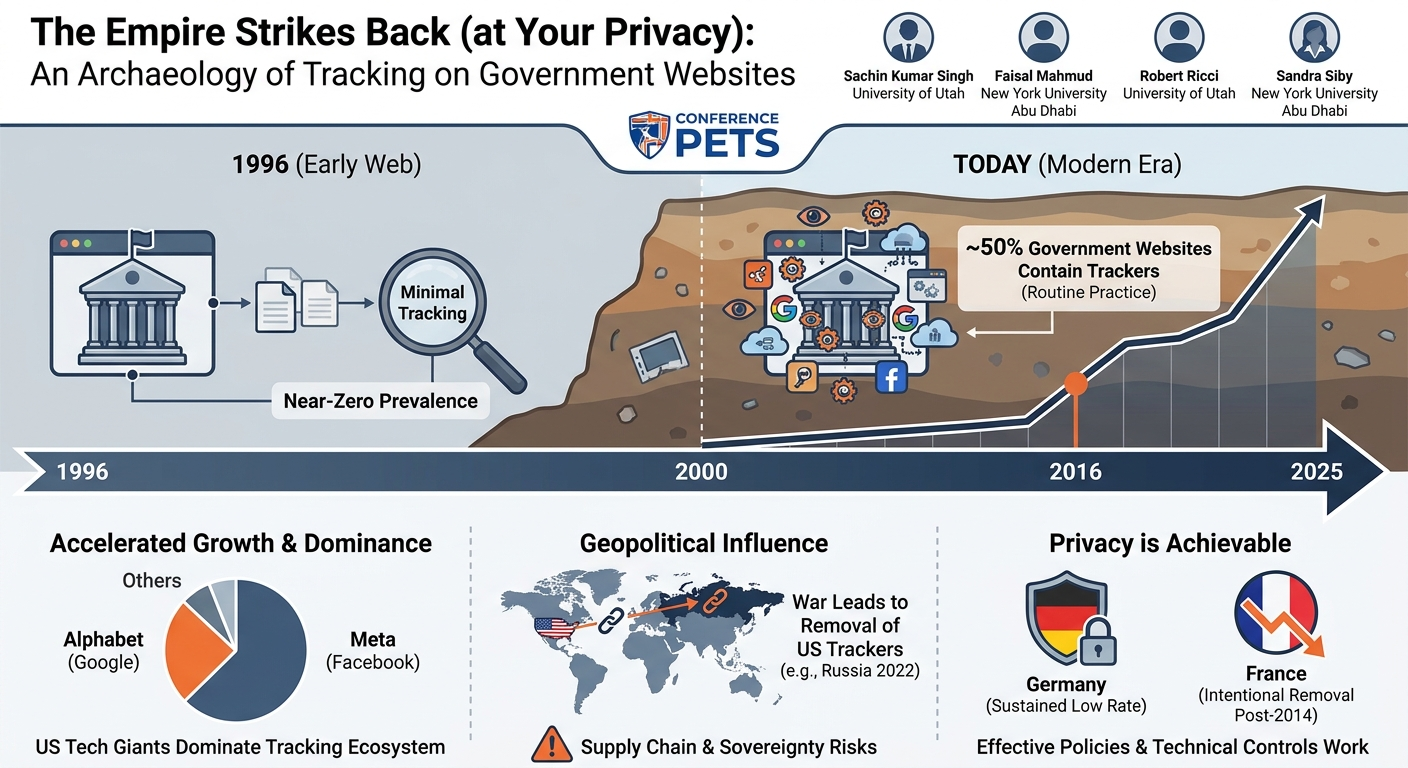
The research presents a stark picture of the evolving landscape of web tracking on government websites, revealing a significant shift from a rare occurrence to a routine practice. The overarching trend observed is an alarming increase in tracker prevalence, moving from practically no trackers at the beginning of the study period (1996) to approximately 50% of government websites containing some form of tracker today. This represents a dramatic transformation in how government digital services interact with user data.
The study pinpoints several key milestones and patterns in this rise. A notable surge in tracker rates began around 2016, marking a period of accelerated adoption globally. While this general trend holds across many regions, the research highlights considerable variations at regional and country-specific levels:
- North America: Countries like Canada, Costa Rica, Mexico, and the United States largely followed the global average trajectory, showing a consistent increase in tracker prevalence over time.
- Europe: This continent exhibited a diverse range of approaches:
- Spain ended up with a significantly higher number of trackers than the average country.
- Germany stood out as an outlier, having largely kept trackers off its government websites for the entire study period, demonstrating that a proactive, privacy-centric approach is achievable.
- The Netherlands showed a more moderate presence of trackers, falling somewhere in the middle.
- France presented a particularly interesting case: it initially had a higher prevalence of trackers, reaching up to 60% around 2014. However, after this peak, France appears to have intentionally started removing trackers, significantly reducing their presence to practically none by 2026. This "localized pullback" suggests a deliberate policy or technological shift.
These localized pullbacks, observed in countries like France and Germany's sustained low rates, are statistically significant findings. They indicate that national policies, technological platform choices, or a combination of both can effectively influence and control the deployment of third-party trackers on government digital properties, offering a blueprint for other nations.
Beyond general trends, the research also identified specific real-world events that impacted tracker usage:
- Polyfill Incident (2024): The site Polyfill, a commonly used programming platform for CSS, began serving malware. The study's data reflected this event, showing that most countries promptly dropped Polyfill from their websites. However, a concerning minority of countries did not, suggesting a lack of awareness or responsiveness to critical security bulletins.
- Russia-Ukraine War (2022): Following Russia's invasion of Ukraine, the study observed a significant geopolitical impact on tracker deployment. American tracking networks were notably removed from Russian government websites, specifically Google Analytics and Facebook tracking. This incident underscores the geopolitical implications of relying on foreign third-party services for critical national infrastructure.
A crucial finding regarding the composition of tracking networks is their overwhelming dominance by a few US-based firms. The vast majority of identified tracking networks belonged to either Alphabet (Google) or Meta (Facebook). Furthermore, this dominance has stabilized over time; while there used to be considerable churn and variety in tracking networks, recent years have seen a consolidation, with these two companies increasingly concentrating the market share. This centralization raises concerns about data control, potential single points of failure, and the influence of foreign corporations on national digital privacy.
The paper, which is linked by the speakers, contains additional details on methodology, other regional analyses, and approaches to handling noisy data, such as measuring the first observed appearance of a tracker. The researchers also created visualizations, including a heatmap, to represent their findings, inviting attendees to discuss these in further detail.
Technical Deep Dive
▶ Watch: Case study: France intentionally removed trackers since 2014 (6:20)
The technical foundation of this "archaeology of tracking" relies on a methodical approach to data collection and analysis, meticulously designed to cover a vast temporal and geographical scope. The primary goal was to identify and quantify the presence of third-party trackers embedded within government websites over nearly three decades.
At its core, web tracking typically involves the embedding of external resources—most commonly JavaScript code, but also other objects like pixels, images, or frames—from a third-party domain into a website. When a user visits the website, their browser executes this embedded code, which can then collect information about the user's activity, device, location, and browsing habits. This data is transmitted back to the third party, allowing them to build comprehensive user profiles, often for purposes of targeted advertising, analytics, or more general surveillance. For government websites, the absence of a clear commercial advertising motive makes the presence of such trackers particularly noteworthy.
The researchers' ability to conduct a historical analysis spanning 30 years was largely predicated on the strategic use of the Internet Archive's Wayback Machine. This invaluable resource provides historical snapshots of websites, allowing researchers to observe how web pages rendered and what external resources they embedded at various points in time. By systematically querying the Wayback Machine for the 16,000 government websites identified in their dataset, the team could reconstruct the digital footprint of these sites from 1996 through 2025. This process involved downloading numerous versions of each website's HTML, along with its associated scripts and assets, to analyze their content.
To accurately identify what constituted a "tracker," the study relied on EasyList. EasyList is a widely adopted, community-driven initiative that maintains extensive filter lists used by ad blockers and privacy tools (like Adblock Plus or uBlock Origin). These lists contain patterns and domains associated with known advertising networks, tracking services, social media widgets (which often track users), and other privacy-invasive elements. By parsing the downloaded website content and comparing the URLs of embedded resources against the EasyList definitions, the researchers could programmatically determine if a given external script or object originated from a domain identified as a tracker. This standardized approach ensured consistency and scalability across the massive dataset.
The analysis focused on national-level government websites and state-owned entities, providing a broad yet specific lens into governmental digital infrastructure. The sheer volume of data—snapshots from 61 countries over 30 years—required sophisticated scripting and data processing techniques. The output of this process was a time-series dataset indicating the presence or absence of trackers on each website at different points, allowing for the observation of trends, spikes, and localized pullbacks.
The talk mentions the availability of artifacts for this research, specifically "the scripts to download all this stuff from the Internet Archive and to do the data processing." This commitment to open science allows other researchers to reproduce their findings, validate methodologies, or extend the analysis to different datasets or timeframes. It underscores the robustness and transparency of their technical approach. Furthermore, the mention of dealing with "noisy data" through methods like measuring the "first time we observe a tracker appearing" highlights an awareness of the challenges inherent in historical web data analysis and a commitment to refining measurement accuracy. While the specifics of this "noisy data" handling weren't detailed in the talk, it points to a careful consideration of methodological nuances.
Demo / Proof of Concept
▶ Watch: Geopolitical impact: Russian sites removed US trackers during war (7:40)
The talk did not include a live demonstration or a proof of concept in the traditional sense, such as showcasing a tool in action or a live exploit. Instead, the presentation focused on the comprehensive findings of their extensive data analysis and the trends observed over a 30-year period. The researchers did mention having "some other fun visualizations," including a "heat map," but these were not explained during the talk. Instead, attendees were invited to discuss these visualizations with the authors at a poster session, indicating they served as supplementary ways to represent the research data rather than interactive demonstrations. The core of the presentation was the statistical and historical evidence gathered from their archaeological study of government websites.
Defensive Implications
▶ Watch: Paper and artifacts available for further research (8:50)
The findings from "The Empire Strikes Back (at Your Privacy)" present several critical defensive implications for governments, web administrators, and privacy advocates. The pervasive presence of third-party trackers on government websites, despite the absence of commercial incentives, demands a fundamental re-evaluation of current practices and a proactive stance on digital privacy.
Firstly, governments must acknowledge and address the inherent conflict between their mandate to protect citizen data and the widespread use of third-party tracking technologies. The default assumption should be privacy by design for all government digital services. This means that privacy considerations, including the minimization of data collection and the avoidance of third-party trackers, should be integrated into the architecture and operation of websites from their inception, rather than being an afterthought.
A primary defensive action involves a thorough audit of all third-party scripts and embedded content on government websites. The Polyfill incident, where a commonly used platform started serving malware, serves as a stark warning about the supply chain risks associated with external dependencies. Governments must establish robust processes for vetting, monitoring, and regularly reviewing all third-party services integrated into their sites. This includes understanding the data collection practices of these services, their security posture, and their compliance with national and international privacy regulations. Proactive monitoring for security bulletins and timely removal of compromised or risky components are essential.
The overwhelming dominance of US-based firms like Alphabet and Meta in the tracking landscape also highlights a significant geopolitical risk. The example of Russian government websites removing American trackers after the 2022 invasion of Ukraine demonstrates how geopolitical tensions can directly impact the functionality and data integrity of government digital infrastructure. Governments, especially those handling sensitive national data, should critically assess the sovereignty implications of relying on foreign-owned tracking networks. Diversification, the development of national or regional alternatives, or strict limitations on the types of data that can be collected by such entities should be considered.
Furthermore, the study provides compelling evidence that reducing or eliminating trackers on government websites is achievable. The examples of Germany, which has consistently maintained low tracker prevalence, and France, which successfully implemented a deliberate removal strategy after 2014, serve as blueprints. These cases suggest that effective defensive measures can be implemented through a combination of:
- Clear Policy Directives: Establishing strong, legally binding policies that prohibit or severely restrict the use of third-party trackers on government websites, emphasizing citizen privacy over analytics convenience.
- Technological Controls: Implementing technical solutions, such as stricter content security policies (CSPs), server-side analytics, or proxying third-party resources to minimize direct connections to tracking domains.
- Awareness and Training: Educating web developers, content managers, and policymakers within government agencies about the privacy implications of embedded content and the importance of adhering to privacy-by-design principles.
Finally, defenders should advocate for greater transparency from government entities regarding their data collection practices. Clear and accessible privacy policies that explicitly state the use of any third-party services and the data they collect are crucial for building and maintaining public trust. The findings of this research serve as a call to action for governments worldwide to uphold their duty to protect citizen privacy in the digital realm.
Key Takeaways
- Pervasive Tracking: Approximately 50% of government websites globally now contain third-party trackers, a significant increase from near-zero prevalence in 1996.
- Accelerated Growth: The rate of tracker adoption on government websites saw a notable acceleration starting around 2016, indicating a recent shift in digital practices.
- Geopolitical Influence: Real-world events, such as the Russia-Ukraine war, demonstrate that geopolitical tensions can directly lead to the removal of foreign tracking networks from government sites, highlighting supply chain and data sovereignty risks.
- Dominance of US Tech Giants: The vast majority of tracking networks found on government websites are controlled by US firms, primarily Alphabet (Google) and Meta (Facebook), indicating a centralized and consolidated tracking ecosystem.
- Feasibility of Privacy: Countries like Germany have successfully maintained minimal tracker presence, and France demonstrated a significant, intentional reduction of trackers, proving that it is possible for governments to prioritize and enforce digital privacy.
- Lack of Justification: Unlike commercial entities, governments inherently lack a financial incentive for targeted advertising through tracking, making its widespread presence on their sensitive services particularly concerning and unjustified.
About the Speaker(s)
The research presented in this talk was a collaborative effort by a team of academics. Robert Ricci, from the University of Utah, delivered the presentation. He clarified that he was not the first author of the paper, but rather presented on behalf of the team. The primary author is Sachin Kumar Singh, a former student of Rob Ricci at the University of Utah, who was unfortunately unable to attend the conference due to visa issues. Sachin Kumar Singh is noted as potentially entering the academic job market in the coming years.
Also involved in the paper and present at the conference was Faisal Mahmud, a paper author from New York University Abu Dhabi. Faisal Mahmud is highlighted as a promising individual who might be on the graduate student market in the near future. His advisor, Sandra Siby, also from New York University Abu Dhabi, is another co-author of the paper, though she was not present at the talk. The team's diverse institutional backgrounds underscore the collaborative nature of this extensive privacy research.
Reviews
Dr. Zero (Offensive Security Researcher) — MUST SEE
This is a massive, 30-year internet measurement study proving that global governments are openly leaking citizen data to Google and Meta. The technical execution is basically grepping the Wayback Machine, but the sheer scale of the archaeology and the geopolitical signal they extracted make it a mandatory read. It's real data proving a catastrophic operational failure in government web infrastructure.
Heather Calloway (CISO) — STRONG ACCEPT
A 30-year empirical audit of third-party risk management failures across global public sector websites. This is highly recommended for any public sector CISO, and a stark reminder for the private sector that a bloated marketing tech stack is a material supply chain risk.
→ Top-rated talks at Privacy Enhancing Technologies Symposium (PETS) 2026
All talks from Privacy Enhancing Technologies Symposium (PETS) 2026