Priv360: Application-Oriented QoE-Optimized Client-Side Protection for 360-Viewer Identification
Sheyda Mirzakhani (Paper author · Linköping University), Niklas Carlsson (Paper author · Linköping University)
Privacy Enhancing Technologies Symposium (PETS) 2026 · Day 3 · Caribou
Overview
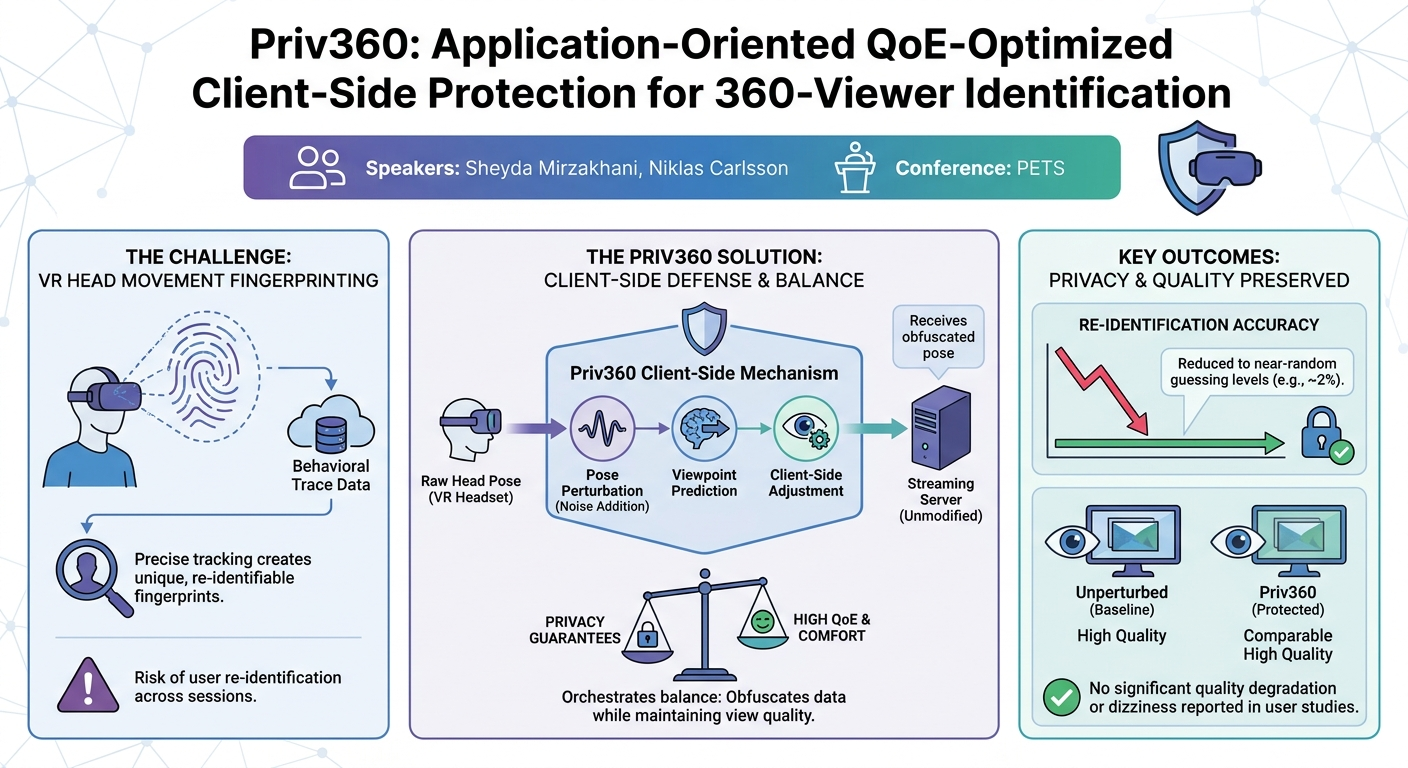
The rapid adoption of virtual reality (VR) and 360-degree video streaming for applications ranging from entertainment to remote collaboration introduces novel privacy challenges. One significant, yet often overlooked, vulnerability stems from the precise tracking of a user's head movements and viewing direction. While essential for optimizing Quality of Experience (QoE) by directing high-resolution content to the user's viewport and reducing bandwidth for peripheral areas, these head pose traces inadvertently create unique behavioral fingerprints that can be used to re-identify individuals. The talk "Priv360: Application-Oriented QoE-Optimized Client-Side Protection for 360-Viewer Identification" addresses this critical privacy concern.
Key moments
- 0:40 Head movements create fingerprintable data in VR streaming.
- 2:00 Introducing Privacy 360: Client-side defense for VR identity.
- 4:00 Detailed explanation of Privacy 360's client-side defense mechanism.
- 6:00 Evaluation shows re-identification accuracy reduced to random levels.
- 6:50 Demonstrating preserved quality of experience and comfort.
- 7:50 User study validates preserved video quality and no dizziness.
- 8:10 Summary: Strong privacy and QoE with client-side defense.
Priv360: Application-Oriented QoE-Optimized Client-Side Protection for 360-Viewer Identification
Speakers: Sheyda Mirzakhani (Paper author, Linköping University); Niklas Carlsson (Paper author, Linköping University)
Conference: PETS
YouTube: https://www.youtube.com/watch?v=237tc5jq82A
Overview
The rapid adoption of virtual reality (VR) and 360-degree video streaming for applications ranging from entertainment to remote collaboration introduces novel privacy challenges. One significant, yet often overlooked, vulnerability stems from the precise tracking of a user's head movements and viewing direction. While essential for optimizing Quality of Experience (QoE) by directing high-resolution content to the user's viewport and reducing bandwidth for peripheral areas, these head pose traces inadvertently create unique behavioral fingerprints that can be used to re-identify individuals. The talk "Priv360: Application-Oriented QoE-Optimized Client-Side Protection for 360-Viewer Identification" addresses this critical privacy concern.
Presented by Niklas Carlsson on behalf of co-author Sheyda Mirzakhani from Linköping University, Priv360 introduces a novel client-side defense mechanism designed to obfuscate these identifying head movements without significantly degrading the user's viewing experience. The core innovation lies in a sophisticated combination of pose perturbation, viewpoint prediction, and client-side adjustments, all orchestrated to achieve a delicate balance between strong privacy guarantees and high QoE. This work is particularly timely given the increasing reliance on VR for sensitive activities like remote conferences, where individual anonymity might be desired.
The significance of Priv360 extends beyond theoretical exploration; it offers a practical, deployable solution that requires no modifications to existing server infrastructure. By demonstrating its effectiveness across various datasets, attacker models, and user studies, the research underscores the feasibility of achieving robust privacy in VR environments without sacrificing usability. This talk provides a crucial step forward in securing the burgeoning landscape of immersive technologies, ensuring that the benefits of VR can be enjoyed without compromising personal privacy.
Background
▶ Watch: Head movements create fingerprintable data in VR streaming. (0:40)
The immersive nature of 360-degree video and VR streaming relies heavily on delivering a seamless and high-quality visual experience. A fundamental technical challenge in achieving this is the efficient utilization of network bandwidth. Unlike traditional video streaming, 360-degree content encompasses a full spherical view, far exceeding what a user can perceive at any given moment. To overcome this, streaming services employ a technique called viewport-adaptive streaming. Here, the server dynamically renders and streams only a high-resolution segment corresponding to the user's current head pose – their viewing direction and orientation – while delivering lower quality for the rest of the sphere. As the user moves their head, the server continuously adapts the streamed content to match the new viewport.
While highly effective for bandwidth optimization and QoE enhancement, this mechanism inadvertently creates a significant privacy vulnerability. The continuous stream of precise head movement data, often captured with high fidelity (e.g., 6 Degrees of Freedom - 6DoF), forms a unique behavioral signature. Much like a person's gait or typing patterns, an individual's head movements are highly characteristic and can be used to re-identify them, even if other personal identifiers are stripped away. This constitutes a fingerprinting vector that allows an adversary, potentially the streaming service itself or an eavesdropper, to track a user's activities across sessions or even link them to other publicly available data.
Prior attempts to address such privacy concerns in other domains often involve adding random noise to data. However, a naive application of noise to head pose data in VR streaming would severely degrade the QoE. If the reported head pose deviates significantly from the actual one, the server would stream high-quality content to the wrong direction, leading to a blurry or disorienting experience in the user's actual field of view, characterized by quality flickering or dizziness. The core problem, therefore, is to design a privacy-enhancing mechanism that can sufficiently obfuscate the user's head movements to prevent re-identification, while simultaneously preserving a high quality of experience and user comfort. This delicate balance is precisely what Priv360 aims to achieve, moving beyond simplistic noise addition to a more intelligent, application-aware approach.
Key Findings
▶ Watch: Detailed explanation of Privacy 360's client-side defense mechanism. (4:00)
The Priv360 framework delivers several pivotal contributions to the field of VR privacy, effectively demonstrating that robust re-identification protection can be achieved without compromising the user's Quality of Experience (QoE). The research highlights four main findings that underpin its significance:
- Effective Re-identification Reduction: Priv360 successfully reduces the re-identification accuracy to near-random guessing levels. For the older 2017 dataset, the re-identification accuracy was brought down to 2.08%, which is statistically equivalent to random guessing. On a newer, self-collected dataset, while slightly worse than random guessing, the reduction was still substantial from a baseline of over 85% to a significantly lower, privacy-preserving level. This indicates that the obfuscation techniques employed by Priv360 are highly effective against various attacker models.
- Preservation of Quality of Experience (QoE) and User Comfort: A critical challenge in head movement obfuscation is avoiding a degraded user experience. Priv360 addresses this by maintaining a QoE that is remarkably close to unperturbed streaming. Objective QoE metrics, such as the quality observed within the user's actual viewport and the absence of significant quality switching or flickering, demonstrated strong performance. Furthermore, a small-scale user study confirmed these objective findings, showing that users rated the video quality of Priv360 similarly to unperturbed video (on a 1-5 scale) and, crucially, reported no dizziness—a common concern with VR head movement manipulations.
- Client-Side Only Implementation: A major practical advantage of Priv360 is its entirely client-side implementation. The system operates solely on the user's device (e.g., VR headset) without requiring any modifications to the server infrastructure or the streaming protocol. This significantly lowers the barrier to adoption, as it avoids the need for complex, large-scale server-side deployments or coordination with content providers. This flexibility makes Priv360 a highly deployable solution for a wide range of existing 360 VR streaming services.
- Flexibility and Robustness: The Priv360 framework is designed to be highly flexible, accommodating various motion prediction methods, different types of deployments, and working effectively against multiple attacker models. The extensive evaluation, which included both older public datasets (48 users) and newly collected data (28 users), multiple objective QoE metrics, and subjective user studies, validated its robustness across diverse system settings and user behaviors. The consistency of results across these varied conditions underscores the general applicability and reliability of the Priv360 approach.
In essence, Priv360 provides a compelling blueprint for how privacy can be ingrained into immersive technologies, proving that user identity protection in 360 VR streaming is achievable without sacrificing the immersive and high-quality experience that users expect.
Technical Deep Dive
▶ Watch: Evaluation shows re-identification accuracy reduced to random levels. (6:00)
The technical ingenuity of Priv360 lies in its multi-component, client-side approach to balancing user privacy with Quality of Experience (QoE) in 360-degree VR streaming. The core problem it solves is the fingerprinting of users through their unique head pose traces, which are continuously sent from the client (VR headset) to the server to optimize content delivery.
At its foundation, the standard model for 360 VR streaming involves the client sending its 6 Degrees of Freedom (6DoF) pose data (position and orientation) in real-time to the server. The server then renders and streams high-quality content specifically for the reported viewing direction, while delivering lower quality for other parts of the 360-degree sphere. Priv360 inserts a sophisticated defense layer directly on the client side, ensuring no server modifications are needed.
The Priv360 client-side processing pipeline operates as follows:
- Raw Pose Input: The process begins with the raw, real-time 6DoF head pose data generated by the VR headset. This data is highly granular and unique to each user's movement patterns.
- Noise Addition: The first step in obfuscation is to introduce noise to this raw pose data. While the talk mentions Gaussian noise as a starting point, implying that other noise models could be explored, the key is to perturb the exact head movements sufficiently to break the re-identification fingerprint. A naive application of noise, however, would directly lead to a mismatch between the reported pose and the actual pose, causing a severe degradation in QoE (e.g., blurriness in the actual viewport).
- Head Movement Prediction and Filtering: To counteract the QoE degradation caused by noise, Priv360 incorporates head movement prediction and filtering techniques. After noise is added, various filters are applied to "smooth things out." This is a critical step because human head movements, while unique, are generally not entirely random; they often follow predictable trajectories for short periods. By predicting the likely future head pose based on the noisy, perturbed history, the system can generate a plausible but obfuscated pose to send to the server. This predicted pose, while different from the actual one, is designed to be close enough to ensure the server streams relevant high-quality content. The framework is designed to be flexible, allowing for different prediction methods to be integrated.
- Sending Perturbed Pose to Server: The output of this prediction and filtering stage is the perturbed head pose, which is then transmitted over the network to the streaming server. From the server's perspective, it receives a valid, albeit slightly altered, head pose. The server proceeds with its normal operation, rendering and streaming high-quality content based on this claimed head movement. This means the area around the perturbed viewing direction will receive optimal quality.
- Client-Side Adjustment (Actual Viewport Compensation): This is where Priv360 truly shines in maintaining QoE. While the server has optimized content for the perturbed pose, the user is still looking in their actual direction. The client-side adjustment component takes the content streamed by the server (which might not be perfectly aligned with the user's actual gaze) and intelligently maps it to the user's real viewport. The idea is that even if the server optimized for a slightly different direction, the surrounding high-quality region delivered by the server, combined with the client's knowledge of the actual gaze, will still result in "good enough" quality within the user's actual field of view. The speaker explicitly states: "when we then look at what we're actually looking, we're not going to get the best possible quality, but hopefully we're going to get good enough." This prevents jarring visual artifacts and maintains comfort.
Evaluation Methodology:
The robustness of Priv360 was rigorously evaluated using a comprehensive methodology:
- Datasets: Two distinct datasets were used:
- An older public dataset from 2017 involving 48 users.
- A newly collected dataset from the current year (at the time of the paper) with 28 users.
- Evaluation Protocol: A "leave-one-video-out" strategy was employed, meaning the system was never trained on the video used for evaluation. This ensures the results are not biased by training data.
- Training: Attackers were primarily trained on the actual perturbed data, reflecting a realistic adversary who observes the obfuscated traces.
- Attacker Models: The study considered three different example attacker models, demonstrating the resilience of Priv360 against various re-identification techniques.
- QoE Metrics: Both objective QoE metrics (e.g., quality within the user's viewport, frequency of quality switching/flickering) and subjective measurements (via a user study) were used to validate the user experience.
The integration of noise with predictive filtering and intelligent client-side rendering adjustments is the core technical contribution, allowing Priv360 to achieve strong privacy guarantees without sacrificing the immersive experience.
Demo / Proof of Concept
▶ Watch: User study validates preserved video quality and no dizziness. (7:50)
While the talk did not feature a live, interactive demonstration in the traditional sense, the research extensively validated the effectiveness and user experience of Priv360 through a small-scale user study, which serves as a crucial proof of concept for its practical viability. This user study directly assessed whether the proposed client-side defense could maintain a high Quality of Experience (QoE) and user comfort, alongside its proven privacy benefits.
The user study involved comparing three different implementations, allowing for a direct assessment of Priv360's performance against both an ideal baseline and a naive approach:
- No Perturbation (Baseline): This represented the standard, unprotected 360 VR streaming experience, where raw head pose data is sent to the server. This served as the benchmark for optimal QoE and user comfort, albeit with no privacy protection.
- Just Add Noise: This implementation involved simply adding noise to the head movement data without the advanced prediction and client-side adjustment mechanisms of Priv360. This was included to highlight the limitations of a simplistic privacy approach, which is expected to severely degrade QoE.
- Priv360 (Labeled as "Predicted"): This was the full Priv360 defense mechanism, incorporating the combination of noise, viewpoint prediction, and client-side adjustments.
Users participating in the study were asked to score their experience on a scale of one to five for various aspects, notably video quality and dizziness. The results provided compelling evidence for Priv360's efficacy:
- Video Quality: Users reported essentially the same video quality for the Priv360 implementation as for the unperturbed baseline. This critical finding validates that the sophisticated client-side adjustments successfully compensate for the intentional perturbations, ensuring a visually comparable experience.
- Dizziness: A significant concern with any manipulation of head movements in VR is the potential for inducing dizziness or motion sickness. The user study specifically found no dizziness reported by users when using Priv360. This is a testament to the effectiveness of the predictive filtering and smooth client-side rendering adjustments, which prevent jarring visual discrepancies that could cause discomfort.
These subjective user study results, combined with objective QoE metrics discussed in the technical deep dive (such as "pretty close quality" in the viewport and "not much quality switching"), collectively serve as a robust proof of concept. They demonstrate that Priv360 is not merely a theoretical construct but a practical system capable of delivering both strong privacy protection and a comfortable, high-quality user experience in real-world VR scenarios.
Defensive Implications
▶ Watch: Summary: Strong privacy and QoE with client-side defense. (8:10)
The findings presented by Priv360 carry significant implications for various stakeholders in the 360-degree VR streaming ecosystem, particularly for those concerned with user privacy and data security. The work provides actionable insights for developers, service providers, and even end-users.
For VR/360 streaming service providers and platform developers, Priv360 offers a clear pathway to integrate robust privacy protections into their offerings. The most compelling implication is the demonstration that client-side privacy mechanisms can effectively mitigate re-identification risks without necessitating disruptive server-side architectural changes. This means providers can enhance user privacy without overhauling their existing content delivery networks or requiring complex coordination with content creators. Implementing a solution like Priv360 allows them to:
- Differentiate their services: By explicitly offering privacy-preserving features, providers can attract privacy-conscious users and build trust.
- Comply with regulations: As privacy regulations like GDPR and CCPA evolve, solutions that minimize personal data collection and fingerprinting become increasingly important for compliance.
- Reduce liability: Minimizing the collection of unique identifiers reduces the risk associated with data breaches and misuse of user behavioral data. The use of pose perturbation combined with viewpoint prediction and client-side adjustment presents a blueprint for maintaining QoE while achieving privacy.
For security researchers and privacy engineers, Priv360 highlights the importance of considering fine-grained behavioral data, such as head movements, as a potent fingerprinting vector in immersive environments. It encourages further research into other subtle forms of biometric or behavioral identifiers that might emerge with new VR/AR technologies. The framework's flexibility, allowing for different motion prediction methods and attacker models, also serves as a valuable foundation for future work on adaptive and more sophisticated privacy defenses.
For end-users of VR and 360-degree content, the talk serves as a crucial awareness builder. It educates users about the inherent privacy risks associated with their interactions in virtual spaces, specifically that their seemingly innocuous head movements can be used to track and re-identify them. This knowledge empowers users to:
- Demand privacy-preserving features: Users can advocate for and prioritize services that implement solutions like Priv360.
- Make informed choices: Understanding the trade-offs between convenience, performance, and privacy is crucial when selecting VR applications and platforms.
Finally, the success of Priv360 in balancing privacy and QoE underscores a broader defensive implication: that privacy need not be an "either/or" proposition with user experience. Through intelligent design and application-aware engineering, it is possible to achieve significant privacy gains while preserving or even enhancing the user's interaction with technology. This work sets a precedent for future privacy-enhancing technologies in immersive computing, emphasizing that user-centric design must equally prioritize both functionality and fundamental rights.
Key Takeaways
- Head Movements are Fingerprintable: Precise tracking of user head movements in 360-degree VR streaming, while optimizing bandwidth, creates unique behavioral fingerprints that can be used for re-identification.
- Priv360 Offers a Client-Side Defense: The proposed Priv360 framework is an entirely client-side solution that protects user identity by obfuscating head pose data without requiring any modifications to server infrastructure.
- Achieves Near-Random Re-identification Accuracy: Priv360 successfully reduces re-identification accuracy to levels comparable to random guessing, demonstrating strong privacy protection against various attacker models.
- Preserves Quality of Experience (QoE) and User Comfort: Through a combination of noise, viewpoint prediction, and intelligent client-side adjustments, Priv360 maintains high video quality and user comfort, with no reported dizziness in user studies.
- Flexible and Robust Framework: The system is adaptable to different motion prediction methods, works across various datasets, and was validated through extensive objective metrics and subjective user studies.
- Privacy Without Compromise: Priv360 proves that robust privacy in immersive VR environments is achievable without sacrificing the high-quality, comfortable user experience that is essential for adoption.
About the Speaker(s)
The research behind Priv360 was primarily conducted by Sheyda Mirzakhani, who is listed as the paper's author from Linköping University. The presentation at PETS was delivered by Niklas Carlsson, also a paper author from Linköping University, who stepped in to present the work. Niklas Carlsson acknowledged Sheyda Mirzakhani's significant contribution, noting that she "did most of this work." Both individuals are affiliated with Linköping University, indicating their expertise in the field of computer science, networking, and potentially privacy or immersive technologies. Their collaboration highlights academic research focused on practical solutions for emerging privacy challenges in digital domains.
Reviews
Dr. Zero (Offensive Security Researcher) — SOLID
Spatial telemetry is a biometric. These researchers figured out how to lie to the server about where you're looking without making the user vomit from VR lag. It's a clever, entirely client-side rendering hack that trashes 6DoF fingerprinting.
Heather Calloway (CISO) — SOLID
This research proves that VR headset telemetry acts as a highly accurate behavioral fingerprint, bypassing traditional privacy controls. If your organization is piloting enterprise VR, this is worth your privacy team's time. The business takeaway is immediate: immersive tech telemetry must be governed as biometric data.
→ Top-rated talks at Privacy Enhancing Technologies Symposium (PETS) 2026
All talks from Privacy Enhancing Technologies Symposium (PETS) 2026