Pantomime: Motion Data Anonymization Using Foundation Motion Models
Simon Hanisch (Paper author · Technical University Dresden), Julian Todt (Paper author · Karlsruhe Institute of Technology), Thorsten Strufe (Paper author · Karlsruhe Institute of Technology)
Privacy Enhancing Technologies Symposium (PETS) 2026 · Day 3 · Caribou
Overview
The advent of the metaverse promises immersive virtual experiences where users interact through digital avatars that mirror their real-world movements. While this greatly enhances social presence and nonverbal communication, it introduces a significant privacy challenge: the underlying motion data itself is a powerful behavioral biometric. This talk, presented by Simon Hanisch and his collaborators Julian Todt and Thorsten Strufe, addresses this critical issue by proposing "Pantomime," a novel approach to anonymize motion data using foundation motion models.
Key moments
- 0:00 Introduction: Motion data privacy problem in metaverse
- 2:50 Naive anonymization fails: Breaks natural human motion
- 3:50 Solution: Foundation motion models and latent spaces
- 4:40 Pantomime method: Encode, noise, decode for anonymization
- 6:10 Evaluation: Privacy-utility trade-off results
- 7:00 User study: Improved naturalness of anonymized motion
- 7:40 Conclusion: General applicability for complex data anonymization
Pantomime: Motion Data Anonymization Using Foundation Motion Models
Speakers: Simon Hanisch (Paper author, Technical University Dresden); Julian Todt (Paper author, Karlsruhe Institute of Technology); Thorsten Strufe (Paper author, Karlsruhe Institute of Technology)
Conference: PETS
YouTube: https://www.youtube.com/watch?v=r4HeFEkPgIk
Overview
The advent of the metaverse promises immersive virtual experiences where users interact through digital avatars that mirror their real-world movements. While this greatly enhances social presence and nonverbal communication, it introduces a significant privacy challenge: the underlying motion data itself is a powerful behavioral biometric. This talk, presented by Simon Hanisch and his collaborators Julian Todt and Thorsten Strufe, addresses this critical issue by proposing "Pantomime," a novel approach to anonymize motion data using foundation motion models.
The core problem stems from the fact that raw motion sequences can be used not only to uniquely identify individuals but also to infer sensitive attributes like age and gender. Current anonymization methods often fall short, either by being too specific to certain applications, requiring vast amounts of training data, or by severely degrading the utility and naturalness of the motion, rendering avatars unrealistic. Pantomime aims to overcome these limitations, enabling rich, expressive virtual interactions without compromising user identity.
This research is particularly pertinent in an era where digital identities are increasingly intertwined with physical actions. As virtual reality and augmented reality environments become more prevalent, the ability to control and protect one's biometric data, even in the form of body movements, becomes paramount. The Pantomime framework offers a pathway to balance the desire for realistic avatar animation with the fundamental right to privacy, laying groundwork for more secure and trustworthy immersive digital spaces.
Background
▶ Watch: Introduction: Motion data privacy problem in metaverse (0:00)
The concept of the metaverse envisions a persistent, shared, 3D virtual space where users interact via avatars. A key component of this immersive experience is the motion capture technology that translates a user's physical movements—captured by VR headsets or dedicated suits—into animations for their digital avatar. This allows for rich nonverbal cues and makes interactions feel more natural and engaging. However, this seemingly innocuous data stream carries profound privacy implications.
Motion data, such as walking gait or specific hand gestures, is recognized as a behavioral biometric. Similar to fingerprints or facial features, these unique movement patterns can serve as highly effective identifiers. Research has demonstrated that individuals can be identified with high accuracy from their walking data alone, and even attributes like age and gender can be inferred. Transmitting this raw, identifying data in environments like the metaverse poses a significant risk of deanonymization and attribute inference, undermining user privacy.
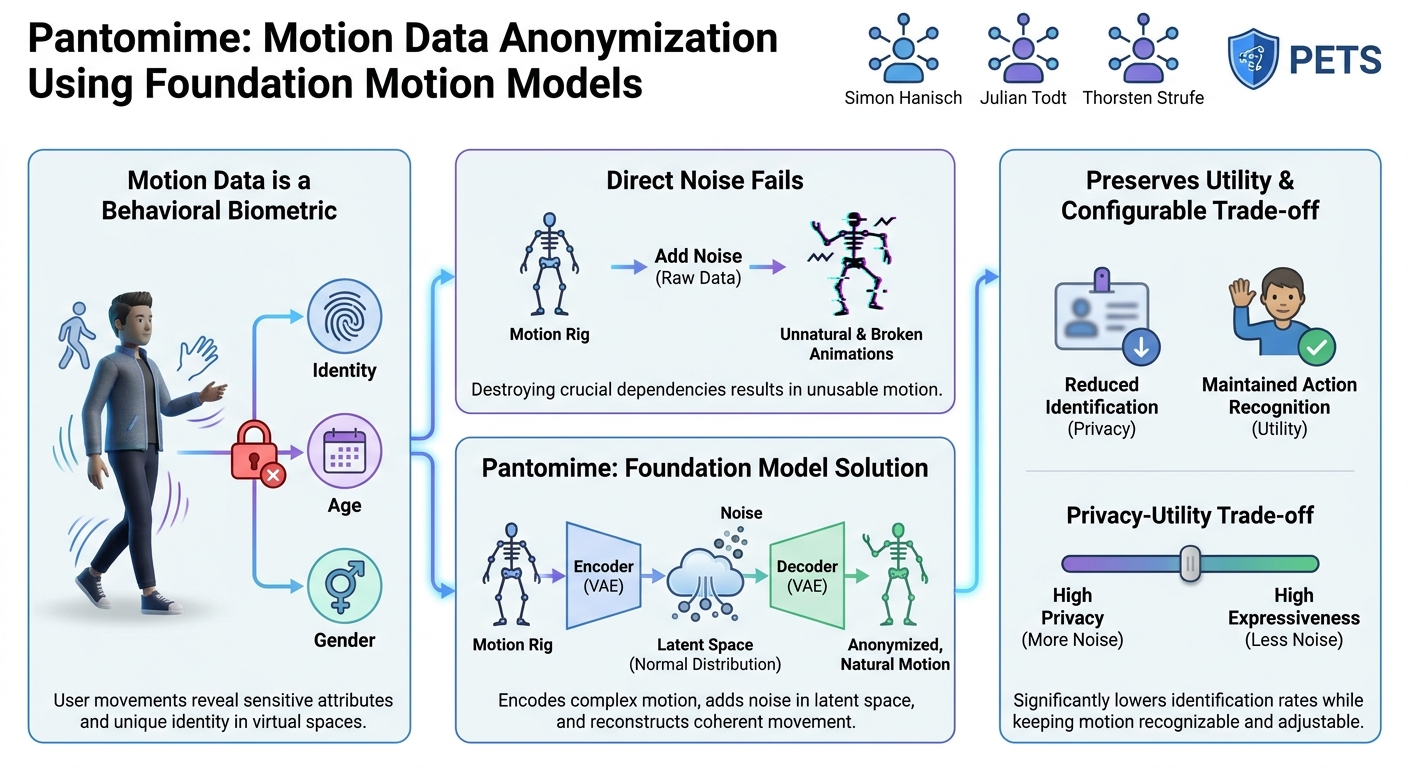
Addressing this research gap requires an anonymization technique that can drastically reduce identifiability while preserving the utility and naturalness of the motion. The challenge lies in maintaining the complex dependencies within human motion—the coordinated movement of limbs, joints, and temporal sequences—while simultaneously obscuring the unique biometric signature. Previous attempts at motion data anonymization have encountered various limitations. For instance, approaches like that by Nad et al. focused specifically on data from games like Beat Saber, limiting its generalizability and demanding substantial training data. Other methods, such as those employing adversarial anonymization by Malik Piasecki et al., often resulted in only symbolic representations of motion or struggled to quantify and maintain "naturalness," making the resulting avatar movements appear unrealistic or robotic. A naive approach of simply adding noise directly to motion data quickly breaks these intricate dependencies, leading to distorted, unnatural, and unusable animations, even if identification rates are reduced. This illustrates the fundamental difficulty: how to add noise to highly structured, dependent data without destroying its inherent meaning and visual coherence.
Key Findings
▶ Watch: Solution: Foundation motion models and latent spaces (3:50)
The central finding presented in the "Pantomime" talk is that foundation motion models provide an effective and generalizable mechanism for anonymizing complex motion data while preserving its essential utility and naturalness. The researchers demonstrated that by transforming raw motion data into a simpler, latent representation, noise can be strategically introduced to obscure individual identity without degrading the visual quality or functional integrity of the movement.
Specifically, the study revealed that Variational Autoencoders (VAEs), a type of foundation motion model, are particularly well-suited for this task. Their ability to encode similar motions into proximate points within a latent space, represented as normal distributions, facilitates the addition of noise in a way that respects the underlying kinematic and temporal dependencies of human movement. This contrasts sharply with direct noise injection, which invariably corrupts these intricate relationships.
Through rigorous evaluation, Pantomime achieved a significant reduction in identification accuracy, bringing it down to near chance level, while largely maintaining the action recognition capabilities and perceived naturalness of the anonymized motions. This innovative approach presents a configurable privacy-utility trade-off, allowing users or system administrators to adjust the level of anonymization based on their specific privacy requirements, without completely sacrificing the richness of avatar interaction. The generalizability of this method suggests its potential applicability beyond motion data, extending to other complex, dependent data types.
Technical Deep Dive
▶ Watch: Pantomime method: Encode, noise, decode for anonymization (4:40)
The core innovation of the Pantomime framework lies in its utilization of foundation motion models to overcome the inherent challenges of anonymizing highly structured and dependent data. Traditional methods of adding noise directly to motion data fail because human motion is not a collection of independent data points; rather, it is a complex interplay of joint angles, limb positions, and temporal sequences, where each element is deeply dependent on others. Disrupting this intricate structure through direct noise injection inevitably leads to unnatural, "broken" movements.
Pantomime addresses this by first transforming the motion data into a more manageable, simplified representation where noise can be applied without destroying critical dependencies. This transformation is achieved using foundation motion models, which are large neural networks trained on vast datasets of motion data. These models act akin to "dictionaries" for motion, learning the underlying grammar and semantics of human movement. A key advantage of these models is their ability to generalize to new, unseen motions, meaning the anonymization is not limited to the specific data used for training.
The researchers specifically opted for Variational Autoencoders (VAEs) as their foundation motion model. A VAE consists of two main components: an encoder and a decoder.
- Encoder: The encoder takes the raw, high-dimensional motion pose (e.g., a specific configuration of joint angles and positions at a given timestamp) as input and compresses it into a lower-dimensional latent space. Crucially, VAEs are designed such that similar motions are mapped to nearby points in this latent space, and each input is encoded not as a single point, but as a normal distribution (defined by a mean and a variance). This probabilistic representation is vital for the anonymization process.
- Latent Space Anonymization: Once the original pose is encoded into its latent representation (a normal distribution), the anonymization takes place. Instead of modifying the raw motion data, Pantomime adds normal distributed noise directly to the mean of this latent distribution. Because the latent space of a VAE captures the high-level semantic features of motion and encodes them probabilistically, adding noise here perturbs the identity-revealing characteristics while maintaining the structural integrity of the motion. The noise essentially shifts the encoded representation within the latent space, generating a new, slightly different normal distribution.
- Decoder: The decoder then takes a sample from this modified latent distribution and reconstructs it back into a full, high-dimensional motion pose. Because the noise was applied in a semantically rich latent space, the reconstructed pose still represents a plausible human movement, preserving the naturalness and dependencies that would be shattered by direct noise application. The reconstructed pose is now anonymized, having been perturbed in its underlying biometric signature, but still visually coherent and functional.
This process ensures that while the specific biometric markers embedded in the original motion are obscured, the overall kinematic chain (e.g., how the hand moves relative to the elbow, which moves relative to the shoulder) and the temporal flow of the motion remain intact. The use of VAEs is critical because their latent spaces are designed to capture meaningful variations in data, making them ideal for targeted perturbation that preserves utility. This sophisticated approach allows for a controlled privacy-utility trade-off, enabling the system to be tuned for stronger anonymization at the cost of slight utility reduction, or vice versa, based on specific application requirements.
Demo / Proof of Concept
▶ Watch: User study: Improved naturalness of anonymized motion (7:00)
The talk effectively demonstrated the practical application of the Pantomime framework through visual examples and quantitative evaluations. A key visual proof of concept was the side-by-side comparison of original, directly noised, and Pantomime-anonymized motion sequences. The "anonymous example" shown in the presentation depicted a human walking, which, after being processed by Pantomime, still appeared entirely natural and human-like, in stark contrast to the distorted, "broken" movements resulting from the naive direct noise approach. This visual evidence underscored the framework's ability to maintain motion naturalness.
Beyond visual appeal, the researchers conducted a comprehensive evaluation focusing on the privacy-utility trade-off.
For privacy quantification, they employed biometric recognition techniques. This involved training models to identify individuals based on their motion data and then measuring the identification accuracy on the anonymized data. The goal for anonymization is to reduce this accuracy to chance level, meaning the system can no longer reliably distinguish between individuals.
For utility quantification, they used action recognition. This involved training models to identify specific actions (e.g., walking, waving) from the motion data. The aim here was to show that even after anonymization, the underlying action or intent of the motion remained recognizable, preserving the functional utility for avatar interaction.
The results were compelling:
- Privacy: Pantomime successfully reduced identification accuracy significantly. As more noise was added in the latent space, the identification rate approached chance level, demonstrating a robust anonymization effect.
- Utility: Crucially, this reduction in identification did not come at a prohibitive cost to utility. The action recognition accuracy remained very close to the "clear level performance" of the original, non-anonymized data. This indicates that the core message or action conveyed by the motion was preserved.
- Trade-off Curve: The evaluation clearly illustrated a trade-off curve, showing that by adjusting the amount of noise added in the latent space, one could choose different points along a spectrum of privacy versus utility. This configurability is a major advantage, allowing deployments to tailor the anonymization strength to specific use cases and user preferences.
Further validating the naturalness, a user study was conducted. An online survey presented motion sequences (original, direct noise, and Pantomime-anonymized) to participants, who rated their perceived naturalness on a scale from 1 (very unnatural) to 5 (very natural).
- Original data predictably scored close to "very natural."
- Direct noise examples, which achieved a 10% or 20% identification rate, scored very poorly, validating that breaking dependencies results in unnatural motion.
- Pantomime's approach, even at comparable identification reduction levels, significantly increased the naturalness score compared to direct noise, approaching the scores of the original data. This subjective user feedback corroborated the objective action recognition metrics, confirming that the anonymized motions were aesthetically pleasing and functionally coherent to human observers. The demonstration effectively proved that Pantomime offers a viable solution for privacy-preserving motion in immersive environments.
Defensive Implications
▶ Watch: Conclusion: General applicability for complex data anonymization (7:40)
The "Pantomime" research carries significant implications for defenders, particularly those involved in developing and securing virtual reality, augmented reality, and metaverse platforms. The primary defensive takeaway is a stark reminder that raw motion data is a behavioral biometric and should be treated with the same level of sensitivity as other personal identifiers like facial scans or voice prints. It is not merely animation data; it is intrinsically tied to user identity and can facilitate pervasive surveillance and profiling.
For platform developers and architects, the findings underscore the urgent need to integrate privacy-by-design principles into motion capture and avatar animation pipelines. Relying on raw motion data transmission without anonymization is a critical vulnerability. Developers should consider implementing techniques like Pantomime at the earliest possible stage, ideally client-side, to ensure that identifying characteristics are removed before data leaves the user's device or enters a shared virtual space. This means:
- Adopting Latent Space Anonymization: Instead of transmitting raw joint data or full motion sequences, systems should explore transforming this data into a non-identifiable latent representation, similar to how Pantomime uses VAEs.
- Configurable Privacy Controls: Platforms should offer users explicit control over their motion data privacy, allowing them to adjust the privacy-utility trade-off. This could manifest as settings for "high privacy" (more anonymization, potentially slightly less expressive motion) versus "high expressiveness" (less anonymization, if the user explicitly consents to the higher privacy risk).
- Educating Users: Developers and platform providers have a responsibility to educate users about the biometric nature of their motion data and the risks associated with its unanonymized transmission. Transparency about data handling practices is crucial.
- Generalizability for Other Data Types: The underlying principle of using foundation models for anonymizing complex, dependent data can be extended. Defenders should consider if similar approaches could protect other forms of sensor data (e.g., physiological data, gaze tracking) that might also contain biometric identifiers.
For individual users of metaverse platforms, the defensive implication is one of awareness and vigilance. Users should understand that their movements in virtual spaces are not necessarily anonymous. They should scrutinize the privacy policies of platforms and demand robust anonymization features. If such features are not available, users should weigh the convenience and expressiveness of full motion capture against the potential privacy risks.
Ultimately, Pantomime provides a concrete, technically sound strategy for mitigating a pervasive privacy threat in emerging digital environments. Its adoption by industry could significantly enhance user trust and foster the responsible development of the metaverse. The research serves as a blueprint for how to build privacy-preserving systems for complex, high-dimensional data, moving beyond simplistic anonymization methods that often fail to address the intricate dependencies inherent in human-generated data.
Key Takeaways
- Motion data is a behavioral biometric: User movements in virtual environments are not anonymous and can be used to identify individuals and infer sensitive attributes like age and gender.
- Direct noise fails for complex data: Simply adding noise to raw motion data destroys crucial dependencies, resulting in unnatural, unusable animations, even if identity is obscured.
- Foundation motion models are key: Using models like Variational Autoencoders (VAEs) allows for transforming complex motion data into a latent space where noise can be applied effectively.
- Pantomime preserves utility and naturalness: The proposed framework significantly reduces identification rates (down to chance level) while largely maintaining the action recognition capabilities and perceived naturalness of the anonymized motions.
- Configurable privacy-utility trade-off: Pantomime offers flexibility, allowing systems to adjust the level of anonymization versus motion expressiveness based on specific privacy requirements.
- Generalizable approach: The core methodology of anonymizing complex, dependent data in the latent space of foundation models can be applied to other data types beyond just human motion.
About the Speaker(s)
The research behind "Pantomime: Motion Data Anonymization Using Foundation Motion Models" was a collaborative effort. Simon Hanisch, who presented the talk, is listed as a paper author from Technical University Dresden. He was joined in this work by Julian Todt and Thorsten Strufe, both credited as paper authors from Karlsruhe Institute of Technology. Their collective expertise likely spans areas such as privacy-enhancing technologies, machine learning, computer graphics, and network security, given the interdisciplinary nature of the research addressing biometric data, neural networks, and privacy in virtual environments.
Reviews
Dr. Zero (Offensive Security Researcher) — STRONG ACCEPT
Hanisch and team tackle VR telemetry harvesting with actual math instead of policy whining. Perturbing VAE latent space to strip biometric gait data while keeping the avatar moving naturally is an elegant, practical defense. This is exactly how you solve a creeping privacy nightmare before it gets calcified into industry standards.
Heather Calloway (CISO) — SOLID
Motion data in AR/VR isn't just application telemetry; it's a regulated behavioral biometric. This research demonstrates a viable, client-side mechanism for anonymizing spatial data without breaking the usability of the application. It's a niche but necessary design pattern for any enterprise privacy team currently vetting VR vendors.
→ Top-rated talks at Privacy Enhancing Technologies Symposium (PETS) 2026
All talks from Privacy Enhancing Technologies Symposium (PETS) 2026