VeriDP: Verifiable Differentially Private Training
Behzad Abdolmaleki (Paper author · University of Sheffield), Amir R. Asadi (Paper author · University of Cambridge), Vahid R. Asadi (Paper author · University of Waterloo), Stefan Köpsell (Paper author · Barkhausen Institut), Bhavish Mohee (Paper author · University of Sheffield), Nahid Roustaeifar (Paper author · University of Sheffield), Maryam Zarezadeh (Paper author · Barkhausen Institut)
Privacy Enhancing Technologies Symposium (PETS) 2026 · Day 3 · Moose
Overview
The proliferation of machine learning models has brought immense capabilities but also significant privacy concerns, particularly regarding the sensitive data used for training. This talk, "VeriDP: Verifiable Differentially Private Training," presented by Maryam Zarezadeh on behalf of her co-authors, addresses a critical gap in the practical application of privacy-preserving machine learning. Specifically, it tackles the challenge of verifying that Differential Privacy (DP) mechanisms, often implemented through DP-SGD (Differentially Private Stochastic Gradient Descent), have been correctly and honestly applied by a model trainer.
Key moments
- 0:00 Introduction: Verifying DP application in SGD
- 2:00 VeriDP solution: Zero-knowledge proof verification for DP-SGD
- 3:50 High-level VeriDP workflow and execution steps
- 4:30 Technical details: Verifiable Gaussian noise generation
- 5:55 Performance evaluation: Proof size, prover time, comparison
- 7:05 Future directions: Larger models, hardware, federated learning
VeriDP: Verifiable Differentially Private Training
Speakers: Behzad Abdolmaleki (Paper author, University of Sheffield); Amir R. Asadi (Paper author, University of Cambridge); Vahid R. Asadi (Paper author, University of Waterloo); Stefan Köpsell (Paper author, Barkhausen Institut); Bhavish Mohee (Paper author, University of Sheffield); Nahid Roustaeifar (Paper author, University of Sheffield); Maryam Zarezadeh (Paper author, Barkhausen Institut)
Conference: PETS
YouTube: https://www.youtube.com/watch?v=KxUR5323EMw
Overview
The proliferation of machine learning models has brought immense capabilities but also significant privacy concerns, particularly regarding the sensitive data used for training. This talk, "VeriDP: Verifiable Differentially Private Training," presented by Maryam Zarezadeh on behalf of her co-authors, addresses a critical gap in the practical application of privacy-preserving machine learning. Specifically, it tackles the challenge of verifying that Differential Privacy (DP) mechanisms, often implemented through DP-SGD (Differentially Private Stochastic Gradient Descent), have been correctly and honestly applied by a model trainer.
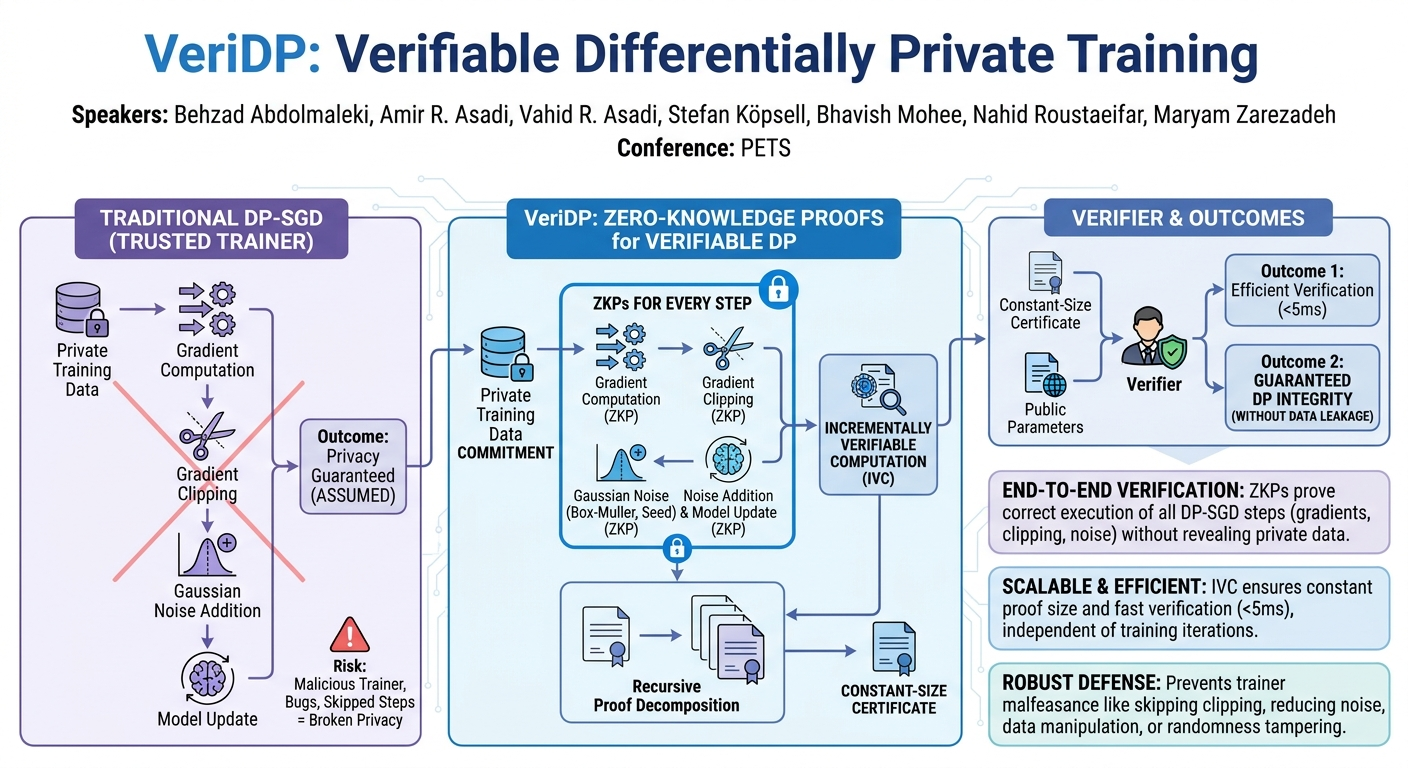
Traditional DP-SGD implementations fundamentally rely on the assumption that the training entity is honest and faithfully executes all the necessary privacy-preserving steps, such as gradient clipping and noise addition. However, in real-world scenarios, a malicious or even negligent trainer could intentionally or unintentionally bypass these mechanisms, thereby compromising the privacy guarantees. VeriDP introduces a novel framework that leverages Zero-Knowledge Proofs (ZKPs) to allow trainers to cryptographically prove the correct application of DP-SGD without revealing any underlying private training data. This innovation is crucial for building trust and ensuring accountability in privacy-sensitive machine learning deployments.
The significance of VeriDP extends beyond mere academic curiosity; it provides a robust solution to a pressing practical problem. By enabling public and verifiable auditing of DP-SGD, VeriDP safeguards against various forms of trainer malfeasance, including skipping clipping, reducing noise levels, manipulating training data, or tampering with randomness. This capability is paramount for industries handling highly sensitive information, such as healthcare, finance, and government, where the integrity of privacy guarantees is not just desirable but legally mandated. VeriDP thus marks a substantial step forward in operationalizing truly trustworthy and privacy-preserving machine learning systems.
Background
▶ Watch: Introduction: Verifying DP application in SGD (0:00)
The foundation of modern machine learning, particularly in deep learning, often rests on optimization algorithms like Stochastic Gradient Descent (SGD). In SGD, a model is iteratively updated by calculating gradients on small batches of training data (mini-batches) and adjusting model weights accordingly. While highly effective for learning complex patterns, this process inherently exposes information about the training data through the gradients themselves. Research has shown that these gradients can be exploited by adversaries to infer sensitive details about individual data points used in training, posing a significant privacy risk.
To counter this, Differential Privacy (DP) emerged as a rigorous mathematical framework to quantify and limit the information leakage about individual records in a dataset. DP ensures that the outcome of a computation is nearly identical whether or not any single individual's data is included in the dataset, thereby providing strong privacy guarantees. A landmark contribution in this area was the introduction of DP-SGD in CCS 2016. DP-SGD modifies the standard SGD algorithm by incorporating two key privacy-preserving steps: first, gradient clipping, which bounds the sensitivity of individual gradients, and second, the addition of carefully calibrated Gaussian noise to the clipped gradients before they are used to update the model. This noise obfuscates the contribution of any single data point, thus achieving differential privacy.
Despite the theoretical elegance and practical utility of DP-SGD, a critical vulnerability persists: the implicit assumption of an honest trainer. Existing DP-SGD systems operate under the premise that the entity performing the training will diligently follow all the prescribed steps—computing gradients, clipping them, adding the correct amount of Gaussian noise, and then updating the model—without deviation. However, in scenarios where the trainer might be malicious, compromised, or simply buggy, these privacy mechanisms could be circumvented. A malicious trainer could, for instance, skip the clipping step, add insufficient noise, or even manipulate the randomness used for noise generation, effectively nullifying the privacy guarantees. This fundamental trust assumption creates a significant security gap, as there has been no robust, publicly verifiable mechanism to confirm that DP-SGD was indeed applied correctly. While prior work like "DP proof" has explored aspects of verifiable differential privacy, it often suffers from limitations such as applicability only to simpler models (e.g., linear or logistic regression) or inefficiency for the iterative nature of general SGD. VeriDP directly addresses this gap, aiming to provide a comprehensive and efficient solution to verify the integrity of DP-SGD execution across all its crucial steps.
Key Findings
▶ Watch: High-level VeriDP workflow and execution steps (3:50)
VeriDP makes several significant contributions to the field of privacy-preserving machine learning by introducing a robust framework for verifiable differentially private training. The core finding is the successful design and implementation of a system that allows a trainer to cryptographically prove the correct application of DP-SGD without revealing any private training data. This capability fundamentally transforms the trust model, moving from an assumed honesty to a verifiable one.
The primary contributions of VeriDP can be summarized as follows:
- Zero-Knowledge Proofs for Each DP-SGD Step: VeriDP provides a detailed construction of zero-knowledge proofs (ZKPs) for every individual step involved in the DP-SGD algorithm. This includes the computation of gradients, the crucial gradient clipping operation, the generation and addition of Gaussian noise, and the final model weight update. By proving each step, VeriDP ensures end-to-end integrity of the DP-SGD process.
- Recursive Proof Decomposition with IVC: To achieve practical efficiency and constant proof size regardless of the training duration or number of iterations, VeriDP intelligently utilizes the concept of Incrementally Verifiable Computation (IVC). This technique allows for the recursive decomposition of proofs into compact, constant-sized certificates. A verifier can then use these small certificates along with public information to efficiently verify the entire SGD algorithm's execution, addressing the scalability challenges often associated with ZKPs over many iterations.
- Trainer Commitment to Dataset: The framework mandates that the trainer commits to the entire dataset at the outset of the training process. This commitment ensures that the trainer cannot alter or manipulate the training data midway through the process, thereby preventing a critical avenue for privacy breaches or model poisoning attacks.
- Defense Against Malicious Trainer Behaviors: VeriDP explicitly provides solutions to defend against a range of malicious behaviors by a trainer. This includes scenarios where a trainer might intentionally skip gradient clipping, reduce the amount of added noise, change the training data after committing, or manipulate the randomness used for noise generation. The ZKPs ensure that any deviation from the specified DP-SGD protocol is detectable.
- Compact and Efficient Proof Verification: A key practical finding is the efficiency of the VeriDP system. The verification time for a proof is remarkably fast, reported to be less than 5 milliseconds. Furthermore, the proof size remains constant, irrespective of the number of training iterations, which is a direct benefit of the IVC integration. The prover's time, while linear with respect to the training process, contributes to the overall scalability of the approach.
- Performance Outperformance: In comparative evaluations, VeriDP demonstrates superior performance against existing approaches like "DP proof" for models with moderate and large batch sizes. This efficiency gain is attributed to VeriDP's constant overhead, which becomes increasingly advantageous as batch sizes grow, making it more practical for real-world machine learning tasks.
- Privacy and Correctness Guarantees: Ultimately, VeriDP's core finding is its ability to simultaneously guarantee both the privacy (through correct DP application) and the correctness (through verifiable execution) of the training process, all within an efficient framework. The verifier gains confidence in the DP application without learning any sensitive information about the private training data.
These findings collectively establish VeriDP as a robust, scalable, and practical solution for verifiable differential privacy, significantly enhancing the trustworthiness of privacy-preserving machine learning.
Technical Deep Dive
▶ Watch: Technical details: Verifiable Gaussian noise generation (4:30)
VeriDP's technical prowess lies in its sophisticated integration of Zero-Knowledge Proofs (ZKPs) to verify every critical step of the DP-SGD algorithm. At its core, a ZKP is an argument system where a Prover (Alice) can convince a Verifier (Bob) that a certain statement is true (e.g., "I performed this computation correctly") without revealing any information beyond the truth of the statement itself. The ZKP system in VeriDP adheres to three fundamental properties:
- Completeness: If the statement is true and the Prover is honest, the Verifier will accept the proof.
- Soundness: If the statement is false, a dishonest Prover cannot convince the Verifier (or can do so only with a negligible probability).
- Zero-Knowledge: The Verifier learns nothing about the secret inputs (e.g., private training data) other than the validity of the statement.
The VeriDP workflow begins with the trainer making a cryptographic commitment to the dataset. This commitment ensures data integrity throughout the training process, preventing any unauthorized modifications to the input data. Additionally, the trainer provides a seed that will be used for generating the necessary Gaussian noise.
For each iteration of the SGD algorithm, VeriDP constructs a ZKP circuit that encompasses the following operations:
- Gradient Computation: The model computes gradients based on a mini-batch of the committed dataset. The ZKP verifies that these gradients are correctly derived from the model and the specified data batch.
- Gradient Clipping: A crucial DP step, gradients are clipped to a predefined L2 norm to limit the influence of any single data point. The ZKP ensures that this clipping operation is applied correctly and that the gradients do not exceed the specified bound.
- Gaussian Noise Generation: This is a critical component for differential privacy. VeriDP's noise generation process is also verifiable:
- It starts with the provided seed, which is used to generate a stream of uniform randomness.
- To transform this uniform randomness into the required Gaussian distribution, VeriDP employs the Box-Muller transform. This renowned algorithm efficiently converts pairs of independent uniform random variables into independent standard Gaussian random variables.
- The generated Gaussian noise is then scaled to the appropriate magnitude, which depends on the privacy budget (epsilon, delta).
- To prevent replay attacks and ensure the integrity of the noise generation, VeriDP incorporates "contents" information, such as the training data and commitment, concatenated with a random value and a hash of these elements. This ensures the uniqueness and verifiability of the noise generation process for each iteration.
- Noise Addition: The scaled Gaussian noise is added to the clipped gradients. The ZKP verifies that this addition is performed accurately.
- Model Weight Update: Finally, the noisy gradients are used to update the model's weights. The ZKP confirms that the model update rule is applied correctly based on the noisy gradients.
A significant challenge in applying ZKPs to iterative algorithms like SGD is the potentially enormous size of the proof, which would grow with each training iteration. VeriDP overcomes this by utilizing Incrementally Verifiable Computation (IVC). IVC allows the proof of one iteration to be recursively incorporated into the proof of the next, resulting in a constant-size certificate that summarizes the correctness of all preceding iterations. This means that regardless of how many epochs or iterations the training process involves, the final proof size remains compact and efficient for verification. This recursive decomposition is key to VeriDP's scalability.
All these steps—from gradient calculation to clipping, noise generation via Box-Muller, and model update—are represented as a circuit in zero-knowledge. The prover executes these steps within the circuit and generates a proof, which is then publicly available. Anyone can then use this proof and the public parameters of the training (e.g., model architecture, privacy budget) to verify that the DP-SGD algorithm was executed correctly, without gaining any insight into the private training data itself. This meticulous design ensures that VeriDP can defend against various malicious actions, including skipping clipping, reducing noise, or tampering with the randomness, thereby providing a strong cryptographic guarantee for differential privacy.
Demo / Proof of Concept
▶ Watch: Performance evaluation: Proof size, prover time, comparison (5:55)
While the talk did not feature a live, interactive demonstration in the traditional sense, the authors presented compelling evaluation results that serve as a robust proof of concept for VeriDP's practical viability and efficiency. These empirical findings demonstrate that the proposed verifiable DP-SGD framework is not merely a theoretical construct but a deployable system capable of operating within acceptable performance parameters.
The evaluation specifically focused on assessing VeriDP's performance across different machine learning models, meticulously measuring key metrics such as verification time, proof size, and prover time. The results highlight several critical aspects of VeriDP's efficiency:
- Verification Time: One of the most impressive results is the extremely low verification time, consistently measured at less than 5 milliseconds. This rapid verification speed is crucial for practical adoption, as it allows for quick and efficient auditing of DP-SGD compliance without introducing significant latency into the overall workflow.
- Constant Proof Size: As a direct benefit of integrating Incrementally Verifiable Computation (IVC), the generated proof size remains constant regardless of the number of training iterations. This is a monumental achievement for iterative algorithms like SGD, where proof sizes would otherwise grow prohibitively large, making verification impractical for long training runs. This constant proof size ensures scalability and ease of storage and transmission for auditing purposes.
- Linear Prover Time: The time required for the prover to generate the cryptographic proof is linear with respect to the number of training iterations. While proof generation is computationally more intensive than verification, its linear scalability ensures that VeriDP remains viable even for training models over many epochs, preserving the overall scalability of the approach.
Furthermore, the authors benchmarked VeriDP against existing solutions, specifically mentioning a prior work referred to as "DP proof." They reported that VeriDP outperforms "DP proof" for models with moderate and large batch sizes. This performance advantage stems from VeriDP's constant overhead, which becomes more efficient as the batch size increases, making it a more practical choice for many real-world machine learning applications that often utilize larger batch sizes for training efficiency. The "DP proof" approach, in contrast, was noted to be less efficient for general SGD and primarily applicable to simpler models like linear or logistic regression.
These evaluation results collectively demonstrate that VeriDP successfully addresses the challenges of efficiency and scalability inherent in applying zero-knowledge proofs to complex, iterative machine learning algorithms. The observed performance metrics validate VeriDP as a practical and effective solution for enabling verifiable differential privacy in real-world machine learning deployments.
Defensive Implications
▶ Watch: Future directions: Larger models, hardware, federated learning (7:05)
VeriDP fundamentally shifts the paradigm of trust in privacy-preserving machine learning, moving from an assumption of honesty to a verifiable guarantee. The defensive implications of this framework are profound and far-reaching, offering robust protections against a variety of threats in sensitive data environments.
Firstly, the most direct defensive implication is the mitigation of malicious or accidental trainer misconduct. In traditional DP-SGD, a trainer could, either intentionally or through error, bypass crucial privacy mechanisms. This includes:
- Skipping gradient clipping: Failing to clip gradients can allow individual data points to disproportionately influence the model update, leading to significant privacy leakage.
- Reducing noise levels: Insufficient noise addition directly compromises differential privacy guarantees, making it easier to infer sensitive information.
- Manipulating training data: A trainer might alter the training dataset after initial commitment, potentially introducing backdoors or compromising privacy.
- Tampering with randomness: If the randomness used for noise generation is predictable or manipulated, the privacy guarantees are invalidated.
VeriDP's zero-knowledge proofs for every step of DP-SGD ensure that any such deviation from the specified protocol is immediately detectable by any verifier. This capability provides a strong deterrent against malicious actors and offers a safety net against unintentional errors, significantly enhancing the integrity of the training process.
Secondly, VeriDP enables independent auditing and regulatory compliance. For organizations operating under strict data privacy regulations (e.g., GDPR, HIPAA), demonstrating compliance with differential privacy has been a significant challenge. VeriDP provides a cryptographic artifact—the proof—that can be publicly verified, offering concrete evidence that DP was correctly applied. This is invaluable for regulatory bodies, internal auditors, and even external stakeholders to gain assurance without needing access to sensitive raw data or proprietary training processes.
Thirdly, the framework enhances trust in shared or outsourced machine learning environments. In scenarios where model training is outsourced to third-party cloud providers or collaborative federated learning setups, the data owner can now be confident that their privacy requirements are being met. The ability to verify DP application without revealing the private training data fosters greater collaboration and data sharing, accelerating innovation in privacy-sensitive domains. The talk specifically mentions applying VeriDP to federated learning as a future direction, highlighting its potential to address challenges like partial participation and heterogeneous clients while maintaining verifiable privacy.
Finally, VeriDP provides a blueprint for building more resilient and trustworthy AI systems. By cryptographically guaranteeing both correctness and privacy, it lays the groundwork for AI applications where the integrity of privacy protection is paramount. This is particularly relevant for high-stakes applications in healthcare (e.g., training models on patient data), finance (e.g., fraud detection with sensitive transaction data), and national security, where the failure of privacy guarantees could have severe consequences. The future work also considers applying VeriDP to larger models with billions of parameters and leveraging hardware accelerators for ZKP, indicating a pathway towards even more robust and scalable defensive capabilities.
Key Takeaways
- VeriDP enables verifiable Differential Privacy (DP) for Stochastic Gradient Descent (SGD) algorithms, addressing the critical problem of trusting trainers to honestly apply privacy mechanisms.
- The system utilizes Zero-Knowledge Proofs (ZKPs) to cryptographically verify every step of DP-SGD, including gradient computation, clipping, noise generation, and model updates, without revealing private training data.
- VeriDP achieves constant proof size and efficient verification (less than 5 ms) by leveraging Incrementally Verifiable Computation (IVC) for recursive proof decomposition, making it scalable for iterative training processes.
- It provides robust defenses against malicious trainer behaviors, such as skipping clipping, reducing noise, manipulating data, or tampering with randomness, ensuring the integrity of privacy guarantees.
- Empirical evaluations show VeriDP outperforms prior verifiable DP approaches for moderate and large batch sizes, demonstrating practical efficiency for real-world machine learning tasks.
- VeriDP significantly enhances trust, auditability, and regulatory compliance in privacy-preserving machine learning, enabling safer deployment in sensitive domains like healthcare and finance.
About the Speaker(s)
The talk "VeriDP: Verifiable Differentially Private Training" was presented by Maryam Zarezadeh, affiliated with the Barkhausen Institut. She spoke on behalf of a collaborative team of co-authors, including Behzad Abdolmaleki (University of Sheffield), Amir R. Asadi (University of Cambridge), Vahid R. Asadi (University of Waterloo), Stefan Köpsell (Barkhausen Institut), Bhavish Mohee (University of Sheffield), and Nahid Roustaeifar (University of Sheffield). Their collective expertise spans critical areas of computer science and engineering, including privacy-preserving machine learning, differential privacy, zero-knowledge proofs, and machine learning algorithms. The depth of the technical solutions presented, particularly the intricate design of ZKPs for DP-SGD and the integration of IVC, reflects a strong research background in cryptography and its application to pressing challenges in data privacy and machine learning. Their affiliations with prestigious academic institutions underscore their contributions to cutting-edge research in these fields.
Reviews
Dr. Zero (Offensive Security Researcher) — STRONG ACCEPT
VeriDP tackles the massive, unspoken assumption in privacy-preserving ML: that the entity training the model isn't lying to you about applying differential privacy. By wrapping DP-SGD steps in zero-knowledge proofs and using IVC to keep the proof size from exploding, they’ve turned 'trust me' into 'verify it.' It's heavy cryptographic lifting that solves a real-world supply chain problem for outsourced ML.
Heather Calloway (CISO) — STRONG ACCEPT
If you are outsourcing machine learning on sensitive data, you are currently relying on paper contracts to ensure the vendor doesn't compromise your privacy guarantees. This research shifts that paradigm from legal trust to mathematical proof. It is a required view for any enterprise AI governance committee figuring out how to audit third-party model trainers.
→ Top-rated talks at Privacy Enhancing Technologies Symposium (PETS) 2026
All talks from Privacy Enhancing Technologies Symposium (PETS) 2026