“We Need a Standard”:Toward an Expert–Informed Privacy Label for Differential Privacy
Onyinye Dibia (Paper author · University of Vermont), Mengyi Lu (Paper author · University of Vermont), Prianka Bhattacharjee (Paper author · University of Vermont), Joseph P Near (Paper author · University of Vermont), Yuanyuan Feng (Paper author · University of Vermont)
Privacy Enhancing Technologies Symposium (PETS) 2026 · Day 3 · Beaver
Overview
This talk, presented at PETS, addresses a critical challenge in the widespread adoption and understanding of Differential Privacy (DP): effective communication of its guarantees. Authored by Onyinye Dibia, Mengyi Lu, Prianka Bhattacharjee, Joseph P Near, and Yuanyuan Feng from the University of Vermont, the research shifts focus from the technical intricacies of DP mechanisms to the realm of usable privacy. It highlights the growing deployment of DP in real-world applications by tech giants like Google and Apple, juxtaposed with a significant gap in how these privacy guarantees are conveyed to various stakeholders, from developers to end-users.
Key moments
- 0:00 Framing the challenge of communicating differential privacy
- 2:00 Why clear communication of DP guarantees is crucial
- 4:55 Expert insights on essential DP parameters often overlooked
- 7:25 Tailoring DP label details for different target audiences
- 8:30 Recommendations for standardized and layered DP label design
- 10:15 Demonstrating the initial prototype of a comprehensive DP label
- 11:55 Future work and open challenges for DP label development
“We Need a Standard”: Toward an Expert–Informed Privacy Label for Differential Privacy
Speakers: Onyinye Dibia (Paper author, University of Vermont); Mengyi Lu (Paper author, University of Vermont); Prianka Bhattacharjee (Paper author, University of Vermont); Joseph P Near (Paper author, University of Vermont); Yuanyuan Feng (Paper author, University of Vermont)
Conference: PETS
YouTube: https://www.youtube.com/watch?v=ZtC8l6ktbmA
Overview
This talk, presented at PETS, addresses a critical challenge in the widespread adoption and understanding of Differential Privacy (DP): effective communication of its guarantees. Authored by Onyinye Dibia, Mengyi Lu, Prianka Bhattacharjee, Joseph P Near, and Yuanyuan Feng from the University of Vermont, the research shifts focus from the technical intricacies of DP mechanisms to the realm of usable privacy. It highlights the growing deployment of DP in real-world applications by tech giants like Google and Apple, juxtaposed with a significant gap in how these privacy guarantees are conveyed to various stakeholders, from developers to end-users.
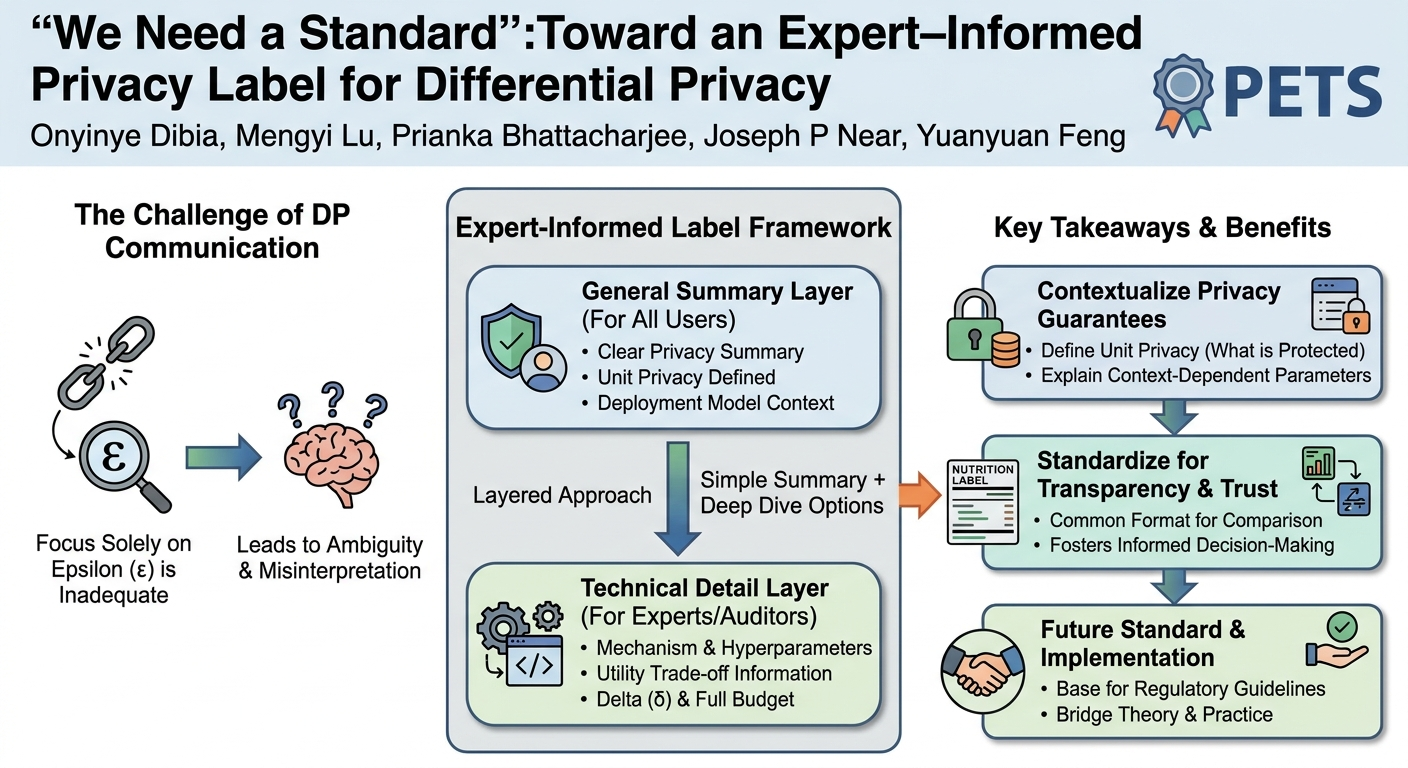
The core of the problem lies in the current lack of standardization and comprehensive context in DP disclosures. Practitioners often encounter isolated parameters like epsilon (ε) without a clear understanding of their implications, leading to confusion, misinterpretation, and ultimately, a reduction in trust. This talk champions the urgent need for a structured, expert-informed privacy label for DP, akin to nutrition labels for food or privacy labels for apps, to demystify its complex assurances. The researchers' primary goal is to lay the groundwork for future standards that can effectively bridge the divide between theoretical DP guarantees and their practical, understandable communication.
The significance of this work cannot be overstated. As Differential Privacy becomes an increasingly vital tool for data analysis while preserving individual privacy, its efficacy hinges not just on its mathematical rigor but also on its transparency and interpretability. By proposing a framework for standardized DP communication, this research aims to enhance trust, facilitate informed decision-making, and ensure that the powerful protections offered by DP are neither misunderstood nor underutilized, thereby closing a crucial gap between academic theory and real-world deployment.
Background
▶ Watch: Framing the challenge of communicating differential privacy (0:00)
Differential Privacy (DP) has emerged as the gold standard for privacy-preserving data analysis, offering strong mathematical guarantees that the output of an analysis will not reveal whether any individual's data was included in the input dataset. The fundamental concept involves carefully adding calibrated noise to query results, ensuring that the presence or absence of a single individual's data record does not significantly alter the final output. For instance, the talk illustrates this with a learning app dataset: if removing a student's record drastically changes the average time spent on the app, an observer could infer information about that student. DP mitigates this by injecting noise, making the results from datasets with and without a specific individual look "very similar."
However, the practical application of DP is far more nuanced than simply adding noise. A complete DP guarantee is not reducible to a single number; it depends on a multitude of factors including deployment models, privacy parameters (like epsilon and delta), algorithm hyperparameters, and the specific context of data usage. This inherent complexity poses a significant challenge for communication. Real-world DP deployments, as noted by the speakers, often use varying information and configurations, leaving stakeholders — from data scientists to end-users — grappling with incomplete or decontextualized privacy statements. The most frequently cited parameter, epsilon, is often presented in isolation, making it difficult for non-experts to interpret its meaning or understand its implications for privacy risk. This leads to widespread confusion and erodes trust in DP systems.
Prior research has attempted to address aspects of DP communication. Commits' work, for example, explained DP concepts but primarily focused on epsilon and communicated only limited parameters. Other studies have highlighted the importance of disclosing epsilon in real-world deployments but have stopped short of proposing a full standard for comprehensive communication. Furthermore, Kelly's work demonstrated the effectiveness of privacy labels in organizing privacy information generally, but these were not tailored specifically to the unique challenges of Differential Privacy. This collective body of work reveals a critical gap: a lack of a comprehensive framework that defines what a complete DP label should disclose to effectively communicate its guarantees. The University of Vermont team’s research directly addresses this void, aiming to inform future standards for DP communication by identifying essential parameters and key considerations for their presentation.
Key Findings
▶ Watch: Expert insights on essential DP parameters often overlooked (4:55)
The research methodology involved an expert interview study with 12 Differential Privacy experts from both academia and industry. These interviews focused on three core areas: identifying important DP parameters, understanding their typical ranges and target audiences, and gathering recommendations for label structure and presentation. The study yielded several crucial findings that directly inform the proposed DP communication standard.
1. Identification of Important DP Parameters:
The experts did not reach full consensus on all parameters, but several key insights emerged. While epsilon (ε) was universally acknowledged as important, the study found that unit privacy and utility information are equally, if not more, critical for understanding DP guarantees, yet they are often overlooked in current disclosures. The finding emphasizes that a DP label should not solely communicate epsilon but must include broader context, such as what constitutes a "unit" of privacy (e.g., an individual record, a query, a day's worth of data) and the resulting trade-off between privacy and data utility. This broader context is essential for a meaningful interpretation of privacy guarantees.
2. Typical Ranges and Context Dependency:
Experts offered guidance on typical ranges for parameters, suggesting values like 0.05 to 1 for epsilon. However, they strongly emphasized that these are not fixed values but are heavily dependent on context. For instance, higher epsilon values might be acceptable in industrial settings or for high-dimensional data. This finding highlights a significant challenge: there is no universal consensus on standard ranges for most DP parameters. This raises an open question for data users: how should they decide on appropriate parameter values without clear, standardized benchmarks? The implication is that any effective DP label must not only disclose the parameter values but also provide sufficient contextual information to aid in their interpretation.
3. Tailoring Information for Different Audiences:
The study identified three primary categories of audience: general, technical, and mixed. The experts agreed that certain parameters are crucial for both general and technical audiences, including epsilon, unit privacy, the deployment model (e.g., local, central, shuffled DP), and empirical metrics. Conversely, highly technical parameters such as delta (δ), the specific mechanism used (e.g., Laplace, Gaussian), and algorithm hyperparameters were deemed more relevant for a technical audience. Utility information received mixed feedback, with some experts considering it important for technical users but less so for a general audience. This led to a key conclusion: no single label design can effectively serve all audiences. A layered approach is necessary, balancing general understanding with the provision of detailed technical information for those who require it.
4. Recommendations for DP Label Design:
Experts converged on three primary recommendations for designing an effective DP label:
- Standardization: Current deployments vary significantly in the information they report. A common, standardized format would make DP guarantees easier to understand, compare, and trust across different products and services.
- Layered Approach: The label should present a simple summary upfront, allowing users to quickly grasp the essential information. For those who need deeper insight, the label should provide options to access more detailed technical specifications.
- Accessibility: DP labels should be easy to find, prominently placed on data releases, documentation, and product information, similar to how nutrition labels are displayed on food packaging.
These findings collectively underscore the complexity of communicating Differential Privacy effectively and provide a robust framework for developing a comprehensive, user-centric DP communication standard.
Technical Deep Dive
▶ Watch: Tailoring DP label details for different target audiences (7:25)
The findings from the expert interviews illuminate the critical technical parameters that must be included in any comprehensive Differential Privacy label, extending far beyond the commonly cited epsilon (ε). Understanding these parameters and their interdependencies is crucial for both implementers and consumers of DP systems.
Epsilon (ε): The Core Privacy Budget
Epsilon quantifies the strength of the privacy guarantee. A smaller epsilon value indicates stronger privacy protection, meaning it's harder to infer an individual's presence or absence in the dataset. The experts suggested typical ranges for epsilon, such as 0.05 to 1, but critically noted that these are context-dependent. In industrial applications or with high-dimensional data, higher epsilon values might be used. A complete label should not just state epsilon but provide context, such as a description of what that specific epsilon value implies for privacy risk, the remaining privacy budget (especially in adaptive or sequential analyses), and links to further explanations.
Delta (δ): The Probability of Failure
While epsilon provides a strong guarantee, delta (δ) accounts for a small probability that the privacy guarantee might not hold. A delta value of zero means pure differential privacy, but often a very small, non-zero delta (e.g., 10<sup>-5</sup> or 10<sup>-9</sup>) is used to achieve better utility, particularly with mechanisms like Gaussian noise. Experts identified delta as more crucial for a technical audience, as its interpretation requires an understanding of statistical probabilities and its interplay with epsilon.
Unit Privacy: Defining the Individual
Perhaps one of the most overlooked yet fundamentally important parameters is unit privacy. This defines what constitutes the "individual" whose privacy is being protected. Is it a single row in a database? A user's entire history? A specific query? The choice of unit privacy significantly impacts the interpretation of epsilon. If epsilon protects a single row, the privacy guarantee is different than if it protects a user's entire activity over time. The experts stressed that without a clear definition of the unit of privacy, the meaning of epsilon is ambiguous. For instance, if a system releases daily statistics, is the unit privacy protecting an individual's contribution to one day's statistic, or their contribution across all days? This needs explicit clarification in a DP label.
Deployment Model: How DP is Applied
The deployment model describes how Differential Privacy is implemented. Key models include:
- Central DP: A trusted curator collects raw data, applies DP, and releases noisy results. The curator is a single point of trust.
- Local DP: Noise is added to each individual's data before it is collected by a central server. This offers stronger guarantees against a malicious curator but typically results in lower utility.
- Shuffled DP: An intermediary shuffles locally privatized data before it reaches the curator, offering a stronger guarantee than local DP while potentially improving utility.
Understanding the deployment model is crucial because it indicates who is trusted and where the privacy-preserving noise is introduced.
Mechanism and Algorithm Hyperparameters: The Specifics of Noise
The specific DP mechanism employed (e.g., Laplace mechanism for numerical queries, Gaussian mechanism for real-valued outputs, Exponential mechanism for selection) and its associated hyperparameters are vital for technical users. For example, the Laplace mechanism's scale parameter is directly derived from epsilon and the query's sensitivity. Disclosing the mechanism used and any specific parameters (e.g., number of iterations, batch size, specific noise distribution parameters) provides critical insight into the technical implementation and its robustness.
Utility Information: The Privacy-Accuracy Trade-off
Differential Privacy inherently involves a trade-off between privacy and data utility (accuracy). Utility information quantifies the impact of privacy-preserving noise on the accuracy or usefulness of the released data. This could be expressed as error bounds, expected noise levels, or the resulting degradation in model performance (e.g., accuracy loss in a machine learning model). While experts had mixed opinions on its importance for a general audience, it is undeniably critical for technical users who need to assess whether the privatized data remains fit for their intended analytical purpose.
Empirical Metrics:
Beyond theoretical guarantees, empirical metrics can provide real-world insights into the performance and privacy implications of a DP system. These could include measurements of actual error introduced, comparisons of privatized vs. non-privatized data utility on specific tasks, or even audits of the privacy budget consumption over time. Such metrics offer practical validation and can enhance trust.
The technical deep dive reveals that a truly informative DP label must transcend a single number and embrace a comprehensive disclosure of these interconnected parameters. The challenge lies in presenting this complexity in a layered, accessible manner that caters to diverse technical competencies without sacrificing crucial details.
Demo / Proof of Concept
▶ Watch: Demonstrating the initial prototype of a comprehensive DP label (10:15)
While the talk did not feature a live software demonstration or a fully implemented system, the researchers presented an initial design prototype for a Differential Privacy label. This prototype serves as a visual manifestation of their expert-informed framework and illustrates how the identified parameters and design recommendations could be integrated into a practical communication tool.
The prototype label was presented in two parts: a full label design on the left side, showcasing various sections for different parameters, and a zoomed-in view of the "privacy parameters" section on the right. The key innovation in this design is its departure from simply displaying a numerical value for epsilon. Instead, the prototype demonstrates a layered approach to information disclosure.
In the zoomed-in section focusing on privacy parameters, the label not only presents the epsilon value but also provides crucial contextual information. This includes:
- A description of what the epsilon value signifies in terms of privacy protection.
- Information about the remaining privacy budget, which is particularly relevant for systems that engage in sequential or adaptive data releases where the budget is consumed over time.
- Links or expandable sections that allow users to access more detailed technical explanations if needed.
The full label design incorporates sections for other critical parameters identified in the study, such as unit privacy information and utility information. By organizing these details into distinct, clearly labeled sections, the prototype aims to make the complex landscape of DP guarantees more navigable. The overarching idea is to present a concise summary initially, allowing users to quickly grasp the high-level privacy posture. Those requiring deeper understanding or technical validation can then "click" or expand specific sections to reveal the underlying details, mechanisms, and hyperparameters. This design directly addresses the expert recommendation for a layered, standardized, and easily accessible communication format, bridging the gap between a simple number and the full technical complexity of Differential Privacy. It serves as a concrete starting point for future iterations and evaluations with diverse user groups.
Defensive Implications
▶ Watch: Future work and open challenges for DP label development (11:55)
The findings and proposed framework for a standardized DP label carry significant implications for various stakeholders involved in the defense against privacy breaches and the responsible deployment of data.
For Data Publishers and DP Implementers:
Organizations that deploy Differential Privacy mechanisms have a clear directive: move beyond rudimentary epsilon disclosure. They should adopt a standardized and layered approach to communicating their DP guarantees. This means:
- Comprehensive Disclosure: Explicitly state not just epsilon, but also delta (δ), the precise unit privacy definition, the deployment model (e.g., central, local), the specific DP mechanism used, relevant algorithm hyperparameters, and quantifiable utility information.
- Contextualization: Provide descriptions and explanations that contextualize parameter values. An epsilon of '1' means little without understanding the sensitivity of the query, the unit of privacy, and the deployment model.
- Accessibility: Integrate these comprehensive DP labels directly into data release documentation, API specifications, product information, and user interfaces, making them as visible and understandable as possible.
- Audience-Specific Communication: Design communication strategies that cater to different technical proficiencies. A simple summary for general users, with drill-down capabilities for technical auditors and developers.
- Enhancing Trust and Transparency: By providing clear, consistent, and comprehensive information, organizations can build greater trust with their users, regulators, and the public, demonstrating a commitment to responsible data stewardship. This proactive transparency can also mitigate legal and reputational risks associated with miscommunicated privacy guarantees.
For Data Users and Consumers:
Individuals and organizations consuming data protected by DP should become more discerning. They should:
- Demand Comprehensive Labels: Users should expect and demand more than just an epsilon value. They should seek out information on unit privacy, deployment model, and utility trade-offs to make informed decisions about data use.
- Understand Nuance: Recognize that DP guarantees are complex and context-dependent. A higher epsilon might be acceptable for some use cases but not others.
- Critically Evaluate Utility: Assess whether the utility information provided aligns with their analytical needs. Does the noise introduced by DP still allow for meaningful insights?
For Regulators and Policy Makers:
The research provides a strong foundation for developing regulatory guidelines and industry standards for DP communication. Regulators can:
- Mandate Standardization: Push for the adoption of common formats and required disclosures for DP systems, akin to data breach notification standards.
- Educate Stakeholders: Promote understanding of DP's complexity beyond epsilon to ensure that privacy assessments are comprehensive.
- Bridge Theory and Practice: Use insights from expert consensus to create practical, enforceable standards that reflect the realities of DP deployment.
Ultimately, the defensive implication is about moving towards a more mature ecosystem for Differential Privacy. By standardizing communication, organizations can better manage their privacy posture, users can make more informed decisions, and the full potential of DP to balance data utility with individual privacy can be realized with greater transparency and trust.
Key Takeaways
- Beyond Epsilon: Current Differential Privacy (DP) communication is inadequate, often focusing solely on epsilon (ε). A comprehensive DP label must include critical context such as unit privacy, deployment model, mechanism, and utility information.
- Unit Privacy is Crucial: Experts highlight that unit privacy (what constitutes an "individual" for protection) is fundamental yet frequently overlooked, leading to ambiguity in privacy guarantees.
- No Single Label Fits All: DP labels must be layered, offering a simple summary for general audiences while providing detailed technical information (e.g., delta (δ), hyperparameters) for experts, to balance understanding and technical depth.
- Context Dictates Parameter Values: There is no universal consensus on standard ranges for most DP parameters; their appropriate values are heavily context-dependent, requiring implementers to provide sufficient contextual details.
- Standardization is Essential: A standardized format for DP labels is urgently needed to make privacy guarantees easier to understand, compare across different services, and foster greater transparency and trust.
- Prototype Design for Future Work: The research presents an initial prototype label demonstrating a layered approach to communicating DP, serving as a foundational step for future design and evaluation with diverse user groups, including end-users and regulators.
About the Speaker(s)
The talk "We Need a Standard: Toward an Expert–Informed Privacy Label for Differential Privacy" was presented by a team of paper authors from the University of Vermont. The speakers include Onyinye Dibia, Mengyi Lu, Prianka Bhattacharjee, Joseph P Near, and Yuanyuan Feng. Their collective research focuses on the crucial area of usable privacy, specifically addressing the challenges of effectively communicating Differential Privacy guarantees to a broad range of stakeholders.
Reviews
Dr. Zero (Offensive Security Researcher) — SOLID
The UVM team is right: Apple and Google slapping an epsilon value on a whitepaper and calling it differential privacy is responsible disclosure theater. This PETS paper drops the math illusion and rightly argues that without defining unit privacy and the deployment model, epsilon is a meaningless number. It's a solid, necessary usable privacy study, even if a prototype based on 12 expert interviews won't set the world on fire.
Heather Calloway (CISO) — SOLID
The research community is finally recognizing that mathematical privacy guarantees mean nothing if we can't explain them to the general counsel or the regulator. This talk outlines a standardized 'nutrition label' for differential privacy, moving past raw epsilon scores into actual business context. If your data science team is pitching differential privacy for a new data monetization project, make them read this first.
→ Top-rated talks at Privacy Enhancing Technologies Symposium (PETS) 2026
All talks from Privacy Enhancing Technologies Symposium (PETS) 2026