SoK: Mapping the Privacy Landscape of Geolocation Ecosystems
Augustin Laouar (Paper author · École Normale Supérieure de Lyon), Paul Lachat (Paper author · INRIA), Loïc Desgeorges (Paper author · Université Claude Bernard Lyon 1), Mathieu Cunche (Paper author · INRIA), Vincent Roca (Paper author · INRIA), Pascale Vicat-Blanc (Paper author · INRIA), Francesco Bronzino (Paper author · École Normale Supérieure de Lyon / Institut universitaire de France)
Privacy Enhancing Technologies Symposium (PETS) 2026 · Day 3 · Beaver
Overview
In an era where location data underpins countless services, from navigation to asset tracking, its pervasive collection and processing raise profound privacy concerns. The talk "SoK: Mapping the Privacy Landscape of Geolocation Ecosystems" by Augustin Laouar and his co-authors from École Normale Supérieure de Lyon, INRIA, and Université Claude Bernard Lyon 1, presented at PETS, delves into a critical yet underexplored dimension of this problem: the production of geolocation data. While much academic and industry attention has historically focused on how location data is collected, used, or stored by services, the intricate mechanisms and privacy implications arising from its initial generation have largely remained overlooked.
Key moments
- 0:00 Introduction: The privacy gap in location data production
- 2:00 Abstract model for geolocation ecosystems (target, resolver)
- 4:40 Finding: Apple bypasses Find My end-to-end encryption
- 6:10 Common cause: Centralization creates inference power
- 7:00 Gaps in existing privacy defense mechanisms
- 7:50 Three key research directions for improved privacy
SoK: Mapping the Privacy Landscape of Geolocation Ecosystems
Speakers: Augustin Laouar (Paper author, École Normale Supérieure de Lyon), Paul Lachat (Paper author, INRIA), Loïc Desgeorges (Paper author, Université Claude Bernard Lyon 1), Mathieu Cunche (Paper author, INRIA), Vincent Roca (Paper author, INRIA), Pascale Vicat-Blanc (Paper author, INRIA), Francesco Bronzino (Paper author, École Normale Supérieure de Lyon / Institut universitaire de France)
Conference: PETS
YouTube: https://www.youtube.com/watch?v=LGmuq3kvr9A
Overview
In an era where location data underpins countless services, from navigation to asset tracking, its pervasive collection and processing raise profound privacy concerns. The talk "SoK: Mapping the Privacy Landscape of Geolocation Ecosystems" by Augustin Laouar and his co-authors from École Normale Supérieure de Lyon, INRIA, and Université Claude Bernard Lyon 1, presented at PETS, delves into a critical yet underexplored dimension of this problem: the production of geolocation data. While much academic and industry attention has historically focused on how location data is collected, used, or stored by services, the intricate mechanisms and privacy implications arising from its initial generation have largely remained overlooked.
This presentation highlights that the very act of generating location data, often by massive private entities like Google and Apple, introduces significant privacy risks. These risks stem from the complex interplay of various entities within what the researchers term a geolocation ecosystem, which can reveal highly sensitive information such as home addresses, work locations, and personal habits. The core challenge in analyzing these diverse systems is the lack of a unified framework. To address this, the authors propose an abstract model designed to provide a common understanding of how geolocation systems operate, enabling a systematic privacy analysis across different technologies and use cases.
The research uncovers critical vulnerabilities, including how major technology companies can potentially bypass widely advertised privacy protections, such as end-to-end encryption in offline finding networks. By identifying common structural causes of privacy threats, particularly the power of inference derived from centralization, the talk not only exposes existing weaknesses but also critiques the scalability and deployment gaps in current defensive mechanisms. Ultimately, it charts a clear path for future research, advocating for greater accountability for central actors, enhanced user control over operating system-level location services, and the development of practical, scalable privacy-preserving technologies.
Background
▶ Watch: Introduction: The privacy gap in location data production (0:00)
The ubiquitous nature of location data in modern society has long been acknowledged as a significant privacy frontier. From turn-by-turn navigation and asset management to security applications and personalized services, geolocation is embedded in nearly every facet of our digital lives. This reliance has led to the production of location data at a massive scale, primarily by large private entities. The sensitivity of this data is undeniable; it can reveal deeply personal routines, associations, and intimate details of an individual's life, including their home, workplace, and frequented locations.
Prior research in location privacy has predominantly concentrated on the lifecycle stages after data production: how location data is collected by devices, subsequently used by applications and services, and ultimately stored by various providers. While crucial, this focus has inadvertently created a blind spot regarding the initial production of location data – the actual process by which a device or entity determines its geographic coordinates. The speaker emphasizes that this dimension of the geolocation process harbors a wealth of unexamined privacy risks, with existing work often limited to isolated analyses of single systems.
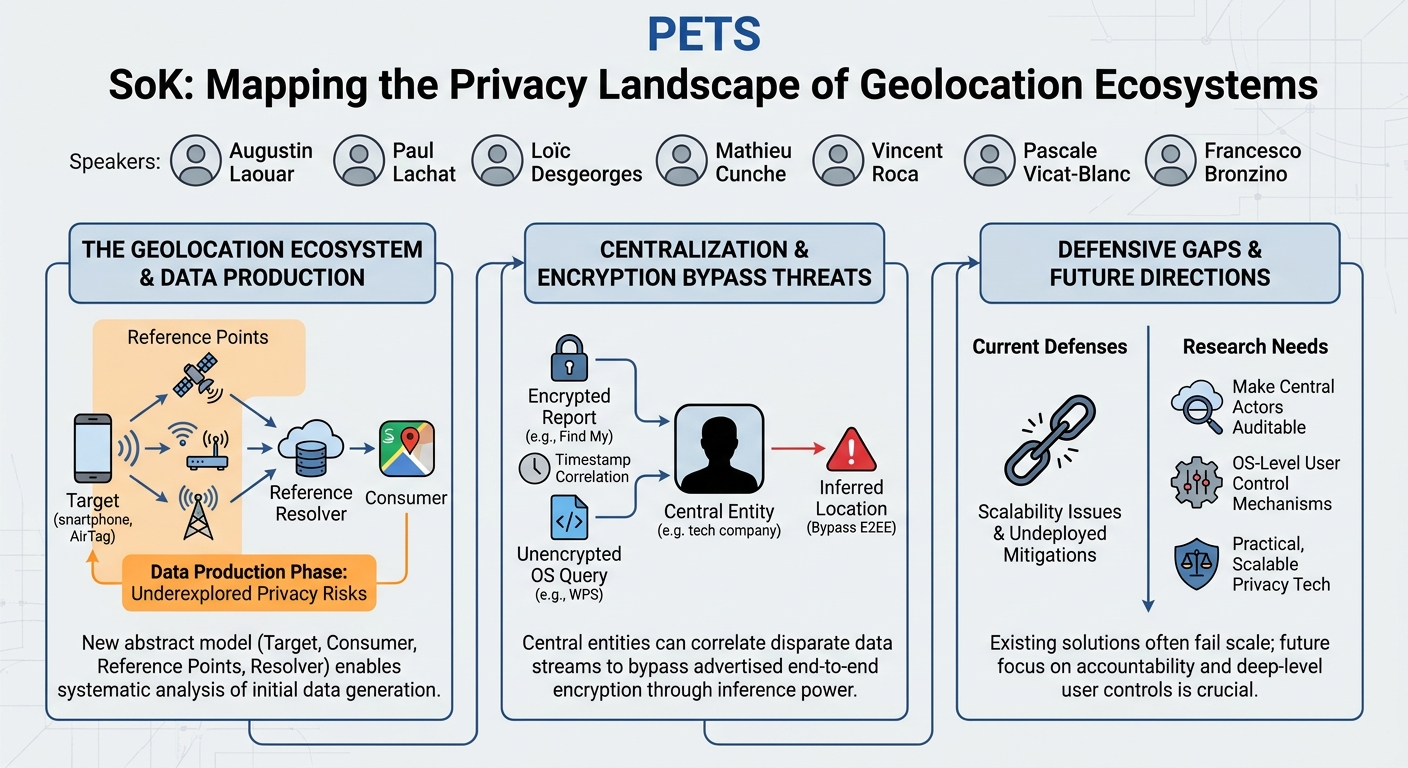
To overcome the inherent diversity and complexity of various geolocation techniques and services, the researchers recognized the need for a foundational, common understanding. They developed an abstract model to systematically analyze and compare different geolocation ecosystems. A geolocation ecosystem, in their definition, encompasses "the set of entities that are involved in the geolocation process." This model breaks down the process into fundamental roles:
- Target: The entity whose position is being determined. This is typically a device like an iPhone or an AirTag.
- Consumer: The location-based service or application that utilizes the geolocation data. An example is Apple Maps, which consumes the iPhone's location.
- Reference Points: Static or mobile entities with known positions that the target uses to compute its own location. In GPS, satellites serve as reference points, their known orbital positions allowing a receiver to calculate distances and triangulate its own position.
- Reference Resolver: A database or service that provides the known positions of reference points. For example, in Wi-Fi Positioning Systems (WPS), a device collects nearby Wi-Fi SSIDs and queries a central database (the reference resolver) to obtain the geographic coordinates associated with those access points. Similarly, cellular antennas and Bluetooth beacons also rely on reference resolvers to provide their known locations.
This abstract model provides a powerful lens through which to analyze the privacy implications of various geolocation systems, regardless of their underlying technology (e.g., GPS, Wi-Fi, cellular, Bluetooth). By deconstructing the process into these core components, the researchers could systematically identify where sensitive data flows, who has access to it, and what inferences can be made at each stage of location data production.
Key Findings
▶ Watch: Finding: Apple bypasses Find My end-to-end encryption (4:40)
The comprehensive analysis of geolocation ecosystems, guided by the abstract model, yielded several critical findings that challenge conventional understandings of location privacy and highlight structural vulnerabilities. The research examined nine representative systems across different use cases, classifying them based on two fundamental properties: whether geolocation is active (target actively involved) or passive (target not involved), and whether it's allo-geolocation (target geolocated by another entity) or ego-geolocation (target geolocates itself).
One of the most striking discoveries pertains to the purported end-to-end encryption in offline finding networks, specifically those operated by major tech companies like Apple (e.g., Apple Find My) and, by extension, Google. The researchers demonstrated a bypass mechanism that allows these central actors to infer the location of tracked items and their owners, despite claims of strong privacy protections. This bypass exploits side channels and correlated data points, revealing a significant gap between advertised security features and practical privacy outcomes.
Beyond this specific bypass, the study identified several pervasive root causes of privacy threats across diverse geolocation systems:
- Continuous Data Flow to Reference Resolvers: Reference resolvers, by their very nature, continuously receive location-related data from users. Devices frequently query these services to determine their positions based on Wi-Fi access points, cellular towers, or Bluetooth beacons. This constant interaction means that the operators of these resolvers accumulate an immense amount of potentially sensitive data about user presence and movement, creating a powerful central point for inference.
- Centralization Creates Inference Power: This is identified as the overarching common cause. Whenever a central entity controls multiple components of the geolocation ecosystem or has access to various data streams, it gains significant inference power. This power allows the entity to correlate seemingly disparate pieces of information – such as timestamps, device identifiers, and metadata from different services – to reconstruct sensitive user location trails, even when individual data points are ostensibly protected.
- Network Provider Capabilities: The research further revealed that network providers, including cellular providers and LPWAN (Low-Power Wide-Area Network) operators like Sigfox, possess inherent capabilities to identify and locate all of their users. This ability stems from their control over the network infrastructure itself, enabling them to track device connections and signal strengths, regardless of user-level privacy settings or application controls.
These findings collectively underscore that current privacy mechanisms and user controls are often insufficient to address the systemic risks inherent in geolocation data production. While cryptographic solutions exist, they frequently face scalability challenges or remain undeployed in practice, leaving significant gaps in protection against powerful, centralized actors within the geolocation ecosystem.
Technical Deep Dive
▶ Watch: Common cause: Centralization creates inference power (6:10)
The foundation of this research is an abstract model designed to deconstruct the complex and varied landscape of geolocation systems into a common, analyzable framework. As previously outlined, this model comprises four core entities: the Target (the entity being geolocated), the Consumer (the service using the location), Reference Points (known physical locations used for positioning, e.g., GPS satellites, Wi-Fi access points, cellular towers), and the Reference Resolver (a database or service providing the precise locations of Reference Points).
The researchers then classified geolocation solutions based on two orthogonal dimensions:
- Active vs. Passive:
- Active: The Target actively participates in the geolocation process, such as an iPhone computing its position using GPS signals.
- Passive: The Target is geolocated by another entity without its direct, active involvement, for example, a surveillance system tracking a device's Wi-Fi probe requests.
- Allo-geolocation vs. Ego-geolocation:
- Allo-geolocation: Another entity determines the Target's location. A classic example is tracking a lost item (e.g., an AirTag) by a network of other devices.
- Ego-geolocation: The Target determines its own location, such as a smartphone displaying its position on a map.
By mapping nine representative systems across these dimensions, the study could systematically analyze their privacy implications. The most impactful technical finding demonstrated a bypass of end-to-end encryption in offline finding networks, exemplified by Apple's Find My network. This bypass is particularly insidious because it leverages seemingly innocuous interactions with unrelated services.
Consider the scenario of locating an Apple AirTag using the Find My network:
- An AirTag periodically emits Bluetooth advertisements containing a rotating identifier.
- Nearby Apple devices (e.g., iPhones, iPads) detect these advertisements.
- Upon detection, the iPhone reports the AirTag's identifier and its own location to Apple's servers. Crucially, the iPhone's reported location is end-to-end encrypted such that only the owner of the AirTag, upon authenticating, can decrypt it. The intention is that Apple itself should not know the AirTag's location at the time of detection.
- However, simultaneously or around the same timestamp, the detecting iPhone is likely engaged in its own ego-geolocation processes. For instance, to determine its own precise location, the iPhone might query an Apple Wi-Fi Positioning System (WPS) reference resolver. This involves sending a list of nearby Wi-Fi SSIDs (Service Set Identifiers) to Apple's servers.
- When the iPhone sends these SSIDs, it is effectively revealing its unencrypted location to Apple's WPS service, as the resolver responds with the associated geographic coordinates. Similarly, other Apple services, such as "online finding" mechanisms, might also receive the iPhone's precise location.
The critical bypass mechanism hinges on timestamp correlation. Apple, as the operator of both the Find My network (receiving encrypted AirTag reports) and various other geolocation services (receiving unencrypted iPhone location requests), can correlate the timestamps of these two distinct data flows. If an iPhone reports an AirTag's advertisement at time T1 and also queries an Apple WPS resolver with its unencrypted location at time T2 (where T1 and T2 are very close), Apple can infer that the AirTag was at the iPhone's location at that approximate time. Furthermore, since the AirTag owner must authenticate to Apple's services to retrieve the decrypted location report, Apple can also link the inferred AirTag location to its owner. This effectively nullifies the privacy guarantees of end-to-end encryption in this specific context.
Beyond this specific attack, the research elaborated on the inherent privacy risks posed by reference resolvers. These databases, whether for Wi-Fi, cellular, or Bluetooth, continuously accumulate and process vast amounts of location data from user devices. Every time a device uses these systems to geolocate itself, it contributes to a centralized repository of location intelligence. This continuous data flow, coupled with the immense scale of these services, provides operators with unparalleled inference power over user movements and habits.
Finally, the paper highlighted the capabilities of network providers. Cellular network operators, for instance, inherently know the location of connected devices based on cell tower triangulation or signal strength. Similarly, LPWAN (Low-Power Wide-Area Network) providers, such as Sigfox, which offer low-bandwidth connectivity for IoT devices, possess the ability to track the approximate location of every device on their network. This is often an intrinsic operational aspect of these networks, enabling them to identify and locate all their users without requiring specific user consent or application-level permissions. These structural capabilities represent fundamental privacy challenges that are difficult to mitigate purely at the application layer.
Demo / Proof of Concept
▶ Watch: Gaps in existing privacy defense mechanisms (7:00)
While the talk did not feature a live software demonstration or a dedicated proof-of-concept during the presentation, the speaker provided a detailed conceptual explanation of the Apple Find My network bypass. This explanation served as a clear illustration of the types of privacy findings derived from their systematic analysis. The speaker walked through the specific steps and data flows involved, demonstrating how Apple could correlate information from different services to infer the location of an AirTag and its owner, despite the presence of end-to-end encryption for the primary location report. This detailed walkthrough functioned as a strong theoretical proof of concept, elucidating the vulnerability without requiring a live code execution. The strength of the research lies in its comprehensive theoretical model and the logical deduction of these privacy threats.
Defensive Implications
▶ Watch: Three key research directions for improved privacy (7:50)
The findings of this research carry significant implications for developers, service providers, and users concerned with location privacy. The identified vulnerabilities and systemic privacy risks necessitate a re-evaluation of current defensive strategies and a push towards more robust, scalable, and user-centric solutions.
The analysis revealed critical gaps in existing defense mechanisms:
- Scalability Limitations: Many proposed privacy-preserving technologies, such as certain peer-to-peer (P2P) or decentralized approaches, are simply not scalable enough to be practical for large-scale geolocation ecosystems. The speaker specifically mentioned that mechanisms like "peer" are "unusable for most of all use cases" involving big databases like reference resolvers. The sheer volume of data and the number of queries handled by services like Apple's Wi-Fi positioning system make decentralized alternatives economically and operationally unfeasible in their current form.
- Undeployed Mitigations: Even simple, effective mitigations often remain "undeployed in practice." This suggests a disconnect between academic research or known best practices and their implementation in real-world systems, possibly due to complexity, cost, or a lack of incentive for service providers.
In response to these gaps, the researchers proposed three major research directions and calls to action:
- Make Central Actors Auditable: Since it's often impossible to completely decentralize or cryptographically secure every aspect of location data production, especially when large, centralized entities operate critical infrastructure, the focus must shift towards accountability. Central actors, such as Apple, Google, and network providers, must be made auditable. This implies developing mechanisms to verify what these companies do with the location data they collect and infer. Auditing could involve transparency reports, independent third-party assessments, or verifiable cryptographic proofs about data handling practices, ensuring that their actions align with stated privacy policies and user expectations. The speaker explicitly stated, "we have to know what Apple do with our location data."
- Bring User Control Mechanisms Down to OS Services: Currently, many user privacy controls exist at the application level, allowing users to grant or deny location access to specific apps. However, the research highlights that Operating System (OS) services themselves often handle and process location data without granular user control. Users have little to no ability to inspect, modify, or restrict how OS-level components, such as the reference resolver used by an iPhone for Wi-Fi positioning, interact with their location data. The recommendation is to extend user control mechanisms to these fundamental OS services, giving users more agency over their device's core geolocation functions. This could involve choosing alternative reference resolvers, opting out of certain OS-level location data sharing, or having clearer visibility into which OS services are accessing location data and why.
- Make Privacy Mechanisms Practical and Scalable: The challenge of scalability for privacy-preserving technologies needs to be directly addressed. Future research should focus on making advanced privacy mechanisms, such as those leveraging secure multi-party computation or differential privacy, practical and efficient enough for real-world deployment in large-scale geolocation ecosystems. This involves optimizing cryptographic protocols, developing more efficient data structures for privacy-preserving queries, and exploring hybrid approaches that combine centralized efficiency with decentralized privacy guarantees. The goal is to develop solutions that can be deployed with big databases like reference resolvers without compromising performance or usability.
These defensive implications underscore the need for a multi-faceted approach, combining technical innovation with policy and accountability measures, to safeguard location privacy in a world increasingly reliant on pervasive geolocation.
Key Takeaways
- Underexplored Privacy Risks in Data Production: The talk highlights a critical gap in location privacy research, emphasizing that significant privacy risks emanate from the production of geolocation data, not just its collection, use, or storage.
- Abstract Model for Unified Analysis: A novel abstract model, defining components like Target, Consumer, Reference Points, and Reference Resolver, provides a common framework to understand and systematically analyze the privacy implications across diverse geolocation ecosystems.
- Centralization as a Root Cause: The core finding is that centralization creates inference power, allowing major tech companies and network providers to correlate seemingly disparate data streams and infer sensitive user locations and identities, even when individual data points are ostensibly protected.
- Bypass of End-to-End Encryption: Specific technical vulnerabilities, such as the demonstrated bypass of end-to-end encryption in Apple's Find My network via timestamp correlation with other unencrypted OS-level location service requests, expose critical weaknesses in advertised privacy features.
- Gaps in Current Defenses: Existing privacy mechanisms are often either unscalable for large, real-world systems (e.g., peer-to-peer solutions for reference resolvers) or remain undeployed, leaving users vulnerable.
- Future Research Directions: Key recommendations include making central actors auditable, extending user control mechanisms to OS services, and developing practical and scalable privacy-preserving technologies to address the systemic challenges.
About the Speaker(s)
The primary speaker for this presentation was Augustin Laouar, representing École Normale Supérieure de Lyon. He presented the research conducted in collaboration with a team of authors from various esteemed institutions. These co-authors include Paul Lachat and Mathieu Cunche from INRIA, Loïc Desgeorges from Université Claude Bernard Lyon 1, Vincent Roca and Pascale Vicat-Blanc also from INRIA, and Francesco Bronzino from École Normale Supérieure de Lyon and Institut universitaire de France. Their collective expertise spans areas of computer science, networking, and privacy, contributing to this comprehensive Systematization of Knowledge (SoK) on geolocation privacy.
Reviews
Dr. Zero (Offensive Security Researcher) — SOLID
This is an academic Systematization of Knowledge that actually lands a punch. While half the paper is just drawing boxes around things we already know about telecom tracking, their timestamp correlation attack against Apple's Find My E2EE is a brilliant reminder that application-layer crypto means nothing if the underlying OS is constantly snitching to the same vendor.
Heather Calloway (CISO) — MUST SEE
This research systematically dismantles the illusion that application-layer encryption protects location data from the underlying operating system provider. It is a mandatory reality check for any enterprise assuming Apple or Google's end-to-end encryption guarantees privacy against the vendors themselves.
→ Top-rated talks at Privacy Enhancing Technologies Symposium (PETS) 2026
All talks from Privacy Enhancing Technologies Symposium (PETS) 2026