Understanding Privacy and Quality Tradeoffs in Synthetic Network Data
Andrew Chu (Paper author · University of Chicago), Kyle MacMillan (Paper author · University of Chicago), Paul Schmitt (Paper author · Cal Poly), Nick Feamster (Paper author · University of Chicago)
Privacy Enhancing Technologies Symposium (PETS) 2026 · Day 2 · Moose
Overview
The proliferation of digital services and interconnected systems has made computer network data an invaluable resource for innovation and operational excellence. Organizations like Netflix leverage telemetry from video streams to optimize Content Delivery Network (CDN) server placement, while security firms such as Cloudflare analyze traffic patterns to develop new heuristics for denial-of-service (DoS) prevention. In an ideal world, sharing such rich datasets could foster collaborative research and accelerate advancements across the internet landscape. However, this vision is often hampered by significant privacy concerns, including the potential leakage of sensitive customer data or proprietary internal network configurations.
Key moments
- 0:00 Introduction: The need for synthetic network data
- 2:05 Research questions: Privacy vulnerability and quality
- 4:00 Membership Inference Attack (MIA) methodology
- 6:00 Non-DP generators vulnerable, Net Diffusion under-generalizes
- 6:50 DP's mixed effectiveness against MIAs
- 8:00 DP's effect on data fidelity and utility
- 9:00 DP can improve utility as a data regularizer
- 9:55 Conclusion: Careful DP application is crucial
Understanding Privacy and Quality Tradeoffs in Synthetic Network Data
Speakers: Andrew Chu (Paper author, University of Chicago), Kyle MacMillan (Paper author, University of Chicago), Paul Schmitt (Paper author, Cal Poly), Nick Feamster (Paper author, University of Chicago)
Conference: PETS
YouTube: https://www.youtube.com/watch?v=bsg0XeAvR_s
Overview
The proliferation of digital services and interconnected systems has made computer network data an invaluable resource for innovation and operational excellence. Organizations like Netflix leverage telemetry from video streams to optimize Content Delivery Network (CDN) server placement, while security firms such as Cloudflare analyze traffic patterns to develop new heuristics for denial-of-service (DoS) prevention. In an ideal world, sharing such rich datasets could foster collaborative research and accelerate advancements across the internet landscape. However, this vision is often hampered by significant privacy concerns, including the potential leakage of sensitive customer data or proprietary internal network configurations.
To circumvent these privacy barriers, the concept of synthetic network data has emerged as a promising alternative. The core idea involves training generative models on real-world, or "ground truth," network data to produce artificial datasets that mimic the statistical properties and distributions of the original, but without containing any actual sensitive records. Furthermore, privacy-enhancing technologies (PETs) like Differential Privacy (DP) can be integrated into this generation process to bolster privacy guarantees. While these efforts are commendable, the research presented by Andrew Chu and his co-authors from the University of Chicago and Cal Poly highlights a critical gap: the lack of robust evaluation regarding both the privacy leakage vulnerabilities of these generators and the impact of DP on the quality of the synthetic data.
This talk, based on their paper, delves into these underexplored tradeoffs. The researchers address two pivotal questions: how susceptible are synthetic network data generators to privacy breaches, specifically membership inference attacks (MIAs), and what are the precise effects of incorporating Differential Privacy on the fidelity (how closely synthetic data matches real data distributions) and utility (how useful synthetic data is for downstream tasks) of the generated output. Their findings underscore that the efficacy of DP is far from universal, varying significantly based on the generator's architecture and training objectives, necessitating a more nuanced and rigorous approach to its application.
Background
▶ Watch: Introduction: The need for synthetic network data (0:00)
The foundational premise for synthetic network data stems from the critical need for observational data to enhance and build new computer network systems. Whether it’s optimizing video streaming experiences or fortifying defenses against sophisticated cyberattacks, insights derived from network traffic are indispensable. Yet, the inherent sensitivity of this data—encompassing everything from user browsing habits to proprietary network topologies—renders direct sharing infeasible for most organizations. This dilemma has spurred interest in techniques that can provide data-driven insights without compromising privacy.
Synthetic data generation offers a potential solution by creating artificial datasets that statistically resemble real data. Early efforts, as referenced by the speaker, involved training models or employing techniques to produce synthetic data that exhibits similar distributions to the ground truth, but without being the "real data" itself. The subsequent integration of privacy-enhancing technologies (PETs), most notably Differential Privacy (DP), aims to provide mathematically rigorous guarantees against privacy leakage. DP works by injecting calibrated noise during the data generation or model training process, making it difficult for an adversary to infer whether any specific individual's data was included in the original training set.
However, the authors point out a significant shortcoming in much of the prior work: the evaluation of privacy and quality tradeoffs has often been superficial. Many studies, as Chu notes, would "just kind of slot in something like DP and crank up the epsilon," referring to setting a high privacy budget (large epsilon) that provides minimal actual privacy protection. This highlights a critical need for robust, empirical measurement of privacy leakage and the corresponding impact on data quality when DP is applied.
The landscape of synthetic network data generators can be broadly categorized into two types:
- Traffic Attribute Generators: These systems take summary statistics about network traffic as input and produce similar aggregate outputs. They often employ machine learning-based generative models or probabilistic methods to model and reproduce traffic characteristics like flow durations, packet sizes, or protocol distributions.
- Raw Packet Generators: These are more granular, designed to generate entire raw packet captures (pcap files). This means they can produce packet-level data that can be dissected with tools like Wireshark, offering a high degree of realism. The methods for these are typically generative models.
For their evaluation, the research team focused on four distinct generators, with the presentation detailing results primarily from NetShare, NetSSM (a system co-authored by Andrew Chu himself, indicating a self-critical evaluation), and NetDiffusion. Each of these represents different architectural approaches to synthetic data generation.
A key adversarial capability evaluated in this work is the Membership Inference Attack (MIA). MIAs exploit a machine learning model's tendency to "memorize" specific characteristics of its training data. An adversary, using an MIA, attempts to determine if a particular record (e.g., a specific network trace) was part of the dataset used to train the target model. If successful, this indicates a privacy breach, as it reveals information about the presence of specific entities or events in the original sensitive data. Differential Privacy is theorized to mitigate such attacks by preventing models from overfitting to individual data points, thereby making it harder for MIAs to distinguish between members and non-members of the training set. This research critically examines whether this theoretical protection holds true in the complex domain of synthetic network data.
Key Findings
▶ Watch: Membership Inference Attack (MIA) methodology (4:00)
The research addressed two primary questions: the vulnerability of synthetic network data generators to privacy leakage via Membership Inference Attacks (MIAs) and the effect of Differential Privacy (DP) on the quality of the generated data, measured by fidelity and utility. The findings reveal a complex interplay between generator architecture, privacy mechanisms, and data characteristics.
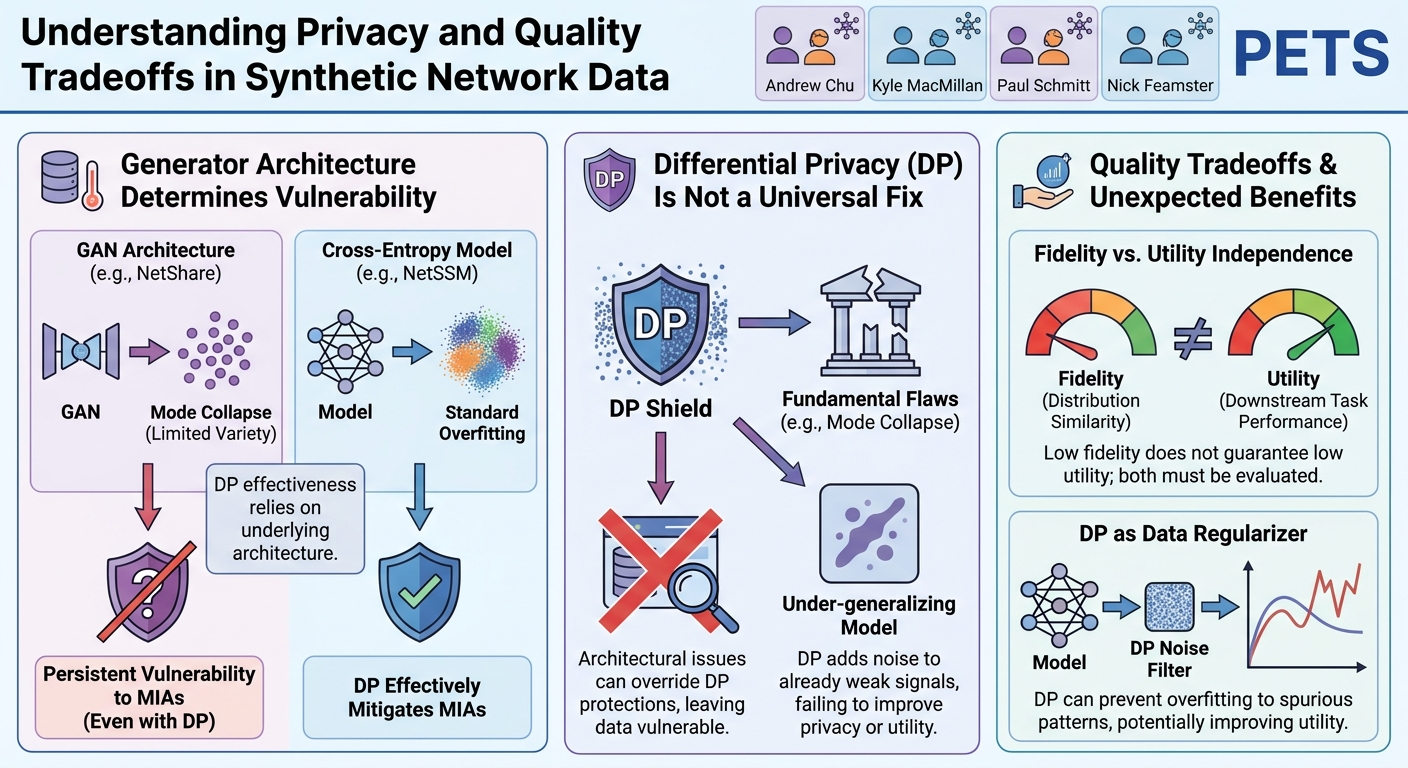
In the non-DP case, the study found that NetShare and NetSSM were both demonstrably vulnerable to MIAs. This indicates that without explicit privacy safeguards, these generators, when trained on real network data, retain enough information about individual training records to allow an adversary to infer their membership in the training set. Conversely, NetDiffusion exhibited an interesting behavior: it was found to be not vulnerable to MIAs. This counter-intuitive result was attributed to the model's tendency to under-generalize. NetDiffusion, when confronted with the evaluated network data, learned a "majority signal" that was broadly consistent across different classes and even within the same class. Consequently, all data samples, both real and synthetic, appeared largely similar to the model, making it impossible for the MIA to distinguish between members and non-members. While this superficially appears to offer privacy, it inherently limits the model's ability to capture fine-grained distinctions in the data, potentially impacting utility.
The introduction of Differential Privacy yielded varied results across the generators:
- For NetSSM, applying DP effectively rendered MIAs ineffective. The model's vulnerability in the non-DP case was attributed to standard overfitting with cross-entropy loss, a common issue that DP is designed to mitigate by introducing noise during training, preventing the model from memorizing specific training examples.
- NetDiffusion remained ineffective against MIAs even with DP. As the model already under-generalized and struggled to learn distinct signals, adding more noise via DP simply made an already noisy signal even noisier, without altering its fundamental inability to distinguish between data points.
- Surprisingly, NetShare remained vulnerable to MIAs despite the application of DP. This persistent vulnerability was attributed to mode collapse, a known issue in Generative Adversarial Networks (GANs), which NetShare utilizes. Mode collapse represents a form of strong structural overfitting, where the generator learns to produce only a limited subset of the possible data distributions, often low-variance values that are consistent across samples. Because the model regresses towards continuous values, the calibrated noise introduced by DP proved insufficient to resolve this deep-seated architectural issue, leaving it susceptible to membership inference.
Regarding data quality, assessed through fidelity (distributional distance between synthetic and ground truth data) and utility (performance of downstream models trained on synthetic data):
- Fidelity: The study observed that DP does not necessarily lead to low fidelity in synthetic network traffic. The impact varied by generator. For instance, NetSSM, a token-based cross-entropy model, showed a larger distributional distance (lower fidelity) with DP, which could be explained by its tokenization approach interacting with the noise. However, other models maintained relatively good fidelity even with DP.
- Utility: The performance of downstream classifiers and regressors trained on DP-enhanced synthetic data also varied significantly across generators. Interestingly, the research found that low fidelity did not always translate to low utility. For example, NetSSM, despite showing lower fidelity, did not necessarily result in negatively affected utility for downstream tasks. Furthermore, in some cases, the DP-enabled synthetic data actually improved the performance of downstream models compared to non-DP synthetic data. This counter-intuitive result suggests that DP can sometimes act as a data regularizer, preventing the synthetic data from overfitting to spurious patterns in the training data, thereby leading to more robust and generalized synthetic data that performs better in downstream applications.
In summary, the key findings emphasize that the effectiveness of DP in safeguarding privacy and its impact on data quality are highly dependent on the specific architecture and training objectives of the synthetic data generator. Blindly applying DP is insufficient; a careful, architecturally aware approach is required.
Technical Deep Dive
▶ Watch: DP's mixed effectiveness against MIAs (6:50)
The research undertakes a comprehensive and technically rigorous evaluation of synthetic network data generators, focusing on their privacy vulnerabilities and the quality implications of Differential Privacy. The methodology is structured around an adversarial model, specific datasets, and a multi-faceted attack and evaluation framework.
The adversary model employed is white-box, granting the attacker significant capabilities. This means the adversary has full access to the underlying distribution of the training data, can generate their own records, query the target model, and observe both its final output and intermediate states (e.g., embeddings, logits). The adversary's ultimate objective is to determine with high confidence whether a specific network trace was included in the dataset used to train the synthetic data generator. This granularity—an individual network trace—is crucial, as it represents a sensitive unit of information whose leakage constitutes a privacy breach.
To conduct these evaluations, the researchers utilized two different datasets, broadly categorized into six distinct classes of network traffic. Each class was systematically partitioned into 50/50 splits. This partitioning strategy was critical for the shadow training method, a sophisticated technique for conducting Membership Inference Attacks.
The Membership Inference Attack (MIA) itself is a binary classifier-based attack leveraging the shadow training method:
- Shadow Data Set Construction: From the initial 50/50 splits of the original datasets, one split is designated as the "ground truth training data set" for a hypothetical target model that an adversary would want to attack. The second 50/50 split is then used to construct multiple shadow training and validation data sets. Specifically, 10 such shadow datasets are created, where samples from the training portion act as "candidate member" samples, and samples from the validation portion act as "non-member" samples.
- Shadow Model Training: A substantial number of shadow models (totaling 1000) are trained. These shadow models mirror the architectures of the synthetic data generators under evaluation (NetShare, NetSSM, NetDiffusion) and are trained across the different data classes and various privacy budgets (epsilon values for DP). The purpose of these shadow models is to simulate the behavior of a target model when trained on data where the membership status of records is known.
- Attack Model Training Data Generation: For each shadow model, the "member" and "non-member" samples are fed back into the model. Key internal representations, such as the last layer embeddings, logits, or prediction vectors, are extracted. These extracted features are then explicitly tagged as belonging to a "member" or "non-member" based on how the shadow dataset was constructed. This process generates a rich dataset for training the attack model.
- Attack Model Training and Evaluation: The collected tagged data is then used to train the actual attack models. These attack models are binary classifiers designed to predict, given a model's output for a record, whether that record was a member of the training set. Finally, these trained attack models are evaluated on the features extracted from the "ground truth target model training data set" (the first 50/50 split) to determine the MIA's effectiveness against the actual synthetic data generators.
The application of Differential Privacy (DP) during the training of the synthetic data generators was a central component of the evaluation. While the talk doesn't specify the exact epsilon values used in their experiments, it highlights that previous work often used impractically high epsilon values (e.g., 40), rendering DP ineffective. This implies the current study employed more realistic and varied privacy budgets to robustly assess DP's impact. DP was implemented to introduce calibrated noise, aiming to prevent model overfitting and enhance privacy.
The characteristics of the evaluated generator architectures are crucial to understanding the findings:
- NetShare: This generator is based on a Generative Adversarial Network (GAN) architecture. While GANs are powerful for generating realistic data, they are notoriously susceptible to mode collapse. This phenomenon occurs when the generator learns to produce a very limited variety of outputs, often converging on a few "modes" of the data distribution, rather than capturing the full diversity. The research found that this strong structural overfitting makes NetShare persistently vulnerable to MIAs, even with DP, as DP's noise cannot adequately resolve the fundamental flaw of mode collapse.
- NetSSM: Described as a token-based cross-entropy model, NetSSM's non-DP vulnerability to MIAs stemmed from standard overfitting. This is a common issue in supervised learning where a model learns the training data too well, including its noise and specific idiosyncrasies, failing to generalize to new data. DP, by adding noise to gradients or model parameters during training, effectively counteracted this overfitting, making MIAs ineffective.
- NetDiffusion: This generator exhibited under-generalization. Instead of learning the nuanced patterns and distinct features across different classes of network traffic, it converged on a "majority signal" that was prevalent across all samples. This meant that the model struggled to differentiate between diverse inputs, making it inherently resistant to MIAs, but also potentially limiting its ability to generate high-quality, diverse synthetic data.
The quality of synthetic data was measured using two key dimensions:
- Fidelity: This metric quantifies how closely the distribution of the synthetic data matches the distribution of the original ground truth data. The researchers used distributional distance metrics to calculate this, providing a statistical measure of similarity.
- Utility: This assesses the practical usefulness of the synthetic data for downstream analytical tasks. The evaluation involved training two types of downstream models—classifiers and regressors—on the synthetic data. The performance of these models (e.g., accuracy for classification, R-squared for regression) then served as a proxy for the utility of the synthetic data. A surprising finding here was that DP could sometimes act as a data regularizer, improving the utility of synthetic data by preventing the downstream models from overfitting to noise or specific patterns in the synthetic data itself.
This meticulous technical approach allowed the researchers to dissect the complex interactions between privacy mechanisms, generator architectures, and data quality, providing a nuanced understanding that goes beyond simplistic assumptions about DP's universal efficacy.
Demo / Proof of Concept
▶ Watch: DP's effect on data fidelity and utility (8:00)
This talk primarily focuses on the rigorous evaluation methodology and findings from the research paper, rather than demonstrating a specific tool or proof-of-concept live during the presentation. The authors detailed their experimental setup for conducting membership inference attacks and assessing data quality, providing visual representations of data patterns and performance metrics for various synthetic data generators under different privacy settings. The presentation was an analysis of results from extensive experiments rather than an interactive demonstration of software.
Defensive Implications
▶ Watch: Conclusion: Careful DP application is crucial (9:55)
The detailed analysis presented in this talk offers crucial insights for both developers of synthetic network data generators and organizations looking to deploy or utilize such solutions. The findings highlight that privacy protection in synthetic data is not a "set it and forget it" task, but rather requires careful consideration of architectural choices and rigorous evaluation.
For Developers of Synthetic Data Generators:
- Architectural Awareness is Paramount: Developers must move beyond a blind application of Differential Privacy. The study clearly demonstrates that the effectiveness of DP is heavily dependent on the underlying generator architecture. For instance, GAN-based models like NetShare, which are prone to mode collapse, can remain vulnerable to Membership Inference Attacks (MIAs) even with DP applied. This implies that addressing inherent architectural weaknesses, such as mode collapse, might be a prerequisite for DP to be truly effective.
- Comprehensive Privacy Evaluation: It is insufficient to simply state that DP is "applied." Developers must conduct thorough evaluations of privacy leakage using techniques like shadow training-based MIAs to empirically demonstrate the actual privacy guarantees of their systems under various privacy budgets (epsilon values).
- Balanced Quality Assessment: Beyond privacy, the fidelity and utility of the synthetic data must be rigorously measured. Developers should understand how DP impacts these metrics for their specific generator and be transparent about these tradeoffs. The finding that DP can sometimes act as a data regularizer and improve utility suggests that thoughtful DP application isn't just about privacy, but can also lead to more robust synthetic data.
- Understanding Under-generalization: For models like NetDiffusion that exhibit under-generalization, while they may appear resistant to MIAs, this comes at the cost of capturing the full diversity and nuance of the original data. Developers need to weigh this inherent "privacy by obscurity" against the potential loss of utility for complex downstream tasks.
For Organizations Utilizing Synthetic Network Data:
- Demand Robust Privacy Guarantees: Organizations should not accept synthetic data solutions without clear, empirical evidence of their privacy protections. This includes requesting detailed reports on MIA susceptibility under various DP configurations. Simply knowing that "DP is used" is not enough; the specific epsilon values and the generator's architectural resilience must be understood.
- Verify Utility for Specific Use Cases: Before integrating synthetic data into critical systems, organizations must validate that the data maintains sufficient utility for their intended downstream tasks (e.g., training intrusion detection systems, network planning, anomaly detection). Low fidelity does not always equate to low utility, and vice-versa, so task-specific evaluation is essential.
- Beware of Architectural Pitfalls: Be cautious about synthetic data generated by models known for issues like mode collapse (common in some GANs), as these may offer weaker privacy guarantees even with DP. Ask providers about the underlying architecture and its known limitations.
- Consider DP as a Quality Enhancer: The insight that DP can act as a data regularizer suggests that synthetic data generated with appropriately applied DP might, in some cases, lead to better-performing downstream models than non-DP synthetic data. This could be a positive side effect worth exploring.
- Avoid Blind Trust: The overarching message is to avoid blindly trusting that DP will solve all privacy concerns. A critical, analytical approach to evaluating both privacy and quality tradeoffs is essential for making informed decisions about adopting synthetic network data.
In essence, defenders need to be as sophisticated in their understanding of synthetic data generation and privacy mechanisms as the attackers trying to exploit them. This talk provides a valuable framework for such an informed defense strategy.
Key Takeaways
- Varied Vulnerability: Synthetic network data generators exhibit significant differences in their vulnerability to Membership Inference Attacks (MIAs), even before Differential Privacy (DP) is applied.
- DP is Not a Panacea: The effectiveness of Differential Privacy against MIAs and its impact on data quality are highly dependent on the specific generator's architecture (e.g., GANs vs. cross-entropy models) and training objectives. Blindly applying DP is insufficient.
- Architectural Limitations: Issues like mode collapse in GAN architectures (e.g., NetShare) can severely limit DP's ability to prevent membership inference, indicating that fundamental model design flaws may override DP's protections.
- Under-generalization Tradeoffs: Some generators, like NetDiffusion, may inherently under-generalize, making them resistant to MIAs but potentially compromising the utility of the synthetic data by failing to capture diverse patterns.
- Beyond Fidelity: Utility Matters: Low fidelity (statistical similarity to real data) does not always translate to low utility (usefulness for downstream tasks), and vice-versa. Both metrics must be evaluated comprehensively.
- DP as a Regularizer: Surprisingly, DP can sometimes act as a data regularizer, potentially improving the utility of synthetic data for downstream tasks by preventing overfitting to spurious patterns.
About the Speaker(s)
The talk was presented by Andrew Chu, a paper author affiliated with the University of Chicago. He was part of a joint research effort that also included Kyle MacMillan and Nick Feamster, both from the University of Chicago, and Paul Schmitt from Cal Poly University. Their collaborative work focuses on understanding the intricate relationships between privacy-enhancing technologies and the practical quality of generated synthetic data, particularly in the context of computer networks. Andrew Chu notably evaluated a system he himself co-authored (NetSSM), demonstrating a commitment to rigorous and self-critical research within the field.
Reviews
Dr. Zero (Offensive Security Researcher) — STRONG ACCEPT
Vendors love slapping Differential Privacy on synthetic data and declaring it magically secure. This research proves that's mathematical theater if the underlying generator architecture is fundamentally flawed. A brutally necessary reality check on the actual privacy guarantees of GANs and diffusion models.
Heather Calloway (CISO) — MUST SEE
Vendors increasingly pitch synthetic data and differential privacy as a get-out-of-jail-free card for sharing sensitive network telemetry. This research proves that narrative is false, making it mandatory reading for your privacy and third-party risk teams.
→ Top-rated talks at Privacy Enhancing Technologies Symposium (PETS) 2026
All talks from Privacy Enhancing Technologies Symposium (PETS) 2026