CURE: Privacy-Preserving Split Learning Done Right
Halil Ibrahim Kanpak (Paper author · Koç University), Aqsa Shabbir (Paper author · Bilkent University), Esra Genç (Paper author · Bilkent University), Alptekin Küpçü (Paper author · Koç University), Sinem Sav (Paper author · Bilkent University)
Privacy Enhancing Technologies Symposium (PETS) 2026 · Day 3 · Moose
Overview
The proliferation of deep learning models has ushered in an era where cloud-scale computation is often a prerequisite for training and deployment. However, the sensitive nature of much of the data used in these models—spanning healthcare, finance, and personal genomics—is subject to stringent regulations and privacy concerns. This fundamental tension between computational demands and data privacy has spurred the development of privacy-preserving machine learning paradigms like federated learning and split learning. In this talk, Sinem Sav from Bilkent University, presenting joint work with Koç University and Bilkent University, introduced CURE: a novel framework for privacy-preserving split learning that leverages homomorphic encryption (HE) to achieve robust privacy guarantees without sacrificing model utility or efficiency.
Key moments
- 0:00 Introduction: Privacy challenges in split learning
- 1:30 Limitations of existing solutions and CURE proposal
- 2:00 CURE's inverted split learning framework and motivation
- 4:50 CURE's technical contributions: Inverted structure, packing, estimator
- 6:30 Details on resource-aware split optimization estimator
- 8:00 Evaluation results: Accuracy and efficiency compared to baselines
- 9:00 Key takeaways: CURE's advantages and performance
CURE: Privacy-Preserving Split Learning Done Right
Speakers: Halil Ibrahim Kanpak (Paper author, Koç University); Aqsa Shabbir (Paper author, Bilkent University); Esra Genç (Paper author, Bilkent University); Alptekin Küpçü (Paper author, Koç University); Sinem Sav (Paper author, Bilkent University)
Conference: PETS
YouTube: https://www.youtube.com/watch?v=QHf28utQHp8
Overview
The proliferation of deep learning models has ushered in an era where cloud-scale computation is often a prerequisite for training and deployment. However, the sensitive nature of much of the data used in these models—spanning healthcare, finance, and personal genomics—is subject to stringent regulations and privacy concerns. This fundamental tension between computational demands and data privacy has spurred the development of privacy-preserving machine learning paradigms like federated learning and split learning. In this talk, Sinem Sav from Bilkent University, presenting joint work with Koç University and Bilkent University, introduced CURE: a novel framework for privacy-preserving split learning that leverages homomorphic encryption (HE) to achieve robust privacy guarantees without sacrificing model utility or efficiency.
CURE directly addresses critical vulnerabilities in traditional split learning, where the exchange of intermediate activations between clients and servers can be exploited via reconstruction attacks to infer sensitive input data. Existing privacy solutions often entail significant trade-offs, with differential privacy degrading model utility and homomorphic encryption typically confined to inference or specific, less generalizable architectures. CURE distinguishes itself by proposing an inverted split learning model where the server operates entirely on encrypted data, eliminating the primary attack surface related to label leakage, and by introducing optimized cryptographic primitives and a resource-aware split estimator. This innovative approach promises to unlock secure and efficient deep learning for highly regulated and sensitive datasets.
Background
▶ Watch: Introduction: Privacy challenges in split learning (0:00)
The journey towards privacy-preserving machine learning is driven by the inherent conflict between the data-hungry nature of deep neural networks and the imperative to protect sensitive information. Split learning emerged as a promising solution, segmenting a neural network's architecture across multiple entities—typically a client holding raw data and a server performing the bulk of computation. In a conventional setup, the client processes the initial layers, sends intermediate activations to the server, which then completes the remaining layers and handles labels. While this distributes computation and keeps raw data on the client side, the exchanged activations are not inherently secure. Adversaries can mount reconstruction attacks on these activations to infer details about the client's original input, compromising privacy.
Prior attempts to fortify split learning against such attacks have explored two main cryptographic avenues: differential privacy (DP) and homomorphic encryption (HE). DP-based solutions introduce noise to activations, offering provable privacy guarantees but often at the cost of significant model utility degradation, depending on the chosen privacy budget. HE-based solutions, which allow computations on encrypted data, offer stronger privacy without utility loss. However, existing HE frameworks for split learning have typically been limited. Many focus solely on the inference phase rather than the more complex training phase, or they are designed for specific, less common architectures like U-shaped split learning. A persistent challenge across these solutions is the delicate trade-off between privacy and efficiency, where robust privacy often comes with prohibitive computational overhead.
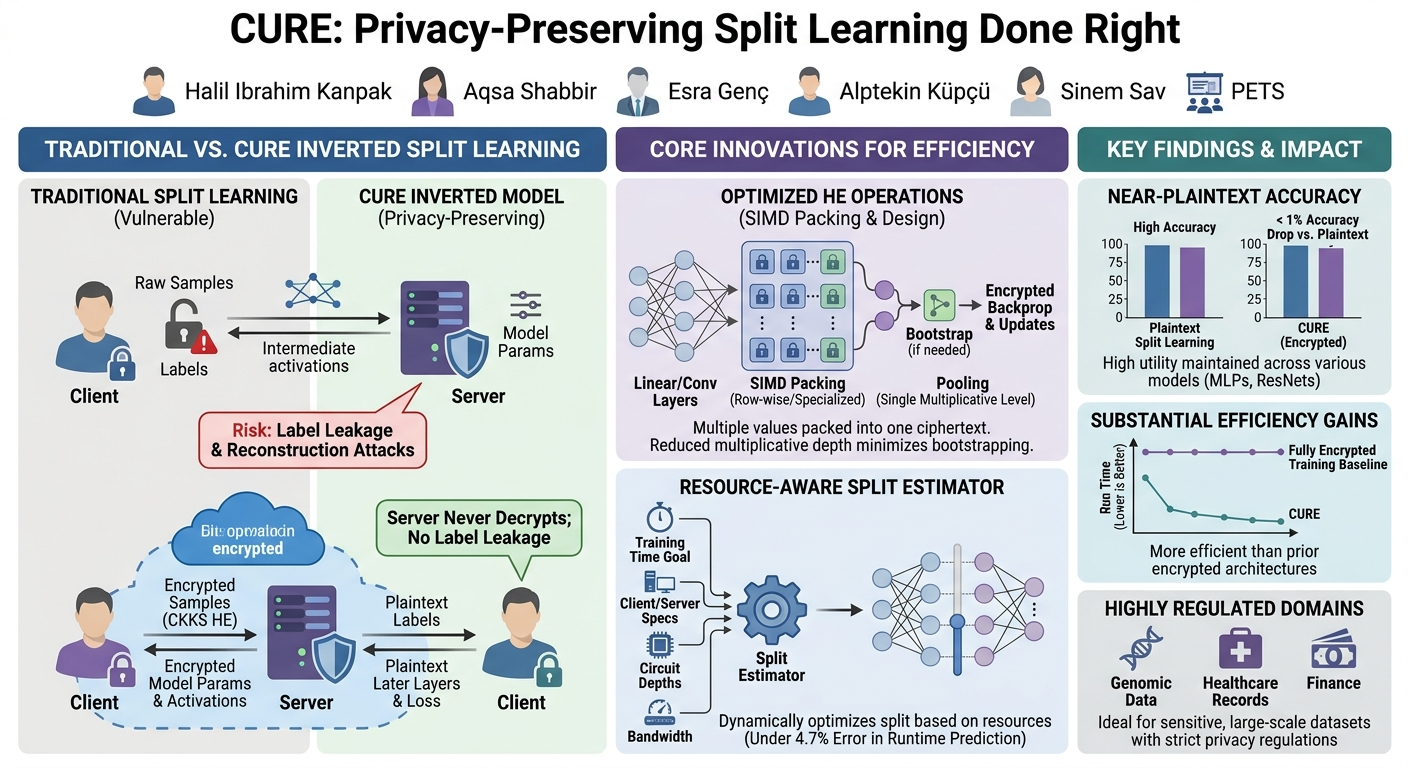
CURE tackles this trade-off head-on by re-imagining the fundamental structure of split learning. Instead of the client holding samples and the server holding labels, CURE proposes an inverted framework: the server now holds the samples (optionally encrypted), and the client holds the labels. Crucially, all server operations in CURE are performed under homomorphic encryption, specifically using the CKKS scheme, ensuring that the server never accesses any model parameters or even the samples in plaintext. This inversion is motivated by two key factors: first, it eliminates the primary attack surface related to label leakage to the server, as the server never sees the sensitive labels. Second, it caters to scenarios where clients might prefer to outsource the storage of samples and parts of the training process to a powerful server, while retaining strict control over the highly sensitive labels. A compelling use case presented is large-scale genomic datasets, particularly in contexts like autism spectrum disorder (ASD) research. Here, unencrypted genomic features might not directly disclose an individual's diagnosis, but the labels themselves directly encode the diagnosis status, making their privacy paramount. CURE's architecture is ideally suited for such environments, operating within a semi-honest server, single-client, single-server deployment scenario, where the cryptographic guarantees are rooted in the robust properties of the CKKS scheme.
Key Findings
▶ Watch: CURE's inverted split learning framework and motivation (2:00)
CURE introduces several pivotal contributions that collectively redefine the landscape of privacy-preserving split learning:
- Privacy-Preserving Inverted Split Learning Architecture: The core innovation of CURE is its inverted system model. Unlike traditional split learning where the client holds samples and the server labels, CURE places the (optionally encrypted) samples on the server and the labels on the client. Critically, all operations performed by the server are executed under homomorphic encryption, ensuring that the server never decrypts or sees any sensitive information, including model parameters or intermediate activations. This fundamental shift effectively eliminates the most significant privacy vulnerabilities associated with label leakage and reconstruction attacks in split learning.
- Optimized Single-Instruction Multiple-Data (SIMD) Packing Schemes: To overcome the computational overhead typically associated with homomorphic encryption, CURE integrates highly optimized packing schemes. These schemes are meticulously tailored for neural network operations, allowing multiple values to be packed into a single ciphertext. This parallelization significantly boosts efficiency for both linear and convolutional layers, enabling complex computations to be performed on encrypted data with reduced latency and resource consumption. The talk highlights specific strategies like row-wise packing for linear layer weights and specialized SIMD operations for convolutional layers.
- Resource-Aware Split Estimator: CURE includes an intelligent resource-aware split estimator designed to dynamically determine the optimal splitting point within a neural network architecture. This estimator considers a comprehensive set of parameters, including desired training time, client and server computational specifications (e.g., rotation latencies, multiplicative and additive circuit depths associated with homomorphic encryption), the number of costly bootstrapping operations, and available network bandwidth. By minimizing the global target of total server computation time, client computation time, and communication time, the estimator ensures that the CURE framework operates at peak efficiency for a given set of resources. Evaluation demonstrated that this estimator predicts runtimes with remarkable accuracy, achieving under 4.7% error.
- Near-Plaintext Accuracy and Substantial Efficiency Gains: Extensive evaluations across various benchmarking datasets and diverse model architectures (from simple multilayer perceptrons (MLPs) to ResNet blocks) confirm CURE's practical viability. The framework consistently achieves accuracy levels comparable to plaintext split learning, with an observed accuracy drop of less than 1% across various settings. Furthermore, CURE demonstrates substantial efficiency improvements when compared to prior work, including fully encrypted training baselines (simulated by CURE itself) and other encrypted split learning architectures. This dual achievement of high utility and efficiency positions CURE as a leading solution for privacy-preserving deep learning.
Technical Deep Dive
▶ Watch: CURE's technical contributions: Inverted structure, packing, estimator (4:50)
The technical prowess of CURE lies in its meticulous integration of cryptographic primitives with neural network operations within its novel inverted split learning architecture. The system operates under a semi-honest security model, where the server follows the protocol but may attempt to learn information from observed data. The cryptographic backbone is the CKKS (Cheon-Kim-Kim-Song) homomorphic encryption scheme, chosen for its ability to perform approximate arithmetic operations on real numbers, which is crucial for neural network computations involving floating-point numbers.
In CURE's inverted architecture, the server holds the dataset samples, which can optionally be encrypted by the client before being sent to the server. The client, however, retains exclusive control over the sensitive labels. All operations on the server side—from forward propagation to backpropagation and weight updates—are executed entirely on encrypted data. The client, in contrast, handles its portion of the neural network (typically the later layers closer to the loss function) using standard plaintext operations, significantly reducing its computational burden. This design ensures that the server, despite performing the majority of the heavy lifting, never gains access to plaintext samples, labels, or even intermediate activations, effectively preventing information leakage.
Performing neural network operations under homomorphic encryption presents unique challenges, primarily due to the limitations of HE schemes. For instance, non-polynomial activation functions (like ReLU, Sigmoid, Tanh) cannot be directly computed on ciphertexts. CURE addresses this by employing well-known techniques of polynomial approximation for these activations, a common practice in HE-based neural network training.
For linear layers (e.g., fully connected layers), CURE employs a row-wise packing scheme. The rows of the weight matrices are packed into single ciphertexts, enabling Single-Instruction Multiple-Data (SIMD) operations. This means that a single encrypted multiplication operation can process multiple elements simultaneously, drastically improving throughput. Similarly, for convolutional layers, specialized SIMD operations are designed to handle the unique structure of convolutions efficiently under encryption. Pooling operations, such as max pooling or average pooling, are carefully engineered to consume only one multiplicative level. This is a critical optimization in HE, as each multiplicative operation increases the "noise" in a ciphertext, requiring costly bootstrapping operations to refresh the ciphertext and continue computations. Minimizing multiplicative depth is paramount for efficiency.
The backpropagation and weight update phases are equally optimized for encrypted computation. The packing schemes and operation sequences are adapted based on whether the gradient is for a linear or convolutional layer, and whether it's a weight gradient or an input gradient. Often, columns of weight matrices are pre-encoded and packed to facilitate efficient gradient computations. The final weight update involves multiplying the encrypted gradient by the learning rate (scaling it) and then subtracting this scaled gradient from the encrypted weights. All these steps occur on the server side, entirely under encryption, with the client only receiving encrypted information for its part of the update.
The resource-aware split estimator is a sophisticated component that addresses the practical deployment challenges of CURE. Its goal is to find the optimal layer index at which to split the neural network between the client and server. The estimator takes into account several key inputs:
- Desired training time: A target for the overall training duration.
- Computer specifications: Detailed information about the computational capabilities of both the client and server, including latencies for specific homomorphic encryption operations like rotations.
- Multiplicative and additive circuit depth: These metrics are crucial for HE, as they dictate the complexity of operations and the frequency of expensive bootstrapping.
- Total bootstrapping operations: Directly impacts overall training time and is derived from the multiplicative depth.
- Available network bandwidth: Essential for estimating communication overhead between the client and server.
The estimator's global target is to minimize the sum of total server computation time, client computation time, and communication time. By analyzing these factors, it dynamically determines the best split point, ensuring that CURE can be efficiently deployed across diverse hardware and network environments. The talk highlights that this estimator achieves an impressive prediction accuracy of under 4.7% error in runtime estimation, validating its efficacy.
Demo / Proof of Concept
▶ Watch: Evaluation results: Accuracy and efficiency compared to baselines (8:00)
While the talk did not feature a live, interactive demonstration of the CURE framework, the authors presented extensive and rigorous evaluation results that served as a comprehensive proof of concept. These evaluations were designed to validate CURE's claims regarding both model utility and computational efficiency, comparing it against established baselines and prior work.
The evaluation methodology involved using several benchmarking datasets and various model architectures. These included simpler models like multilayer perceptrons (MLPs) and more complex, deeper networks such as ResNet blocks. Some of these architectures were directly drawn from existing literature, allowing for direct comparison with published results.
Three main categories of baselines were used:
- Plaintext Split Learning: This baseline involved unencrypted split learning, serving as the upper bound for model utility. It allowed the authors to quantify the accuracy drop introduced by CURE's privacy-preserving mechanisms.
- Fully Encrypted Training: Since no exact system architecture matched CURE's inverted split learning model, the authors configured CURE itself to simulate a fully encrypted training scenario. This was achieved by shifting all network layers to the server side, forcing all operations to be conducted under homomorphic encryption. This baseline provided a direct comparison of CURE's efficiency gains over a purely HE-based training approach.
- Other Encrypted Split Learning Architectures: The authors also compared CURE against existing encrypted split learning architectures, specifically mentioning U-shaped split learning. While structurally different, these comparisons highlighted CURE's superior performance in relevant contexts.
The evaluation yielded compelling results:
- Accuracy: Across various architectures and settings, CURE consistently achieved accuracy levels that almost matched plaintext performance. The observed accuracy drop was minimal, always less than 1%. This demonstrates that CURE's use of homomorphic encryption and polynomial approximations for activations does not significantly impair the model's predictive power.
- Efficiency: CURE showcased substantial efficiency improvements compared to related work. Specifically, when compared to the simulated fully encrypted training baselines, CURE exhibited significant reductions in computational overhead. The talk showed comparative graphs, indicating that CURE, even with varying numbers of parallelization cores or different split indices, offered a much more efficient solution.
- Estimator Accuracy: The efficacy of the resource-aware split estimator was also rigorously tested. The evaluation confirmed that the estimator could predict runtimes very accurately, with an error rate of under 4.7%. This validation is crucial for the practical deployability of CURE in diverse computational environments.
These comprehensive evaluations, encompassing utility, efficiency, and the performance of the core optimization components, provide strong empirical evidence for CURE's viability as a robust and practical privacy-preserving split learning framework.
Defensive Implications
▶ Watch: Key takeaways: CURE's advantages and performance (9:00)
CURE presents significant defensive implications for organizations grappling with the challenge of leveraging cloud-scale compute for deep learning while safeguarding highly sensitive data. The framework offers a practical and robust solution for scenarios where traditional data sharing or even conventional split learning poses unacceptable privacy risks.
Firstly, CURE directly addresses the vulnerability of label leakage. In many domains, such as healthcare (patient diagnoses), finance (credit scores), or genomics (disease susceptibility), labels are often the most sensitive piece of information. By ensuring that the server never sees labels in plaintext and performs all its operations under homomorphic encryption, CURE provides a strong guarantee against this critical privacy breach. Defenders can now consider outsourcing model training to untrusted cloud environments without fear of their sensitive labels being exposed.
Secondly, CURE's inverted split learning architecture mitigates the risk of reconstruction attacks that plague traditional split learning. By encrypting all server-side activations and model parameters, even if an adversary compromises the server, they cannot infer client input data from intermediate representations. This strengthens the security posture against sophisticated attackers aiming to reconstruct original data from shared activations.
Organizations handling large-scale genomic datasets or other highly regulated information (e.g., patient records, biometric data) can leverage CURE to comply with privacy regulations like GDPR or HIPAA. The ability to outsource the storage of large datasets and much of the computational burden to powerful servers, while maintaining cryptographic control over sensitive diagnostic labels, opens new avenues for collaborative research and model development that were previously constrained by privacy concerns.
Furthermore, the resource-aware split estimator empowers defenders to deploy privacy-preserving models efficiently. By dynamically optimizing the split point based on available compute resources and network bandwidth, CURE ensures that the overhead of homomorphic encryption is minimized, making it a more practical solution for real-world applications. This means that privacy doesn't necessarily come at the cost of prohibitive performance, a common deterrent for adopting advanced cryptographic techniques.
In essence, CURE provides a blueprint for defenders to implement privacy-by-design principles in their machine learning pipelines. It encourages a shift towards architectures where sensitive data is protected at its source and throughout its processing lifecycle, rather than relying solely on access controls or anonymization techniques that might be susceptible to re-identification. Adopting CURE-like frameworks allows organizations to unlock the power of deep learning for sensitive applications, fostering innovation while upholding the highest standards of data privacy and security.
Key Takeaways
- CURE introduces a novel inverted split learning architecture where the server operates entirely on encrypted data, protecting sensitive labels and preventing reconstruction attacks.
- The framework leverages CKKS homomorphic encryption for server-side computations, ensuring strong privacy guarantees without decrypting any sensitive information.
- Optimized SIMD packing schemes and careful design of HE operations (e.g., pooling consuming only one multiplicative level) significantly enhance computational efficiency.
- A resource-aware split estimator dynamically optimizes the network split point, achieving high accuracy in runtime prediction (<4.7% error) and minimizing overall training time across diverse environments.
- CURE consistently delivers near-plaintext model accuracy (less than 1% accuracy drop) while demonstrating substantial efficiency gains over prior fully encrypted training methods.
- This approach is particularly well-suited for highly sensitive datasets like large-scale genomics, enabling privacy-preserving deep learning in regulated domains.
About the Speaker(s)
The talk "CURE: Privacy-Preserving Split Learning Done Right" was presented by Sinem Sav from Bilkent University. This work represents a collaborative effort between researchers from Koç University and Bilkent University. The paper authors and collaborators include Halil Ibrahim Kanpak (Koç University), Aqsa Shabbir (Bilkent University), Esra Genç (Bilkent University), and Alptekin Küpçü (Koç University). Their collective expertise spans the domains of privacy-preserving machine learning, homomorphic encryption, and secure computation, contributing to the innovative design and rigorous evaluation of the CURE framework.
Reviews
Dr. Zero (Offensive Security Researcher) — SOLID
They inverted the split learning architecture so the server does the heavy lifting under HE, but never touches the highly sensitive labels. It's a clever shift in the threat model that stops reconstruction attacks dead. Good math, real ciphertext optimizations, and they built a resource estimator to make it actually deployable.
Heather Calloway (CISO) — SOLID
This research introduces a practical framework for privacy-preserving machine learning that uses homomorphic encryption without the traditional performance death-spiral. By inverting the split-learning model so the server never sees the plaintext labels, it removes the biggest compliance hurdle for outsourcing ML on regulated data. Worth your architecture team's time if the business is pushing to train models on healthcare or financial datasets in untrusted cloud environments.
→ Top-rated talks at Privacy Enhancing Technologies Symposium (PETS) 2026
All talks from Privacy Enhancing Technologies Symposium (PETS) 2026