tigro: Trust Infrastructure for Grassroots Organizing via Grounded Digital Annotations
Leah Namisa Rosenbloom (Paper author · Northeastern University), Seny Kamara (Paper author · Brown University and MongoDB Research), Zachary Espiritu (Paper author · MongoDB Research), Tarik Moataz (Paper author · MongoDB Research), Amine Bahi (Paper author · École Normale Supérieure), John Wilkinson (Paper author · Brown University)
Privacy Enhancing Technologies Symposium (PETS) 2026 · Day 3 · Moose
Overview
In an increasingly digital world, grassroots organizing faces significant challenges, particularly the risks of surveillance, disinformation, and infiltration. The PETS conference talk, "TIGRO: Trust Infrastructure for Grassroots Organizing via Grounded Digital Annotations," presented by Leah Namisa Rosenbloom and co-authored with Seny Kamara, Zachary Espiritu, Tarik Moataz, Amine Bahi, and John Wilkinson, introduces a novel protocol designed to address these critical issues. TIGRO, an acronym for Trust Infrastructure for Grassroots Organizing, proposes a system that grounds digital trust in pre-existing physical relationships, enabling secure and private vetting of digital content by activists.
Key moments
- 0:00 Introduction and motivation for TIGRO protocol
- 2:00 TIGRO's two core design principles
- 3:20 High-level overview: grounded key agreement
- 4:06 Encrypted annotation system for private vetting
- 5:51 TIGRO's advantages compared to related work
- 7:00 Adversary model and implementation variants
- 8:11 TIGRO's security against various adversaries
tigro: Trust Infrastructure for Grassroots Organizing via Grounded Digital Annotations
Speakers: Leah Namisa Rosenbloom (Paper author, Northeastern University); Seny Kamara (Paper author, Brown University and MongoDB Research); Zachary Espiritu (Paper author, MongoDB Research); Tarik Moataz (Paper author, MongoDB Research); Amine Bahi (Paper author, École Normale Supérieure); John Wilkinson (Paper author, Brown University)
Conference: PETS
YouTube: https://www.youtube.com/watch?v=sEGChLSoOXo
Overview
In an increasingly digital world, grassroots organizing faces significant challenges, particularly the risks of surveillance, disinformation, and infiltration. The PETS conference talk, "TIGRO: Trust Infrastructure for Grassroots Organizing via Grounded Digital Annotations," presented by Leah Namisa Rosenbloom and co-authored with Seny Kamara, Zachary Espiritu, Tarik Moataz, Amine Bahi, and John Wilkinson, introduces a novel protocol designed to address these critical issues. TIGRO, an acronym for Trust Infrastructure for Grassroots Organizing, proposes a system that grounds digital trust in pre-existing physical relationships, enabling secure and private vetting of digital content by activists.
The core motivation behind TIGRO stems from real-world incidents where digital platforms were exploited to undermine activist efforts. From fake protests organized by malicious actors during the Black Lives Matter movement to the need for structured vetting protocols in the Sudanese Revolution and strong digital security culture in the Hong Kong anti-extradition protests, the talk highlights the urgent demand for robust, privacy-preserving tools tailored to the unique needs of marginalized communities. TIGRO aims to bridge the gap between the collective, in-person nature of grassroots activism and the often individual-centric, surveillance-prone digital realm, offering a pathway to build collective power and affect systemic change more securely.
The significance of TIGRO lies in its innovative approach to establishing digital trust. By starting with an on-the-ground key agreement, the protocol ensures that digital interactions are rooted in verified physical presence, circumventing the vulnerabilities of purely digital identity systems. This foundational shift allows for the creation of a collective digital identity with respect to a server, rather than exposing individual identities. Furthermore, TIGRO facilitates private, need-to-know vetting of digital artifacts through encrypted annotations, empowering activists to collectively assess information trustworthiness without increasing their risk of surveillance or infiltration.
Background
▶ Watch: Introduction and motivation for TIGRO protocol (0:00)
Grassroots organizing, defined as the process by which individuals from marginalized communities build collective power to drive systemic change, inherently relies on trust and effective communication. Historically, these movements have operated through established physical networks, where trust is built through direct interaction and shared experiences. However, the proliferation of digital platforms has introduced new complexities and vulnerabilities. While these platforms offer unprecedented reach and coordination capabilities, they also present avenues for adversaries to sow disinformation, infiltrate movements, and conduct surveillance.
The talk provides several compelling case studies illustrating these challenges. During the 2020 Black Lives Matter protests in Philadelphia, activists encountered fake protests organized online by groups like the Proud Boys, who impersonated BLM organizers to ambush participants. This necessitated a reliance on pre-existing physical networks to vet digital content, highlighting the inadequacy of digital-only verification. Similarly, the 2019 Sudanese Revolution saw activists implement a structured vetting protocol involving chains of trusted one-to-one contacts and crowdsourced content moderation to verify digital artifacts. In Hong Kong's anti-extradition law amendment bill protest movement, a strong digital security culture emerged, emphasizing minimal information sharing, digitization, and retention, with sharing restricted to a need-to-know basis. These examples underscore a critical problem: how to adapt the organic, physically-rooted trust and communication protocols of grassroots organizers to digital spaces without exacerbating surveillance risks, disinformation campaigns, or infiltration attempts.
Existing digital tools often fall short in meeting these specific requirements. End-to-end encrypted (E2EE) messengers, while providing communication privacy, typically rely on individual digital identities, making them susceptible to context collapse in large group chats and failing to inherently ground trust in physical presence. Platform-dependent "blue checks" and community fact-checking systems are subject to corporate volatility and control, as demonstrated by recent changes in major social media platforms. Digital annotation software like Third Voice, Hypothesis, and NB, while useful for collaborative work, are generally not privacy-preserving and are also based on individual digital identities. Finally, anonymous communication protocols provide anonymity but lack the fine-grained trust mechanisms necessary for vetting within a trusted network; they often function as public bulletins rather than private, authenticated channels. The absence of a solution that integrates physical trust with secure digital communication and vetting mechanisms created a significant gap, which TIGRO aims to fill.
Key Findings
▶ Watch: High-level overview: grounded key agreement (3:20)
The central contribution of the TIGRO project is the development of a novel protocol that fundamentally redefines how trust is established and maintained within digital activist communities. The key findings and contributions can be summarized as follows:
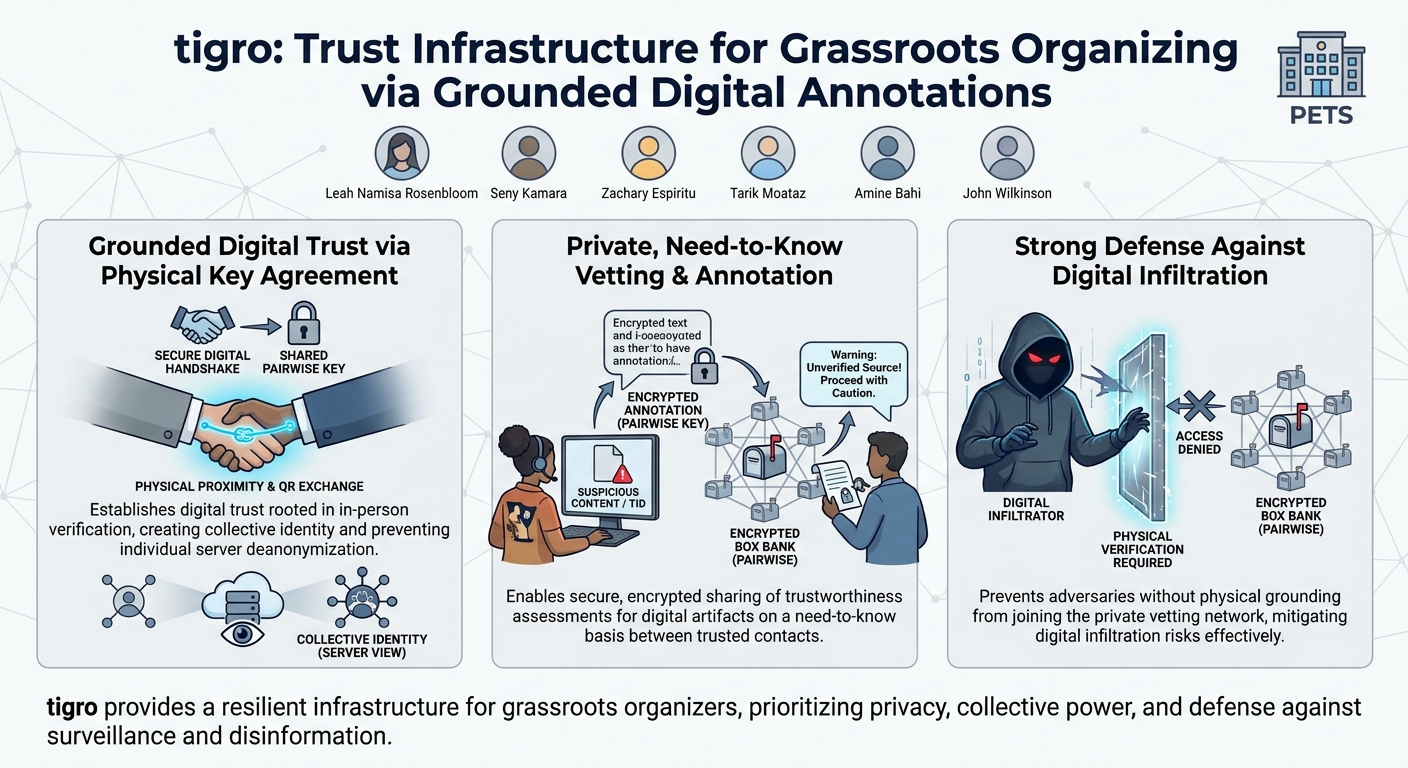
- Grounding Digital Trust in Collective Physical Presence: TIGRO introduces an innovative mechanism for establishing digital trust that is explicitly rooted in physical interaction. Unlike traditional cryptographic systems designed for authenticating individuals and their devices, TIGRO's grounded key agreement allows physically proximal individuals to generate shared keys. This process creates a collective identity with respect to a third-party server, ensuring that the server perceives a group rather than identifiable individuals. This directly addresses the observation that activists operate collectively and in person, providing a robust foundation for digital interactions that resists individual deanonymization by the service provider.
- Private and Need-to-Know Vetting of Digital Artifacts: The protocol enables activists to privately assess the trustworthiness of digital content. By allowing users to label digital artifacts with unique identifiers (TID) and encrypting annotations using their pairwise shared keys, TIGRO facilitates private vetting and information sharing on a need-to-know basis. Only trusted contacts who encounter the same artifact can access their comrades' opinions, ensuring that sensitive assessments are not exposed broadly or to adversaries. This mechanism is crucial for combating disinformation and making informed decisions about interacting with potentially risky digital content.
- Resistance to Digital Infiltration: TIGRO significantly enhances resilience against digital infiltration. Because all legitimate digital interactions within the TIGRO framework are rooted in the initial grounded key exchange, an adversary attempting to infiltrate the movement digitally (e.g., by posing as a legitimate participant online) cannot gain access to the private vetting network without first establishing physical presence and participating in a key exchange. This makes digital infiltration "not applicable" in the TIGRO model, as unauthorized digital identities cannot forge the foundational physical trust.
- Collective Identity and Anonymity with Respect to the Server: The design of TIGRO ensures that individual identifiers are never directly shared with the server. Each key agreement can establish new individual identifiers for that specific interaction, maintaining a high degree of anonymity for participants vis-à-vis the service provider. The server only sees collective activity, significantly reducing the risk of surveillance and data aggregation that could be used to identify and target activists.
- Addressing Limitations of Existing Tools: TIGRO's design explicitly overcomes the shortcomings of widely used tools, which often lead to context collapse, reliance on individual digital identities, platform dependency, or a lack of fine-grained trust. By offering a put-and-get model for annotations rather than send-and-receive messaging, and by integrating privacy-preserving mechanisms, TIGRO provides a more suitable and secure infrastructure for the nuanced communication and trust dynamics of grassroots movements.
Technical Deep Dive
▶ Watch: Encrypted annotation system for private vetting (4:06)
The TIGRO protocol is built upon several core technical components designed to achieve its goals of grounded trust, private annotation, and collective anonymity.
Grounded Key Agreement
The foundation of TIGRO is the grounded key agreement. This mechanism is designed to root digital authentication in physical co-presence. The talk models this using an authenticated proximity channel ideal functionality. In this theoretical model, if Alice and Bob, both sending their identifiers and location, are within a predefined distance delta from each other, the functionality returns a shared key.
In practice, this ideal functionality can be instantiated using existing technologies. A common approach involves a QR code exchange coupled with Diffie-Hellman key exchange. When Alice and Bob are physically proximal, they can scan each other's QR codes, which contain public key material. This physical interaction verifies their co-presence, after which a Diffie-Hellman exchange can securely derive a shared pairwise key. A critical aspect of this process is that it can establish new individual identifiers for each interaction. This means that the server never directly receives these individual identifiers, maintaining a layer of anonymity and preventing the linking of individual digital identities over time. The server only perceives the collective identity formed by these pairwise keys.
Encrypted Annotation System
Once a pairwise key is established between two or more participants, TIGRO enables a private, need-to-know encrypted annotation system. Consider an example: Alice encounters an online event, say a protest organized by "Eve." Alice might wish to annotate this event with a warning, such as "No one I know can confirm the identity of Eve, proceed with caution."
The process works as follows:
- Artifact Identification: The digital artifact (e.g., the online event) is assigned a unique identifier, referred to as a TID. This TID could be a hash of the event details, a URL, or any unique string that consistently identifies the artifact.
- Annotation and Encryption: Alice creates her annotation for the TID. She then encrypts this annotation using the pairwise key she shares with Bob.
- Shared Encrypted PO Box: Alice sends the encrypted annotation to a shared encrypted PO box. This mailbox is accessible only to Alice and Bob, as only they possess the decryption key.
- Retrieval by Contact: Later, if Bob comes across the same online event, he can search the shared PO box using the same TID. If Alice has previously annotated it, Bob will retrieve her encrypted annotation and can decrypt it using their shared key.
This system ensures privacy because access to the PO box and decryption of the annotation is gated by the shared key. It also operates on a need-to-know basis: Bob only searches for Alice's annotation once he himself has encountered the specific artifact (identified by the TID) and requires more context to safely interact with it. This prevents unsolicited information sharing that could lead to context collapse or exposure of sensitive vetting information to those who don't need it.
Multi-User System: Encrypted Box Bank
To scale beyond a simple Alice-and-Bob scenario, TIGRO extends to a multi-user system using an encrypted box bank. Instead of a single shared mailbox, the system supports multiple mailboxes, each pairwise distributed between any two trusted contacts. For example, in a group of Alice, Bob, and Charlie, there would be a mailbox for Alice-Bob, another for Alice-Charlie, and a third for Bob-Charlie. Each of these mailboxes is secured by a unique pairwise key established through a grounded key agreement. This architecture allows for a flexible and secure network of trust, where information is shared only between specific, authenticated pairs of individuals who have physically verified their connection.
Comparison with Related Work
The talk explicitly contrasts TIGRO with existing communication and trust mechanisms, highlighting its unique advantages:
- End-to-End Encrypted Messengers: Widely used for organizing, these platforms (e.g., Signal, WhatsApp) still rely on individual digital identities. They operate on a send-and-receive model, which can lead to context collapse in large group chats, making it difficult to find specific information or maintain separate conversational contexts. TIGRO's put-and-get annotation model, tied to specific artifacts, avoids this.
- Blue Checks and Community Fact-Checking: These systems are typically platform-dependent and subject to corporate volatility. As seen with changes on major social media platforms, the trustworthiness and availability of such features can change arbitrarily, making them unreliable for critical activist communications. TIGRO provides an independent, community-controlled trust mechanism.
- Digital Annotation Software: Tools like Third Voice, Hypothesis, and NB are generally not privacy-preserving and are designed for co-working rather than secure, anonymous vetting. They also rely on individual digital identities, which TIGRO explicitly avoids.
- Anonymous Communication Protocols: While TIGRO can utilize anonymous communication layers (like Tor), these protocols primarily provide anonymity but lack fine-grained trust mechanisms. They are often public bulletins with basic send-and-receive structures, insufficient for the nuanced, private vetting required by grassroots movements.
Adversary Model
TIGRO considers a comprehensive set of grassroots adversaries, categorized by their capabilities and attack vectors:
- Physical and Recovery Adversaries: These are individuals or devices in close physical proximity, potentially capable of observing physical interactions or attempting to recover data from devices.
- Digital Passive Adversaries: These adversaries operate online, attempting to gather public information or monitor network traffic. This includes the third-party host (the server provider), which TIGRO aims to prevent from deanonymizing users or linking their activities.
- Infiltration Adversaries:
- Physical Infiltration: An adversary who has physically infiltrated the activist community and poses as a legitimate participant. TIGRO explicitly states that it does not cover this case. If an adversary has gained physical access and trust within the community, they will naturally observe and learn what is discussed.
- Digital Infiltration: A network adversary attempting to pose as a legitimate participant online without physical access. This is where TIGRO is very strong. Because all legitimate digital interactions are rooted in the grounded key exchange, a digital infiltrator cannot bypass this physical verification step to join the trusted network.
Implementations and Security Considerations
The talk briefly mentions two different implementations of TIGRO, differing in their leakage characteristics:
- Medium Leakage Version: This implementation reveals the number, timing, and existence of operations, as well as anonymous social network graphs. While preserving content privacy, it provides some metadata to a sophisticated adversary.
- Subliminal Leakage Version: This more robust version reveals no information beyond the existence of the structure itself. The number, timing, and existence of operations are all hidden. This comes at the cost of being "much slower."
Additionally, TIGRO can be layered with Tor for enhanced anonymity. Two configurations are discussed:
- Single Tor Circuit: Using one Tor circuit for all mailboxes. This is faster but potentially links an individual's identity across different mailboxes if the circuit is compromised or analyzed.
- Different Tor Circuit per Box: Using a unique Tor circuit for each pairwise mailbox. This is "much slower" but offers significantly higher safety by preventing the linking of an individual's activity across different trusted relationships.
Against grassroots adversaries, TIGRO's security guarantees include:
- On-the-ground Adversaries: They might learn who is talking to whom physically but cannot deanonymize subsequent server requests or decrypt communications (assuming the anonymous channel is used).
- Network (Third-Party Host) Adversaries: Their knowledge is reduced to the specific leakage characteristics of the chosen implementation (medium vs. subliminal). They cannot access the contents of the encrypted mailboxes.
- Digital Infiltration: This threat is effectively mitigated, as legitimate digital interactions require prior grounded key exchange, making it impossible for an adversary to digitally pose as a trusted participant without physical verification.
Demo / Proof of Concept
▶ Watch: Adversary model and implementation variants (7:00)
The talk mentions the existence of "two different implementations" of the TIGRO protocol: a "medium leakage one" and a "subliminal leakage one," along with options for integrating a Tor layer. While these implementations demonstrate the technical feasibility of the TIGRO design principles, the conference presentation itself did not include a live demonstration or a detailed walk-through of a functional proof of concept. The speaker stated, "I'm actually not even going to talk about the security definition cuz we don't have time, but that there it is," indicating a focus on the conceptual and theoretical aspects of the protocol within the given time constraints, rather than a practical demonstration of the software.
Defensive Implications
▶ Watch: TIGRO's security against various adversaries (8:11)
TIGRO offers several crucial defensive implications for grassroots organizers and marginalized communities operating in hostile digital environments:
- Robust Defense Against Digital Infiltration: The most significant defensive implication is TIGRO's inherent resistance to digital infiltration. By requiring a grounded key agreement (physical co-presence) to establish digital trust, the protocol ensures that adversaries cannot simply create fake online profiles and infiltrate activist networks. This fundamentally alters the threat model for digital organizers, making it significantly harder for state actors, malicious groups, or provocateurs to gain access to sensitive discussions and planning.
- Enhanced Privacy and Anonymity: TIGRO's design promotes collective identity over individual identity with respect to the server. By generating new, pairwise identifiers for each interaction and preventing the server from linking individual activities, it drastically reduces the risk of surveillance and deanonymization by service providers. This allows activists to communicate and vet information without fear that their digital footprint will be used to identify or target them.
- Secure and Private Vetting of Information: The encrypted annotation system provides a critical tool for combating disinformation. Organizers can privately share their assessments of suspicious links, events, or individuals on a need-to-know basis. This empowers communities to collectively vet information without exposing their internal discussions or concerns to external adversaries, thereby reducing the spread of fake news and preventing traps set by malicious actors.
- Decentralized and Resilient Trust Infrastructure: By rooting trust in physical interactions and enabling pairwise encrypted communication, TIGRO offers a decentralized trust infrastructure. This reduces reliance on centralized platforms and their inherent vulnerabilities, such as corporate volatility, censorship, or data breaches. The community maintains control over its trust network, making it more resilient to external pressures.
- Mitigation of Context Collapse: Unlike traditional group chats in E2EE messengers, TIGRO's put-and-get annotation model, tied to specific digital artifacts, helps prevent context collapse. Information related to a specific event or artifact is stored and retrieved only when relevant, ensuring clarity and preventing sensitive vetting information from getting lost or misapplied in broader discussions.
- Empowering Informed Decision-Making: By providing a secure channel for sharing vetted information, TIGRO enables activists to make more informed decisions about participating in events, sharing content, or interacting with new contacts. This proactive approach to risk assessment is vital for maintaining the safety and effectiveness of grassroots movements.
Key Takeaways
- Trust Rooted in Physical Presence: TIGRO fundamentally grounds digital trust in physical, in-person interactions through an "authenticated proximity channel," making it robust against digital infiltration.
- Private, Need-to-Know Vetting: The protocol enables activists to privately annotate and vet digital artifacts using pairwise encrypted mailboxes, ensuring sensitive information is shared only among trusted contacts who need it.
- Collective Identity & Server Anonymity: TIGRO creates a collective digital identity with respect to the server, preventing the deanonymization of individual participants and reducing surveillance risks.
- Strong Defense Against Digital Infiltration: Because all legitimate digital interactions are tied to prior physical key exchanges, TIGRO effectively neutralizes attempts by adversaries to digitally infiltrate movements.
- Addresses Limitations of Existing Tools: TIGRO offers a solution that overcomes the shortcomings of end-to-end encrypted messengers, platform-dependent fact-checking, and non-privacy-preserving annotation software.
- Flexible Anonymity Layers: Implementations can incorporate Tor circuits with varying levels of leakage, allowing organizers to balance speed and anonymity based on their specific threat model.
About the Speaker(s)
The TIGRO project is a collaborative effort by a team of researchers from various academic institutions and industry. The talk was presented by Leah Namisa Rosenbloom, who is listed as a paper author from Northeastern University. Her work focuses on critical aspects of cryptography and its application to social and political movements. The co-authors on the paper include Seny Kamara from Brown University and MongoDB Research, Zachary Espiritu and Tarik Moataz from MongoDB Research, Amine Bahi from École Normale Supérieure, and John Wilkinson from Brown University. This diverse group of researchers brings expertise from academia and industry to address complex privacy and security challenges faced by grassroots organizations.
Reviews
Dr. Zero (Offensive Security Researcher) — SOLID
Rosenbloom and Kamara actually built a protocol around a realistic threat model instead of just throwing Signal at activists and calling it a day. TIGRO ditches central PKI for physical key exchanges to gate an encrypted, decentralized annotation network. It is a clever cryptographic primitive, even if a usable real-world implementation is probably still years away.
Heather Calloway (CISO) — WEAK
This is an academic privacy protocol designed for grassroots activists, not enterprise security teams. However, its core mechanic—forcing physical co-presence to bootstrap digital trust—is a conceptual model identity architects should understand for securing high-value targets.
→ Top-rated talks at Privacy Enhancing Technologies Symposium (PETS) 2026
All talks from Privacy Enhancing Technologies Symposium (PETS) 2026