RSAC™ Conference Award for Excellence in the Field of Mathematics
Shai Halevi (Senior Principal Applied Scientist, AWS Cryptography · Amazon Web Services), Victor Shoup (Principal Research Scientist · Offchain Labs), Adi Shamir (Professor · Weizmann Institute of Science)
RSA Conference 2025 · Day 2 · West Stage · Keynote
Overview
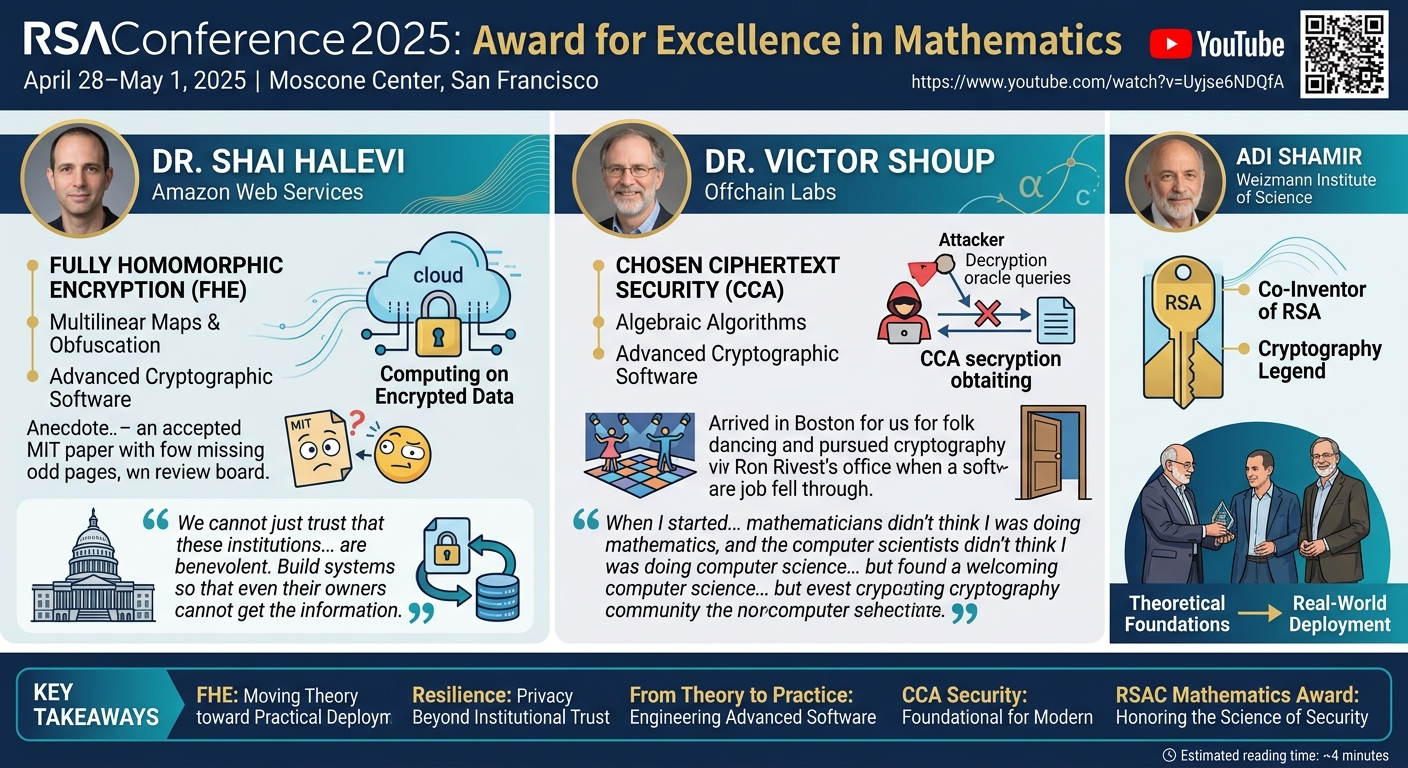
The RSAC 2025 Conference Award for Excellence in the Field of Mathematics, co-sponsored by the International Association for Cryptologic Research (IACR), was presented jointly to Dr. Shai Halevi of Amazon Web Services and Dr. Victor Shoup of Offchain Labs. Presented by cryptography legend Adi Shamir — the "S" in RSA — the ceremony recognized decades of foundational work in public-key cryptography, homomorphic encryption, and the translation of advanced cryptographic theory into practical, deployable software. ---
Key moments
- 0:36 Adi Shamir presents Math Award to Halevi and Shoup
- 0:58 Halevi honored for public-key cryptography and obfuscation work
- 2:00 Halevi's blank-pages paper was still accepted at conference
- 2:10 Shoup honored for chosen-ciphertext secure cryptography contributions
- 3:30 Systems must resist abuse even by owners and governments
- 3:48 Cryptographic computing: owners can be denied unneeded data access
- 4:28 Shoup's mission: move encrypted computation from theory to practice
RSAC Conference Award for Excellence in the Field of Mathematics
Speakers: Adi Shamir (Weizmann Institute of Science) · Shai Halevi (Amazon Web Services) · Victor Shoup (Offchain Labs)
Event: RSA Conference 2025 — April 28–May 1, 2025, Moscone Center, San Francisco
Watch on YouTube: https://www.youtube.com/watch?v=Uyjse6NDQfA
Reading time: ~4 minutes
TL;DR
The RSAC 2025 Conference Award for Excellence in the Field of Mathematics, co-sponsored by the International Association for Cryptologic Research (IACR), was presented jointly to Dr. Shai Halevi of Amazon Web Services and Dr. Victor Shoup of Offchain Labs. Presented by cryptography legend Adi Shamir — the "S" in RSA — the ceremony recognized decades of foundational work in public-key cryptography, homomorphic encryption, and the translation of advanced cryptographic theory into practical, deployable software.
Introduction
Each year at RSA Conference, amid the product launches, threat intelligence briefings, and policy debates, a quieter moment takes center stage: the recognition of the mathematical work that makes all of modern cryptography possible. The RSAC Award for Excellence in the Field of Mathematics honors researchers whose contributions to the mathematical foundations of security have shaped the field — often in ways that practitioners encounter daily without knowing their origin. In 2025, that recognition fell to two cryptographers whose collaborative and independent work has pushed the boundaries of what it means to build systems that are secure not just against external attackers, but against the very organizations that operate them.
The Presenter: A Living Legend
There are few figures better suited to present a prize in cryptography than Adi Shamir, co-inventor of the RSA public-key cryptosystem and a longtime professor at the Weizmann Institute of Science. Shamir's presence on stage — as both presenter and implicit namesake of the conference itself — lent the ceremony a particular resonance.
▶ Watch: Adi Shamir presents the award (0:00)
Shamir introduced both laureates with a warmth and humor characteristic of long professional friendships. He arrived armed not only with descriptions of their technical achievements, but with the kind of personal anecdotes that humanize researchers who are often known primarily through dense academic papers.
Shai Halevi: From Obfuscation to Homomorphic Encryption
Dr. Shai Halevi was recognized for major contributions to public-key cryptography — particularly in the areas of multilinear maps, obfuscation, and fully homomorphic encryption — as well as for the development of advanced cryptographic software.
▶ Watch: Halevi's contributions recognized (0:30)
Shamir illustrated Halevi's early career with an anecdote that the audience received with visible delight: as a PhD student at MIT, Halevi submitted a paper to a major conference in which, due to a printing error, only the odd-numbered pages were included. The paper was accepted anyway. "Talking about obfuscation," Shamir noted dryly — the double meaning landing cleanly with a cryptography-literate crowd.
Halevi's technical contributions span some of the most consequential open problems in modern cryptography. Multilinear maps and program obfuscation touch on fundamental questions about the limits of what can be hidden in computation. Fully homomorphic encryption (FHE) — the ability to perform arbitrary computation on encrypted data without ever decrypting it — has long been described as cryptography's "holy grail." Halevi has been central to efforts to make FHE not merely theoretically possible but practically deployable, developing software libraries that bring these capabilities within reach of real-world systems.
In accepting the award, Halevi articulated the deeper motivation behind this work: building systems that are resilient to abuse not just by external adversaries, but by the institutions and governments that own and operate them. "We cannot just trust that these institutions and the people who lead them will always be benevolent," he said. "So it is important that we build them so that even their owners cannot get the information that is not needed for the organization to operate."
Victor Shoup: Chosen Ciphertext Security and Cryptographic Software
Dr. Victor Shoup was honored for contributions to public-key cryptography — particularly chosen ciphertext secure systems and the underlying algebraic algorithms that support them — along with his own body of advanced cryptographic software.
▶ Watch: Shoup's background and contributions (2:00)
Shamir's introduction of Shoup offered perhaps the evening's most charming origin story. Shoup arrived in Boston not because of any particular attraction to cryptography, but because Boston was a center for folk dancing in the United States. Seeking a software engineering position through Ron Rivest's office — and finding that Rivest was unable to place him at a startup — Shoup, "desolate and desperate," was left with no option but to pursue academia. Decades later, he stood on the RSA Conference main stage holding the field's mathematics prize.
The technical substance of Shoup's recognition is significant. Chosen ciphertext attacks represent one of the canonical threat models in cryptography: an adversary who can query a decryption oracle for arbitrary ciphertexts and observe the results. Building encryption systems that remain secure under this adversary model — CCA-secure systems — is a non-trivial challenge that Shoup's work helped formalize and solve. His contributions to the algebraic underpinnings of these systems, and to the software that implements them, have influenced how cryptographic protocols are designed and deployed across the industry.
In his remarks, Shoup reflected on the interdisciplinary nature of his career path — initially unwelcome among both pure mathematicians and computer scientists — and on the warmth of the cryptographic research community he eventually found. He singled out his collaborative work with Halevi on computing over encrypted data: "Several years working with Shai, trying to turn computing on encrypted data from theory to practice."
Notable Quotes
"We cannot just trust that these institutions and the people who lead them will always be benevolent. It is important that we build systems so that even their owners cannot get the information that is not needed for the organization to operate." — Shai Halevi
"When I started out in graduate school doing research in computational number theory, the mathematicians didn't think I was doing mathematics, and the computer scientists didn't think I was doing computer science. But when I moved into cryptography, I found a very welcoming research community." — Victor Shoup
Key Takeaways
- Fully homomorphic encryption has a practical champion. Shai Halevi's work on FHE software moves one of cryptography's most theoretically profound ideas toward real-world deployment, enabling computation on encrypted data without exposing it to decryption.
- Cryptographic resilience extends to institutional trust. Both laureates articulated a vision of security systems that remain privacy-preserving even when operated by governments or corporations that may not always act in users' interests — a framing with direct relevance to the policy debates of 2025.
- The path from theory to practice is the hard problem. The award recognized not just mathematical discovery but the engineering discipline of building software that makes advanced cryptography accessible and deployable — a distinction that often separates academic impact from real-world security improvement.
- Chosen ciphertext security remains foundational. Shoup's contributions to CCA-secure systems underpin a large portion of the encryption protocols in active use today, making his recognition a reminder of how deeply theoretical cryptographic work shapes everyday security infrastructure.
- The RSAC Mathematics Award reflects the conference's ongoing commitment to honoring the foundational science that makes the security industry possible — even as the spotlight more often falls on products, threats, and policy.
Reviews
Dr. Zero (Offensive Security Researcher) — SOLID
A cryptography award ceremony conducted by Adi Shamir with actual substance — Halevi on FHE and obfuscation, Shoup on CCA-secure systems — and a genuinely important framing from Halevi about building systems resistant to their own operators, not just external attackers. Short, well-executed, and a necessary counterweight to the vendor keynote circuit.
Heather Calloway (CISO) — SOLID
RSA Conference Mathematics Award presented to Shai Halevi and Victor Shoup for advancing Fully Homomorphic Encryption toward practical deployment. Adi Shamir presents. Halevi's acceptance remark — that systems must resist even their own operators — is the most important sentence in the ceremony.