Opening Keynote: Risky Business: Some High-Risk Users You May Not Have Thought of and How to Protect Them
Eva Galperin (Head of Security Research · Electronic Frontier Foundation)
Swiss Cyber Storm 2023 · Day 1 · Arena
Overview
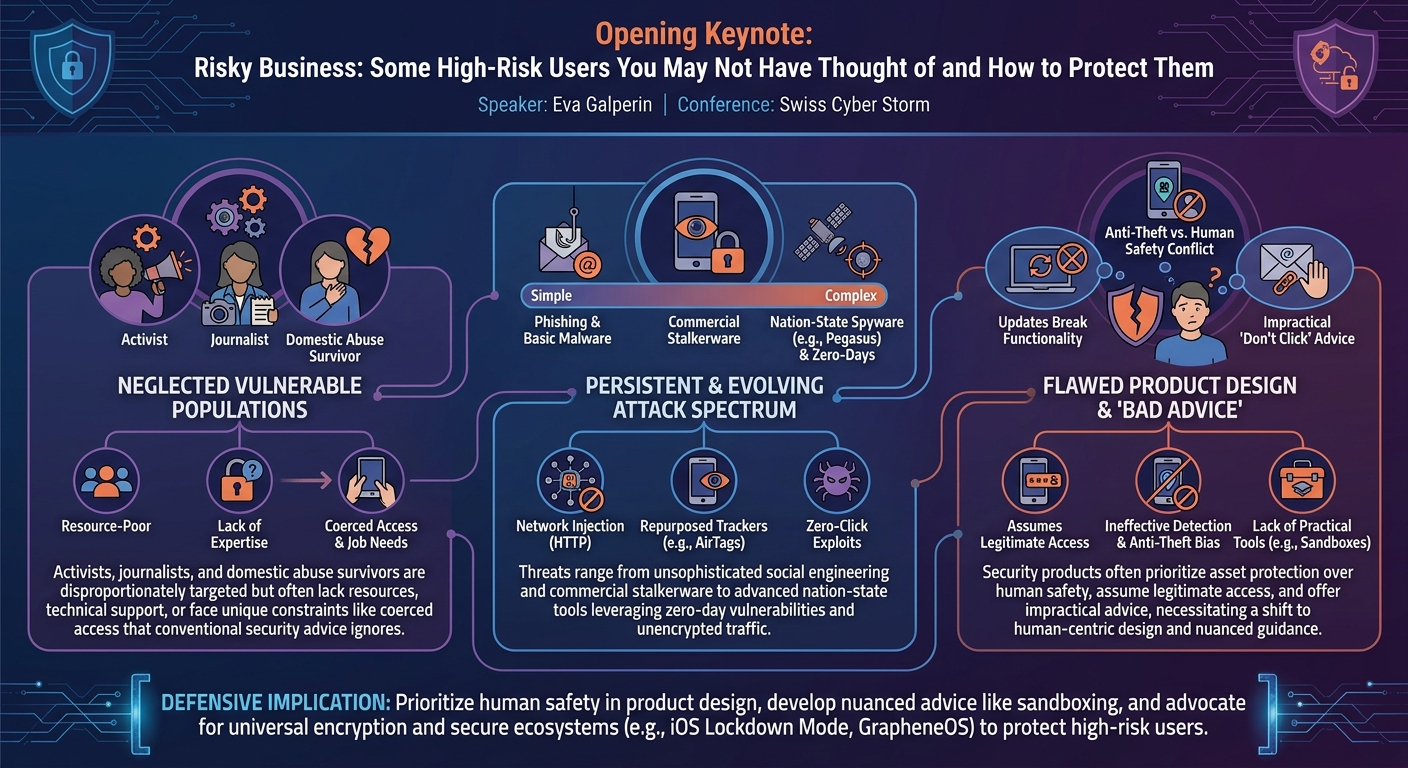
In an insightful and urgent keynote at Swiss Cyber Storm, Eva Galperin, Head of Security Research at the Electronic Frontier Foundation (EFF), illuminated a critical blind spot in contemporary cybersecurity: the protection of high-risk human users. Titled "Risky Business: Some High-Risk Users You May Not Have Thought of and How to Protect Them," her talk pivoted the conversation from securing networks and devices to safeguarding the individuals who often face the most sophisticated and personal digital threats. Galperin argued that while the industry has made significant strides in fortifying infrastructure, it has largely failed to address the unique vulnerabilities of activists, journalists, and survivors of domestic abuse, who are frequently targeted by powerful state actors, commercial spyware, or intimate partners.
Key moments
- 2:00 Introduction: Protecting historically vulnerable humans
- 4:00 Activists & journalists: Unprepared, highly targeted users
- 9:30 Network injection attacks exploit unencrypted traffic
- 15:00 Critiquing bad security advice for journalists
- 18:30 Domestic abuse: The 'close access' stalkerware problem
- 24:00 AirTags and physical trackers used for stalking
- 28:30 “People are not things”: The core dilemma
Risky Business: Some High-Risk Users You May Not Have Thought of and How to Protect Them
Speakers: Eva Galperin, Head of Security Research, Electronic Frontier Foundation
Conference: Swiss Cyber Storm
YouTube: https://www.youtube.com/watch?v=HzVLRDD2kxw
Overview
In an insightful and urgent keynote at Swiss Cyber Storm, Eva Galperin, Head of Security Research at the Electronic Frontier Foundation (EFF), illuminated a critical blind spot in contemporary cybersecurity: the protection of high-risk human users. Titled "Risky Business: Some High-Risk Users You May Not Have Thought of and How to Protect Them," her talk pivoted the conversation from securing networks and devices to safeguarding the individuals who often face the most sophisticated and personal digital threats. Galperin argued that while the industry has made significant strides in fortifying infrastructure, it has largely failed to address the unique vulnerabilities of activists, journalists, and survivors of domestic abuse, who are frequently targeted by powerful state actors, commercial spyware, or intimate partners.
Galperin’s presentation served as a powerful call to action, urging the cybersecurity community to rethink its priorities and design principles. She meticulously detailed how conventional security wisdom and product development often overlook the real-world dynamics of these populations, from journalists whose job requires opening suspicious links to domestic abuse survivors whose physical devices are compromised by those with close access. By highlighting specific attack methodologies—ranging from nation-state-level spyware like Pegasus to widely available physical tracking devices like Apple AirTags—Galperin underscored the urgent need for a human-centric approach to security, one that acknowledges the complex interplay of technology, social dynamics, and personal safety.
The talk is critically important because it challenges the prevailing, often technical-centric, view of cybersecurity. Galperin demonstrates that even as we strive for advanced defenses against abstract threats, fundamental human vulnerabilities persist and are actively exploited. Her work with the EFF, a leading organization dedicated to protecting civil liberties in the digital world, lends significant weight to her arguments, positioning her as a key voice advocating for those most at risk in an increasingly surveilled and interconnected world.
Background
▶ Watch: Introduction: Protecting historically vulnerable humans (2:00)
The premise of Swiss Cyber Storm's 10th edition, "the human factor," set the stage for Eva Galperin's keynote. The conference organizers noted that despite decades of technological advancements in cybersecurity, a critical gap remains: the failure to adequately understand and account for human behavior and vulnerabilities. As the opening remarks highlighted, "techies have been running security for 20-30 years and look where we are," underscoring the need to integrate non-IT perspectives and learn how to "understand humans and work with them to improve the security and secure experience for them." Galperin’s talk directly addressed this challenge, arguing that the industry's historical focus on securing networks, devices, and IoT infrastructure has inadvertently left the most vulnerable individuals exposed.
The problem stems from several factors. Firstly, many high-risk users, such as grassroots activists or freelance journalists, are not "professional activists" or cybersecurity experts. They often lack the resources, technical expertise, or organizational support to conduct thorough threat analyses or implement sophisticated defenses. This contrasts sharply with large organizations like Thomson Reuters, which can afford dedicated IT and security teams. Secondly, many security products and advice are designed with an inherent assumption of legitimate access or a clear adversarial model, failing to account for scenarios like coerced password sharing or physical device compromise by an intimate partner.
Galperin's background as Director of Cybersecurity at the Electronic Frontier Foundation (EFF) provides crucial context for her insights. The EFF has a long history of defending digital civil liberties, from writing privacy and security guides like "Surveillance Self-Defense" to suing the NSA over mass surveillance programs and championing end-to-end encryption. Her work has consistently involved "chasing APTs" and, more recently, tackling the specific challenges faced by survivors of domestic abuse and the proliferation of physical trackers such as AirTags, Tiles, and Samsung SmartTags. This extensive experience positions her uniquely to bridge the gap between high-level technical threats and their profoundly human impact.
Key Findings
▶ Watch: Network injection attacks exploit unencrypted traffic (9:30)
Galperin's talk revealed several critical findings regarding the overlooked vulnerabilities of high-risk users and the shortcomings of conventional cybersecurity approaches.
1. Neglected Vulnerable Populations:
The core finding is that specific groups—activists, journalists, and survivors of domestic abuse—are disproportionately targeted and underserved by mainstream security efforts.
- Activists: Often become activists "by accident," lacking prior threat analysis. They can be targeted by powerful state actors even for seemingly innocuous campaigns, such as Mexican scientists working on soda taxes being targeted with Pegasus spyware in 2016.
- Journalists: While some in large organizations have security support, most are freelancers or work for small, "scrappy" organizations that lack funding for advanced security tools. They are targeted not just for "speaking truth to power" but also for their trusted relationships, which attackers can leverage.
- Survivors of Domestic Abuse: Face daily espionage by abusers using readily available stalkerware and physical trackers. This population highlights the "close access problem," where abusers often have physical access to devices or coerce passwords, a dynamic not typically addressed by product design.
2. Persistent and Evolving Attack Vectors:
Galperin demonstrated that attackers leverage a spectrum of sophistication, from basic social engineering to nation-state-level capabilities.
- Network Injection: Even with high rates of web encryption, unencrypted HTTP traffic remains a critical vulnerability. The case of former Egyptian MP Ahmed Elana in 2020, redirected from an HTTP site to an inexa website that exploited his phone with Predator surveillance malware, illustrates this point.
- Commercial Spyware: Vendors like NSO Group (Pegasus), FinFisher, Hacking Team, Cyrox, and inexa are increasingly using no-click zero-day vulnerabilities, necessitating constant device updates. These tools are accessible to many governments.
- Basic Malware/Phishing: Unsophisticated attacks remain effective. Examples included Syrian pro-Assad hackers distributing malware links in Facebook groups disguised as "anti-hacker" tools in 2011-2012, and the Vietnamese government sending malware via an email attachment with a compelling but poorly executed lure (Comic Sans, "Mr. Oxfam" inviting to an "Asia conference").
- Stalkerware: Commercial "malware for hire" designed for covert surveillance, often marketed to spy on "cheating" partners. Despite increased detection by antivirus products like Kaspersky and Malwarebytes, the market persists, indicating a societal acceptance of privacy invasion in intimate relationships.
- Physical Trackers: Devices like AirTags and Tiles, designed to find lost items, are widely repurposed for stalking. Apple's vast "Find My" network, comprising all Apple devices with the feature enabled, makes AirTags particularly effective as tracking devices, creating an "entire snitch network."
3. Inadequate Security Practices and Product Design:
Current security advice and product development often fail these users due to fundamental design flaws and a lack of empathy.
- Bad Advice: Common advice like "don't open strange attachments or click strange links" is impractical for journalists whose job demands it. Similarly, "take your security updates all the time" can break essential functionality, leading users to revert updates without informing IT.
- Product Design Assumptions: Devices are often designed assuming that physical access or a password implies legitimate access, ignoring the realities of coercion and abuse.
- Anti-Theft vs. Anti-Stalking Conundrum: Galperin highlights a critical trade-off: it's impossible to create an anti-theft device (designed to track a stolen item covertly) that isn't also a "perfect stalking device." The industry's prioritization of property over human safety in this context is a significant ethical failing.
- Ineffective Detection: Detector apps for physical trackers, including Apple's own "Detect," were found to be largely ineffective in Galperin's upcoming research, and some products like Tile even offer "anti-theft mode" that disables stalking alerts.
Technical Deep Dive
▶ Watch: Critiquing bad security advice for journalists (15:00)
Galperin's talk delved into several technical aspects, illustrating both the sophistication of modern attacks and the often-simple vulnerabilities that persist.
The historical context of government espionage was set with the revelation that the NSA, starting in 2003, exploited the fact that much of the world's internet traffic passed through US telecommunications infrastructure. This involved secretly copying data without warrants, leading to EFF lawsuits and, famously, Edward Snowden's leaks. The tech industry's response to this pervasive surveillance was a monumental effort to encrypt the web. Through initiatives like Certbot and the widespread adoption of SSL certificates, the percentage of encrypted web traffic has reached "extremely high levels of penetration," a significant victory for user privacy.
However, Galperin highlighted that "occasionally we miss a spot and the consequences are very bad." The case of Ahmed Elana, a former Egyptian MP, served as a stark reminder. In August and September 2020, Elana was subjected to a network injection attack. This occurred when he visited an unencrypted HTTP webpage. Attackers, likely leveraging control over network infrastructure, redirected his browser to an inexa website, which then delivered an exploit to his phone, installing Predator surveillance malware. This "man-in-the-middle attack" required no user interaction beyond visiting an unencrypted site, demonstrating that 99% encryption is "not good enough" when even a single unencrypted connection can be catastrophically exploited.
Galperin categorized attackers faced by journalists and activists into three tiers:
- Hackers for Hire: These groups, such as BelTrex (responsible for a phishing campaign against Fight for the Future in 2017), Netwire, and Apen, often engage in targeted phishing and malware distribution. Their methods can be relatively unsophisticated but effective against less prepared targets.
- Commercial Spyware Vendors: This tier includes notorious names like FinFisher, Hacking Team, NSO Group (Pegasus), Cyrox, and inexa. These companies develop and sell sophisticated surveillance tools, increasingly relying on no-click zero-day vulnerabilities. This is the primary reason why users are constantly urged to update their iPhones and other devices. The targeting of Mexican scientists with Pegasus for their work on a soda tax campaign underscores the breadth of targets for such powerful tools.
- Top-Tier Government Actors: These are nation-states with vast resources that "roll their own malware," including agencies like the NSA, FSB, GRU, and Unit 8200. Their attacks are often "especially difficult to protect against" due to their high targeting, custom nature, and the "obsessive and sophisticated people" behind them.
Despite the rise of advanced threats, Galperin stressed that many attacks against activists remain "extremely unsophisticated." She provided two historical examples:
- Syrian Activists (2011-2012): Pro-Assad hackers distributed malware links in Facebook groups frequented by anti-Assad activists. The lure was a fake "anti-hacking tool called anti-hacker," a classic example of social engineering exploiting fear. At this time, mobile targeting was less prevalent.
- Vietnamese Government targeting Eva Galperin: Galperin herself received a targeted email with an attachment from "Mr. Oxfam" inviting her to an "Asia conference." The lure aimed to exploit an activist's interest in international meetings. Amusingly, the email was written in Comic Sans, which Galperin found "a little bit insulting." This example, despite its aesthetic flaws, demonstrated a sophisticated understanding of activist interests, even if the execution was technically basic.
In terms of effective defenses, Galperin highlighted several practical solutions:
- dZ0ne: A project developed by former EFF colleague Mick Lee (now at Freedom of the Press Foundation), dZ0ne is a sandbox designed to safely open "strange links and documents." This tool directly addresses the "don't do your job" problem faced by journalists, providing a secure way to interact with potentially malicious content.
- iOS Lockdown Mode: Apple's Lockdown Mode for iOS has been a "really great success" for vulnerable populations. Galperin noted that every emergency patch released by Apple since Lockdown Mode's implementation has been for a vulnerability that "could have been prevented by having lockdown mode enabled."
- Android Security: For Android users, the recommendation is a Pixel phone running GrapheneOS. Galperin stated, "GrapheneOS is love," emphasizing its enhanced security and privacy features compared to standard Android distributions.
The talk also provided a detailed technical overview of stalkerware and physical trackers.
- Stalkerware: This commercial malware is designed to covertly spy on devices, often advertised to track "cheating" partners. Galperin successfully lobbied Kaspersky to improve its detection, leading to a "separate little alert" for stalkerware. Other companies like Malwarebytes also increased detection. While the market for Android stalkerware didn't shrink, detection rates significantly increased in 2020-2021. On iOS, stalkerware primarily works by installing covert apps or by taking "unauthorized iCloud backups," both of which can be revealed by Apple's Safety Check feature.
- Physical Trackers (AirTags, Tiles, Samsung SmartTags): Galperin noted a shift from stalkerware to physical trackers during COVID. Apple AirTags, released in 2021, connect to the "entire network of Apple devices with Find My turned on," creating an "extremely powerful tracking network." This vast "snitch network" makes AirTags far more effective for stalking than products like Tile, which rely on users having the Tile app installed. Apple has been "slowly increasing the number of alerts" for unwanted tracking, but a "loophole" allows the timer to reset if the tracker comes back within pairing distance. Galperin's upcoming research revealed that "none of the detector apps" (including Apple's own Detect app for Android) are "any good." Furthermore, Tile introduced an "anti-theft mode" that disables tracking alerts, directly enabling stalking.
Galperin concluded this section by highlighting the fundamental conflict: there is "absolutely no way to create an anti-theft device... that is not also a perfect stalking device." This technical and ethical dilemma requires a re-evaluation of product design priorities.
Demo / Proof of Concept
▶ Watch: AirTags and physical trackers used for stalking (24:00)
While Eva Galperin's keynote did not include a live, interactive technical demonstration or a real-time proof of concept execution, it effectively presented compelling evidence and real-world examples that served a similar purpose. Throughout her talk, Galperin displayed screenshots and visual aids directly from her research and the cases she discussed.
For instance, she showed:
- An example of the unsophisticated malware distribution method used against Syrian activists, illustrating how links to a fake "anti-hacker" tool were posted in Facebook groups.
- The actual email with the Comic Sans font and the "Mr. Oxfam" lure used by the Vietnamese government in a phishing attempt against her, highlighting the blend of social engineering and technical unsophistication.
- Advertisements for stalkerware products, including one particularly chilling image depicting a man holding the arm of a woman with a black eye, clearly demonstrating the target demographic and malicious intent behind these commercial tools.
- Statistics and reports from companies like Malwarebytes showing the increase in stalkerware detection, providing empirical data on the scale of the problem.
- Visuals of Apple AirTags and their integration with the "Find My" network, explaining how these everyday devices are repurposed for nefarious tracking.
These visual proofs, combined with detailed accounts of incidents like the targeting of Mexican scientists with Pegasus and Ahmed Elana with Predator surveillance malware, served to concretely illustrate the threats and vulnerabilities discussed. They acted as a powerful "proof of concept" by showcasing the tangible realities of digital and physical stalking, making the abstract technical concepts immediately relatable and impactful for the audience.
Defensive Implications
▶ Watch: “People are not things”: The core dilemma (28:30)
Eva Galperin's talk presents a profound shift in perspective for defenders, moving beyond traditional network and device security to a human-centric approach. The defensive implications are broad, spanning product design, policy, user education, and resource allocation.
1. Prioritize Human Safety in Product Design: The most critical implication is the need to fundamentally rethink how security products and features are designed. Companies must abandon the assumption that physical access or a password always implies legitimate access, especially in the context of domestic abuse. For tracking devices like AirTags and Tiles, the "people are not things" mantra demands that anti-stalking measures take precedence over anti-theft functionalities. This means designing detection mechanisms that cannot be easily disabled (unlike Tile's anti-theft mode) and ensuring that alerts for unwanted tracking are robust, frequent, and unavoidable, even if it impacts product sales or convenience.
2. Develop Nuanced and Practical Security Advice: Defenders must stop giving "bad advice" that forces users to choose between security and their job or safety. Instead of "don't open strange links," provide tools like dZ0ne that allow safe interaction with potentially malicious content in sandboxed environments. Security updates should be communicated with an understanding of potential functionality breaks, and support should be available to mitigate these issues, preventing users from rolling back crucial patches. Advice must be tailored to the user's "level of comfort" and emphasize actions they are "actually going to do."
3. Advocate for Universal Encryption and Secure Ecosystems: The case of Ahmed Elana highlights that even a single unencrypted HTTP connection can be a critical vulnerability. Defenders must continue to push for 100% web encryption and advocate for browser and network configurations that actively prevent connections to unencrypted sites. For mobile devices, recommending secure ecosystems like iOS Lockdown Mode (which has proven effective against numerous zero-day vulnerabilities) and GrapheneOS on Pixel for Android users provides robust, pre-emptive defense against sophisticated attacks.
4. Address the "Close Access Problem": For survivors of domestic abuse, the threat often comes from someone with physical access to their devices and intimate knowledge of their digital habits. Defenders need to develop security solutions that specifically address these scenarios, such as easier ways to revoke access, identify unauthorized backups (as seen with iOS Safety Check), and detect covertly installed stalkerware. Education for domestic abuse shelters and support organizations on these specific threats is paramount.
5. Support Vulnerable Organizations and Individuals: The disparity in resources between large corporations and small activist groups or freelance journalists is a major vulnerability. The cybersecurity community should explore initiatives to provide pro-bono security audits, subsidized access to advanced tools, or specialized training for these high-risk populations. This could involve funding non-profits that offer security support or developing open-source tools tailored to their unique needs.
6. Push for Faster Standards and Policy Changes: The slow pace of standards bodies like the IETF and IEEE in addressing emerging threats like physical trackers is problematic. Defenders should actively participate in these forums to accelerate the development and adoption of robust, non-circumventable detection standards. Furthermore, advocating for legal and policy changes that hold stalkerware vendors accountable and classify malicious tracking as a serious offense is crucial.
7. Educate Law Enforcement: Many police forces lack the technical understanding to deal with digital and physical stalking. Training programs are needed to educate law enforcement on how to identify stalkerware, detect physical trackers, collect digital evidence, and understand the dynamics of tech-enabled abuse. This ensures that victims can receive appropriate assistance and that perpetrators are held accountable.
Ultimately, the defensive implication is a call for empathy and a broadening of the cybersecurity mandate. It's about securing people, not just data or infrastructure, by designing with the most vulnerable in mind and acknowledging the complex human factors that underpin digital security.
Key Takeaways
- People, Not Things: Cybersecurity must fundamentally shift its focus from securing networks and devices to protecting human beings, especially those in high-risk categories like activists, journalists, and survivors of domestic abuse.
- Vulnerable Populations are Unique: These groups face distinct threats, often lack resources or cybersecurity expertise, and operate under conditions (e.g., coerced access, job requirements to open suspicious links) that render conventional security advice impractical or dangerous.
- The "Close Access Problem" is Critical: Product design often ignores the reality of malicious actors having physical access to devices or intimate knowledge, particularly in domestic abuse scenarios, making stalkerware and physical trackers highly effective.
- Sophisticated and Simple Attacks Coexist: High-risk users face a spectrum of threats, from nation-state-sponsored Pegasus and Predator surveillance malware leveraging zero-days, to commercial stalkerware, and even unsophisticated social engineering via phishing or basic malware links.
- Physical Trackers are a Stalking Epidemic: Devices like Apple AirTags are being widely repurposed for stalking, leveraging vast "snitch networks" like Apple's "Find My" to create highly effective tracking tools, with current detection mechanisms and product designs failing to adequately protect victims.
- Design for Safety, Not Just Functionality: There is an inherent conflict between designing effective anti-theft devices and preventing stalking; products must prioritize human safety over property tracking, and security advice must be nuanced, practical, and empathetic to be effective.
About the Speaker(s)
Eva Galperin is the Head of Security Research at the Electronic Frontier Foundation (EFF), a prominent non-profit organization dedicated to defending civil liberties in the digital world. Her work at the EFF focuses on protecting vulnerable populations from digital threats. She has a distinguished track record in cybersecurity, including authoring the EFF's "Surveillance Self-Defense" privacy and security guides, actively "chasing APTs" (Advanced Persistent Threats), and contributing to major legal and policy battles such as suing the NSA over mass surveillance and championing end-to-end encryption. More recently, Galperin has become a leading voice in addressing the intersection of technology and gender-based violence, specifically focusing on the problems faced by survivors of domestic abuse and the proliferation of physical tracking devices like Apple AirTags, Tiles, and Samsung SmartTags. Her expertise lies in bridging the gap between highly technical security challenges and their profound human impact.
Reviews
Dr. Zero (Offensive Security Researcher) — STRONG ACCEPT
Most 'human element' keynotes are an hour of vendors telling you to buy their phishing simulation platform. Galperin actually did the work. She forces a realistic threat model onto populations the industry usually ignores, calling out specific hardware failures and surveillance vendors by name.
Heather Calloway (CISO) — STRONG ACCEPT
Galperin forces a complete rethink of how we handle executive protection and high-risk employee threat models. If your security program assumes the adversary is always remote and the user's physical environment is safe, her research on close-access threats dismantles that assumption.