Converging Behaviors Across Threat Actors
Joe Slowik (Threat Hunter and Forensic Expert / Lead of Threat Intel Program · Huntress)
Swiss Cyber Storm 2023 · Day 1 · Arena
Overview
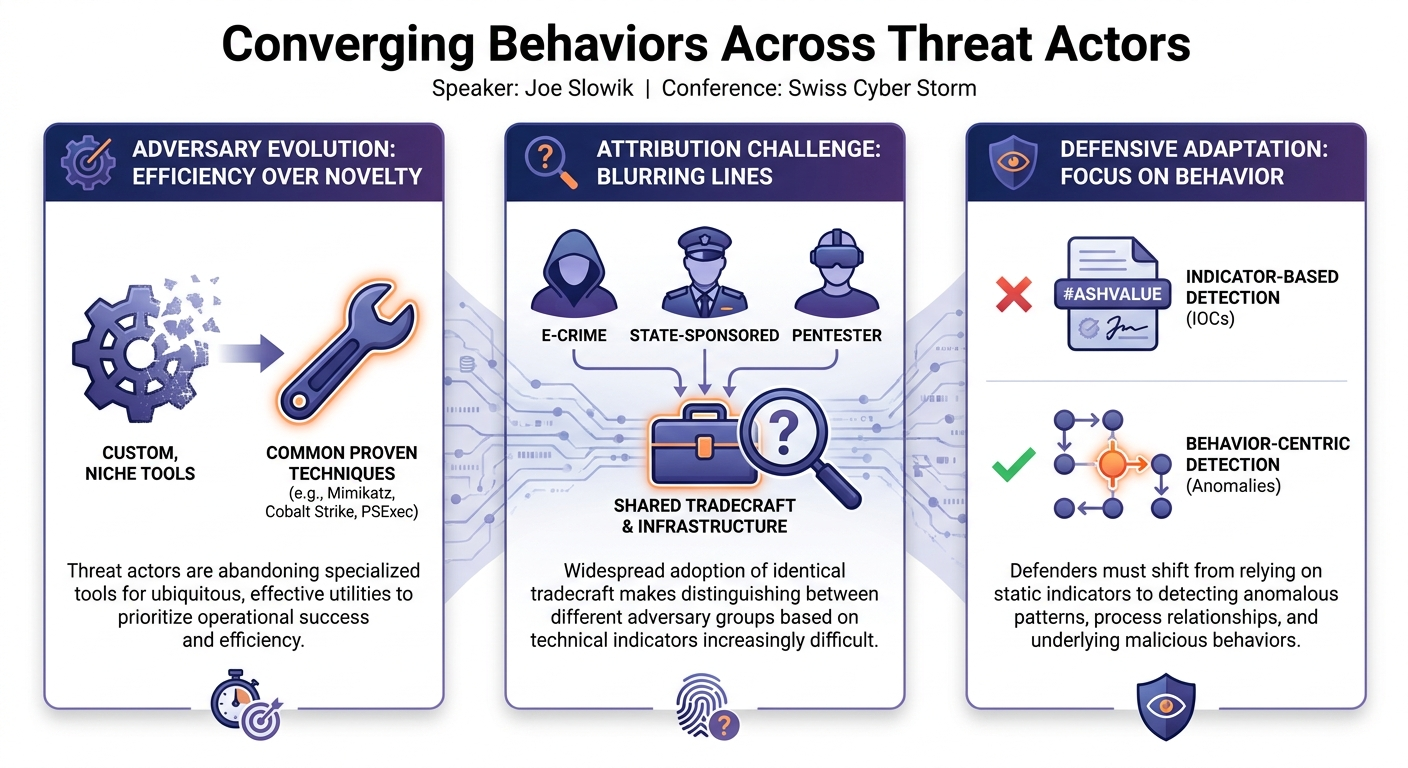
In his compelling talk at Swiss Cyber Storm, Joe Slowik, a veteran threat hunter and forensic expert leading the threat intelligence program at Huntress, delved into the increasingly complex landscape of cyber adversaries. The core thesis of his presentation, "Converging Behaviors Across Threat Actors," posits that traditional methods of attribution are becoming obsolete as diverse threat actors increasingly adopt similar, effective operational methodologies and tools. This convergence challenges long-held assumptions within the cybersecurity industry, forcing defenders, law enforcement, and threat intelligence researchers to fundamentally rethink how they identify, track, and counter malicious activity.
Key moments
- 0:00 Introduction to converging behaviors across threat actors
- 4:00 Adversaries specialize and do simply what works
- 6:00 Convergent evolution: Similar problems, similar solutions
- 8:00 Common tools: Mimikatz, Cobalt Strike, PSExec ubiquitous
- 12:00 Attribution challenges due to behavioral convergence
- 14:00 Defense implications: Adversaries converge on effective tradecraft
- 20:00 Opportunities for defenders: Focus on behavior-based detection
- 22:30 Q&A: AI's impact on threat actor velocity, not diversity
Converging Behaviors Across Threat Actors
Speakers: Joe Slowik, Threat Hunter and Forensic Expert / Lead of Threat Intel Program, Huntress
Conference: Swiss Cyber Storm
YouTube: https://www.youtube.com/watch?v=qkT9xUmqUP8
Overview
In his compelling talk at Swiss Cyber Storm, Joe Slowik, a veteran threat hunter and forensic expert leading the threat intelligence program at Huntress, delved into the increasingly complex landscape of cyber adversaries. The core thesis of his presentation, "Converging Behaviors Across Threat Actors," posits that traditional methods of attribution are becoming obsolete as diverse threat actors increasingly adopt similar, effective operational methodologies and tools. This convergence challenges long-held assumptions within the cybersecurity industry, forcing defenders, law enforcement, and threat intelligence researchers to fundamentally rethink how they identify, track, and counter malicious activity.
Slowik highlights a critical shift in adversary tradecraft: a move away from highly specialized, custom-built tools towards a common set of proven techniques and readily available utilities. This evolution is driven by the adversaries' primary objective – success – rather than novelty or sophistication for its own sake. The implications are profound, impacting everything from how we perform attribution to the efficacy of our defensive strategies and the very policies that govern network security. Slowik argues that understanding this convergence is paramount for developing resilient and adaptable cyber defenses in an environment where malicious activity is increasingly designed to blend seamlessly with legitimate IT operations.
The talk serves as a stark warning and a call to action, urging the security community to move beyond indicator-based detection to a more sophisticated, behavior-centric approach. By drawing parallels with biological convergent evolution, Slowik illustrates why similar problems often lead to similar solutions, whether in nature or in the realm of cyber warfare. This analytical framework underscores the necessity for defenders to co-evolve with their adversaries, focusing on the underlying behaviors that enable successful intrusions rather than chasing an ever-dwindling pool of unique attack signatures.
Background
▶ Watch: Introduction to converging behaviors across threat actors (0:00)
The traditional understanding of cyber adversaries often paints a picture of highly specialized, unitary entities, each with distinct tradecraft, custom tools, and unique operational signatures. This perception has historically fueled the cyber threat intelligence (CTI) industry, leading to the creation of elaborate naming schemes (e.g., Fancy Bear, Charming Kitten) and the belief that distinct clusters of activity could reliably attribute an intrusion to a specific group or nation-state. As defined by NIST, an adversary is "a person, group, organization, or government potentially that conducts or has intent to conduct detrimental activities." However, Slowik argues that this formal definition often carries an implicit bias: the assumption that a single operation is the culmination of actions by a single, unique entity.
The reality, as Slowik reveals, is far more complex. High-end threat operations, including much of modern ransomware activity, are inherently difficult. This difficulty has led to a significant specialization and division of labor within the adversary ecosystem. We now commonly observe distinct roles such as initial access brokers (IABs), who gain initial footholds into victim networks and then sell that access, and ransomware affiliates, who leverage established ransomware-as-a-service platforms. Even within state sponsored operations, there's a trend towards contractors developing tools and other entities focusing on widespread access development. This compartmentalization means that a single intrusion might involve multiple, distinct entities, each contributing a specialized piece to the overall attack chain.
This specialization, combined with the inherent challenges of conducting cyber operations, creates a strong incentive for threat actors to simply "do what works." Rather than expending resources on developing novel, custom tools for every phase of an attack, adversaries are increasingly opting for efficient, effective, and readily available solutions. Slowik draws an insightful analogy to convergent evolution in biology, where different species independently evolve similar traits or body plans to solve similar environmental problems (e.g., fish, mammals, and reptiles developing similar hydrodynamic shapes to move through water; crabs evolving independently multiple times due to the effectiveness of their body plan). Just as nature converges on optimal solutions, cyber adversaries converge on the most efficient and effective methods to achieve their objectives. This fundamental principle underpins the observed shift in the threat landscape, where operational success outweighs uniqueness, leading to a homogenization of attack techniques.
Key Findings
▶ Watch: Convergent evolution: Similar problems, similar solutions (6:00)
Joe Slowik's central finding is that success in cyber operations is about achieving the objective, not about the novelty or uniqueness of the method employed. This pragmatic approach by adversaries has led to a noticeable dying customization or a "rapidly retreating use of custom tools" across the threat landscape. Instead, the tools and techniques of the trade are coalescing around certain common features, driven by their proven effectiveness and efficiency.
Slowik highlights several ubiquitous tools and techniques that exemplify this convergence:
- Mimikatz: This tool, created by Benjamin Delpy, is an almost universal staple in post-exploitation. Its primary function is credential dumping, specifically extracting plaintext passwords, NTLM hashes, and Kerberos tickets from the Local Security Authority Subsystem Service (LSASS) process memory on Windows systems. Slowik notes that in the "vast majority, almost every intrusion" observed by Huntress, adversaries perform credential dumping using Mimikatz or one of its common alternatives (like LSS dump or Proc dump). This consistent behavior underscores its effectiveness.
- Cobalt Strike Beacon: While custom post-intrusion frameworks still exist (e.g., BritaTel), Cobalt Strike Beacon remains "fairly prevalent out there in the ecosystem." Even in highly sophisticated attacks, such as the initial supply chain compromise of SolarWinds Orion, the adversaries ultimately deployed Cobalt Strike Beacon for their post-exploit activity. Its modularity, extensive features, and relatively low detection rates make it a go-to choice for persistent access, command and control, and lateral movement.
- BloodHound / ADFind: Once credentials are dumped, adversaries need to understand the victim's network environment. Tools like BloodHound and ADFind are widely used for Active Directory mapping. They enable attackers to identify privilege escalation paths, locate high-value targets, and understand group memberships, facilitating efficient lateral movement and privilege escalation. Slowik observes these tools being leveraged by a wide spectrum of threat actors, from "fairly decent pentesters through e-crime groups all the way up to your APTs."
- Sysinternals PSExec: This utility from Microsoft's Sysinternals suite is "ubiquitous in threat operations." Once privileged credentials are acquired, PSExec provides a straightforward method for remote execution of software within victim environments. Its legitimacy as an administrative tool allows adversaries to "blend in" with normal network activity, making detection challenging.
Slowik acknowledges that custom tools still exist, but often for "very niche applications." These include highly specialized scenarios like operational technology (OT) intrusions, where specific systems and protocols necessitate bespoke solutions, or the initial, highly stealthy phases of complex supply chain intrusions like the SolarWinds Orion event. However, for the majority of intrusions observed in reality, the trend is clear: convergence around a common, effective set of tools and techniques. This pattern highlights a fundamental aspect of adversary behavior: they are "fundamentally very lazy creatures" who will use what works until it no longer provides an advantage, making efficiency and effectiveness the primary drivers of their evolving tradecraft.
Technical Deep Dive
▶ Watch: Attribution challenges due to behavioral convergence (12:00)
The convergence of adversary behaviors is not merely an abstract concept but is deeply rooted in the widespread adoption of specific, effective technical tools and methodologies. Joe Slowik details how these tools, often legitimate or widely available, form the bedrock of modern intrusions, transcending the boundaries between different threat actor types.
At the heart of many successful intrusions is credential dumping, a technique almost universally observed. Mimikatz stands out as the preeminent tool for this purpose. It exploits vulnerabilities in the Windows operating system's handling of authentication data, specifically targeting the Local Security Authority Subsystem Service (LSASS) process. LSASS stores sensitive authentication information, including plaintext passwords, NTLM hashes, and Kerberos tickets, in memory. Mimikatz's functionality allows attackers to extract this data, granting them access to user credentials that can be reused for lateral movement or privilege escalation. While other methods like LSS dump or Proc dump exist, Mimikatz's comprehensive capabilities and ease of use have made it a staple. The fact that it’s often used in "almost every intrusion" Huntress observes underscores its continued efficacy and the challenge it poses to defenders who must secure memory and detect suspicious access to LSASS.
Following initial access and credential theft, adversaries require robust post-intrusion frameworks for sustained operations. Cobalt Strike Beacon has emerged as the de facto standard in this space. Originally designed as a legitimate penetration testing tool, its powerful capabilities have been heavily co-opted by malicious actors. Beacon provides a versatile command and control (C2) channel, enabling remote code execution, file transfer, keylogging, screenshot capture, and lateral movement. Its modularity allows attackers to extend its capabilities with custom scripts and modules, while its flexible communication profiles (e.g., HTTP, HTTPS, DNS, SMB) enable it to mimic legitimate network traffic, making detection difficult. The SolarWinds attackers' use of Cobalt Strike Beacon post-compromise illustrates that even the most advanced adversaries rely on proven, off-the-shelf solutions when available and effective, rather than always investing in entirely custom C2s.
To navigate compromised networks and identify high-value targets, Active Directory mapping tools are indispensable. BloodHound and ADFind are two prominent examples. BloodHound visualizes complex relationships within an Active Directory environment, revealing paths to privilege escalation and domain dominance. It collects data on users, groups, computers, and trusts, then uses graph theory to identify attack paths that might otherwise remain hidden. ADFind, a command-line tool, offers a more direct way to query Active Directory for specific information, such as user accounts, group memberships, and computer properties. Both tools are critical for attackers to efficiently identify administrative accounts, find machines with vulnerable configurations, and plan their lateral movement strategy. Their widespread adoption across the spectrum of threat actors highlights the universal need to understand the victim's environment to maximize impact.
Finally, for remote execution and lateral movement, adversaries frequently turn to legitimate system administration tools. Sysinternals PSExec is a prime example. This utility allows administrators to execute processes on remote systems, making it incredibly useful for legitimate IT tasks. However, in the hands of an attacker who has already acquired privileged credentials, PSExec becomes a powerful weapon. It enables them to remotely launch malware, execute commands, or install additional tools on other machines within the network, often without triggering traditional security alerts because it leverages legitimate administrative protocols. This "living off the land" approach, where adversaries use benign, built-in operating system features or legitimate third-party tools, is a cornerstone of the convergence trend. It allows attackers to blend in with legitimate IT administrator operations, making their malicious activities harder to distinguish from normal network traffic and system processes.
The combined effect of these converging behaviors is a shift away from easily identifiable indicators of compromise (IOCs), such as unique malware signatures or distinct C2 network traffic. Modern intrusions are increasingly malware-less or rely on standard encrypted protocols like HTTPS, making traditional perimeter defenses and signature-based detection less effective. Adversaries have learned to operate within the noise of normal network activity, presenting a significant challenge for defenders who must now identify subtle anomalies in the execution of legitimate tools.
Demo / Proof of Concept
▶ Watch: Defense implications: Adversaries converge on effective tradecraft (14:00)
This particular talk did not feature a live demonstration or a specific proof of concept. Joe Slowik's presentation focused on the theoretical framework and observed trends in adversary behavior, drawing on his extensive experience in threat hunting and incident response.
Defensive Implications
▶ Watch: Q&A: AI's impact on threat actor velocity, not diversity (22:30)
The converging behaviors of threat actors carry profound defensive implications across several critical areas, fundamentally challenging established security practices. Slowik outlines these impacts on attribution, defense strategies, and policy.
Firstly, the convergence significantly undermines attribution. Historically, behavioral attribution, relying on frameworks like the Diamond Model of intrusion analysis or mapping techniques to the MITRE ATT&CK framework, sought to identify unique clusters of actions and tradecraft to differentiate between threat actors. However, if diverse adversaries (from e-crime to state-sponsored espionage) all begin to use the same tools and techniques—Mimikatz, Cobalt Strike, PSExec, BloodHound—then their "diamond models" or ATT&CK mappings start to look remarkably similar. This homogenization makes it "significantly more difficult" to distinguish who is behind an attack based purely on technical analysis. Defenders are therefore pushed to "dig deeper and analyze at a more thorough level" or pursue more formal, non-technical types of attribution, which often fall outside the scope of commercial CTI.
Secondly, the implications for defense strategy are paradoxical. While some might initially believe that a standardization of tradecraft simplifies defense by narrowing the focus, Slowik emphasizes a critical nuance: adversaries converge on tradecraft "because it works." These techniques—credential theft, "living off the land" (using legitimate system tools), and in-memory execution—are effective precisely because they are hard for defenders to find. The shift from custom malware and distinct C2 frameworks means that traditional, indicator-based detection (e.g., malware signatures, network signatures for C2) is largely obsolete. Adversaries now intentionally "blend in with a variety of legitimate applications," such as PSExec, PowerShell-based frameworks, TeamViewer, or ScreenConnect. This makes identifying the "malicious use of benign tools" exceptionally challenging, a problem that even advanced AI solutions have yet to adequately solve. The conclusion is clear: defenders must "migrate towards a behavior-centric way of detecting adversary behavior," looking for anomalies rather than known bad signatures.
Finally, there are significant policy concerns. If adversaries no longer rely on custom binaries or unique C2s, then existing "best practices" and security guidance, often focused on preventing the execution of unknown code, require redefinition. Policies must evolve to combat adversaries who mimic legitimate IT administrator operations. This necessitates thinking about "effective mechanisms that can enable and create for a lasting or sustainable defensive mindset," moving beyond quick-study guides and into more fundamental, harder-to-implement changes in how networks are secured and monitored. The goal is to develop capabilities that can co-evolve with threat actors, identifying opportunities within this complex, less unique environment. Slowik suggests leveraging methods like graph theory to identify "anomalous parent process relationships," "odd administrator activity," or "anomalous logins" within an environment. Such behavior-based detections can powerfully identify a broad spectrum of threat actors, leading to "significant wins" by focusing on the underlying intent and method rather than specific, fleeting indicators.
Key Takeaways
Joe Slowik's talk distilled several crucial insights regarding the evolving threat landscape and the necessary adaptations for cybersecurity professionals:
- Adversaries are Complex but Efficient Entities: Despite the perceived sophistication of some attacks, threat actors are fundamentally driven by efficiency. Their primary goal is to achieve their objectives (e.g., data theft, ransomware deployment), and they will opt for the most effective and least effort-intensive methods, not necessarily the most novel or unique.
- Success Trumps Novelty in Operations: No "award" is given for the fanciest hack; only for success. This incentive structure leads adversaries to reuse proven techniques and readily available tools like Mimikatz, Cobalt Strike Beacon, and PSExec, rather than investing in custom development for every intrusion.
- Convergence Undermines Traditional Attribution: The increasing similarity in tradecraft across diverse threat actors (e-crime, state-sponsored) renders traditional behavioral attribution methods, such as those based on the Diamond Model or MITRE ATT&CK, less reliable. Distinguishing between groups based solely on technical indicators becomes significantly harder.
- Defense Must Shift to Behavior-Centric Detection: The move by adversaries to "live off the land" and blend in with legitimate IT operations makes indicator-based detection largely obsolete. Defenders must adopt a behavior-centric detection approach, focusing on anomalous activities, process relationships, and login patterns rather than specific signatures.
- Convergent Tradecraft Offers a Potential Advantage: While challenging, the convergence of adversary behaviors also presents an opportunity. By focusing defensive efforts on the common, effective techniques adversaries employ, security teams can develop more targeted and impactful detections that address a broader spectrum of threats.
- AI Will Increase Velocity, Not Necessarily Diversity, of Attacks: While AI can accelerate the development and deployment of exploits (e.g., through more thorough fuzzing), the principles of convergent evolution suggest that AI models will also coalesce around the most efficient solutions. This implies an increase in the speed and scale of attacks, but not necessarily a greater diversity in fundamental attack methodologies.
About the Speaker(s)
Joe Slowik is a highly experienced and respected figure in the cybersecurity industry. He currently serves as a Threat Hunter and Forensic Expert, leading the Threat Intelligence Program at Huntress, a US-based company. His background includes extensive experience within the US government, where he gained significant expertise in incident response and various aspects of national security. In addition to his role at Huntress, Joe also conducts consulting and training through his own company, sharing his deep knowledge of adversary behaviors and defensive strategies with a broader audience. Known for his analytical approach and ability to connect complex technical details with broader strategic implications, Slowik is a sought-after speaker and expert in the field of cyber threat intelligence.
Reviews
Dr. Zero (Offensive Security Researcher) — SOLID
Slowik is delivering the exact right weather report for a climate we've been living in since 2019. It's a necessary corrective for defenders who still buy magical 'APT attribution' feeds, even if the underlying realization that everyone just uses Cobalt Strike isn't exactly breaking news.
Heather Calloway (CISO) — STRONG ACCEPT
Joe Slowik's talk dismantles the ROI of traditional, attribution-heavy cyber threat intelligence. He argues convincingly that because state-sponsored and e-crime actors now use the exact same commodity toolsets, indicator-based defense is a dead end. This is required viewing for any security leader still justifying their budget around stopping advanced persistent threats rather than defending against Mimikatz and PSExec.