How adaptive is the CAT?
Hans-Peter Waldegger (Swisscom B2B)
Swiss Cyber Storm 2023 · Day 1 · Panorama
Overview
In his Swiss Cyber Storm talk, "How adaptive is the CAT?", Hans-Peter Waldegger from Swisscom B2B delves into the critical evolution of strong authentication from static, point-in-time verification to a dynamic model of Continuous Adaptive Trust (CAT). Waldegger highlights the unique challenges posed by Business-to-Business (B2B) environments, where employees often manage multiple concurrent sessions across diverse applications, demanding a more sophisticated and less intrusive approach to security than traditional Business-to-Consumer (B2C) scenarios. The talk addresses the inherent tension between robust security and user experience, proposing a framework that leverages an Identity Provider (IDP) to intelligently evaluate and adapt authentication requirements based on context and risk.
Key moments
- 0:00 Introduction to Continuous Adaptive Trust (CAT) and B2B
- 2:35 Swisscom's Levels of Assurance (LOA) classification
- 5:10 Problem of session aging and re-authentication burden
- 9:15 Architectural challenge: synchronizing RP and IDP information
- 12:45 Leveraging LOA for silent, policy-driven re-authentication
- 16:00 Adaptive nature and Swisscom's focus for regulated environments
- 26:50 Addressing privacy concerns with continuous user tracking
How adaptive is the CAT?
Speakers: Hans-Peter Waldegger, Swisscom B2B
Conference: Swiss Cyber Storm
YouTube: https://www.youtube.com/watch?v=oNsgPXUugRE
Overview
In his Swiss Cyber Storm talk, "How adaptive is the CAT?", Hans-Peter Waldegger from Swisscom B2B delves into the critical evolution of strong authentication from static, point-in-time verification to a dynamic model of Continuous Adaptive Trust (CAT). Waldegger highlights the unique challenges posed by Business-to-Business (B2B) environments, where employees often manage multiple concurrent sessions across diverse applications, demanding a more sophisticated and less intrusive approach to security than traditional Business-to-Consumer (B2C) scenarios. The talk addresses the inherent tension between robust security and user experience, proposing a framework that leverages an Identity Provider (IDP) to intelligently evaluate and adapt authentication requirements based on context and risk.
The core problem Waldegger tackles is the user fatigue associated with frequent re-authentication prompts, which can lead to "negligence" and ultimately undermine security. By introducing a system that can silently re-authenticate users based on predefined Levels of Assurance (LOA), time-based validity, and contextual factors such as location and device confidence, Swisscom B2B aims to significantly reduce user friction. This adaptive strategy not only enhances the security posture by continuously assessing trust but also improves productivity by minimizing interruptions, making it a compelling solution for complex enterprise landscapes.
Background
▶ Watch: Introduction to Continuous Adaptive Trust (CAT) and B2B (0:00)
The landscape of strong authentication has long been dominated by point-in-time verification, typically involving two factors out of three categories: something you know (e.g., password), something you have (e.g., phone, hardware token), or something you are (e.g., biometric). While effective at the moment of login, this traditional approach suffers from a fundamental limitation: sessions age. As time passes, the initial strong authentication becomes less reliable, increasing the risk of compromise through means such as token compromise, session hijacking, or simply a change in user context (e.g., location, device posture). Waldegger emphasizes that the software representation of an authenticated session diminishes in quality over time, creating a security gap.
The conventional response to aging sessions is re-authentication. However, in a complex B2B environment where users might interact with numerous applications simultaneously—from office suites and accounting systems to backend administration tools like Jira—repeated re-authentication requests become a significant burden. This "human factor," as Waldegger terms it, leads to user frustration and negligence, potentially driving users to seek workarounds or adopt less secure practices. For instance, an admin user accessing sensitive data while traveling across borders highlights the need for continuous evaluation, where a static, initial authentication is insufficient to cover dynamic changes in risk factors.
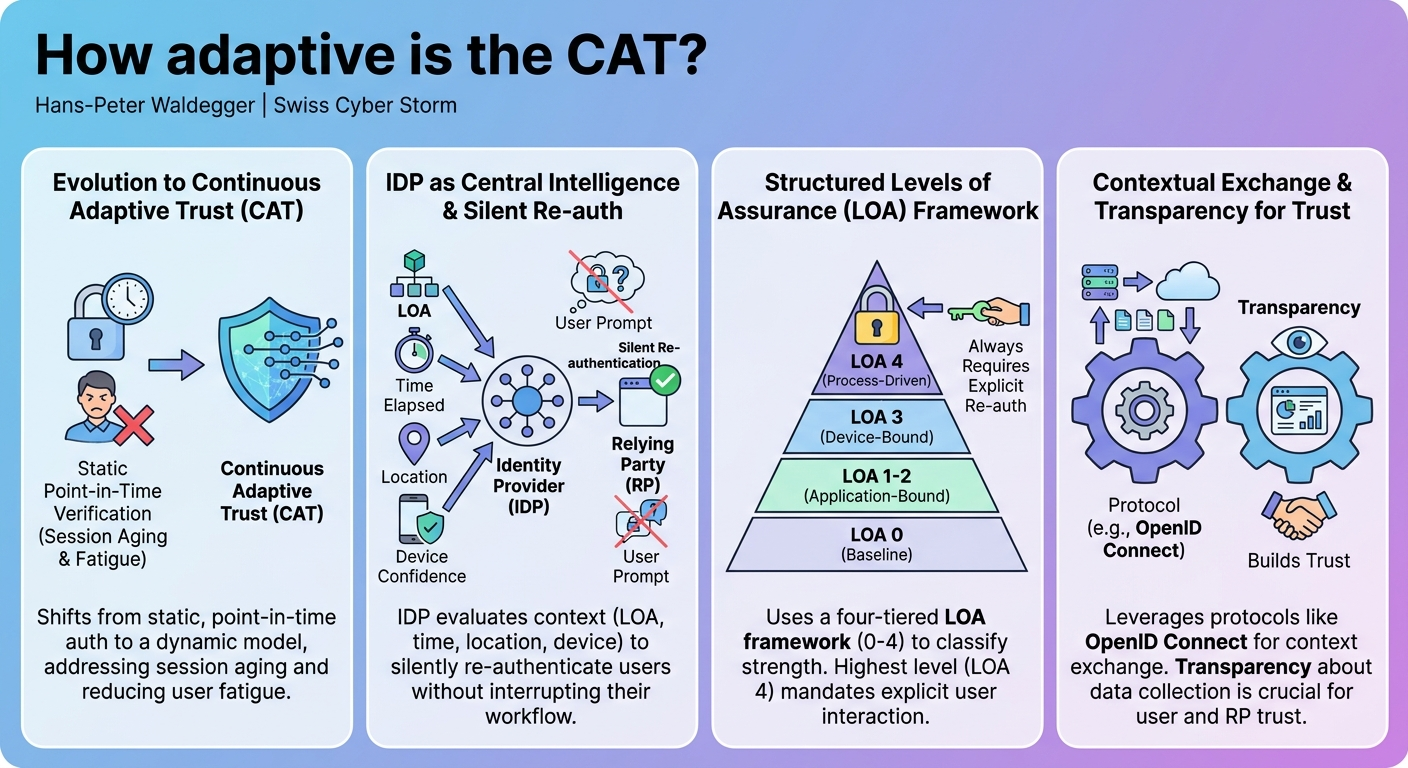
To address these challenges, Swisscom B2B employs a structured classification system for authentication strength, known as Levels of Assurance (LOA):
- LOA 0 (Username/Password): Acknowledged as insufficient but a baseline, offering minimal assurance.
- LOA 1 (Backend-Triggered 2FA): Involves username/password combined with a second factor triggered by the backend (e.g., SMS OTP). The application itself binds and verifies these factors.
- LOA 2 (Application-Bound 2FA): Similar to LOA 1, but with a stronger emphasis on how the application integrates and verifies the two factors.
- LOA 3 (Device-Bound 2FA): Represents a significant leap in security, where two factors are cryptographically bound on the user's device. Examples include Passkeys utilizing a security enclave, smart cards, or advanced FIDO tokens. This level involves a cryptographic representation of the user or device, verifiable by the backend.
- LOA 4 (Process-Driven Highest Assurance): The pinnacle of strong authentication for Swisscom B2B, this level transcends the token or device itself. It mandates a secure, central process for managing user identities and cryptographic items, including robust procedures for token replacement and PIN resets. This ensures the integrity and recoverability of the authentication mechanism, representing a holistic approach to identity management and security.
The inherent challenge in moving towards continuous authentication lies in synchronizing information between the Relying Party (RP), which manages the user's session, and the Identity Provider (IDP), which holds the core identity and authentication context. In distributed enterprise architectures, this synchronization is complex, yet it also presents an opportunity for the IDP to act as a central intelligence hub, offering a more comprehensive view of user activity and authentication history across all applications.
Key Findings
▶ Watch: Problem of session aging and re-authentication burden (5:10)
The central innovation presented by Waldegger is the concept of leveraging the Identity Provider (IDP) as a sophisticated decision engine within a Continuous Adaptive Trust framework. This approach moves beyond the limitations of point-in-time authentication by enabling the IDP to maintain a comprehensive, real-time view of user authentication context, history, and associated risk factors.
A primary finding is the feasibility and benefit of silent re-authentication. Instead of forcing users to repeatedly provide credentials, the IDP can, under specific conditions, silently confirm a previous authentication to a Relying Party (RP). This decision is based on the previously achieved Level of Assurance (LOA), the time elapsed since that authentication, and other contextual attributes (e.g., geographical location, device posture). For instance, if an RP requests re-authentication at LOA 1, and the IDP knows the user successfully authenticated at LOA 3 within the last few minutes from a trusted location, the IDP can respond positively without user interaction. This drastically reduces user friction, addressing the "human factor" problem directly. Waldegger notes that for the highest assurance level, LOA 4, re-authentication is always explicitly required, ensuring that critical access remains under strict, explicit control.
The system's adaptive nature is another key finding. RPs are not monolithic in their security requirements. Different applications, or even different actions within the same application, may demand varying levels of authentication strength and acceptable session durations. Waldegger explains that RPs can dynamically define their specific requirements, including the desired LOA, the maximum acceptable time lag since the last authentication (e.g., 60 minutes), and additional contextual attributes such as country restrictions. This flexibility allows for fine-grained control, ensuring that security measures are proportionate to the risk associated with the specific access request. For legacy applications that may not support dynamic protocol exchanges, static configurations managed by the IDP or an intermediary gateway can still enable these adaptive capabilities.
Finally, Waldegger stresses that trust comes from transparency. For a system that continuously evaluates user context, including potentially sensitive information like location, it is paramount that both the Relying Parties and the end-users understand how these decisions are made. Swisscom's prototype demonstrates this by providing "device confidence" and "location confidence" metrics to applications, explaining how these percentages are derived (e.g., SIM-card bound location at 100% confidence, geo-fencing at 80%, rooted device lowering confidence to 30-40%). Crucially, for users, continuous tracking of data like location must be explicitly communicated and consented to, especially in B2C scenarios. In B2B, while employers can often mandate such measures through employment contracts, clear communication remains essential for user acceptance and legal compliance.
Technical Deep Dive
▶ Watch: Architectural challenge: synchronizing RP and IDP information (9:15)
The technical architecture underpinning Swisscom B2B's Continuous Adaptive Trust (CAT) solution revolves around a clear separation of concerns between Relying Parties (RPs) and a centralized Identity Provider (IDP). In typical enterprise environments, RPs represent the applications or systems that users wish to access, while the IDP is responsible for authenticating users and managing their identity information.
The challenge lies in the inherent distribution of information: the RP holds the user's active session, while the IDP maintains the user's authentication history and contextual data. To bridge this gap, Swisscom leverages OpenID Connect (OIDC) as a primary protocol for communication. OIDC extends OAuth 2.0 to provide identity information in the form of ID Tokens, which are JSON Web Tokens (JWTs) containing claims about the authenticated user. In this architecture, the IDP shares critical information with RPs through OIDC attributes and claims. This can include details about how the user was authenticated (e.g., the specific Level of Assurance (LOA) achieved), when the authentication occurred, and potentially other contextual data such as the user's current location or device posture.
Waldegger also mentions the Continuous Access Evaluation Protocol (CAEP) as a "better protocol" for future integration. Unlike OIDC, which primarily relies on RPs pulling information from the IDP, CAEP offers a callback mechanism, enabling the IDP to proactively push security events or changes in authentication context to RPs. This push-based model reduces latency and improves the real-time adaptiveness of the system. However, Waldegger acknowledges that a significant challenge with CAEP is establishing a shared semantic understanding between diverse RPs and the IDP regarding the meaning and implications of the shared information.
The IDP acts as the central intelligence hub for adaptive authentication. When an RP requests user authentication, or re-authentication, it communicates its specific requirements to the IDP. These requirements are highly flexible and can include:
- Required Level of Assurance (LOA): The minimum LOA the RP deems acceptable for the requested action.
- Acceptable Time Lag: The maximum duration since the last successful authentication at the specified LOA that the RP will accept without requiring user interaction (e.g., 60 minutes).
- Additional Attributes: Contextual conditions, such as the user being within a specific set of countries (geo-fencing).
Upon receiving such a request, the IDP evaluates it against its comprehensive record of the user's past authentications and current context. If the IDP determines that a previous authentication satisfies all of the RP's criteria (e.g., user authenticated at LOA 3 thirty minutes ago, from Switzerland, meeting an RP's request for LOA 3 within 60 minutes in Switzerland), it can respond to the RP with a confirmation of authentication without prompting the user. This is the core mechanism of silent re-authentication. A crucial exception is for LOA 4, the highest level of assurance, where the system is designed to always require explicit user re-authentication to maintain the utmost security integrity.
To support the diverse landscape of enterprise applications, including legacy systems that may not be able to dynamically consume OIDC claims or integrate with newer protocols, Swisscom employs a flexible approach. For such RPs, the adaptive authentication logic can be configured statically. This might involve an intermediary gateway or a Radius interface that translates static application configurations into dynamic requests to the IDP, enabling these older systems to benefit from continuous adaptive trust without requiring extensive modifications. This ensures that the overall security posture of the enterprise is elevated, even for applications with limited modern protocol support.
The system also incorporates metrics for trust transparency. The IDP can provide RPs with quantifiable measures like "device confidence" and "location confidence." For example, a device with a SIM card directly bound to Swisscom's backend might yield 100% location confidence, while geo-fencing might achieve 80%. A rooted device, however, would significantly lower device confidence, perhaps to 30-40%, influencing authentication decisions. This transparency is vital for RPs to understand the basis of the IDP's authentication confirmations and for users to comprehend the implications of data collection.
Demo / Proof of Concept
▶ Watch: Adaptive nature and Swisscom's focus for regulated environments (16:00)
While the talk does not feature a live, step-by-step demonstration of the Continuous Adaptive Trust (CAT) system, Hans-Peter Waldegger references the existence of "some POCs that are available now" (12:00), indicating that the concepts discussed are past the theoretical stage and have been implemented in experimental or pilot environments.
He specifically highlights a "prototype" for demonstrating the transparency aspect of the system (22:00). This prototype visually conveys information about device confidence and location confidence to the user, illustrating how the system assesses trust. Waldegger mentions "standard geofencing" and "advanced geofencing" (which may be renamed to "continuous tracking or location information" due to marketing and legal considerations) as part of this prototype. This suggests a visual interface designed to make the continuous evaluation of contextual data, such as the user's location, explicit and understandable to the end-user. While the detailed mechanics of these POCs are not elaborated upon, their mention underscores Swisscom B2B's active development and testing of these adaptive authentication concepts.
Defensive Implications
▶ Watch: Addressing privacy concerns with continuous user tracking (26:50)
The implementation of Continuous Adaptive Trust (CAT) offers several profound defensive implications for organizations, particularly those operating in complex B2B environments:
- Reduced User Fatigue and Enhanced Security Posture: By intelligently minimizing the number of explicit re-authentication prompts, CAT directly addresses the "human factor" problem. Users are less likely to become negligent, bypass security measures, or choose weaker authentication methods out of frustration. This reduction in friction leads to higher user adoption of strong authentication, thereby enhancing the overall security posture.
- Dynamic, Contextual Risk Assessment: CAT moves beyond static, point-in-time authentication to a continuous evaluation of trust. By incorporating contextual data such as Levels of Assurance (LOA), time since last authentication, geographical location, and device confidence, the system can dynamically adapt the required authentication strength to the perceived risk of an access request. This means a user's session can be passively downgraded or require re-authentication if their context changes (e.g., moving to a high-risk location, using a compromised device).
- Centralized Policy Enforcement and Consistency: The Identity Provider (IDP) acts as a central authority for authentication decisions across all integrated Relying Parties (RPs). This centralization ensures consistent application of security policies, even across a diverse ecosystem of applications, including legacy systems that may not natively support advanced authentication protocols. The IDP can enforce global policies, such as country-specific access restrictions, uniformly.
- Improved Auditability and Compliance: Waldegger notes that the clear definition of LOAs and the logic behind silent re-authentication make the system easier to explain to auditors, especially in regulated environments (18:00). This structured approach to adaptive authentication provides a robust framework for demonstrating compliance with stringent security requirements, as the decision-making process is transparent and based on quantifiable metrics.
- Enhanced Incident Response: Continuous evaluation provides more granular and up-to-date information about user sessions. If a session is compromised or a user's context changes adversely, the IDP can react more swiftly to revoke access or trigger step-up authentication, limiting the window of opportunity for attackers.
- Privacy by Design and Transparency: While potentially privacy-invasive due to continuous tracking (e.g., location), the emphasis on transparency for both RPs and users is a critical defensive measure. By explicitly informing users about data collection and providing mechanisms for consent (e.g., via OpenID Connect), organizations can build trust and mitigate legal and ethical concerns. This proactive communication is especially vital when considering future B2C applications of such technology.
- Gradual Migration Strategy: The ability to support legacy applications through static configurations or intermediary gateways provides a practical migration path for enterprises. Organizations can incrementally adopt CAT, starting with basic silent re-authentication for older systems and gradually integrating more dynamic, OIDC-based interactions for newer applications, minimizing disruption while enhancing security.
Key Takeaways
- Evolution of Authentication: Strong authentication is shifting from static, point-in-time verification to a dynamic model of Continuous Adaptive Trust (CAT), addressing the limitations of aging sessions and evolving risks.
- Levels of Assurance (LOA): Swisscom B2B utilizes a robust, four-tiered LOA framework (LOA 0-4) to classify authentication strength, with LOA 4 representing the highest, process-driven assurance.
- Mitigating User Fatigue: The core benefit of CAT is reducing user friction through silent re-authentication, where the Identity Provider (IDP) can confirm a user's identity to a Relying Party (RP) without requiring explicit user interaction.
- IDP as Central Intelligence: The IDP acts as a central decision engine, leveraging comprehensive data on user authentication history, LOA, time elapsed, location, and device confidence to make adaptive access decisions.
- OpenID Connect for Contextual Exchange: OpenID Connect (OIDC) is a key protocol used to transmit rich contextual information and authentication claims from the IDP to RPs, enabling adaptive policy enforcement.
- Transparency Builds Trust: For CAT to be effective and accepted, especially with continuous data collection like location tracking, transparency to both applications and end-users about how trust decisions are made is paramount.
- B2B Specificity: The unique complexities of B2B environments, with multiple concurrent sessions and diverse applications, make adaptive trust solutions particularly relevant and challenging, requiring flexible integration strategies for legacy systems.
About the Speaker(s)
Hans-Peter Waldegger is a representative from Swisscom B2B, where he focuses on advanced security solutions, particularly in the realm of strong authentication processes. His expertise lies in developing and implementing systems that address the challenges of secure access in complex enterprise environments. Waldegger's work at Swisscom B2B, as highlighted in his talk, centers on the practical application of Continuous Adaptive Trust (CAT) to balance robust security with an improved user experience for business clients.
Reviews
Dr. Zero (Offensive Security Researcher) — WEAK
Swisscom B2B just reinvented conditional access and gave it a new acronym. The entire premise of 'Continuous Adaptive Trust' is standard session management dressed up as a revelation. If you've looked at an Entra ID admin panel in the last five years, you already know everything in this talk.
Heather Calloway (CISO) — SOLID
This is a competent architectural primer on moving from static MFA to continuous risk-based authentication. It outlines exactly what your identity architects should be building right now to reduce user friction, though it glosses over the severe ecosystem limitations of legacy application support.