Resilience Rising: Countering the Threat Actors Behind Black Basta Ransomware
Angelo Violetti (Security Consultant · SEC Consult)
Swiss Cyber Storm 2023 · Day 1 · Panorama
Overview
In this comprehensive talk at Swiss Cyber Storm, Angelo Violetti, a Security Consultant at SEC Consult, dissects the sophisticated operations of the Black Basta ransomware group. The presentation, titled "Resilience Rising: Countering the Threat Actors Behind Black Basta Ransomware," offers a deep dive into the human-operated ransomware ecosystem, focusing specifically on Black Basta's tactics, techniques, and procedures (TTPs). Violetti emphasizes that behind every modern ransomware attack are human criminals, structured much like legitimate companies, making understanding their motivations and methodologies crucial for effective defense.
Key moments
- 0:00 Introduction to Black Basta and human factor
- 2:00 Understanding the Ransomware as a Service ecosystem
- 4:00 Key ransomware characteristics and initial recommendations
- 7:00 Black Basta's typical attack steps and TTPs
- 17:00 Exploiting human factor of attackers with deception
- 21:00 Crucial prevention and remediation for encryption
- 27:00 FBI disruption of Quackbot and TA577's malware shift
- 31:00 Q&A: Initial access costs and extortion trends
Resilience Rising: Countering the Threat Actors Behind Black Basta Ransomware
Speakers: Angelo Violetti, Security Consultant, SEC Consult
Conference: Swiss Cyber Storm
YouTube: https://www.youtube.com/watch?v=iD_KZAqNDZ0
Overview
In this comprehensive talk at Swiss Cyber Storm, Angelo Violetti, a Security Consultant at SEC Consult, dissects the sophisticated operations of the Black Basta ransomware group. The presentation, titled "Resilience Rising: Countering the Threat Actors Behind Black Basta Ransomware," offers a deep dive into the human-operated ransomware ecosystem, focusing specifically on Black Basta's tactics, techniques, and procedures (TTPs). Violetti emphasizes that behind every modern ransomware attack are human criminals, structured much like legitimate companies, making understanding their motivations and methodologies crucial for effective defense.
The talk not only illuminates Black Basta's full attack lifecycle, from initial access to data exfiltration and encryption, but also provides actionable recommendations for organizations to enhance their defensive posture. Violetti skillfully blends insights into the adversaries' playbooks with practical, often cost-effective, countermeasures. A significant highlight is the discussion around exploiting the "human factor" on the attackers' side, alongside the critical analysis of recent events, such as the FBI's disruption of key infrastructure used by Black Basta's primary initial access broker, TA577, and the subsequent adaptation by the threat actors.
Background
▶ Watch: Introduction to Black Basta and human factor (0:00)
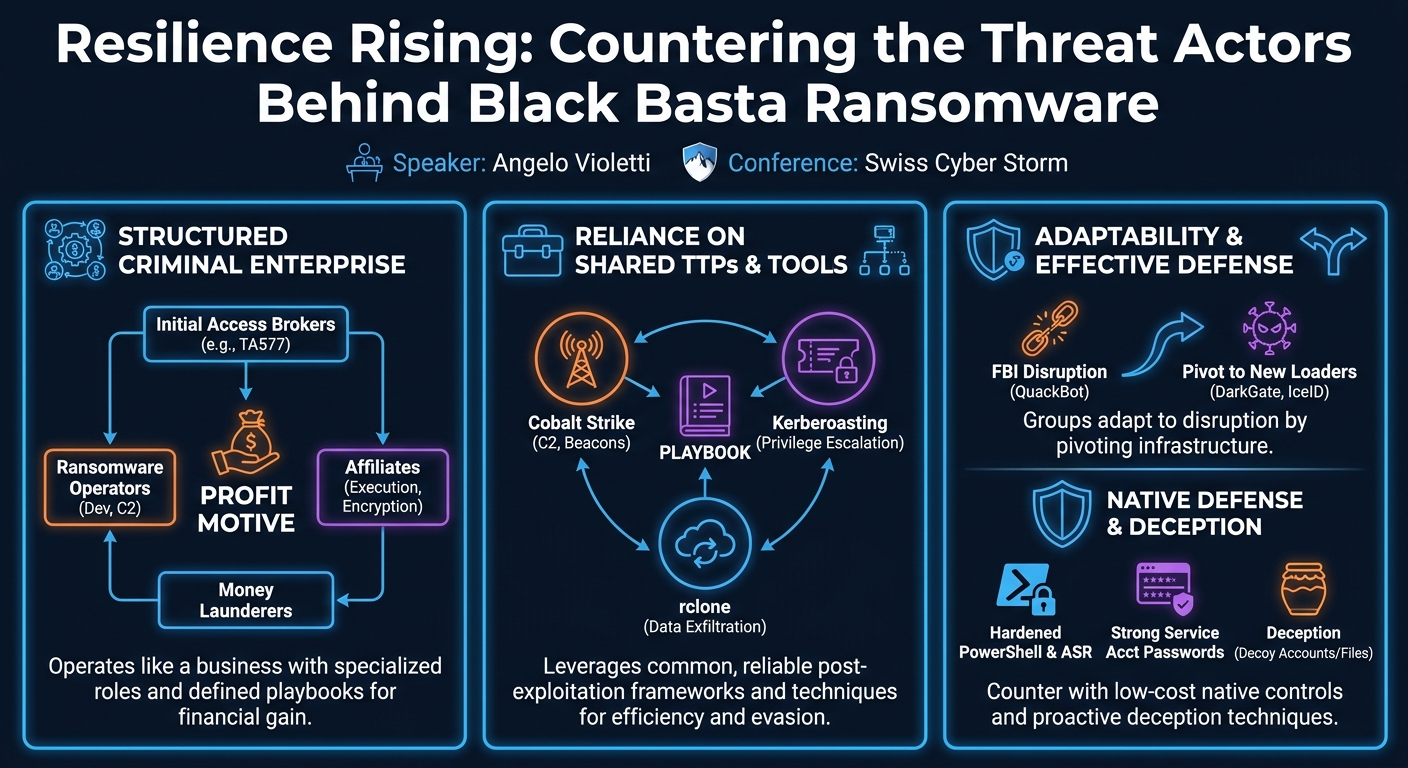
The landscape of modern cybercrime is increasingly dominated by Ransomware-as-a-Service (RaaS), a highly structured and profitable ecosystem. This model involves various specialized actors, each playing a distinct role in the attack chain. At the foundation are Initial Access Brokers (IABs), whose sole objective is to compromise corporate networks, often through malware or phishing, and then sell this access to other criminal gangs. The Ransomware Operators develop and maintain the ransomware software, manage the command-and-control (C2) infrastructure, recruit affiliates, and take a percentage of the ransom payments. Ransomware Affiliates are the technical operatives who perform the actual attacks, leveraging the acquired initial access to gain privileges, exfiltrate data, and ultimately encrypt systems. Finally, Money Launderers complete the cycle by cleaning the illicit gains.
Violetti underscores that the primary driver for all these actors is financial gain. This fundamental motivation dictates their strategies: they prioritize attacks that yield the highest financial return, which often means targeting business-critical data and exploiting the easiest misconfigurations and vulnerabilities to ensure rapid and efficient attacks. This efficiency allows them to maximize the number of victims and, consequently, their profits. The speaker highlights that paying ransoms directly fuels this criminal enterprise, making it profitable. Furthermore, ransomware groups operate with defined playbooks, detailing every step an affiliate should take, and utilize reliable tools designed to evade common security controls like EDRs and antiviruses. A critical insight for defenders is that many TTPs and tools are shared across different ransomware gangs, meaning that understanding and detecting the core methodologies of one group often provides defense against many others.
Key Findings
▶ Watch: Key ransomware characteristics and initial recommendations (4:00)
The talk presents several key findings regarding Black Basta's operations and the broader ransomware ecosystem:
- Structured Criminal Enterprise: Black Basta, like many modern ransomware groups, operates as a highly structured organization, with specialized roles (IABs, operators, affiliates) and defined playbooks, mimicking legitimate businesses. This structure makes them highly efficient and resilient.
- Reliance on Specific Initial Access Brokers and Malware: Black Basta heavily relies on the IAB known as TA577, which historically used malware like QuackBot and PikaBot for initial compromise, primarily delivered via email-based attacks involving zipped files containing multi-stage payloads.
- Ubiquity of Post-Exploitation Frameworks: Cobalt Strike is identified as the most common and reliable post-exploitation framework used by Black Basta and other threat actors due to its high defense evasion capabilities and commercial-grade reliability. Detecting Cobalt Strike TTPs is thus a crucial defensive strategy against a wide range of ransomware groups.
- Effective Privilege Escalation: Kerberoasting is highlighted as an exceptionally effective technique for privilege escalation, working 94% of the time when attempted (95% of the time, it's attempted). This allows attackers to quickly gain domain admin privileges within a day of initial access.
- Adaptation to Disruption: A significant finding was the impact of the FBI's disruption of the QuackBot infrastructure on August 24-25th. This event led to a temporary pause in Black Basta's reported victims (from August 22nd to October 11th) and forced TA577 to pivot to new malware loaders, including DarkGate and IceID, demonstrating the group's adaptability and resilience.
- Exploiting the Human Factor: The talk emphasizes that both attackers and defenders can leverage the "human factor." Attackers exploit human vulnerabilities (e.g., clicking malicious links, weak passwords), while defenders can implement deception techniques (e.g., fake Kerberoastable accounts, decoy files with fake credentials) to bait and detect adversaries.
- Importance of Native Windows Defenses: Simple, native Windows functionalities like hardened PowerShell, Attack Surface Reduction (ASR) rules, and Windows Firewall can significantly reduce risk without incurring additional costs, demonstrating that effective defense doesn't always require expensive tools.
Technical Deep Dive
▶ Watch: Exploiting human factor of attackers with deception (17:00)
Black Basta's attack methodology is a multi-stage process, meticulously executed by affiliates following established playbooks. The initial breach often originates from TA577, an Initial Access Broker, which typically spreads malware via email-based phishing campaigns. These emails often contain .zip files that, when opened, unleash a chain of execution involving WScript and PowerShell to download and execute the final payload, historically QuackBot or PikaBot. QuackBot, for instance, established persistence and provided initial access to the compromised network.
Once initial access is secured, TA577 sells this access to Black Basta affiliates. The affiliates then deploy their primary post-exploitation framework: Cobalt Strike. This commercial penetration testing tool is favored for its robust capabilities, including its ability to establish resilient beacons (C2 channels) via HTTPS or DNS. Notably, DNS beacons are particularly stealthy, making detection challenging. Violetti provides a regular expression to help parse DNS logs to identify suspicious Cobalt Strike DNS beacon activity. Alongside Cobalt Strike, SystemBC is often deployed as a proxy, facilitating the download of additional tools and data exfiltration. SystemBC is sometimes found masquerading as benign .txt files (e.g., systembc.txt), highlighting a common evasion tactic.
The next phase involves enumeration and privilege escalation. Affiliates use tools like SoftPerfect Network Scanner for IP scanning and BloodHound for comprehensive Active Directory enumeration, mapping relationships between users, groups, and resources to identify attack paths. They also enumerate installed antivirus and EDR solutions, with a common objective being to disable Windows Defender. For privilege escalation, Kerberoasting is a highly effective technique, leveraged in 95% of attacks and yielding success 94% of the time. This involves requesting Kerberos service tickets (TGS-REQ) for service principal names (SPNs) associated with service accounts, then cracking the weak NTLM hashes offline to obtain plaintext passwords, often leading to domain admin privileges within a day. Credentials obtained through Kerberoasting are then used to dump further credentials, potentially accessing backup infrastructure.
For defense evasion and lateral movement, Black Basta affiliates abuse legitimate remote management tools like AnyDesk, which can blend into the baseline activity of administrators. Cobalt Strike's ability to relay traffic is also crucial for lateral movement, allowing agents to tunnel C2 traffic through compromised hosts. This often results in anomalous login attempts from systems with generic hostnames (e.g., "win star") that don't conform to an organization's naming conventions, providing a potential detection point.
Data exfiltration is performed using rclone, a legitimate and highly versatile command-line tool for synchronizing files to various cloud storage providers (Azure, AWS, Mega) or SFTP servers. Its efficiency and reliability make it ideal for quickly siphoning off large volumes of sensitive data identified during the enumeration phase. Finally, the encryption phase is executed by spreading the Black Basta ransomware payload across the network, often leveraging Group Policy Objects (GPOs) within Active Directory to deploy the malware to servers and workstations simultaneously, ensuring widespread impact.
Demo / Proof of Concept
▶ Watch: Crucial prevention and remediation for encryption (21:00)
The provided transcript does not describe a live demonstration or a proof-of-concept during the talk. The speaker focuses on explaining Black Basta's TTPs and providing defensive recommendations based on observed attack patterns and tools.
Defensive Implications
▶ Watch: Q&A: Initial access costs and extortion trends (31:00)
Violetti provides a robust set of defensive implications, categorized into prevention, detection, and strategic recommendations, emphasizing that many effective measures are low-cost and leverage native system functionalities.
Preventative Measures:
- Awareness Activities: Crucial for minimizing the impact of phishing attacks, which are a primary vector for IABs like TA577.
- Harden PowerShell: Implement language mode and Attack Surface Reduction (ASR) rules to block malicious PowerShell executions. This can prevent the download and execution of payloads like QuackBot or SystemBC.
- Windows Firewall: Configure the Windows Firewall to block processes from making unauthorized external connections, preventing malware from downloading additional stages or establishing C2 communications.
- Strong Passwords & Least Privilege for Service Accounts: This is highlighted as a "game-changer" for preventing Kerberoasting attacks. Service accounts should have complex, unique passwords and adhere strictly to the least privilege principle, never being granted unnecessary domain admin rights.
- Encrypt Company Data at Rest: Encrypting sensitive data can mitigate the impact of data exfiltration, making stolen information useless to the attackers.
- Protect Virtualized Environments: Ransomware groups increasingly target virtualized environments due to their high impact potential. Securing these systems is paramount.
Detection Measures:
- DNS Cobalt Strike Beacon Detection: Implement regex-based detection rules for DNS logs to identify the characteristic patterns of Cobalt Strike DNS beacons, a critical indicator of compromise.
- General Cobalt Strike TTP Detection: Since Cobalt Strike is widely used, developing detection rules for its common TTPs (e.g., process injection, reflective DLL loading, specific network patterns) can cover a broad spectrum of ransomware groups.
- SystemBC Masquerading Detection: Monitor for executable files (e.g.,
.exe) that are renamed with.txtextensions (e.g.,systembc.txt), a common evasion technique. - Enumeration Tool Detection: Establish detection rules for the use of common enumeration tools like BloodHound or SoftPerfect Network Scanner.
- Windows Defender Disablement Detection: Alert on attempts to disable or tamper with antivirus and EDR solutions, especially Windows Defender.
- Unauthorized Remote Management Tool Detection: Monitor for the usage of remote management tools (e.g., AnyDesk) that are not part of the organization's approved baseline.
- Deception Techniques:
- Fake Kerberoastable Accounts: Create decoy service accounts with SPNs and monitor them highly. Any attempt to Kerberoast these accounts will immediately trigger an alert, indicating compromise.
- Decoy Files: Place fake sensitive files (e.g.,
passwords.xlswith fake credentials) in shared folders and alert on any access attempts. This requires robust logging and SIEM capabilities. - Lateral Movement Detection: Monitor for suspicious lateral movement patterns, particularly those indicative of Cobalt Strike relaying traffic.
- Anomalous Login Detection: Create detection rules for login attempts originating from systems with non-compliant hostnames (e.g., generic "win star" names), which can indicate C2 servers or compromised machines used for relaying.
Remediation and Strategic Planning:
- Backup and Recovery Strategy: Maintain robust, air-gapped backups to ensure business continuity even if encryption occurs.
- Crisis Management Procedures: Develop and regularly test incident response plans to ensure the organization knows what to do in the event of a ransomware attack (scope incident, isolate systems, initiate IR).
- Maturity Assessment (e.g., Irma service): Understand the organization's current cybersecurity maturity, identify gaps, and define a target state for improving detection and response capabilities.
- Periodic Vulnerability and Misconfiguration Assessments: Regularly scan and remediate common vulnerabilities and misconfigurations that attackers frequently exploit.
- EDR/MDR Services: While not 100% foolproof, EDR and Managed Detection and Response (MDR) services are valuable tools for identifying early stages of attacks and preventing encryption.
- War Games: Simulate real-life attack scenarios to test processes, communication, and team readiness during an incident.
- Purple Teaming: Foster collaboration between red and blue teams to simulate TTPs, verify detection capabilities, and identify improvement actions.
- Rapid Response Team: Have access to or maintain an internal rapid response team to manage incidents effectively if an encryption event occurs.
Key Takeaways
- Ransomware is Human-Operated and Business-Driven: Modern ransomware groups like Black Basta operate as structured enterprises, driven by financial gain, and leverage well-defined playbooks and specialized roles.
- Cobalt Strike is a Critical Detection Point: Detecting the TTPs associated with Cobalt Strike is paramount, as it is the most common post-exploitation framework used by Black Basta and many other ransomware groups.
- Initial Access Brokers are Key: The disruption of TA577's QuackBot infrastructure by the FBI highlights the importance of targeting IABs, even though threat actors demonstrate adaptability by pivoting to new malware like DarkGate and IceID.
- Low-Cost Defenses are Effective: Native Windows security features (Powershell hardening, Windows Firewall, ASR rules) and fundamental security hygiene (strong passwords, least privilege) can significantly reduce risk without substantial investment.
- Deception Can Turn the Tables: Proactive deception techniques, such as creating fake Kerberoastable accounts or decoy files, can provide early warnings and disrupt attacker operations.
- Comprehensive Strategy is Essential: A multi-layered defense incorporating preventative measures, robust detection, a well-defined incident response plan, and continuous maturity assessment is crucial for resilience against sophisticated ransomware threats.
About the Speaker(s)
Angelo Violetti is a Security Consultant at SEC Consult, a position he joined last year. With approximately four years of experience in Digital Forensics and Incident Response (DFIR), Angelo also contributes to DFI reports in various engagements during his free time. He holds a Master's degree in Cybersecurity and possesses a range of security certifications, including the GCFA (GIAC Certified Forensic Analyst) and several offensive security certifications, indicating a strong background in both defensive and offensive security disciplines.
Reviews
Dr. Zero (Offensive Security Researcher) — SOLID
Violetti's breakdown of Black Basta is a highly competent, textbook DFIR readout that tells you exactly how TA577 operates. It doesn't break new ground—we are still talking about Cobalt Strike, SystemBC, and Kerberoasting in 2024—but it maps the affiliate playbook with zero marketing fluff. A practical baseline for blue teams, even if offensive researchers will sleep through it.
Heather Calloway (CISO) — SOLID
Violetti’s breakdown of Black Basta isn't groundbreaking new threat intel, but it is a sobering look at exactly how human-operated ransomware moves through an enterprise. It strips away the mystique of RaaS to reveal a highly standardized, predictable attack chain. Worth having your detection engineering team watch to ensure they are covering the basics, because the attackers certainly are.