Our supplier has been hit! What do we do now?
Gregor Wegberg (Head of Digital Forensics and Incident Response · Oneconsult)
Swiss Cyber Storm 2023 · Day 1 · Panorama
Overview
In an increasingly interconnected digital landscape, organizations are not only vulnerable to direct cyberattacks but also to the cascading effects of incidents impacting their critical suppliers and service providers. Gregor Wegberg, Head of Digital Forensics and Incident Response at Oneconsult, addresses this pressing issue in his talk, "Our supplier has been hit! What do we do now?". Wegberg highlights a significant shift in the incident response landscape, noting that a growing number of cases his team handles involve clients grappling with the aftermath of a ransomware attack on a key partner, rather than a direct assault on their own systems. This talk deliberately steers clear of discussing large-scale infrastructure providers like Okta, focusing instead on the more common yet often overlooked scenario of a critical, perhaps smaller, supplier being compromised.
Key moments
- 0:00 Introduction: The growing threat of supply chain attacks
- 2:00 Real-world example: Kisters ransomware attack impact
- 7:00 Essential first step: Asset management and third-party access
- 11:30 Gaining transparency: Contractual requirements and community building
- 16:45 Rebuilding trust: Evaluating supplier recovery and lessons learned
- 29:00 Q&A: Is ISO 27001 sufficient for supplier security?
Our supplier has been hit! What do we do now?
Speakers: Gregor Wegberg, Head of Digital Forensics and Incident Response, Oneconsult
Conference: Swiss Cyber Storm
YouTube: https://www.youtube.com/watch?v=NfrG3L7LA4Y
Overview
In an increasingly interconnected digital landscape, organizations are not only vulnerable to direct cyberattacks but also to the cascading effects of incidents impacting their critical suppliers and service providers. Gregor Wegberg, Head of Digital Forensics and Incident Response at Oneconsult, addresses this pressing issue in his talk, "Our supplier has been hit! What do we do now?". Wegberg highlights a significant shift in the incident response landscape, noting that a growing number of cases his team handles involve clients grappling with the aftermath of a ransomware attack on a key partner, rather than a direct assault on their own systems. This talk deliberately steers clear of discussing large-scale infrastructure providers like Okta, focusing instead on the more common yet often overlooked scenario of a critical, perhaps smaller, supplier being compromised.
The core of Wegberg's presentation revolves around the severe challenges faced by organizations when a crucial third party — be it a software provider, logistics partner, or energy sector enabler — is incapacitated by a cyberattack. The immediate fallout often includes service disruption, a critical lack of transparency from the affected supplier, and a profound uncertainty about how to react and what defensive measures to implement. Wegberg underscores that this indirect attack vector necessitates a re-evaluation of existing security strategies, urging companies to look beyond their internal perimeters and consider the security posture and incident readiness of their entire supply chain.
Wegberg illustrates the gravity of the situation with two real-world examples involving Swiss companies: a ransomware attack on Kers, a German provider of software and services for the energy sector, and a similar incident affecting SSI Schäfer, a top logistics and warehouse solutions provider. These cases highlight not only the operational paralysis caused by such attacks but also the frustrating lack of timely and detailed information available to affected customers, often due to legal constraints or a desire by the victimized supplier to minimize public exposure. The talk serves as a crucial call to action for organizations to proactively prepare for these indirect threats, emphasizing transparency, collaboration, and robust contractual agreements as foundational pillars of resilience.
Background
▶ Watch: Introduction: The growing threat of supply chain attacks (0:00)
The modern enterprise operates within a complex ecosystem of vendors, service providers, and technology partners. While the benefits of outsourcing and specialized services are undeniable, this interconnectedness introduces significant security risks that are often underestimated or poorly managed. Traditionally, cybersecurity efforts have focused heavily on securing an organization's internal infrastructure, networks, and endpoints against direct threats. However, as attackers increasingly target the weakest links in the supply chain, the security posture of third-party entities has become a critical determinant of an organization's overall resilience.
Wegberg points out that the problem isn't new, but its prevalence and impact are escalating. He notes that over the past 18 to 24 months, a significant portion of Oneconsult's incident response engagements have shifted from direct client attacks to assisting clients whose key suppliers have been compromised. This trend highlights a fundamental gap in many organizations' security strategies: while they may have robust internal controls, their reliance on external entities creates an extended attack surface that is often outside their direct control and visibility.
Several factors contribute to this vulnerability. First, many critical suppliers, especially smaller or specialized ones, may not possess the same level of security maturity or financial resources as their larger clients. They might lack dedicated security teams, advanced threat detection capabilities (like NDR or EDR), or comprehensive incident response plans. Second, the nature of supplier access often bypasses conventional security controls. As Wegberg explains, suppliers frequently have direct, privileged access into client environments, often utilizing tools like TeamViewer or AnyDesk. These remote access solutions, while convenient, can circumvent firewalls, VPNs, and other established security perimeters, providing a direct conduit for attackers if the supplier's system is compromised. Furthermore, these accounts often possess privileged access, such as domain administrator or local administrator rights, necessary for their work but highly dangerous if exploited.
The lack of transparency following a supplier incident is another pervasive issue. As demonstrated by the Kers and SSI Schäfer cases, victimized suppliers are often reluctant to disclose the full scope and technical details of an attack. This reluctance can stem from legal concerns, fear of reputational damage, or pressure from law enforcement (as seen with Kers, where German police imposed a gag order). This information vacuum leaves client organizations in the dark, unable to accurately assess their own risk exposure, search for Indicators of Compromise (IoCs), or implement targeted defenses. The challenge is exacerbated by the fact that many existing contracts do not explicitly mandate timely and detailed incident disclosure, leaving clients with little leverage to demand information beyond vague assurances of service disruption. This creates a reactive environment where clients often learn about incidents through informal channels or public news, rather than structured communication.
Key Findings
▶ Watch: Essential first step: Asset management and third-party access (7:00)
Gregor Wegberg's talk distills several critical findings for organizations navigating the complex landscape of supply chain cyberattacks:
- Visibility into Third-Party Access is Paramount: A foundational requirement is a comprehensive understanding of which services, hardware, and software are used from third parties, and critically, what kind of access these third parties have into the organization's environment. This includes knowing whether they have direct network access, use remote desktop tools like TeamViewer or AnyDesk, or possess privileged accounts. Without this asset management and identity management insight, effective response is impossible.
- Traditional Security Controls Are Often Ineffective Against Third-Party Breaches: Most internal security controls, such as firewalls, NDR, EDR, and SIEM systems, are designed to protect the organization's perimeter and internal assets. However, third-party access often bypasses these controls, creating a direct path for attackers. Organizations must recognize that the risk profile of these third-party accounts and access mechanisms is fundamentally different and often higher than internal users.
- Transparency is Crucial but Frequently Absent: Effective incident response to a supplier breach hinges on timely and detailed information from the affected supplier (e.g., IoCs, Tactics, Techniques, and Procedures (TTPs), scope of compromise). However, suppliers are often unwilling or legally unable to provide this, leaving clients to operate on hypotheses. This lack of transparency is a major impediment to a confident and effective response.
- Community and Contractual Leverage are Essential for Information Sharing: To overcome the transparency barrier, Wegberg advocates for building communities of affected organizations to collectively demand information. Furthermore, incorporating explicit clauses into contracts that mandate incident disclosure, vulnerability reporting, and data privacy incident notification provides necessary legal leverage. This shifts the dynamic from ad-hoc requests to legally binding obligations.
- Rebuilding Trust Requires Due Diligence, Not Abandonment: While it might be tempting to sever ties with a compromised supplier, Wegberg advises against it. Suppliers who have experienced an attack often learn valuable lessons and are more motivated to improve their security. The focus should be on evaluating their post-incident remediation efforts, lessons learned, and commitment to future resilience, often through detailed questionnaires and direct engagement with their technical and management teams.
- Current Threat Landscape (in Switzerland) is Opportunistic, but Evolving: As of the talk, Wegberg notes that most attacks observed in Switzerland against suppliers are financially motivated and opportunistic, meaning attackers are not typically targeting a supplier specifically to pivot to their clients. However, he cautions that this could change, and organizations must prepare for a future where such sophisticated supply chain attacks become more common. One case mentioned involved lateral movement between companies via trust relationships between Active Directories, but even this was an accidental consequence of the attack, not a deliberate pivot.
Technical Deep Dive
▶ Watch: Gaining transparency: Contractual requirements and community building (11:30)
The technical implications of a supplier breach are profound, often exploiting fundamental trust relationships and bypassing conventional security architectures. Wegberg's discussion highlights several key technical aspects that demand attention.
At the heart of the problem lies the nature of third-party access. Many suppliers require direct access to client environments to perform their services, whether it's maintaining specialized hardware, updating software, or providing technical support. This access frequently relies on remote control tools like TeamViewer or AnyDesk. While convenient, these tools establish direct connections that often circumvent an organization's primary network security controls, including corporate firewalls, Intrusion Detection/Prevention Systems (IDS/IPS), and Network Detection and Response (NDR) solutions. An attacker who compromises a supplier's workstation can leverage these established, trusted channels to gain immediate entry into the client's network, effectively bypassing the first line of defense.
Compounding this issue is the common practice of granting privileged accounts to third-party personnel. These accounts, often possessing domain administrator or local administrator rights, are necessary for the supplier to perform their duties but represent a significant security risk if compromised. Attackers gaining control of such accounts can achieve widespread access, move laterally within the client's network, and execute malicious payloads, including ransomware. The challenge for client organizations is that their Endpoint Detection and Response (EDR) and Security Information and Event Management (SIEM) systems might not have full visibility or context into the activities originating from these external, unmanaged devices.
Identity management is crucial here. Wegberg stresses the importance of tagging or categorizing these third-party accounts as high criticality within an organization's Security Operations Center (SOC). This ensures that any suspicious activity associated with these accounts triggers an elevated alert and a quicker, more aggressive response. The lack of host-based security controls on the supplier's devices means that the client organization has limited telemetry on the origin of the attack, making it harder to distinguish legitimate supplier activity from malicious actions post-compromise.
Furthermore, a supplier incident often has significant data privacy implications. If the compromised supplier processes personal data on behalf of the client, the client organization may be obligated under regulations like GDPR or local data protection laws to assess data breaches, notify authorities, and potentially inform affected individuals. This legal obligation underscores the necessity for timely and detailed incident information from the supplier, which is frequently withheld.
In situations where transparency is lacking, organizations are forced to operate on a hypothesis-driven response. Wegberg suggests assuming the worst-case scenario: a ransomware attack likely involved data exfiltration and the compromise of credentials such as passwords, access tokens, and cached credentials. This assumption guides immediate defensive actions, such as resetting passwords, revoking access tokens, and monitoring for unusual activity originating from or targeting resources associated with the compromised supplier. The integrity of any software or updates received from the supplier post-incident also becomes a critical concern, raising fears of backdoored applications or compromised source code, a complex issue that currently lacks readily available tools and processes for rapid verification.
Demo / Proof of Concept
▶ Watch: Rebuilding trust: Evaluating supplier recovery and lessons learned (16:45)
Gregor Wegberg's presentation at Swiss Cyber Storm was an insightful discussion focused on strategic and practical advice for managing supplier-related cyber incidents. The talk did not include a live technical demonstration or a proof of concept of an attack or a specific defensive tool. Instead, it relied on real-world case studies and expert analysis to convey its key messages.
Defensive Implications
▶ Watch: Q&A: Is ISO 27001 sufficient for supplier security? (29:00)
The insights shared by Gregor Wegberg carry substantial defensive implications for organizations aiming to bolster their resilience against supply chain cyberattacks. Proactive measures and a shift in mindset are imperative to mitigate the risks posed by compromised third parties.
- Robust Asset and Identity Management for Third Parties: The foundational step is to gain complete visibility. Organizations must meticulously document every service, hardware, and software product used from external suppliers. Crucially, this includes detailing the nature of access granted to these third parties: what systems they touch, what protocols they use (e.g., TeamViewer, AnyDesk, VPN), and what privileged accounts (e.g., domain admin, local admin) they possess. This information should be integrated into existing asset management and identity management systems. Third-party accounts should be explicitly tagged or categorized as "high criticality" within the SOC to ensure that any anomalous activity associated with them triggers an immediate, prioritized investigation.
- Strengthening Contractual Security Clauses: Organizations must leverage their legal agreements to enforce better security practices and transparency from suppliers. Contracts should explicitly mandate:
- Incident Disclosure: Clear requirements for timely notification of any security incident, including details on the type of attack, scope of compromise, and potentially compromised data.
- Vulnerability Reporting: Obligations to report identified vulnerabilities in their products or services.
- Data Privacy Incident Protocol: Specific procedures for handling incidents involving personal data processed on the client's behalf, aligning with regulations like GDPR.
- Post-Incident Review: Agreement for the supplier to participate in post-incident reviews and provide details on remediation and lessons learned.
- Cultivating a Community of Affected Organizations: When a critical supplier is hit, individual organizations often lack the leverage to demand comprehensive information. Wegberg advocates for forming informal or formal communities with other clients of the same supplier. This collective power can pressure the supplier to provide more detailed and timely information, fostering a shared understanding of the threat and enabling more coordinated defensive actions. Organizations can leverage existing forums like closed user groups or national CERT/CSIRT briefings to identify common suppliers and initiate such collaborations.
- Developing Supplier-Specific Incident Response Playbooks: Standard incident response plans often assume direct attacks. Organizations need to develop specific playbooks for supplier incidents. These should include:
- Detection Mechanisms: How to identify a supplier compromise (e.g., monitoring public news, threat intelligence, unusual activity from supplier accounts).
- Information Gathering Checklist: A structured set of questions to ask the compromised supplier to extract crucial technical and operational details (e.g., IoCs, TTPs, affected systems, remediation steps).
- Internal Actions: Steps to take if information is scarce (e.g., assuming ransomware and data exfiltration, immediate password resets for all potentially exposed accounts, revoking access tokens, disconnecting services if feasible).
- Communication Strategy: Protocols for internal and external communication during a supplier incident.
- Proactive Engagement and Relationship Building: Don't wait for an incident. Organizations should proactively engage with their key suppliers, building relationships beyond mere contractual obligations. Discuss hypothetical "what if" scenarios, understand their incident response capabilities, and express a willingness to collaborate. This fosters trust and can make information sharing easier during a crisis.
- Integrating Supplier Risk into Business Continuity Management (BCM): Supplier dependencies must be a core component of the Business Impact Analysis (BIA). Identify critical business processes and the suppliers essential to their operation. Understand the potential impact of a supplier outage or compromise on these processes and develop contingency plans.
- Evaluating Post-Incident Trust and Remediation: After a supplier incident, the decision to continue working with them should not be based on emotion. Instead, organizations should use a structured approach:
- Questionnaires: Utilize detailed questionnaires to assess the supplier's short-term, mid-term, and long-term remediation measures.
- Lessons Learned: Focus on the supplier's "lessons learned" – genuine reflections on what went wrong and how they will improve, rather than generic marketing statements.
- Direct Engagement: Arrange calls with the supplier's higher management and technical teams to discuss the incident and their recovery plan in detail.
- Continuous Internal Security Improvement: A supplier incident can serve as a potent catalyst for improving internal security. Organizations should use these events to identify their "dark places" – areas of their own environment where security was an afterthought or neglected. This might involve reviewing remote access policies, enhancing monitoring of third-party accounts, or strengthening internal network segmentation.
- Understanding the Limitations of Certifications: While certifications like ISO 27001 are valuable starting points for establishing a security baseline, Wegberg cautions that they are not a sufficient guarantee of real-world security or incident readiness. Certifications often focus on documentation and processes, but may not adequately cover communication protocols during an incident or the actual adherence to those processes in a crisis.
Key Takeaways
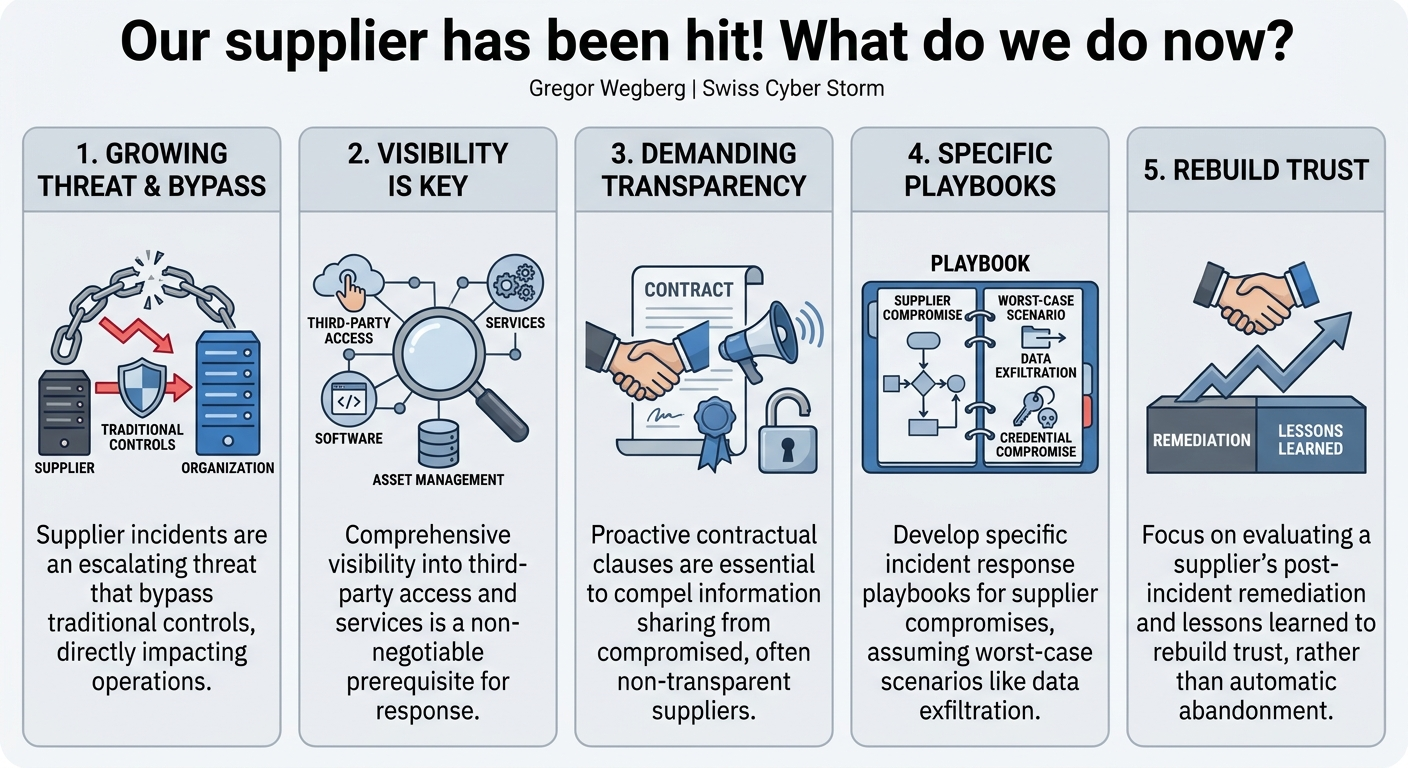
- Supplier incidents are a rapidly growing and significant threat, often bypassing traditional security controls and directly impacting client operations.
- Comprehensive visibility into third-party access and services is non-negotiable, requiring robust asset and identity management to identify and prioritize risks associated with external partners.
- Transparency from compromised suppliers is critical but frequently lacking, necessitating proactive contractual clauses and community-driven efforts to compel information sharing.
- Proactive engagement and relationship building with key suppliers are essential, fostering trust and facilitating smoother communication and collaboration during an incident.
- Organizations should develop specific incident response playbooks for supplier compromises, preparing to act on limited information and assuming worst-case scenarios like data exfiltration and credential compromise.
- Don't automatically abandon a compromised supplier; instead, focus on evaluating their post-incident remediation, lessons learned, and commitment to rebuilding trust through structured assessments and direct engagement.
About the Speaker(s)
Gregor Wegberg is the Head of Digital Forensics and Incident Response (DFIR) at Oneconsult, a prominent cybersecurity firm. With extensive experience in incident handling, he is at the forefront of responding to complex cyberattacks affecting a wide range of organizations. Wegberg has observed a notable shift in the threat landscape, with an increasing number of cases involving client companies impacted by incidents originating from their critical suppliers. He is known for his practical, real-world insights into cybersecurity challenges and has previously shared his expertise at the Swiss Cyber Storm conference. His professional profile and further details can be found on LinkedIn.
Reviews
Dr. Zero (Offensive Security Researcher) — SOLID
Wegberg tackles the reality of what happens when your logistics or software vendor gets popped and goes radio silent. It is not dropping new exploit chains, but the advice on forming victim cabals to squeeze breached vendors for IoCs is exactly the kind of pragmatic warfare defenders need. Competent IR work, even if we have been screaming about third-party risk for a decade.
Heather Calloway (CISO) — STRONG ACCEPT
A realistic look at the operational nightmare of a critical supplier breach. Wegberg correctly identifies that the primary challenge is the information vacuum created by panicked vendors and their legal counsel. Essential context for anyone updating their incident response playbooks or vendor contracts.