Tell me what you use and I will tell you who you are!
Mario Bischof (Senior Penetration Tester · InfoGuard)
Swiss Cyber Storm 2023 · Day 1 · Panorama
Overview
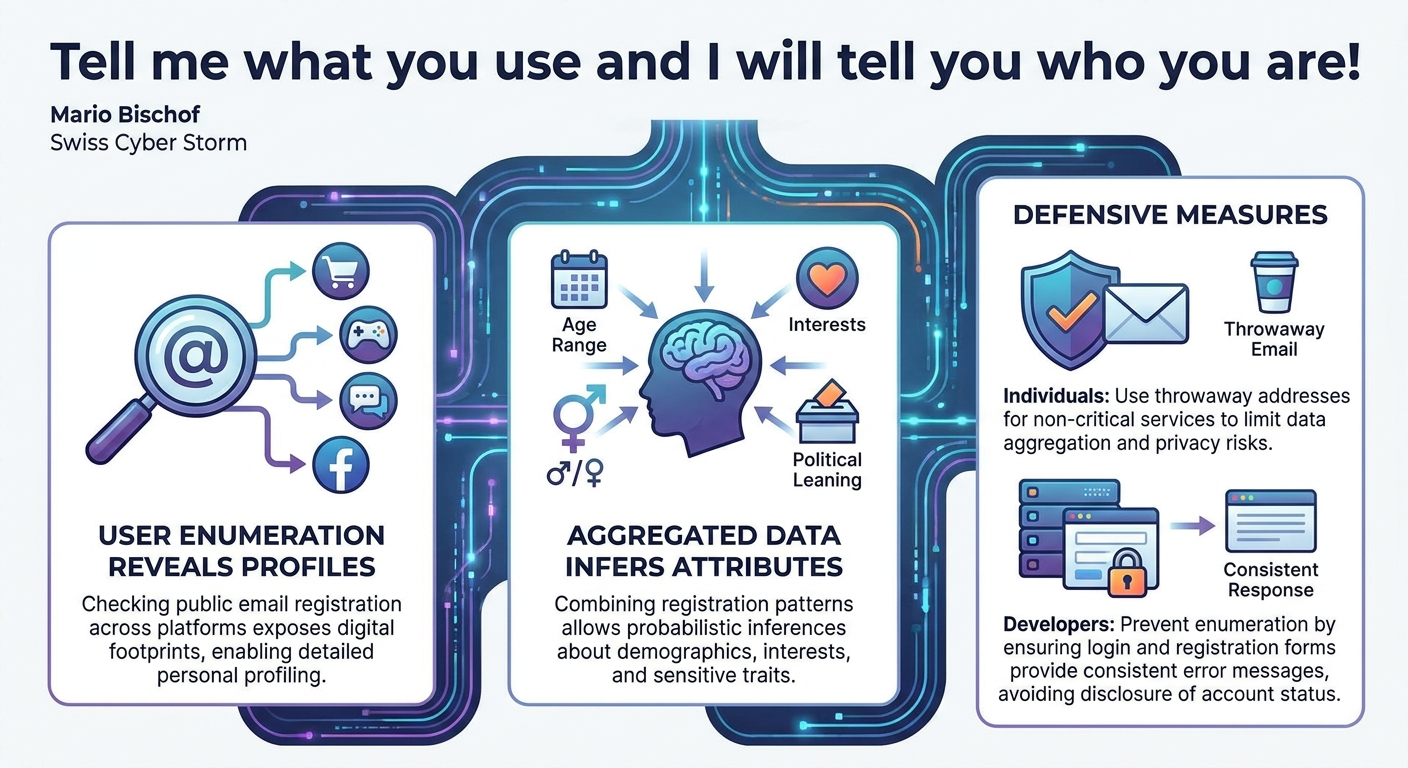
In his Swiss Cyber Storm talk, "Tell me what you use and I will tell you who you are!", Mario Bischof, a Senior Penetration Tester at InfoGuard and PhD student at the University of Fribourg, unveiled an ambitious interdisciplinary research project. This ongoing work explores the profound implications of Open Source Intelligence (OSINT) derived from a seemingly innocuous data point: whether an email address is registered on a public web platform. Bischof's custom-developed tool, accountbraber, automates this user enumeration process across hundreds of websites, demonstrating how patterns of online registration can be leveraged to construct highly detailed and often sensitive profiles of individuals.
Key moments
- 0:40 Introducing the Account Grabber tool and data
- 3:50 Analyzing average age trends across web platforms
- 8:00 Gender distribution insights, including "Big Tech"
- 10:00 Revealing privacy risks: prostitution forum case study
- 12:00 Building user profiles using prototyping theory
- 16:00 Predicting age and gender from user registration patterns
- 21:00 Ethical implications and raising awareness of data privacy
Tell me what you use and I will tell you who you are!
Speakers: Mario Bischof, Senior Penetration Tester, InfoGuard
Conference: Swiss Cyber Storm
YouTube: https://www.youtube.com/watch?v=eoMB3Rb3Jmg
Overview
In his Swiss Cyber Storm talk, "Tell me what you use and I will tell you who you are!", Mario Bischof, a Senior Penetration Tester at InfoGuard and PhD student at the University of Fribourg, unveiled an ambitious interdisciplinary research project. This ongoing work explores the profound implications of Open Source Intelligence (OSINT) derived from a seemingly innocuous data point: whether an email address is registered on a public web platform. Bischof's custom-developed tool, accountbraber, automates this user enumeration process across hundreds of websites, demonstrating how patterns of online registration can be leveraged to construct highly detailed and often sensitive profiles of individuals.
The core premise of Bischof's research is that aggregated registration data, even from publicly accessible sources, reveals far more about a person than any single data point might suggest. By analyzing which platforms an email address is associated with, it becomes possible to infer demographic information like age and gender, pinpoint specific interests, and even speculate on political leanings or religious affiliations. This talk serves as a critical wake-up call, highlighting the pervasive privacy risks inherent in the digital exhaust we leave behind and underscoring the urgent need for both individual vigilance and improved defensive measures by web application developers.
Background
▶ Watch: Introducing the Account Grabber tool and data (0:40)
The genesis of this research lies in accountbraber, an open-source intelligence project developed by Mario Bischof. The tool's primary function is user enumeration on web applications, a process that determines if a given email address is already registered with a particular online service. Bischof's initial development involved analyzing approximately 300 to 400 web applications to identify enumeration vectors, with accountbraber currently supporting around 100 diverse platforms. This talk is presented as "Chapter 2," building upon prior work shared at InfoGuard's Innovation Days, indicating an evolution and expansion of the initial concept.
The fundamental problem enabling this research is the common design flaw in many web applications: they inadvertently disclose whether an email address exists in their user database. This often occurs through password reset forms, registration pages, or API endpoints that return different error messages or behaviors for registered versus unregistered emails. While some security-conscious industries like banking, insurance, and gambling sites tend to mitigate this, many general-purpose platforms do not. Bischof's project benefits from an internal InfoGuard apprenticeship program, where an apprentice significantly enhanced the tool, underscoring its practical utility and ongoing development. The current dataset for analysis comprises around 400 random Swiss email addresses, augmented with self-declared age and gender information, serving as the training data for these nascent profiling capabilities.
Key Findings
▶ Watch: Gender distribution insights, including "Big Tech" (8:00)
Mario Bischof's preliminary analysis of just 400 Swiss email addresses using accountbraber revealed strikingly consistent and often cliché-confirming patterns, laying a strong foundation for the profiling hypotheses.
One significant finding involved average age distribution across different web platforms. While the general average age of registrants clustered between 40 and 50, specific outliers provided clear demographic indicators. For instance, a porn site showed an average age of 54, while platforms related to software development, online gaming, mobile travel trackers, and baby shops consistently registered average ages in the high 30s. These observations, though anecdotal at this early stage, align with common societal perceptions and demonstrate the immediate inferential power of registration data.
Similarly, gender distribution exhibited discernible trends. Technology-related online shops, adult-oriented platforms (like the porn site and casual dating sites), and online gaming portals showed a clear male dominance in their user bases. Conversely, general online shopping portals featuring hygiene and beauty products, as well as online pharmacies, tended to lean towards a higher proportion of female registrants. These patterns, while potentially reinforcing stereotypes, highlight the ability to infer gender identification with reasonable probability based purely on registration choices.
The analysis also touched upon Big Tech platforms (e.g., Apple ID, Google account). As expected, these services showed a very high registration rate across the sample, with an even distribution between male and female registrants, suggesting near-universal adoption. Bischof posited that differential registration here (e.g., only Apple ID, no Google account) could even indicate a user's preferred operating system or device ecosystem (iPhone vs. Android).
Perhaps the most potent illustration of the privacy implications came from a specific use case: a forum discussing prostitution, which publicly stated having 49,000 members. Bischof calculated that this figure represents approximately 0.5% of the Swiss population, meaning statistically, roughly "every 177th citizen" could be registered. Strikingly, his small sample of 400 emails included two individuals registered on this platform (numbers 144 and 353). This example starkly highlighted the blackmail potential of such information, especially if a high-profile individual's private email were linked to a sensitive platform. The ability to connect these individual data points across multiple platforms, rather than viewing them in isolation, is the ultimate goal, enabling the construction of comprehensive and potentially damaging personal profiles.
Technical Deep Dive
▶ Watch: Revealing privacy risks: prostitution forum case study (10:00)
The technical foundation of this research is the accountbraber tool, an OSINT-focused application designed for user enumeration. At its core, accountbraber takes an email address and systematically queries a list of target web applications to determine if that email is registered. The output is a matrix where each row represents an email and columns represent web applications, with a '1' indicating registration and a '0' indicating non-registration. Bischof invested significant effort in analyzing 300-400 web applications to identify reliable enumeration vectors, resulting in the tool's current support for over 100 platforms.
The methods for user enumeration vary depending on the target web application:
- Explicit Disclosure: The simplest case is when a web application directly states, "This email is already registered," often during a signup attempt or password reset flow.
- HTTP Response Analysis: More technically, enumeration can involve using libraries like Python's
requeststo send HTTP requests (e.g., to a login or password reset endpoint) and then parsing the HTTP response body or status codes for specific strings or patterns that indicate registration status. - API Endpoints: Some applications expose public or semi-public API endpoints that, when queried with an email, might return different data or error messages based on whether the email is known to the system.
- Signup Form Tricks: Even without direct API access, submitting partially completed signup forms can sometimes trigger error messages that reveal registration status before full submission, such as "Email already in use."
Bischof's research then moves beyond simple enumeration to profiling through pattern analysis. With the collected registration data (currently 400 Swiss emails with known age and gender), he proposes two main analytical frameworks:
- Prototyping Theory: This involves defining abstract "prototypes" of individuals, such as an "Outdoor Enthusiast" (registered on hiking, sports, geocaching sites) or a "Hips Programmer" (with a GitHub account, tech forums, etc.). Each prototype is associated with a set of interests. For any given email address,
accountbrabercalculates the overlap or match percentage between its registration pattern and each defined prototype. For example, a 50% match for "Outdoor Enthusiast" might be less telling than a 71.4% match for "Hips Programmer," suggesting a higher probability of technical affinity. By aggregating these matches across numerous prototypes, a comprehensive profile of a person's interests and likely characteristics can be constructed. Crucially, even the absence of a registration on a specific platform can provide valuable meta-information (e.g., an email not found on Google but on Apple might suggest an iOS user).
- Predictive Modeling (Hypothesis): Bischof hypothesizes that registration patterns can be used to predict unknown demographic properties like age and gender.
- Age Prediction: By plotting a person's registered platforms onto a scatter plot of average ages for each platform, one could infer a probable age range for that individual. If a person is registered on platforms with average ages of 35, 38, and 42, their own age is likely within that vicinity.
- Gender Prediction: Similarly, by examining the gender distribution percentages of the platforms an individual is registered on, a probability of their gender identification can be estimated. For instance, if an email is registered on three platforms with 81%, 78%, and 70% female users, and one with 20% female users, the probability of the person identifying as female could be around 65%.
Bischof acknowledges that these predictions are based on fuzzy data and operate on probabilities, but he asserts that "the more platforms you have, the more detailed... and the more certain these predictions will be."
The research faces significant technical challenges. Data acquisition is cumbersome and slow, often requiring the use of Selenium for browser automation, which Bischof admits is "ugly" and inefficient. Collecting data for a single email can take between three to five minutes, making the expansion of the current 400-sample dataset a considerable undertaking. The analysis of results is also incomplete, with current observations being preliminary. Future work includes evaluating more sophisticated analytical methods, such as machine learning models or neural networks, to refine the predictive capabilities. Bischof also alluded to the potentially "dangerous" implications of predicting highly sensitive attributes like political orientation or religion, underscoring the ethical considerations of this powerful OSINT technique.
Demo / Proof of Concept
▶ Watch: Predicting age and gender from user registration patterns (16:00)
While Mario Bischof's presentation did not feature a live, interactive demonstration of accountbraber querying emails in real-time, the entire talk served as a powerful proof of concept for the underlying research. Bischof effectively demonstrated the tool's capabilities and the validity of his hypotheses through a series of compelling data visualizations and statistical analyses derived from accountbraber's output.
The "Demo / Proof of Concept" section of his talk was implicitly embedded in the "Key Findings" and "Technical Deep Dive" sections. He presented:
- Output Format: A clear visual representation of
accountbraber's output, showing a table where rows represented individual email addresses and columns represented web applications, with '1' for registered and '0' for not registered. This illustrated the raw data from which profiles are built. - Average Age Scatter Plot: A scatter plot displaying the average age of registrants for over 100 web applications. This visual highlighted how specific platforms correlate with distinct age demographics (e.g., the porn site at 54, baby shops in the high 30s), proving the initial inferential power.
- Gender Distribution Bar Charts: Bar charts for various web applications, showcasing the male-to-female registrant ratios. Examples included technology shops (male-dominated), general shopping (female-leaning), and online gaming (heavily male-dominated), visually confirming gender-based patterns.
- Big Tech Usage: A bar chart illustrating the widespread registration on major platforms like Apple and Google, demonstrating their near-universal adoption and even gender distribution.
- Prototyping Example: Conceptual slides outlining the "Outdoor Enthusiast" and "Hips Programmer" prototypes, and how a specific email's registration pattern could achieve a 50% or 71.4% match, thereby indicating likely interests.
- Predictive Inference: Manual drawings overlaid on the age and gender distribution charts, illustrating how a person's registration pattern across multiple sites could statistically suggest their probable age range or gender identification (e.g., "65% probability of identifying as female").
- Real-World Statistical Impact: The striking example of the prostitution forum, where two individuals from his small 400-email sample were found registered, served as a stark demonstration of the blackmail and privacy risks.
These visual aids and statistical examples effectively functioned as the proof of concept, illustrating the practical application of accountbraber and the profound insights that can be gleaned from aggregated user enumeration data. The findings, though preliminary, clearly validate the core hypothesis: "Tell me what you use and I will tell you who you are."
Defensive Implications
▶ Watch: Ethical implications and raising awareness of data privacy (21:00)
Mario Bischof's research carries significant defensive implications for both individuals and organizations, highlighting critical vulnerabilities in online privacy and security.
For individuals, the message is clear: exercise extreme caution with your primary email address. The ease with which accountbraber can profile users based on registration patterns underscores the danger of using a single email for all online services. Bischof strongly advises using throwaway email addresses for non-critical, sensitive, or potentially privacy-compromising registrations. The example of the prostitution forum explicitly demonstrated how associating a primary email with such a platform could lead to blackmail or reputational damage, especially for individuals in positions of power like CXOs. Every registration leaves a digital trace, and the aggregation of these traces paints an increasingly detailed personal picture, making individuals vulnerable to targeted attacks, social engineering, and unwanted scrutiny.
For organizations and web application developers, the primary defensive implication is the urgent need to disable user enumeration features. Web applications should be designed such that they do not reveal whether an email address is registered in their system. This means:
- Consistent Error Messages: Password reset forms and login pages should return generic error messages (e.g., "Invalid username or password," or "If an account exists for that email, a reset link has been sent") rather than explicitly stating "This email is not registered" or "Email already in use."
- API Security: Any public-facing APIs should be carefully reviewed to ensure they do not offer enumeration vectors. Different HTTP response codes, body content, or timing variations can all be exploited.
- Signup Form Logic: Signup processes should be designed to avoid disclosing registration status prematurely.
Bischof noted that some security-aware industries, such as banking, insurance, and gambling sites, already implement these measures, proving their feasibility. However, many other platforms still fall short. The talk serves as a stark reminder that even seemingly innocuous public information, when aggregated and analyzed, can transform into powerful OSINT tools for profiling. As Bischof concluded, "if it's possible this will be done or it is already being done," emphasizing that raising awareness is crucial for prompting both users and developers to adopt more privacy-conscious practices.
Key Takeaways
- User Enumeration is a Potent OSINT Vector: Tools like
accountbraberdemonstrate how simply checking public web registrations can reveal extensive personal information, often overlooked as a privacy threat. - Aggregated Data Creates Detailed Profiles: Combining registration data from multiple platforms allows for highly accurate inferences about an individual's age, gender, interests, and potentially even sensitive attributes like political orientation or religion.
- Privacy Risks are High for Primary Emails: Using a single, private email for all online registrations creates a comprehensive digital footprint that can be exploited for profiling, social engineering, or blackmail.
- Individuals Must Adopt Proactive Privacy Measures: Employing throwaway email addresses for non-critical or sensitive online services is a crucial defense against unwanted profiling and data aggregation.
- Web Applications Must Prevent User Enumeration: Developers should implement consistent error messages and secure API designs to avoid inadvertently disclosing user registration status, thereby protecting user privacy.
- Ongoing Research Highlights Evolving Threats: This work-in-progress underscores the continuous need for research into OSINT techniques to raise awareness and drive the development of more robust privacy and security defenses.
About the Speaker(s)
Mario Bischof is a Senior Penetration Tester at InfoGuard, where he is part of the red team, focusing on offensive security operations and vulnerability discovery. Beyond his professional role, Bischof is also a PhD student at the University of Fribourg, where he is engaged in an applied science research collaboration. His academic pursuits complement his practical experience, driving interdisciplinary research into areas such as OSINT and its implications for privacy and security. His work, including the accountbraber tool and the profiling research presented in this talk, reflects his commitment to understanding and highlighting emerging threats in the cybersecurity landscape.
Reviews
Dr. Zero (Offensive Security Researcher) — SOLID
This is a standard OSINT talk wrapped in academic framing. Bischof proves that user enumeration across a hundred sites can profile a target's demographics, which is fundamentally true but hardly a breakthrough.
Heather Calloway (CISO) — SOLID
User enumeration is routinely dismissed as a low-severity finding. This talk demonstrates how attackers can scale those minor leaks into aggressive demographic profiling and executive extortion pipelines.