Beyond Classical MFA: Reinforcing Systems in an Evolving Digital Landscape
Mauro Verderosa
Swiss Cyber Storm 2023 · Day 1 · Arena
Overview
In his compelling talk at Swiss Cyber Storm, Mauro Verderosa, a distinguished expert in identity and access management, challenged the prevailing assumption that Multi-Factor Authentication (MFA) inherently provides robust security. Titled "Beyond Classical MFA: Reinforcing Systems in an Evolving Digital Landscape," Verderosa meticulously deconstructed the common pitfalls and sophisticated bypass techniques that render traditional MFA solutions vulnerable, often creating a false sense of security. He argued that while MFA is a critical component of modern security, its effectiveness is deeply dependent on its implementation, the context of its use, and the human factor it aims to protect.
Key moments
- 0:00 The 'fake illusion' of MFA security
- 2:00 Human factor vulnerabilities and credential attacks
- 7:00 Vulnerabilities of SMS and email OTP tokens
- 10:00 MFA Fatigue: A social engineering attack
- 16:00 Sophisticated Man-in-the-Middle proxy attacks explained
- 18:00 Introduction to Passwordless authentication (FIDO/FIDO2)
- 22:00 Limitations of FIDO and future challenges
Beyond Classical MFA: Reinforcing Systems in an Evolving Digital Landscape
Speakers: Mauro Verderosa, CEO, Swiss Cyber Security
Conference: Swiss Cyber Storm
YouTube: https://www.youtube.com/watch?v=VZMOI_qA710
Overview
In his compelling talk at Swiss Cyber Storm, Mauro Verderosa, a distinguished expert in identity and access management, challenged the prevailing assumption that Multi-Factor Authentication (MFA) inherently provides robust security. Titled "Beyond Classical MFA: Reinforcing Systems in an Evolving Digital Landscape," Verderosa meticulously deconstructed the common pitfalls and sophisticated bypass techniques that render traditional MFA solutions vulnerable, often creating a false sense of security. He argued that while MFA is a critical component of modern security, its effectiveness is deeply dependent on its implementation, the context of its use, and the human factor it aims to protect.
Verderosa's presentation served as a stark reminder that the battle between attackers and defenders continues to escalate, with access control remaining a primary target. Citing recent data from the Verizon Data Breach Investigations Report (DBIR), he highlighted the alarming trend of human-factor related incidents, such as pretexting and credential theft, which are not improving but actively worsening. The talk was a call to action for organizations to move beyond a superficial understanding of MFA, urging them to adopt more resilient authentication mechanisms and holistic security strategies that account for both technical vulnerabilities and human behavior.
This article delves into Verderosa's insights, exploring the nuances of MFA implementation, the advanced attack vectors that compromise it, and the transformative potential of passwordless authentication. It outlines practical defensive implications and key takeaways for security professionals striving to build truly reinforced systems in an increasingly hostile digital landscape.
Background
▶ Watch: The 'fake illusion' of MFA security (0:00)
The pervasive reliance on Multi-Factor Authentication (MFA) stems from its promise to significantly elevate security beyond single-factor passwords. Traditionally, MFA combines at least two of three distinct factors: something you know (like a password, PIN, or secret phrase), something you have (such as a physical token, smart card, or mobile device generating OTPs), and something you are (biometric data like a fingerprint, facial scan, or voice recognition). Mauro Verderosa acknowledged these classical components, also mentioning less common but emerging factors like something you do (e.g., a specific signature or algorithm execution) and somewhere you are (geo-location based access control).
Despite the clear advantages MFA offers in reducing the attack surface, improving compliance, and enhancing overall security, Verderosa underscored a critical and often overlooked reality: its efficacy is frequently undermined by poor implementation and a resultant false sense of security. The speaker emphasized that the "human factor" remains the weakest link, as evidenced by the Verizon DBIR report, which indicated that incidents related to pretexting and credential theft are not just persistent but are actively worsening. This continuous trend highlights a fundamental challenge: users, feeling secure due to the presence of MFA, may inadvertently make imprudent decisions, such as clicking phishing links or approving malicious login requests.
The talk elaborated on the inherent vulnerabilities of common MFA methods. SMS-based One-Time Passwords (OTPs) and even Time-based One-Time Passwords (TOTPs) generated by apps like Google Authenticator are susceptible to sophisticated attacks, including Man-in-the-Middle (MITM), spoofing, and session swap attacks. Similarly, email-based authentication methods face analogous threats, compounded by the general insecurity of email itself. Verderosa's background section effectively set the stage for the subsequent deep dive into how these vulnerabilities are exploited, arguing that a mere presence of MFA is insufficient; its robustness lies in its intelligent and context-aware deployment.
Key Findings
▶ Watch: Vulnerabilities of SMS and email OTP tokens (7:00)
Mauro Verderosa's talk revealed several critical findings that challenge conventional wisdom surrounding MFA and point towards a more secure future for authentication. The overarching discovery is that classical MFA, while beneficial, is not a panacea and often creates a false sense of security due to inherent implementation flaws and advanced attack vectors.
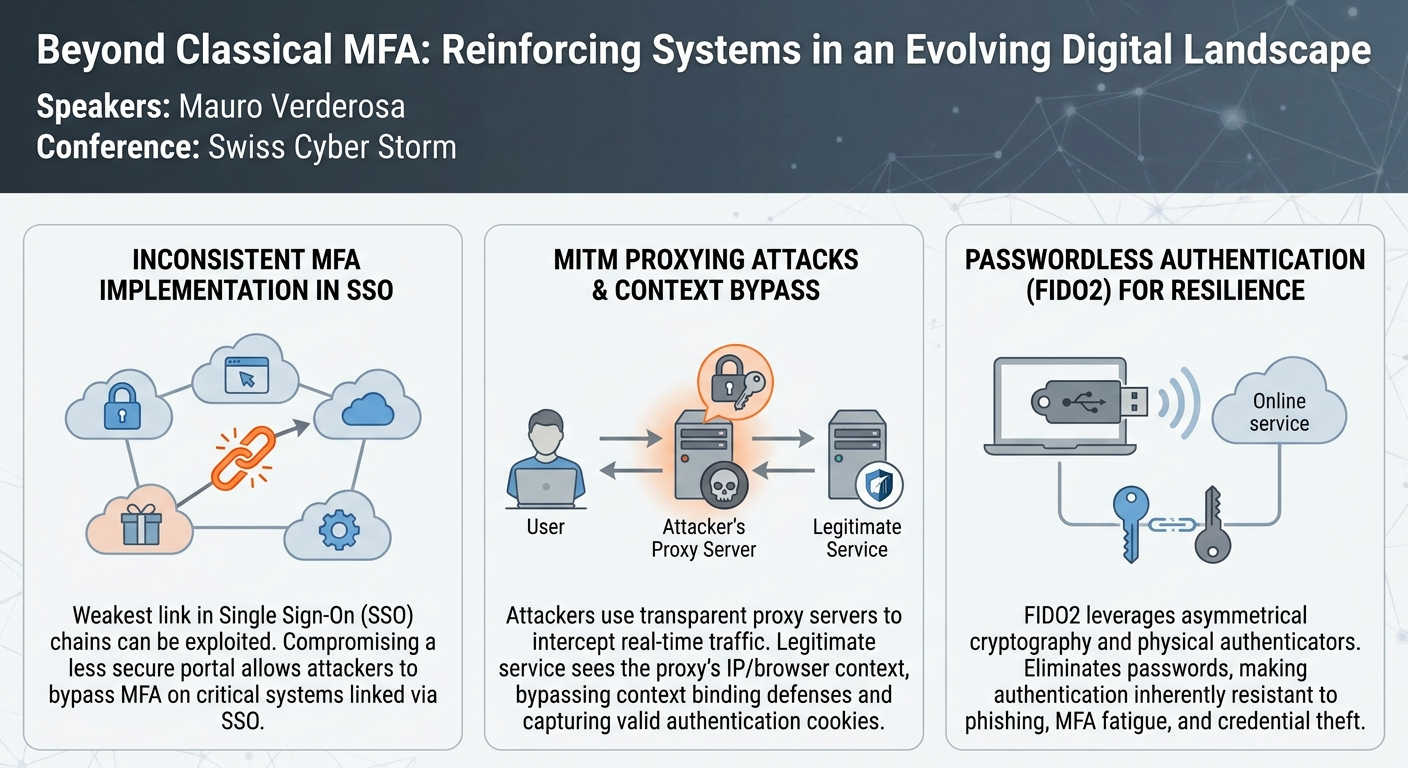
First, Verderosa demonstrated that inconsistent MFA implementation across an organization's various portals, especially when linked via Single Sign-On (SSO), creates critical weak points. An attacker can exploit a less secure portal within the SSO chain to bypass MFA on a more critical system, adhering to the "weakest link" principle. This highlights that security is only as strong as its most vulnerable component.
Second, logic errors in authentication flows can completely negate MFA's purpose. Verderosa illustrated how a lack of session continuity between password entry and OTP verification allows attackers to directly brute-force the OTP challenge, especially if the OTP is short (e.g., less than six digits). This finding emphasizes the need for meticulous session management throughout the entire authentication process.
Third, the concept of MFA fatigue was identified as a growing threat. Attackers leverage stolen credentials to repeatedly trigger push notifications on a user's device, hoping the user will eventually approve the malicious login out of annoyance, distraction, or while asleep. This psychological manipulation underlines the vulnerability of human decision-making in security.
Fourth, Verderosa detailed how cookie theft, particularly when authentication cookies lack context binding, enables attackers to hijack active sessions. By stealing and replaying a session cookie, attackers can bypass MFA entirely. The critical insight here is that binding session cookies to contextual information like the user's IP address or browser signature can mitigate this, but this defense itself has limitations against more advanced attacks.
Fifth, the talk showcased highly sophisticated Man-in-the-Middle (MITM) proxying attacks that render even context-bound cookies ineffective. In these scenarios, the attacker's server acts as a transparent proxy between the user and the legitimate service. The user authenticates against the real service, including MFA, but all traffic flows through the attacker. This allows the attacker to intercept and store valid authentication cookies, and crucially, because the attacker's server is the one communicating with the legitimate service, the IP address and browser signature match the attacker's context, making it impossible for the legitimate service to detect the compromise through context binding alone. This finding highlights the extreme sophistication of modern attacks targeting authentication.
Finally, Verderosa introduced passwordless authentication, specifically FIDO2, as a significant leap forward in addressing these vulnerabilities. FIDO2 leverages asymmetrical cryptography and physical authenticators, eliminating the need for passwords and making authentication resistant to phishing, MFA fatigue, and credential theft. By binding authentication to a physical token and cryptographic keys, FIDO2 substantially reduces the attack surface related to human factors and stolen credentials. However, he also acknowledged that FIDO2 is not without its own challenges, such as the physical theft or loss of the authenticator, and the ongoing need for user education and system integration.
Technical Deep Dive
▶ Watch: MFA Fatigue: A social engineering attack (10:00)
Verderosa systematically dissected several prevalent attack vectors against classical MFA, providing detailed technical explanations and outlining their mechanisms.
Inconsistent MFA Implementation and SSO Vulnerabilities
A common pitfall arises when organizations implement Single Sign-On (SSO) across various applications with differing security requirements. Verderosa illustrated a scenario where a company might have a highly secure portal protecting sensitive patient data, enforced with MFA, alongside a less critical portal (e.g., for Christmas card distribution) that might have weaker or no MFA. If these two portals are linked via SSO, an attacker who compromises the less secure portal can leverage the SSO token to gain unauthorized access to the highly protected system, bypassing its MFA requirements. This "weakest link" principle highlights that the overall security posture is dictated by the least secure component in the authentication chain. Security teams for critical data might be unaware of the security posture of marketing or HR applications, leading to these vulnerabilities.
Logic Errors in Authentication Flows
Another significant vulnerability stems from logic errors in how MFA challenges are handled. Verderosa described a typical web login process: a user enters credentials, which are validated, and then the user is redirected to a page requesting an OTP. A critical flaw occurs if the session state is not properly maintained or bound across these steps. If an attacker, having obtained the primary credentials (e.g., via phishing), can directly access the OTP verification page without a valid, pre-existing session token from the initial login, they can launch a brute-force attack against the OTP. This is particularly effective if the OTP is short (e.g., 4 digits), allowing it to be cracked in "a matter of seconds." The recommendation is to ensure robust session binding throughout the entire authentication process and to use OTPs of at least six, ideally eight, digits.
MFA Fatigue Attacks
This attack vector exploits human psychology. After an attacker obtains a user's primary credentials (e.g., through a successful phishing campaign), they attempt to log into the user's account. This triggers a push notification on the user's mobile device, prompting them to approve or deny the login. The attacker repeatedly sends these notifications—sometimes dozens—in the hope that the user, being distracted, annoyed, or even asleep (e.g., notifications in the middle of the night), will inadvertently click "approve." Once approved, the attacker gains full access. This attack demonstrates how MFA, without careful user education and context-aware approval mechanisms, can be turned against the user.
Cookie Theft and Context Binding
Verderosa detailed how attackers steal authentication cookies to bypass MFA. In one scenario, a user connects to a secure site, performs MFA, and a cookie is generated to maintain the session, preventing re-authentication on subsequent visits. An attacker, having compromised the user's browser (e.g., via malware from a phishing link), can steal this encrypted cookie. While encrypted, the attacker can use a local application (implied to be a tool that can decrypt browser-stored cookies, though not named explicitly) to decrypt the cookie. Once decrypted, the attacker can inject this cookie into their own browser, effectively hijacking the user's session and gaining authenticated access without needing to provide credentials or MFA.
The proposed mitigation for this is context binding. By embedding contextual information—such as the user's IP address and browser signature—into the cookie, the server can invalidate the cookie if the context changes (e.g., a different IP address or browser attempts to use it). This makes stolen cookies unusable for an attacker operating from a different machine or network.
Advanced Man-in-the-Middle (MITM) Proxying Attacks
Verderosa then presented a more sophisticated attack that circumvents context binding: MITM proxying. This attack typically involves:
- Attacker Setup: The attacker sets up a proxy server (e.g., an AWS EC2 instance) and a malicious DNS server.
- Phishing Campaign: The attacker sends a phishing email (e.g., "Amazon package waiting for you") containing a link to a domain controlled by their malicious DNS server.
- User Redirection: When the user clicks the link, their DNS query is resolved by the attacker's DNS server, directing them to the attacker's proxy server.
- Transparent Proxying: The attacker's proxy server then acts as an intermediary. When the user attempts to log into a legitimate service (e.g., Google, Microsoft), the proxy forwards the user's requests to the actual service. Crucially, the web page displayed to the user is not a replica but the real Google/Microsoft portal, served through the proxy.
- Credential and MFA Interception: The user performs their full authentication, including entering their password and completing MFA (e.g., approving a push notification or entering an OTP). All this information, including the authentication cookie returned by the legitimate service, passes through the attacker's proxy.
- Session Hijacking: The attacker intercepts and stores the valid authentication cookie. Because the proxy is the one directly communicating with the legitimate service, the IP address and browser signature presented to the service are those of the attacker's proxy. Therefore, if the legitimate service implements context binding, it will bind the cookie to the attacker's proxy's context. The attacker can then use this cookie from their proxy, effectively replicating the "user's" session, completely bypassing MFA and any context-based defenses. This makes the attack "really sophisticated" because the attacker's environment becomes the authenticated context from the server's perspective.
Passwordless Authentication with FIDO2
To counter these advanced threats, Verderosa advocated for passwordless authentication, specifically highlighting the FIDO2 protocol. The core concept is to eliminate passwords entirely and leverage asymmetrical cryptography (e.g., RSA, ECC curves).
How FIDO2 Works:
- Key Pair Generation: Instead of a password, an asymmetrical key pair (a private key and a public key) is generated. The private key is securely stored on a user's physical authenticator (e.g., a USB security key, a biometric reader integrated into a device), often protected by a PIN or biometric unlock. The public key is registered with the online service.
- Registration Process:
- The user initiates registration with a FIDO2-enabled server.
- The server sends a cryptographic challenge to the user's browser.
- The browser forwards this challenge to the physical FIDO2 authenticator.
- The authenticator generates a unique key pair for that service.
- It then uses its newly generated private key to sign (encrypt) the server's challenge.
- The authenticator sends the signed challenge along with its public key back to the server.
- The server uses the received public key to decrypt the challenge. If the decryption is successful and the challenge matches, the server verifies the authenticity of the authenticator and stores the public key.
- Login Process:
- When the user attempts to log in, the server sends a fresh cryptographic challenge.
- The user's browser forwards this challenge to the FIDO2 authenticator.
- The authenticator uses its stored private key to sign the challenge.
- The signed challenge is sent back to the server.
- The server uses the previously stored public key to verify the signature. If valid, authentication is granted.
Advantages of FIDO2:
- Phishing Resistance: Since no password is ever transmitted or stored, FIDO2 is inherently resistant to phishing and credential theft. The private key never leaves the authenticator.
- MFA Fatigue Immunity: Push notifications for approval are irrelevant as the authentication relies on a physical action with the authenticator.
- Strong Context Binding: The cryptographic keys are bound to a specific physical device, making session hijacking significantly harder.
- No Social Engineering: The only way to compromise a FIDO2 authentication is to physically steal the authenticator and know its PIN/biometric unlock.
While a powerful solution, FIDO2 isn't entirely foolproof. Verderosa noted that physical theft of the laptop or the FIDO2 token itself remains a risk, as does human unpredictability in losing devices. However, it represents a substantial shift towards more secure and resilient authentication.
Demo / Proof of Concept
▶ Watch: Introduction to Passwordless authentication (FIDO/FIDO2) (18:00)
While Mauro Verderosa's talk did not feature a live, real-time demonstration, he extensively detailed the practical mechanics of how several of the discussed attacks could be executed, effectively outlining proof-of-concept (PoC) methodologies. These descriptions provided a clear, step-by-step understanding of the technical implementation of each attack.
For the cookie theft attack (where context binding is absent), Verderosa explained how an attacker could compromise a browser, steal the encrypted authentication cookie, and then use "one simple command" with a locally installed "application" (whose name was not specified but implied to be a common tool for cookie manipulation or decryption) to decrypt it. Following decryption, the attacker would simply copy the cookie into their own browser to gain unauthorized access to the victim's session. This detailed explanation serves as a blueprint for a practical demonstration.
The Man-in-the-Middle (MITM) proxying attack was described with even greater technical specificity, illustrating how an attacker could set up the infrastructure required for such a sophisticated bypass. Verderosa detailed:
- Setting up the Proxy: An attacker would prepare a proxy application (e.g., using a few clicks on an AWS EC2 container). He explicitly stated this could be done even by someone with "no idea about Linux" or dependencies, suggesting user-friendly tools exist.
- DNS Configuration: The attacker would then set up a malicious DNS server, either on a second EC2 container or by leveraging free/trial online DNS services. This DNS server would resolve the target domain to the attacker's proxy IP.
- Phishing Campaign: A phishing email (e.g., "King of Nigeria lottery" or "Amazon package") would direct the victim to a link that, via the malicious DNS, points to the attacker's proxy.
- Transparent Interception: When the victim accesses the legitimate service (e.g., Microsoft Portal, Google Portal) through the proxy, the proxy acts as a transparent intermediary. The page displayed to the user is "not a simulation, a replica... This is the real Google that is just is using as proxy the server of the attacker."
- Credential and Cookie Capture: The user performs their full authentication, including MFA. The attacker's proxy intercepts the authentication request, forwards it to the real service, and upon receiving the legitimate authentication cookie, stores it in a database before passing it back to the user to maintain the illusion.
These descriptions were sufficiently granular to constitute a technical walkthrough of how these attacks would be performed in a real-world PoC, highlighting the specific tools and infrastructure involved without needing a live screen share.
Defensive Implications
▶ Watch: Limitations of FIDO and future challenges (22:00)
Mauro Verderosa's analysis of MFA vulnerabilities and advanced attacks provides critical insights for defenders seeking to reinforce their systems. The defensive implications extend beyond merely implementing MFA to adopting a more strategic, context-aware, and forward-looking approach to authentication.
- Prioritize Robust MFA Implementation: Beyond simply enabling MFA, organizations must ensure its correct and consistent implementation across all linked services, especially those involved in Single Sign-On (SSO). The security posture must be uniform, addressing the "weakest link" principle. This involves thorough security assessments of all integrated applications, not just the most critical ones.
- Strengthen Session Management: To counter logic errors and brute-force attacks against OTPs, it is crucial to maintain strong session continuity throughout the entire authentication process. This means binding sessions to initial login attempts, preventing direct access to OTP verification pages, and using sufficiently long OTPs (at least six to eight digits).
- Implement Context Binding for Sessions and Cookies: A fundamental defense against cookie theft is to bind authentication cookies and sessions to contextual information. This includes details like the user's IP address, browser signature, and potentially other device characteristics. If a session cookie is stolen and replayed from a different context, the server should invalidate it, forcing re-authentication. Verderosa explicitly suggested this precaution for "Every time you expose Services."
- Educate Users on MFA Fatigue and Phishing: Given the prevalence of MFA fatigue attacks, user awareness and training are paramount. Users must be educated not to blindly approve push notifications, especially when they haven't initiated a login. Training should emphasize vigilance against phishing attempts that precede these attacks, highlighting that attackers often strategically time these pushes (e.g., "in the middle of the night") to exploit user distraction or sleepiness.
- Adopt Passwordless Authentication (FIDO2) Strategically: Verderosa strongly advocated for the adoption of passwordless authentication, particularly FIDO2, as the most resilient defense against many modern threats. The journey to passwordless requires several strategic steps:
- Initial Analysis: Understand existing assets, system compatibility (e.g., legacy systems from the '80s running "super version of Java" might not be compatible), and the specific context of the company.
- Partner Engagement: Collaborate with experienced partners who can guide the implementation and integration process.
- Integration and Monitoring: Carefully integrate FIDO2 protocols and continuously monitor their performance and security.
- Address Pitfalls: Be prepared for challenges such as legacy system incompatibility, distributed teams, and user resistance. Verderosa emphasized the need for patience with users, acknowledging that changing ingrained authentication habits takes time.
- Acknowledge and Adapt to Evolving Threats: Defenders must recognize that the security landscape is constantly evolving. While FIDO2 offers significant improvements, no solution is entirely foolproof. Continuous monitoring, threat intelligence gathering, and a willingness to adapt new technologies are essential. The speaker candidly admitted that "some other Bad stuff Will Will appear in my opinion some Big incident etc but is a part part of the game so say It's a Natural Evolution and time will tell whether this Works or Not." This underscores the need for ongoing vigilance and a proactive security posture.
Key Takeaways
- MFA is Not a Silver Bullet: While essential, classical MFA is often an illusion of security. Its effectiveness is heavily dependent on robust implementation, consistent application across all connected services, and the context in which it operates.
- Human Factor Remains the Weakest Link: Attacks like MFA fatigue and pretexting exploit human psychology and lack of awareness, demonstrating that even with MFA, users can be manipulated into compromising their accounts.
- Sophisticated Attacks Bypass Traditional MFA: Attackers leverage advanced techniques such as inconsistent SSO implementations, logic errors in authentication flows, cookie theft without context binding, and highly advanced Man-in-the-Middle (MITM) proxying to circumvent MFA.
- Context Binding is Crucial, But Has Limitations: Binding session cookies to contextual data like IP address and browser signature is a vital defense against cookie theft, but it can be defeated by MITM proxying attacks where the attacker's server becomes the perceived legitimate context.
- Passwordless Authentication (FIDO2) Offers Superior Protection: FIDO2, leveraging asymmetrical cryptography and physical authenticators, significantly enhances security by eliminating passwords and making authentication inherently resistant to phishing, credential theft, and MFA fatigue.
- Strategic Implementation and User Education are Key: Adopting advanced authentication like FIDO2 requires careful planning, addressing legacy systems, engaging expert partners, and patiently educating users about new processes and persistent threats.
About the Speaker(s)
Mauro Verderosa is a highly experienced professional in the cybersecurity domain, with a career spanning over 20 years, primarily focused on identity and access management. He is recognized as an official training provider for (ISC)², a leading organization for information security certifications. Verderosa is the CEO of a cybersecurity company based in Geneva, Switzerland, which specializes in identity management solutions. Beyond his corporate role, he is deeply committed to fostering the cybersecurity community in Switzerland. He is the founder of the Swiss Cyber Security Association, which he states is one of the largest hubs for security experts in Switzerland. Additionally, Mauro Verderosa founded the Swiss Chapter for (ISC)², further demonstrating his dedication to advancing cybersecurity knowledge and professionalism within the region.
Reviews
Dr. Zero (Offensive Security Researcher) — WEAK
Verderosa spent an hour presenting Adversary-in-the-Middle attacks and push fatigue as if they were novel discoveries. FIDO2 is absolutely the right prescription for these issues, but we've known the diagnosis for years. If you need a conference talk to tell you that SMS OTPs and weak SSO integrations get popped, you're in the wrong room.
Heather Calloway (CISO) — SOLID
A competent, technically sound recap of why legacy MFA is failing and why FIDO2 is the required standard. Worth sharing with IT operations or junior architects, but it doesn't break new strategic ground for security leadership.