Cyber Resilience on the Swiss Financial Center – the Swiss FS-CSC
Alexandra Arni (Head of ICT and Executive Officer · Swiss Bankers Association, Swiss FS-CSC)
Swiss Cyber Storm 2023 · Day 1 · Scenario
Overview
In an era defined by escalating cyber threats, the financial sector stands as a prime target, necessitating robust and coordinated defense mechanisms. Alexandra Arni, Head of ICT at the Swiss Bankers Association and Executive Officer of the Swiss Financial Sector Cyber Security Center (Swiss FS-CSC), delivered a compelling presentation at Swiss Cyber Storm, detailing a groundbreaking initiative to fortify the cyber resilience of Switzerland's financial institutions. This talk illuminated the journey and operational framework of the Swiss FS-CSC, an organization established to bridge critical gaps in communication, information sharing, and collective defense against sophisticated cyber adversaries.
Key moments
- 1:30 Introducing Swiss FS-CSC and its goal
- 3:40 Why financial sector collaboration is essential for cyber defense
- 6:06 Founding of Swiss FS-CSC as a public-private partnership
- 12:00 Key benefits for Swiss FS-CSC members
- 14:40 Real-world DDoS attack coordinated response
- 18:00 Q&A: Technical information sharing and IOCs
- 24:00 Q&A: Cloud adoption challenges for financial institutions
- 26:00 Q&A: Lessons for other industries to build similar organizations
Cyber Resilience on the Swiss Financial Center – the Swiss FS-CSC
Speakers: Alexandra Arni, Head of ICT and Executive Officer, Swiss Bankers Association, Swiss FS-CSC
Conference: Swiss Cyber Storm
YouTube: https://www.youtube.com/watch?v=rD-XoY5eTS4
Overview
In an era defined by escalating cyber threats, the financial sector stands as a prime target, necessitating robust and coordinated defense mechanisms. Alexandra Arni, Head of ICT at the Swiss Bankers Association and Executive Officer of the Swiss Financial Sector Cyber Security Center (Swiss FS-CSC), delivered a compelling presentation at Swiss Cyber Storm, detailing a groundbreaking initiative to fortify the cyber resilience of Switzerland's financial institutions. This talk illuminated the journey and operational framework of the Swiss FS-CSC, an organization established to bridge critical gaps in communication, information sharing, and collective defense against sophisticated cyber adversaries.
The Swiss FS-CSC represents a pioneering model of public-private partnership, bringing together banks, insurance companies, government authorities, and other key stakeholders. Born from a recognition that individual institutions, regardless of size, can no longer effectively counter complex cyber risks in isolation, the center fosters a collaborative ecosystem for shared intelligence, coordinated response, and continuous improvement. Arni's presentation underscored the strategic imperative behind this collective approach, positioning the Swiss FS-CSC not just as a defensive bulwark for the financial sector but also as a potential blueprint for other industries grappling with similar cyber challenges.
This article delves into the intricacies of the Swiss FS-CSC, exploring its foundational principles, organizational structure, operational services, and tangible successes. It examines how this initiative, six years in the making before its full operational launch in 2022, has rapidly become a cornerstone of Switzerland's national cyber security strategy, significantly enhancing the collective ability of its financial center to withstand, detect, and recover from cyber incidents.
Background
▶ Watch: Introducing Swiss FS-CSC and its goal (1:30)
The financial sector's inherent attractiveness to cyber attackers stems from its "deep pockets" and the critical role it plays in national and global economies. As Arni highlighted, cyber risk has emerged as one of the most dangerous operational risks for financial institutions. The motivations behind these attacks are diverse, ranging from criminal intent to political or even military objectives. Compounding this vulnerability, the rapid digitalization of economies and the widespread adoption of remote work during the pandemic have significantly expanded the attack surface, leading to an elevated risk landscape and, consequently, increased regulatory scrutiny.
Historically, individual financial institutions have invested heavily in their own cyber defenses. However, the escalating sophistication and scale of modern cyber threats have rendered isolated solutions increasingly unrealistic. Banks and insurance companies, even large ones, face limitations in terms of specialized expertise and resources required to counter highly organized and persistent adversaries. The realization that cyber risk can only be effectively countered by combining the know-how of individual companies and collectively building new resources formed the genesis of the Swiss FS-CSC.
The journey towards the establishment of the Swiss FS-CSC began in 2016 with government recommendations to strengthen the cyber resilience of banks and insurance companies. This was followed in 2018 by the publication of Switzerland's National Strategy for the Protection of Switzerland against Cyber Risks, which advocated for the establishment of the National Cyber Security Centre (NCSC), a body that became operational in 2019. Concurrently, the Swiss Bankers Association adopted its own cyber security strategy, proposing key measures including the creation of a crisis coordination cell for the financial market and a platform for information exchange between financial institutions and the government. These dual strategic developments laid the groundwork for the comprehensive public-private partnership model that underpins the Swiss FS-CSC. The project formally kicked off in June 2020, led by the NCSC, and after two years of intensive work, the association was successfully founded in April 2022, marking a significant milestone in Switzerland's collective cyber defense capabilities.
Key Findings
▶ Watch: Founding of Swiss FS-CSC as a public-private partnership (6:06)
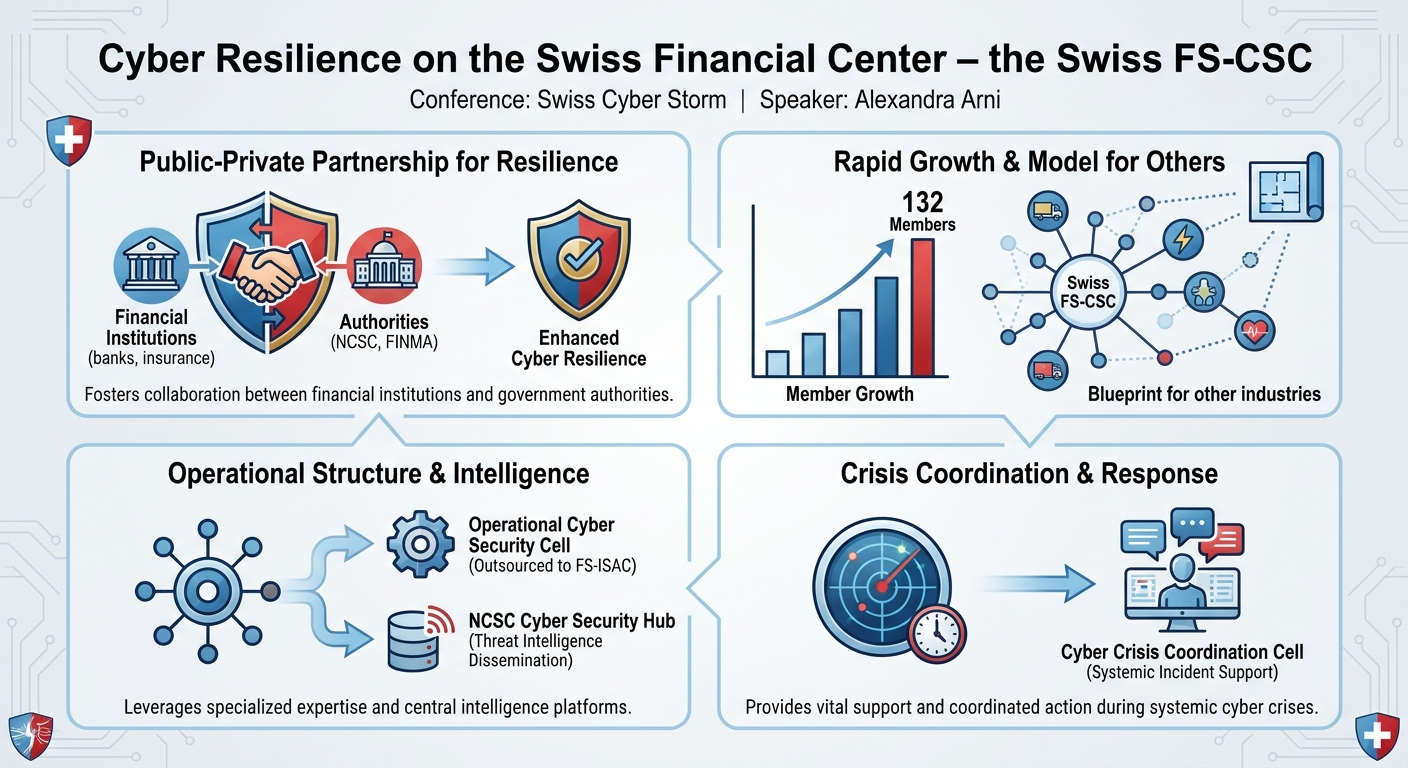
The Swiss FS-CSC has rapidly demonstrated its efficacy and critical importance to the Swiss financial sector. A primary indicator of its success is its remarkable growth, achieving 132 members within its first year, significantly surpassing its initial targets. This rapid adoption underscores the recognized need for such a collaborative platform among financial institutions. The association has received "excellent feedback from all sides and also from our members," affirming its value proposition and operational effectiveness. Critically, the Swiss FS-CSC is positioned as a potential role model for other industries and sectors of the economy, demonstrating the tangible benefits of a structured public-private partnership in enhancing national cyber resilience.
The core strength of the Swiss FS-CSC lies in its embodiment of a robust public-private partnership, built upon three essential elements:
- Use of Synergies among Financial Institutions: By pooling resources, expertise, and intelligence, members can leverage collective strength far beyond what individual entities could achieve. This includes sharing best practices and developing common defensive strategies.
- Cooperation with Each Other and with the Authorities: The center actively facilitates direct collaboration between financial institutions and key government bodies like the NCSC, FINMA (the Swiss Financial Market Supervisory Authority), and the State Secretariat for International Finance. This ensures a unified front against cyber threats, integrating strategic and operational responses across both public and private domains.
- Creation of a Digital Ecosystem: This refers to the establishment of platforms and processes for seamless information sharing in both crisis prevention and crisis management. Such an ecosystem is vital for timely threat intelligence dissemination, coordinated incident response, and continuous learning from collective experiences.
As articulated by Lucas Matter, a prominent figure in the Swiss cyber security landscape, the prevailing sentiment is that "the only way forward is cooperation or public private partnership." The Swiss FS-CSC stands as a testament to this principle, proving that a coordinated digital defense strategy, combining the expertise and resources of both authorities and the private sector, is indispensable in an increasingly interconnected global IT landscape.
Technical Deep Dive
▶ Watch: Real-world DDoS attack coordinated response (14:40)
The organizational architecture of the Swiss FS-CSC is designed for comprehensive cyber security management, encompassing governance, daily operations, strategic oversight, and expert collaboration. It consists of several key bodies:
- Association Board: Comprising four members, this body is responsible for the overall organizational and financial management of the Swiss FS-CSC.
- Business Office: This office handles the daily activities and operational coordination of the association, serving as the central hub for administrative and member support functions.
- Steering Board: This crucial body includes important stakeholders from both government and the financial sector. Its responsibilities span strategic decisions, oversight of the Operational Cyber Security Cell, and supervision of the Crisis Coordination Cell.
- Expert Group: A vital component, this group comprises over 70 experts drawn from member institutions. It is structured into seven specialized chapters, each addressing a distinct area of cyber security:
- Risk Management: Focuses on identifying, assessing, and mitigating cyber risks across the financial sector.
- Exercises and Training: Plans and organizes both operational and strategic cyber exercises, including a significant operational exercise planned for November in Zurich. It also develops other education and training opportunities for members.
- Regulation and Compliance: Addresses legal frameworks and regulatory requirements pertaining to cyber security in the financial market.
- Operational Excellence: Dedicated to fostering information sharing and disseminating threat intelligence among members, ensuring they gain insights into ongoing and future threats.
- Technology and Innovation: Explores emerging technologies and innovative solutions, with current discussions including topics such as Microsoft cloud security in the financial sector.
- Relationship Management and Organization Development: Focuses on enhancing internal and external relationships and ensuring the continuous evolution of the association's structure and services.
- Crisis Management Support: Directly supports the Crisis Coordination Cell, providing expert guidance and resources during systemic cyber incidents.
A critical operational function, the Operational Cyber Security Cell, has been strategically outsourced to FS-ISAC. FS-ISAC is an internationally experienced service provider in the cyber sector, known for its expertise in financial sector information sharing and analysis. This outsourcing arrangement leverages specialized capabilities and global threat intelligence.
Another cornerstone of the Swiss FS-CSC's operational model is its close collaboration with the NCSC, which operates the Cyber Security Hub. This hub serves as a central platform where FS-ISAC publishes comprehensive information on threats, prevention strategies, and indicators of compromise (IOCs). Members of the Swiss FS-CSC have direct access to this platform, enabling them to receive timely and actionable threat intelligence to decrease imminent and future risks. The NCSC's role is pivotal in facilitating this information exchange, embodying the public-private partnership at an operational level.
Membership in the Swiss FS-CSC is open to a broad range of entities critical to the financial ecosystem. This includes banks, insurance companies, security firms, and their associations. Key financial infrastructure providers like SIX and the Swiss National Bank are also included. Furthermore, government authorities such as the NCSC, FINMA, and the State Secretariat for International Finance are invited to cooperate as affiliates, ensuring alignment between regulatory bodies and industry players. Branches and subsidiaries of foreign financial institutions, as well as banks from Liechtenstein, are also eligible to join, broadening the collective defense perimeter.
The benefits for members are multi-faceted, designed to enhance individual and collective cyber resilience. Members gain access to a robust information exchange network, allowing them to share knowledge, best practices, and connect with experts and decision-makers from other financial institutions and government entities. The continuous flow of threat intelligence provides crucial insights into the evolving threat landscape. Perhaps most critically, members benefit from the Cyber Crisis Coordination Cell, which provides vital information and support specifically tailored to systemic crises. For proactive risk mitigation, members are offered a variety of exercises—operational and strategic—alongside other education and training opportunities, fostering a culture of preparedness and continuous improvement.
Demo / Proof of Concept
▶ Watch: Q&A: Technical information sharing and IOCs (18:00)
The efficacy of the Swiss FS-CSC's integrated public-private partnership model was tangibly demonstrated during a real-world incident on June 15th. On that day, a video speech by the Ukrainian president was scheduled to be delivered in the Swiss Parliament. From the early morning hours, a series of Distributed Denial of Service (DDoS) attacks were planned and executed against several financial institutions in Switzerland.
In response to this coordinated assault, the Swiss FS-CSC's Business Office and other relevant bodies immediately sprang into action. Their primary role was to ensure rapid alignment and coordination among the concerned financial institutions. Simultaneously, the NCSC took necessary steps on its end, leveraging its national cyber security mandate. This parallel and coordinated effort resulted in a swift, joint reaction from both the public and private sectors.
The collaborative response enabled the problem to be analyzed and effectively addressed within the same day. Fortunately, due to this rapid and synchronized intervention, the incident was contained and did not escalate into a systemic crisis for the entire financial sector. This event served as a powerful validation of the Swiss FS-CSC's operational model, showcasing the critical importance of a structured framework for information sharing, coordinated response, and mutual support between financial institutions and government authorities in mitigating large-scale cyber threats. The incident underscored the value of the Cyber Security Hub as a platform for disseminating real-time information, as detailed information regarding the DDoS attacks was quickly made available to members.
Defensive Implications
▶ Watch: Q&A: Lessons for other industries to build similar organizations (26:00)
The establishment and operational model of the Swiss FS-CSC offer profound defensive implications for its members and serve as a valuable lesson for other sectors. For financial institutions, membership translates into significantly increased cyber resilience for their own organizations, contributing directly to the reputation and stability of the entire Swiss financial sector. By actively participating, members are at the forefront of shaping the future of cyber security in Switzerland.
Defenders within member organizations benefit from several key mechanisms:
- Proactive Threat Intelligence: Access to the NCSC Cyber Security Hub and the intelligence shared by FS-ISAC ensures that members are continuously informed about ongoing and emerging threats. This allows them to implement preventative measures, such as patching vulnerabilities (e.g., as demonstrated by information shared regarding a recent "Microsoft key" vulnerability), before incidents can fully materialize.
- Coordinated Incident Response: The Cyber Crisis Coordination Cell provides essential support and guidance during systemic crises, ensuring that information flows efficiently and that responses are harmonized across the sector. This structured approach helps prevent panic and ensures that critical actions are taken in a timely manner.
- Enhanced Preparedness through Exercises: Regular operational and strategic cyber exercises allow institutions to test their response plans, identify weaknesses, and improve their readiness for future attacks. This continuous learning process is crucial for adapting to the evolving threat landscape.
- Knowledge and Best Practice Sharing: The Expert Groups, particularly the Operational Excellence chapter, foster an environment where experts can exchange knowledge, discuss best practices, and collectively address complex cyber security challenges. This peer-to-peer learning helps uplift the overall maturity level of all participating institutions, addressing the inherent variety in cyber security maturity across the sector.
The discussion around the adoption of Microsoft cloud for financial institutions also highlights a key defensive challenge and the FS-CSC's role in addressing it. While FINMA-regulated institutions have been cautious due to security and data protection concerns, the FS-CSC, through its Technology and Innovation chapter, actively supports and guides banks in their transition to the cloud, recognizing it as the future. This proactive engagement helps members navigate complex security considerations and regulatory hurdles.
Ultimately, the Swiss FS-CSC reinforces the notion that effective cyber defense in critical sectors requires a collective, intelligence-driven, and continuously evolving approach. The emphasis on prevention, information sharing, and coordinated action provides a robust framework for defenders to not only protect their individual organizations but also to contribute to the resilience of the entire financial ecosystem.
Key Takeaways
- The Swiss FS-CSC is a successful public-private partnership initiative, significantly enhancing cyber resilience within the Swiss financial sector by fostering collaboration between financial institutions and government authorities.
- Individual cyber defenses are insufficient against modern threats; collective effort, shared intelligence, and coordinated response are paramount for critical infrastructure sectors.
- The organization has rapidly grown to 132 members, serving as a successful model for other industries seeking to establish similar collective defense mechanisms.
- Key operational components include an Expert Group with seven specialized chapters, an Operational Cyber Security Cell outsourced to FS-ISAC, and leveraging the NCSC Cyber Security Hub for threat intelligence dissemination.
- The Cyber Crisis Coordination Cell and regular cyber exercises are vital for both preventing incidents and ensuring a coordinated, effective response during systemic crises.
- The success of such an initiative relies on a clear vision, a recognized need, strong leadership, and sustained support from both industry stakeholders and government bodies.
About the Speaker(s)
Alexandra Arni is a distinguished professional with over 20 years of experience at the Swiss Bankers Association, 15 of which have been dedicated to ICT and cyber security. As the Head of ICT at the Swiss Bankers Association and the Executive Officer of the Swiss Financial Sector Cyber Security Center (Swiss FS-CSC), she plays a pivotal role in shaping cyber resilience strategies for Switzerland's financial industry. Arni's academic background includes training as an information scientist and a Master's degree in Strategic Management with a focus on E-business management, complemented by specialized training in related topics. Her extensive expertise and leadership have been instrumental in the successful establishment and operation of the Swiss FS-CSC, driving its mission to strengthen cyber security across the Swiss financial center.
Reviews
Dr. Zero (Offensive Security Researcher) — WEAK
Arni spent an entire session explaining that Swiss banks finally figured out how to form an ISAC. It took them six years to set up a steering committee and outsource the actual operational intelligence to FS-ISAC. If you need a blueprint for bureaucratic org charts you will love this, but defenders won't find a single drop of actionable signal.
Heather Calloway (CISO) — SOLID
Alexandra Arni outlines the architecture and early wins of the Swiss FS-CSC, essentially Switzerland’s modern answer to the traditional financial ISAC. If you are operating a regulated financial entity in Europe, this is required context for how your incident response will interface with the state, but for everyone else, it’s a standard blueprint of how public-private cyber consortiums are structured.