Navigating The Coordinated Vulnerability Disclosure Landscape
Edwin Foudil (Security Researcher, Bug Bounty Hunter, Pentester)
Swiss Cyber Storm 2023 · Day 1 · Scenario
Overview
In the intricate and often chaotic realm of software security, vulnerabilities are an undeniable reality. Edwin Foudil, a seasoned security researcher, bug bounty hunter, and pentester, delivered a compelling talk at Swiss Cyber Storm, shedding light on the critical yet frequently mismanaged process of Coordinated Vulnerability Disclosure (CVD). Foudil's presentation, aptly framed with an animal theme to align with the conference's "human factor" motto, cuts through the complexity to offer actionable principles for both organizations and ethical hackers. He argues that while the ideal CVD process should resemble a "symphony" of collaboration, it often devolves into "absolute chaos," marked by lawsuits, hidden data breaches, and a fundamental lack of communication.
Key moments
- 2:00 Defining Coordinated Vulnerability Disclosure (CVD)
- 4:50 Hacker Archetypes: Dolphins and Beg Bounty Hunters
- 6:15 Principle 1: Implement security.txt for contact
- 9:00 Principle 2: Define a process for handling reports
- 16:00 Principle 4: Provide legal protection and Safe Harbors
- 18:50 Q&A: Differentiating legitimate vs. scam reports
- 23:45 Q&A: Future outlook for CVD and adoption
Navigating The Coordinated Vulnerability Disclosure Landscape
Speakers: Edwin Foudil, Security Researcher, Bug Bounty Hunter, Pentester
Conference: Swiss Cyber Storm
YouTube: https://www.youtube.com/watch?v=BcKLMOaV7dQ
Overview
In the intricate and often chaotic realm of software security, vulnerabilities are an undeniable reality. Edwin Foudil, a seasoned security researcher, bug bounty hunter, and pentester, delivered a compelling talk at Swiss Cyber Storm, shedding light on the critical yet frequently mismanaged process of Coordinated Vulnerability Disclosure (CVD). Foudil's presentation, aptly framed with an animal theme to align with the conference's "human factor" motto, cuts through the complexity to offer actionable principles for both organizations and ethical hackers. He argues that while the ideal CVD process should resemble a "symphony" of collaboration, it often devolves into "absolute chaos," marked by lawsuits, hidden data breaches, and a fundamental lack of communication.
This talk is not merely a theoretical exposition; it's a practical guide born from extensive experience in the bug bounty space. Foudil underscores the importance of a structured approach to CVD, recognizing that software vulnerabilities are not a sign of human error but an inherent consequence of the "complexity of all the ingredients" in modern codebases, with an average of one to 100 vulnerabilities per 2,000 lines of code. By outlining four core principles—establishing contact, defining a clear process, building hacker relationships, and providing legal protection—Foudil provides a roadmap for transforming the current turbulent landscape into a more secure and collaborative ecosystem. His insights are invaluable for any organization seeking to mature its security posture and for any ethical hacker navigating the challenges of responsible disclosure.
Background
▶ Watch: Defining Coordinated Vulnerability Disclosure (CVD) (2:00)
The pervasive presence of security vulnerabilities is an inescapable fact of the digital age. As Foudil starkly points out, even in relatively small codebases, the density of flaws can be alarming, with estimates suggesting between one and 100 vulnerabilities for every 2,000 lines of code. This isn't due to incompetence but rather the inherent complexity of modern software development, where myriad components, languages, and frameworks interact in unpredictable ways. Given this reality, the ability to effectively manage and remediate discovered vulnerabilities becomes paramount, leading to the necessity of Coordinated Vulnerability Disclosure (CVD).
CVD, often interchangeably referred to as bug bounty programs or responsible disclosure, is the process by which ethical hackers identify security weaknesses in a company's products or services and inform the affected organization, allowing them to fix the issue before it can be exploited maliciously. However, the current landscape is far from ideal. Foudil highlights a disturbing trend of "chaos," citing instances like hackers receiving lawsuits for their disclosures, companies attempting to protect data breaches by routing them through bug bounty programs (as famously seen with Uber in 2017), and even journalists being sued for covering previously disclosed vulnerabilities. This adversarial environment undermines trust and discourages ethical security research.
Despite these challenges, Foudil acknowledges the "shining bright lights" in the industry who are actively working to improve the CVD landscape. He specifically credits individuals like Dr. Mita Lazari, whose tireless efforts have led to the widespread adoption of legal safe harbors in bug bounty programs, offering crucial protection to researchers. Furthermore, a growing community of content creators—such as Live Overflow, NahamSec, and Insider PhD—are democratizing knowledge through free online resources, empowering more individuals to engage in ethical hacking and responsible reporting. Organizations like the Electronic Frontier Foundation (EFF) and the Open Source Security Foundation (OpenSSF) also play a vital role, providing essential guidance for companies looking to establish robust CVD programs. These collective efforts represent a concerted push towards a more structured, collaborative, and legally sound framework for vulnerability management.
Key Findings
▶ Watch: Principle 1: Implement security.txt for contact (6:15)
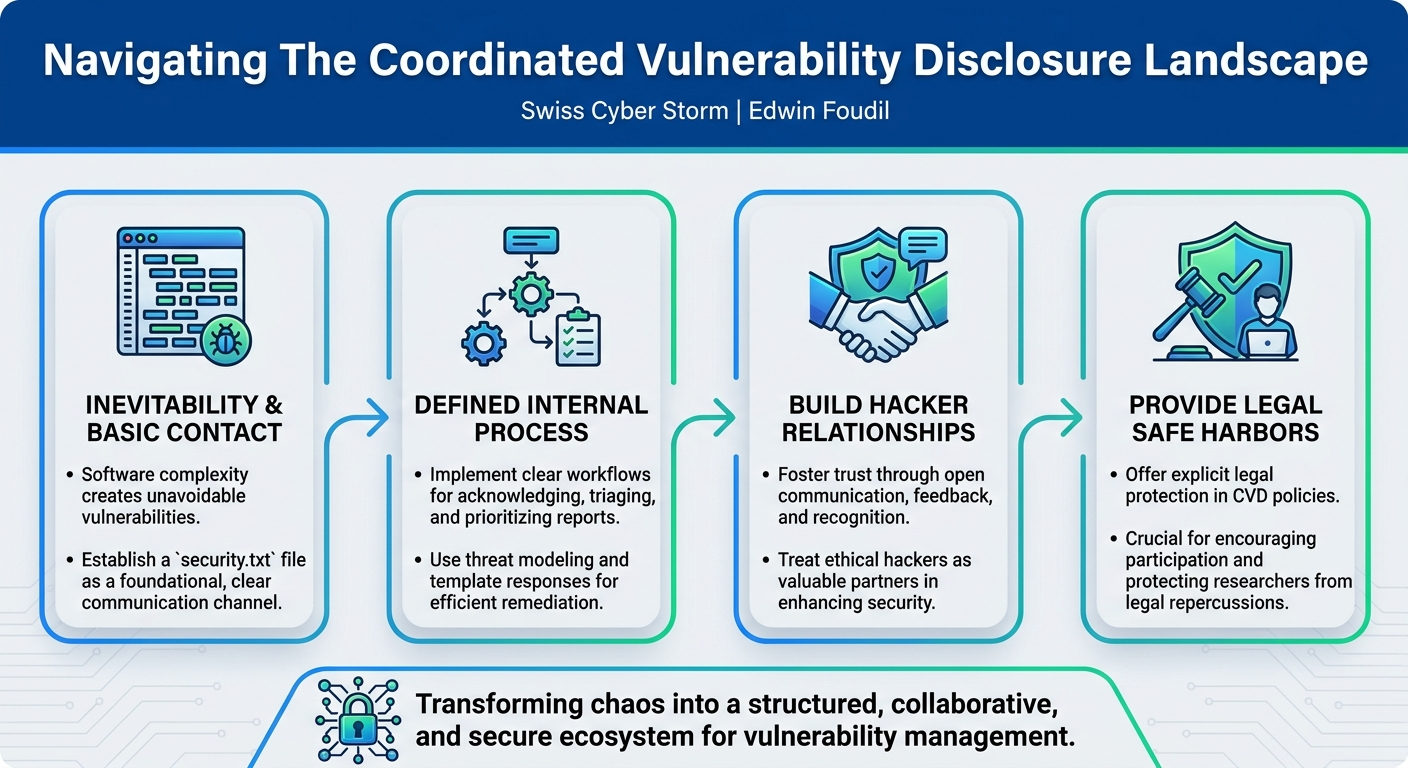
Edwin Foudil's talk distills the essence of effective Coordinated Vulnerability Disclosure into four fundamental principles, designed to foster a more collaborative and secure environment for both organizations and ethical hackers. These principles address the core challenges of communication, process, relationship management, and legal safety that plague the current CVD landscape.
Foudil introduces his principles with an insightful analogy, defining the ethical hacker through the story of Kelly the Dolphin. Trained to collect rubbish for fish, Kelly cleverly learns to rip single pieces of trash into smaller bits to maximize her reward. This, Foudil argues, perfectly encapsulates the hacker mindset: resourceful, innovative, and always looking for an angle, not necessarily for malicious intent but often to optimize their efforts within a given system. He also humorously introduces the "Beg Bounty Hunter" as a fluffy but fierce figure, acknowledging the challenges of dealing with less legitimate or low-quality reports.
The first and most foundational principle is to have a way to be contacted. Foudil emphasizes that the entire CVD process is stillborn if a company cannot be reached by a researcher who discovers a vulnerability. This seemingly simple requirement is often overlooked, creating unnecessary friction.
The second principle mandates that organizations define a process for actually handling the reports they receive. Beyond mere contact, there must be a clear, internal workflow for acknowledging, triaging, prioritizing, and remediating vulnerabilities. Without this, even well-intentioned contact can lead to bottlenecks and frustration.
Third, Foudil stresses the importance of building a strong relationship with your hackers. This goes beyond transactional interactions; it involves fostering trust, collaboration, and mutual respect. Ethical hackers, particularly those who consistently submit valid reports, should be seen as valuable partners rather than adversaries.
Finally, and perhaps most critically in today's legal climate, organizations must provide legal protection to researchers. The threat of legal repercussions can deter even the most ethical hackers, making a legal safe harbor an indispensable component of any credible CVD program. These four principles, when diligently implemented, transform CVD from a chaotic ordeal into a streamlined, effective mechanism for enhancing security.
Technical Deep Dive
▶ Watch: Principle 2: Define a process for handling reports (9:00)
The core of Foudil's actionable advice lies in the detailed implementation of his four principles, each backed by specific technical and procedural considerations.
1. Establishing a Point of Contact: The security.txt File
The most basic yet often neglected step in CVD is providing a clear channel for communication. Foudil champions the adoption of security.txt, a standardized text file placed in the /.well-known/ directory of a website (e.g., https://example.com/.well-known/security.txt). This file serves as a machine-readable and human-readable way for security researchers to find contact information for an organization's security team. Its simplicity is its strength; it can be as straightforward as contact: mailto:[email protected]. Foudil even conducts a live, 30-second exercise, encouraging the audience to write down their own contact: mailto: entry, demonstrating how effortlessly this foundational step can be implemented. He highlights its growing adoption, noting that even the Swiss government has started encouraging its use, with prominent Swiss firms like Swisscom already implementing it. Foudil playfully underscores its local relevance, revealing that the RFC for security.txt was actually written in Switzerland.
2. Defining a Robust Reporting Process
Once contact is established, a defined internal process is crucial. Foudil advises companies to invest in template responses for various scenarios—acknowledging receipt, confirming validity, requesting more information, or even rejecting invalid reports. This streamlines communication and ensures consistency, preventing the security team from wasting time on repetitive tasks.
A critical aspect of this process is vulnerability prioritization, which, as Foudil explains, necessitates thorough threat modeling. A Cross-Site Scripting (XSS) vulnerability, for instance, will have vastly different impacts on Company A versus Company B, depending on their assets, data, and user base. Effective threat modeling allows an organization to accurately assess the severity and potential impact of a reported vulnerability, guiding remediation efforts and resource allocation.
Foudil illustrates a well-executed triage process with a real-world example: a report he submitted to Keybase. The vulnerability was in a security-sensitive piece of functionality that validated a website hostname using a regular expression in JavaScript. The technical flaw stemmed from a common pitfall: JavaScript's regex engine requires two backslashes (\\) to escape a literal dot (.), whereas most other languages only require one. This meant that Keybase's regex, intended to match specific hostnames, inadvertently allowed . to match any character. Foudil's proof of concept demonstrated that an attacker could bypass the validation with a domain like totally not twitter.com, impacting a critical feature related to Twitter integration.
The Keybase response exemplified best practices:
- A "simple, short, straight to the point" initial acknowledgement.
- Direct linking to the pull request in their open-source codebase, allowing Foudil (as the hacker) to see the exact patch.
- A subsequent request for Foudil to confirm the fix, which he did, completing the disclosure cycle.
This example highlights a transparent, efficient, and collaborative remediation process, from initial report to verified fix.
3. Building Strong Hacker Relationships
Foudil advocates for moving beyond transactional interactions with hackers. Organizations should actively cultivate relationships with consistent, high-quality reporters, treating them as extensions of their security team. This can involve:
- Rewarding engagement: Not just financially, but through recognition and collaboration.
- Direct communication: Engaging in Zoom calls or meetings to discuss findings, patch cycles, and company strategy.
- Listening to feedback: Encouraging hackers to provide input on the program itself, not just the vulnerabilities. This iterative feedback loop helps programs mature.
- Providing feedback to hackers: Helping them improve their reporting quality and understanding of the system.
This rapport fosters loyalty and encourages continued, high-quality contributions. Foudil acknowledges the challenge of differentiating between legitimate and "beg bounty" reports. While prioritizing known, reputable hackers (like Tavis Ormandy or Frans Rosén) can streamline triage, he also recognizes the potential to disadvantage new talent. His suggested mitigation includes using email rules and keyword matching to filter obvious spam, allowing human analysts to focus on substantive reports, regardless of the reporter's reputation.
4. Providing Legal Protection: Legal Safe Harbors
The final and "most important" principle is the provision of legal protection for ethical hackers. Foudil stresses that, in today's environment, a legal safe harbor is no longer optional but a necessity. He credits Dr. Mita Lazari for her global advocacy in making these protections commonplace. A safe harbor clause in a CVD policy explicitly states that the company will not pursue legal action against researchers who adhere to the program's rules, even if their actions might technically violate terms of service or anti-hacking statutes. This significantly lowers the barrier to participation for ethical hackers, who might otherwise fear legal repercussions. Foudil, while emphasizing he's "not a lawyer," strongly advises companies to consult legal experts to draft robust safe harbor provisions, acknowledging it's a critical starting point in building trust and ensuring a "healthy working environment" for researchers.
Demo / Proof of Concept
▶ Watch: Q&A: Differentiating legitimate vs. scam reports (18:50)
While the talk did not feature a live, interactive demonstration of a new exploit, Edwin Foudil provided a highly detailed and illustrative proof of concept walkthrough using a real-world vulnerability he had previously discovered and disclosed to Keybase. This served as an effective case study, showcasing both the technical nature of a critical flaw and the ideal Coordinated Vulnerability Disclosure (CVD) process.
The vulnerability centered on a hostname validation flaw within a security-sensitive component of Keybase's platform. This component relied on a regular expression implemented in JavaScript to verify the legitimacy of hostnames. The critical technical detail lay in the subtle but significant difference in how JavaScript's regex engine handles the . (dot) character compared to many other programming languages. In most contexts, . is escaped with a single backslash (\.) to match a literal dot. However, JavaScript's regex requires two backslashes (\\.) for this purpose.
Keybase's implementation, likely following a common pattern from other languages, used a single backslash. This oversight meant that . was interpreted as a wildcard matching any character, rather than a literal dot. Foudil's proof of concept demonstrated that an attacker could craft a malicious hostname, such as totally not twitter.com, which would bypass the intended validation. Because this functionality was tied to sensitive operations related to Twitter integration, this seemingly minor regex error constituted a critical flaw. The demonstration highlighted how seemingly small technical details, when misunderstood or incorrectly implemented, can lead to significant security vulnerabilities. The subsequent description of Keybase's response, including linking directly to the pull request for the fix, further reinforced the concept of a transparent and effective disclosure process, illustrating how a vulnerability moves from discovery to verified remediation.
Defensive Implications
▶ Watch: Q&A: Future outlook for CVD and adoption (23:45)
Edwin Foudil's insights offer a clear roadmap for organizations to bolster their defensive posture through effective Coordinated Vulnerability Disclosure (CVD). The implications span technical implementation, process refinement, and strategic relationship management.
- Implement
security.txtas a Baseline: The most immediate and universally applicable defensive action is to establish asecurity.txtfile at/.well-known/security.txton all public-facing web properties. This simple text file is the absolute minimum requirement for enabling ethical hackers to contact an organization's security team. Its adoption is frictionless, and its absence signals a lack of readiness to engage with the security research community. Organizations should ensure this file contains clear contact information, such as amailto:address, and keep it updated.
- Develop a Defined and Documented CVD Process: Beyond merely receiving reports, organizations must have a clear, written, and understood internal process for handling them. This includes:
- Templatized Responses: Prepare standardized templates for acknowledging receipt, requesting more information, confirming validity, and communicating resolution or rejection. This ensures consistent, efficient, and professional communication, saving valuable time for security teams.
- Robust Threat Modeling: Prioritization of vulnerabilities cannot be arbitrary. Organizations must invest in comprehensive threat modeling across their services to accurately assess the impact and severity of reported issues. An XSS on a public blog comment section has a different impact than an XSS on an authenticated financial portal. This allows for intelligent resource allocation and rapid remediation of critical flaws.
- Efficient Triage: Implement systems (which could be as simple as email rules or dedicated platforms) to quickly triage incoming reports, differentiating legitimate findings from spam or "beg bounty" attempts. Keywords and patterns can help filter low-quality submissions, allowing security teams to focus on actionable intelligence.
- Cultivate Strong Relationships with Ethical Hackers: Defenders should view ethical hackers not as adversaries but as an extension of their security team. This implies:
- Collaboration and Feedback: Engage with researchers, especially those who consistently provide high-quality reports. Offer feedback on their submissions and, importantly, be open to their feedback on the CVD program itself. This iterative improvement fosters a strong, mutually beneficial relationship.
- Recognition and Incentivization: While not explicitly a "bug bounty" talk, Foudil's principles align with recognizing and rewarding valuable contributions. This can involve public acknowledgement, private communications, or even direct collaboration on patch development, as seen in the Keybase example.
- Transparency: Where feasible, provide visibility into the remediation process, such as linking to public pull requests or explaining the steps taken to fix an issue. This builds trust and assures researchers their efforts are impactful.
- Establish Clear Legal Safe Harbors: This is paramount for attracting and retaining ethical security researchers. Organizations must consult legal counsel to implement a legal safe harbor clause in their CVD policy. This clause explicitly states that the company will not pursue legal action against researchers who adhere to the program's rules while conducting their testing. Without this protection, many ethical hackers will simply avoid engaging with the organization, leaving critical vulnerabilities undiscovered by legitimate means.
- Educate Internal Stakeholders: The CVD process is not solely the responsibility of the security team. Developers, product managers, and legal teams must understand their roles and responsibilities within the disclosure process. This ensures smooth internal coordination and rapid response to reported vulnerabilities.
By embracing these defensive implications, organizations can transform the "chaos" of vulnerability management into a structured, collaborative, and ultimately more secure environment.
Key Takeaways
- Vulnerabilities are Inevitable: Software complexity ensures vulnerabilities are a constant reality (1-100 per 2,000 lines of code), necessitating a robust Coordinated Vulnerability Disclosure (CVD) process.
security.txtis Foundational: Every organization must establish asecurity.txtfile in the/.well-known/directory to provide a clear, simple point of contact for ethical hackers.- Defined Processes are Crucial: Implement clear internal procedures for acknowledging, triaging, and prioritizing vulnerability reports, leveraging template responses and comprehensive threat modeling to ensure efficient remediation.
- Build Hacker Relationships: Foster trust and collaboration with ethical hackers through open communication, feedback, and recognition, treating them as valuable partners in enhancing security.
- Legal Protection is Essential: Provide legal safe harbors in CVD policies to protect ethical hackers from legal repercussions, a critical factor for encouraging participation and high-quality disclosures, championed by figures like Dr. Mita Lazari.
- Learn from Real-World Examples: The Keybase vulnerability, illustrating a JavaScript regex flaw and a transparent disclosure process, serves as a model for effective technical communication and remediation within CVD.
About the Speaker(s)
Edwin Foudil is an accomplished professional in the cybersecurity field, recognized for his expertise as a Security Researcher, Bug Bounty Hunter, and Pentester. He has accumulated extensive experience within the bug bounty space, having managed various programs and contributed significantly to the industry. Foudil describes himself as someone who "very rarely get[s] out of my little black dungeon back at home," humorously acknowledging that he is "definitely not a professional speaker" despite his engaging presentation style. Online, he is known for using a frog as his profile picture, a detail he highlighted to playfully introduce the animal theme of his talk.
Reviews
Dr. Zero (Offensive Security Researcher) — SOLID
Foudil delivers the exact same Coordinated Vulnerability Disclosure talk we've all been sitting through since 2017. It is fundamentally correct advice about legal safe harbors and basic report routing, but it remains pure Bug Bounty 101.
Heather Calloway (CISO) — SOLID
This is a straightforward, competent briefing on establishing a Coordinated Vulnerability Disclosure (CVD) program. If your organization still lacks a security.txt file or a legal safe harbor for researchers, this is a necessary baseline, though mature security programs will find it to be mostly table stakes.