Making sense of data dumps and data leaks in times of war and peace
Stefan Soesanto (Senior Researcher · Center for Security Studies at ETH Zurich)
Swiss Cyber Storm 2023 · Day 1 · Arena
Overview
In an era of increasingly unstable geopolitics, the landscape of information warfare has undergone a profound transformation, particularly evident in ongoing conflicts like the war in Ukraine and the Israel-Hamas conflict. Stefan Soesanto, a Senior Researcher at the Center for Security Studies at ETH Zurich, presented a critical analysis of data dumps and data leaks, arguing that traditional distinctions between these terms are dissolving, especially in wartime. His talk highlighted the overwhelming volume of data being released, the challenges analysts face in discerning its veracity and value, and the severe real-world implications, including the weaponization of personal information.
Key moments
- 0:00 Introduction and problem of overwhelming data dumps
- 6:00 Distinguishing data dumps from data leaks
- 12:40 Practical shortcuts for analyzing wartime data dumps
- 16:00 Case study: Kiber Sportif's Babakov leaks and Swiss connection
- 20:30 Myrotvorets website: kill list and real-world assassinations
- 24:50 Ethical questions: targeting military spouses and children
- 26:50 Q&A: Dissolution of rules in cyber warfare
Making sense of data dumps and data leaks in times of war and peace
Speakers: Stefan Soesanto, Senior Researcher, Center for Security Studies at ETH Zurich
Conference: Swiss Cyber Storm
YouTube: https://www.youtube.com/watch?v=cjdecgHbofo
Overview
In an era of increasingly unstable geopolitics, the landscape of information warfare has undergone a profound transformation, particularly evident in ongoing conflicts like the war in Ukraine and the Israel-Hamas conflict. Stefan Soesanto, a Senior Researcher at the Center for Security Studies at ETH Zurich, presented a critical analysis of data dumps and data leaks, arguing that traditional distinctions between these terms are dissolving, especially in wartime. His talk highlighted the overwhelming volume of data being released, the challenges analysts face in discerning its veracity and value, and the severe real-world implications, including the weaponization of personal information.
Soesanto's research delves into the emergent ecosystems of threat actors, ranging from politically motivated activists to sophisticated state-coordinated hacking groups and opportunistic "war grifters." He introduced practical "shortcuts" for assessing the relevance and legitimacy of leaked data, emphasizing the critical need for contextualization. A central focus of his presentation was the Ukrainian group Kiber Sportif, which he posits as a likely state-coordinated entity, demonstrating how data exfiltration can feed into a complex nexus of intelligence operations, public information campaigns, and even "kill lists" like Myrotvorets. The talk concluded with a stark examination of the ethical and legal vacuum surrounding the targeting of non-combatant personal data in cyberspace, urging for a re-evaluation of defensive strategies and international norms in this new, highly personalized form of warfare.
Background
▶ Watch: Introduction and problem of overwhelming data dumps (0:00)
The genesis of this research stems from the early days of the war in Ukraine, where an unprecedented volume of data—terabytes of information purportedly from Russian, Ukrainian, and even European entities—was indiscriminately dumped into the public domain. Journalists, academics, and analysts found themselves swamped, unable to process, verify, or even prioritize the deluge of information. This problem is not confined to Ukraine; similar dynamics are already emerging in the Israel-Hamas conflict, with both verified and fabricated data dumps appearing on platforms like Telegram. The sheer scale and lack of actionable intelligence within these dumps underscored a critical gap in understanding and analysis.
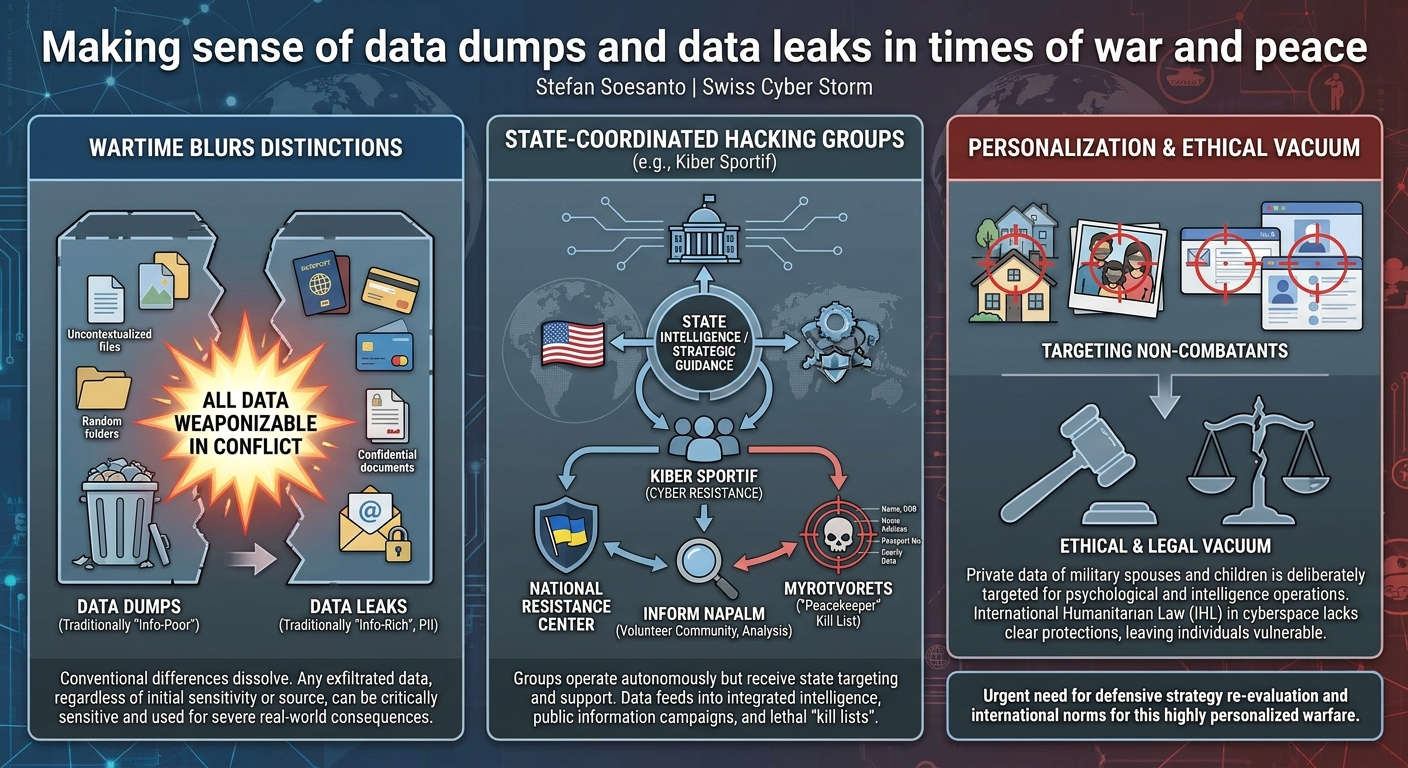
Traditionally, data dumps and data leaks have distinct definitions. A data dump typically refers to a large volume of data transferred from one system to another, often considered "information poor" due to its random, uncontextualized nature (e.g., internal business files). Its dissemination is usually broad, with little specificity on origin or purpose, often initiated by activist or hacking groups. In contrast, a data leak involves the unknowing exposure of sensitive data, generally "information rich" (e.g., PII, financial data). Leaks are often released via trusted intermediaries like journalists, with clear context regarding their origin, content, exfiltration method, and intended audience (e.g., the Snowden leaks). In peacetime, these categories often converge or diverge based on their relevancy, which is determined by an ecosystem of journalists, researchers, and public interest.
However, Soesanto argues that this traditional distinction largely collapses in wartime. The established ecosystem of information analysis is disrupted by the emergence of new, often unpredictable, actors and dynamics. Old activist groups resurface, and entirely new entities appear, making virtually any data a potential target. These wartime ecosystems exhibit unique internal dynamics and can be broadly categorized into two types: the "old-school activism" that now includes opportunistic war grifters (e.g., New Anonymous), who jump from conflict to conflict chasing headlines, and a more complex spectrum of state-involved groups, ranging from "state-encouraged" to "state-controlled." The attribution challenge for these state-linked entities is significant, blurring the lines of responsibility. Furthermore, the sheer volume means few in the industry possess the time or resources to investigate every dump or leak, leading to a vast amount of potentially sensitive information going unexamined. In a conflict zone, where any piece of information, even seemingly innocuous data, can be weaponized, the lack of clear investigative pathways and the breakdown of traditional definitions pose severe risks.
Key Findings
▶ Watch: Practical shortcuts for analyzing wartime data dumps (12:40)
Soesanto's research highlights several critical findings regarding the nature and analysis of data dumps and leaks in wartime:
- Dissolution of Traditional Distinctions: The primary finding is that the conventional differences between data dumps and data leaks become largely irrelevant in wartime. Any piece of data, regardless of its initial perceived sensitivity or the manner of its release, can contain critically important information that can be weaponized or have severe real-world consequences, such as endangering individuals.
- Emergence of New Analytical Shortcuts: To navigate the overwhelming volume and complexity of wartime data releases, Soesanto proposes several "shortcuts" for rapid assessment of a dump's potential value and legitimacy:
- Hosting Choices: The infrastructure used to host data can be indicative. Russian groups tend to use Russian providers, while Ukrainian groups show more variety but can sometimes be tied to specific providers.
- Data Availability: The presence of mirror links or re-uploads signifies the group's commitment to the data's dissemination. If a dump is quickly removed and never re-uploaded, its perceived value to the perpetrators was likely low, suggesting it might be less significant.
- Language Skills: Many groups, particularly non-Russian-speaking ones, dump vast amounts of Russian-language data without the capacity to fully analyze it. This indicates a "spray and pray" approach, where the group itself doesn't know the full content or value of what they've exfiltrated.
- Size vs. Value: There is often an inverse relationship between the size of a data dump and the value of its contained information. Smaller, more targeted dumps frequently yield more valuable intelligence, whereas massive dumps (like those hosted by DDoS Secrets) are often "information poor" and difficult to sift through.
- Origin Details: The more specific and detailed the information provided about the data's origin, how it was exfiltrated, and its context, the higher the likelihood of its legitimacy and significance.
- Group History: Understanding the history and modus operandi of the releasing group provides crucial context for evaluating their claims and the data's credibility.
- Rise of State-Coordinated Hacking Groups: The talk identifies a new category of threat actor: state-coordinated hacking groups. These groups, exemplified by Kiber Sportif (also known as Cyber Resistance), operate with a degree of autonomy but receive strategic guidance or targeting information from state intelligence services. Their operations are integrated into broader state-level information warfare and intelligence-gathering efforts.
- Weaponization of Personal Data and Ethical Vacuum: A profound finding is the "personalization" of information warfare, where private data of non-combatants—specifically military spouses and children—is deliberately targeted, exfiltrated, and used for intelligence or psychological operations. The case of Victor Neshchu's family highlights this. This practice falls into an ethical and legal void, as current International Humanitarian Law (IHL) in cyberspace does not explicitly address the protection of such data, leaving individuals vulnerable and challenging established norms of conduct in conflict. This raises critical questions for countries like Switzerland with its militia system, where many citizens have military ties.
Technical Deep Dive
▶ Watch: Case study: Kiber Sportif's Babakov leaks and Swiss connection (16:00)
The technical deep dive of Soesanto's talk focuses on the intricate ecosystem surrounding data dumps and leaks in wartime, particularly highlighting the evolution of actor methodologies and the specific case of the Ukrainian group Kiber Sportif.
In the context of the Ukraine War, several actor types emerged. On the Russian side, groups like Nesa, also known as Project Nemesis, are suspected of being closely related to Russian military intelligence. Their dumps often contain information with a clear intelligence value, distinguishing them from purely open-source releases. On the other hand, groups like New Anonymous are characterized as war grifters, opportunistic actors who breach any accessible database, website, or FTP server, dumping terabytes of data without necessarily understanding its content. Their motivation appears to be primarily attention-seeking, moving from conflict to conflict (e.g., Ukraine, Sudan, Israel-Hamas). Entities like DDoS Secrets played a significant role by hosting these massive data dumps on torrents, essentially providing a dissemination vector for groups like New Anonymous, despite acknowledging they lacked the resources to properly vet the content for PII or other sensitive information. This created a massive, uncurated repository of potentially dangerous data.
Soesanto then introduced Kiber Sportif, a Ukrainian group also known as Cyber Resistance, which emerged approximately one year into the full-scale invasion, on February 24, 2023. This group self-identifies as a team of activists that has cooperated with Ukrainian law enforcement since 2014, though this history cannot be independently verified. What makes Kiber Sportif unique is its highly specialized modus operandi: they focus on breaching the private email accounts of Russian military officers, their spouses, and other "Persons of Interest" (e.g., judges, athletes, military bloggers). The rationale is that these private accounts often contain a wealth of valuable, unclassified intelligence.
Kiber Sportif's operational model involves a multi-stage dissemination process:
- Intelligence First Pick: The exfiltrated data is first provided to the Ukrainian intelligence service. Kiber Sportif openly states this special relationship, indicating a direct link to state operations.
- Ecosystem Dissemination: After the intelligence service has extracted any operational value, the data is then disseminated through a specific ecosystem of interconnected entities:
- National Resistance Center: This entity was established by Ukrainian law and is run by the Ukrainian Special Operations Forces. Its mission is to organize resistance across all domains (online, offline, partisan groups). Kiber Sportif's logo is prominently displayed on the National Resistance Center's website, suggesting a close alignment or coordination.
- Inform Napalm: An international volunteer community with deep ties to both activist networks and state actors. They translate their findings into multiple languages and are considered a key resource for tracking the Ukraine conflict. Like the National Resistance Center, Inform Napalm features Kiber Sportif's logo and uses their leaked data in their reporting.
- Myrotvorets (Peacekeeper): This is perhaps the most controversial component of the ecosystem. Supported by the Ukrainian Ministry of the Interior, Myrotvorets is an extensive "kill list" that identifies "enemies of Ukraine." It includes Russian military personnel, intelligence officers, private individuals, and even children (as young as six years old), complete with passport numbers, birthdates, and home addresses. Myrotvorets is actively used by Ukrainian border guards to vet individuals entering the country. Alarmingly, individuals listed on Myrotvorets have been assassinated, making it a platform with direct, lethal consequences. All data exfiltrated by Kiber Sportif concerning listed individuals is funneled into Myrotvorets.
This integrated approach leads Soesanto to strongly suspect that Kiber Sportif is not merely an independent activist group but rather a state-coordinated hacking group. Their receipt of targets, likely from Ukrainian intelligence, and their special relationship with Ukrainian Special Operations Forces, as well as the seamless integration into the state-backed Myrotvorets platform, point to a level of coordination far beyond typical hacktivism.
A compelling case illustrating Kiber Sportif's targeting strategy involves Victor Neshchu, identified as the head of the Russian military intelligence service's Fancy Bear operation, responsible for interfering in the US presidential election. While the FBI's wanted poster for the 12 individuals included only 11 pictures, Neshchu's image remained unrevealed. Kiber Sportif successfully breached the private email account of Neshchu's wife, obtaining and subsequently publishing the first known public picture of Victor Neshchu, along with images of his wife and son, Daniel. This act, framed by Kiber Sportif as "going where the FBI didn't dare," highlights the group's willingness to target non-combatant family members for intelligence and psychological impact, raising significant questions about the applicability of International Humanitarian Law (IHL) in cyberspace, especially concerning the protection of civilians and their private data.
Demo / Proof of Concept
▶ Watch: Ethical questions: targeting military spouses and children (24:50)
While the talk did not feature a live technical demonstration or a traditional proof of concept involving code execution or system exploitation, Stefan Soesanto effectively demonstrated the concepts and findings through detailed explanations, real-world examples, and visual evidence. He presented screenshots of various websites and online discussions, including:
- Examples of data dumps being posted on forums related to the Israel-Hamas conflict, highlighting both fake and verified data.
- Screenshots of Twitter (now X) discussions around the Nestlé data breach, illustrating how data from Kelvin Security was misattributed to Anonymous.
- Images from the website of the National Resistance Center and Inform Napalm, visually confirming the prominent display of the Kiber Sportif logo, thereby illustrating the close association between these entities.
- A screenshot of the Myrotvorets website, demonstrating its "kill list" interface and the type of personal information it publishes.
- The FBI's wanted poster for Russian intelligence officers, juxtaposed with the image of Victor Neshchu (and his family) released by Kiber Sportif, to underscore the group's unique targeting and impact.
These visual aids and case studies served as compelling "proofs of concept" for the talk's core arguments regarding the evolving nature of information warfare, the interconnectedness of state and non-state actors, and the real-world implications of data dumps and leaks.
Defensive Implications
▶ Watch: Q&A: Dissolution of rules in cyber warfare (26:50)
The insights from Stefan Soesanto's talk carry profound defensive implications for individuals, organizations, and policymakers, particularly in an increasingly volatile global environment.
For individuals, especially those with any connection to military, government, or critical infrastructure roles (including reservists in militia systems like Switzerland's), the most critical implication is the personalization of information warfare. Private email accounts, social media profiles, and even the digital footprint of family members (spouses, children) are now legitimate targets for intelligence gathering and psychological operations. Individuals must practice stringent operational security (OPSEC), assuming that any personal data shared online or stored in private accounts could be exfiltrated and weaponized. This includes strong, unique passwords, multi-factor authentication, avoiding oversharing personal details, and being acutely aware of phishing attempts targeting not just themselves but also their closest contacts.
For organizations, the traditional cost-benefit analysis of investigating data breaches needs to be re-evaluated. In wartime, even seemingly "information poor" data dumps can contain critical intelligence when combined with other sources. Organizations must:
- Enhance Data Categorization and Understanding: Develop robust internal frameworks to categorize and assess the sensitivity of all data, not just what's traditionally considered PII or financial data. Assume that any exfiltrated data could be sensitive in a conflict context.
- Monitor the Threat Landscape: Stay abreast of the evolving tactics of both state-sponsored groups and war grifters. Understanding the hosting choices, data availability patterns, and language capabilities of threat actors can provide early indicators of legitimate threats versus noise.
- Protect Personnel and Families: Implement proactive measures to educate employees about the risks to their personal data and that of their families, especially for those in sensitive roles. This might include providing resources for personal cyber hygiene or offering secure communication channels.
- Review Incident Response Plans: Ensure incident response plans account for scenarios where exfiltrated data might be used for psychological operations, public shaming, or to endanger individuals, requiring coordination with HR, legal, and public relations teams.
- Strengthen Supply Chain Security: Data dumps often reveal internal communications or vendor relationships. Organizations must enhance security across their supply chain, as a breach in a seemingly innocuous partner could lead to the exfiltration of sensitive internal data.
For policymakers and international law bodies, the talk highlights a severe regulatory and ethical vacuum. The targeting of non-combatant personal data, particularly that of military spouses and children, directly challenges the spirit, if not the letter, of International Humanitarian Law (IHL). Urgent actions are needed:
- Develop Norms for Cyberspace: There is an immediate need to establish clear, internationally agreed-upon norms and rules of engagement for information warfare, specifically addressing the protection of civilian data in conflict. The current lack of consensus allows actors to operate without constraint.
- Re-evaluate IHL Applicability: International legal experts must actively engage with the realities of modern cyber warfare to determine how existing IHL principles can be adapted or expanded to protect individuals caught in the crossfire of data breaches.
- Address State-Coordinated Groups: The rise of groups like Kiber Sportif blurs the lines of attribution and accountability. Policymakers must develop frameworks to address the actions of such state-coordinated entities and hold sponsoring states responsible.
- Educate the Public: Governments have a role in educating their citizens about the risks of information warfare and providing guidance on personal cyber security, especially in countries with a citizen-soldier model.
Ultimately, the defensive posture must shift from reactive mitigation of technical vulnerabilities to a proactive, holistic approach that considers the human element, the ethical dimensions, and the complex geopolitical context of information warfare.
Key Takeaways
- Wartime Blurs Definitions: The traditional distinctions between "data dumps" and "data leaks" are largely irrelevant in wartime; any exfiltrated data can be considered sensitive and weaponized, regardless of its initial form or intent.
- New Analytical Shortcuts are Crucial: To cope with the overwhelming volume of data, analysts must leverage practical shortcuts like assessing hosting choices, data availability, language skills of perpetrators, the size-to-value ratio of dumps, and the specificity of origin claims.
- Rise of State-Coordinated Hacking Groups: The emergence of groups like Kiber Sportif (Cyber Resistance), which operate within complex, state-backed ecosystems (e.g., National Resistance Center, Inform Napalm, Myrotvorets), signifies a new, highly effective form of hybrid warfare.
- Personalization of Information Warfare: Attacks are increasingly targeting the private data of non-combatants, including military spouses and children, for intelligence gathering and psychological impact, with severe real-world consequences such as inclusion on "kill lists" like Myrotvorets.
- Ethical and Legal Vacuum: There is a critical lack of clear International Humanitarian Law (IHL) in cyberspace regarding the protection of private data of non-combatants, creating an unchecked environment for potentially harmful actions.
- Challenges for Neutral Nations: Countries with militia systems, like Switzerland, face unique challenges as their citizens with military ties become potential targets for personal data exfiltration, necessitating a re-evaluation of national defense and data protection strategies.
About the Speaker(s)
Stefan Soesanto is a Senior Researcher at the Center for Security Studies (CSS) at ETH Zurich. In his role, he leads the Cyber Defense project and co-heads the Risk and Resilience team. The core mission of ETH Zurich, and by extension, his team, is to educate the public and support the Federal Administration, specifically working with entities such as the Swiss Defense Department (VBS) and the Federal Office for Civil Protection (BABS). His research focuses particularly on analyzing the cyber aspects of conflicts, with a specific emphasis on the Ukrainian side of the ongoing war, providing critical insights into the evolving landscape of information warfare.
Reviews
Dr. Zero (Offensive Security Researcher) — STRONG ACCEPT
Soesanto drops the academic fluff and maps out exactly how wartime data dumps feed state-sponsored kill lists. This isn't theoretical cyber-policy bullshit; it's a gritty, named-names look at the Kiber Sportif to Myrotvorets intelligence pipeline.
Heather Calloway (CISO) — STRONG ACCEPT
Stefan Soesanto dismantles the traditional distinction between data leaks and data dumps, showing how state-coordinated groups weaponize personal data in conflict zones. This is required reading for any leadership team managing operations, personnel, or executive risk near geopolitical hotspots. It fundamentally changes how we need to value and protect non-combatant PII.