From Data Center Centric To Data Centric - Stories from companies that got resilient the hard way
Robert Rolle (Entity Security Specialist)
Swiss Cyber Storm 2023 · Day 1 · Panorama
Overview
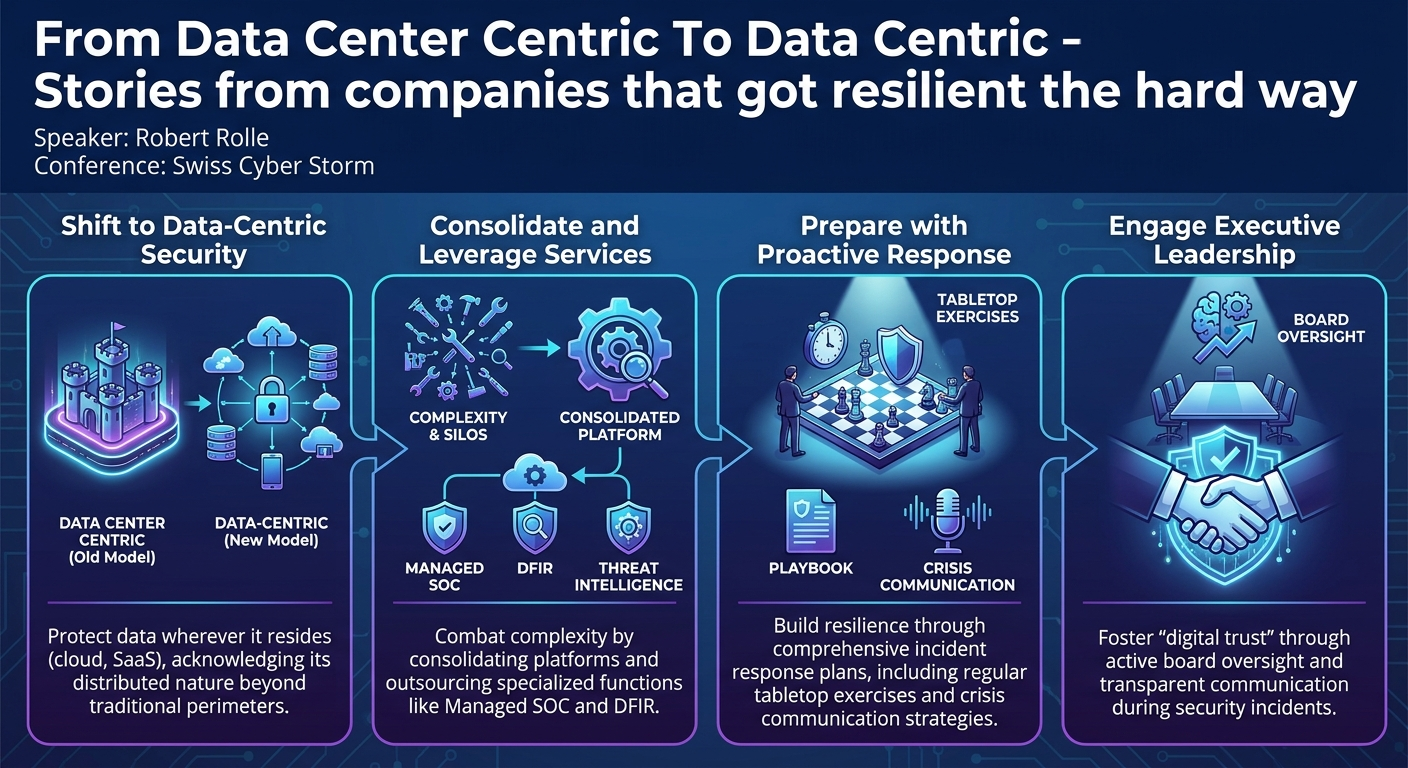
In an insightful presentation at Swiss Cyber Storm, Robert Rolle, an Entity Security Specialist at NTT, delved into the evolving landscape of enterprise security, advocating for a fundamental shift from a data center-centric to a data-centric security paradigm. Titled "From Data Center Centric To Data Centric - Stories from companies that got resilient the hard way," Rolle's talk highlighted the critical need for organizations to adapt their security strategies in an era where business operations and data increasingly reside beyond traditional perimeter defenses. He emphasized three core principles: the inevitability of this data-centric shift, the paramount importance of consolidating security platforms to reduce complexity, and the strategic advantage of leveraging specialized security services.
Key moments
- 0:45 Core argument: shifting to a data-centric world
- 4:10 Personal story: why security is often ignored
- 8:10 Aotech case study: business impact of a breach
- 12:10 Anonymous client: ransomware incident timeline
- 14:15 NTT's incident response: the "Ghostbusters" approach
- 17:00 Post-incident: lessons learned and tabletop exercises
- 21:50 Q&A: Aotech's recovery and rebuilding trust
- 26:00 Q&A: Recommendations on backup structures
From Data Center Centric To Data Centric - Stories from companies that got resilient the hard way
Speakers: Robert Rolle, Entity Security Specialist, NTT
Conference: Swiss Cyber Storm
YouTube: https://www.youtube.com/watch?v=7Rcr61hZMRY
Overview
In an insightful presentation at Swiss Cyber Storm, Robert Rolle, an Entity Security Specialist at NTT, delved into the evolving landscape of enterprise security, advocating for a fundamental shift from a data center-centric to a data-centric security paradigm. Titled "From Data Center Centric To Data Centric - Stories from companies that got resilient the hard way," Rolle's talk highlighted the critical need for organizations to adapt their security strategies in an era where business operations and data increasingly reside beyond traditional perimeter defenses. He emphasized three core principles: the inevitability of this data-centric shift, the paramount importance of consolidating security platforms to reduce complexity, and the strategic advantage of leveraging specialized security services.
Rolle's discussion was not merely theoretical; it was grounded in compelling real-world case studies, illustrating the severe consequences of neglecting these principles and the pathways to achieving true resilience. Through a mix of market analysis, personal anecdotes, and detailed incident response narratives, he painted a vivid picture of the challenges modern enterprises face and the proactive measures required to navigate them successfully. The talk served as a stark reminder that in a world where data is the most valuable asset, its protection demands a comprehensive, adaptable, and service-oriented approach, moving beyond the outdated notion of a single, impenetrable data center.
The relevance of this talk is amplified by the accelerating pace of digital transformation, cloud adoption, and the sophistication of cyber threats. As businesses increasingly rely on distributed services like Salesforce, their data is no longer confined to on-premises infrastructure but scattered across various cloud environments. This distributed reality renders traditional, perimeter-focused security models insufficient, underscoring the urgency for organizations to embrace a data-centric mindset. Rolle's insights provide a crucial roadmap for security professionals and business leaders alike, urging them to proactively invest in resilient security architectures and expert services to safeguard their most precious digital assets.
Background
▶ Watch: Core argument: shifting to a data-centric world (0:45)
Robert Rolle began by framing the historical perception of security, drawing from his own experience as a system engineer where security was often seen as merely "a box in a wall" – an add-on rather than an integral component. This mindset, he explained, led to an underestimation of security's value, with focus often skewed towards infrastructure sales. However, a personal awakening, triggered by the utility of a password manager that scanned the dark web for compromised accounts, revealed the inherent value and necessity of leveraging specialized security services, shifting his perspective entirely.
This personal journey mirrored a broader market evolution, as articulated by insights from Gartner and KPMG, which Rolle cited to underscore the macro trends driving the shift to data-centric security. Firstly, there's an increasing board oversight and demand for digital trust. New regulations, such as the SEC rule requiring NYSE-listed companies to disclose security breaches within four business days, exert immense pressure on executive management. This mandates that C-level executives take direct responsibility for cybersecurity, recognizing data as the core value of their business, distributed globally across various service providers.
Secondly, the market demands cybersecurity platform consolidation paired with automation. With security encompassing upwards of 60 subdomains, managing an equivalent number of vendors becomes an insurmountable challenge, leading to complexity and security gaps. Automation is essential to keep pace with agile attackers. Thirdly, the concept of threat exposure management is critical in a parameterless and data-centric world. The traditional network perimeter has dissolved, as data and operations are distributed across numerous cloud services and third-party platforms. This necessitates a focus on protecting the data itself, irrespective of its location, rather than solely on the infrastructure it resides on. These market forces collectively highlight why the problem of data center-centric security persists and why a fundamental re-evaluation of security strategy is not just advisable, but imperative.
Key Findings
▶ Watch: Aotech case study: business impact of a breach (8:10)
The talk meticulously outlined several key findings that are critical for modern organizations striving for cyber resilience. Foremost among these is the undeniable transition from a data center-centric to a data-centric security model. As business models evolve and reliance on cloud services like Salesforce becomes commonplace, corporate data is no longer confined within organizational perimeters but is distributed globally. This necessitates a security strategy that prioritizes the protection of data itself, wherever it resides, acknowledging it as the most precious asset.
A second crucial finding is the urgent need for consolidation and complexity reduction within cybersecurity portfolios. Rolle highlighted that with security encompassing potentially 60 or more subdomains, managing a multitude of disparate vendors and solutions is unsustainable and often counterproductive. This fragmentation creates blind spots, increases operational overhead, and hinders effective threat response. Consolidating platforms and leveraging integrated solutions are essential steps to streamline security operations and improve overall posture.
Thirdly, the presentation strongly advocated for leveraging security services as the most efficient and effective way to achieve both consolidation and complexity reduction. Instead of attempting to build and maintain every security capability in-house, organizations can benefit significantly from specialized external providers offering services such as Managed SOC (Security Operations Center), DFIR (Digital Forensics and Incident Response), and threat intelligence. These services provide access to expert knowledge, advanced tools, and continuous monitoring that most individual companies struggle to replicate internally, particularly given the rapid pace of threat evolution.
Finally, the talk underscored the profound impact of proactive incident response planning and open communication during a crisis. The AOTech case study demonstrated that even in the face of a severe breach, transparent communication from leadership can help retain stakeholder trust. Furthermore, the anonymous client's post-incident tabletop exercises revealed the critical gaps in preparation (e.g., lack of offline contact information) and the immense value of simulating crisis scenarios to build resilience and refine response protocols. These findings collectively emphasize that effective cybersecurity in the modern era is less about buying more "boxes" and more about strategic investment in services, streamlined operations, and comprehensive preparedness.
Technical Deep Dive
▶ Watch: NTT's incident response: the "Ghostbusters" approach (14:15)
The technical deep dive of the talk was primarily driven by two compelling case studies, one public and one anonymous, illustrating the realities of modern cyberattacks and the nuances of effective response.
The first example involved AOTech, a German biotech company with 5,000 employees and a multi-million-dollar business, listed on both the Frankfurt and New York stock exchanges. Their core operations involve complex biological science, requiring extensive data sharing with business partners, making their data highly distributed and valuable. AOTech suffered a significant hack, which had severe repercussions: inability to pay bills or salaries, failure to file required stock exchange documents, and eventual delisting from the Frankfurt Stock Exchange. Critically, the company lost access to its client contact book, leaving them unable to communicate with customers. The CEO, demonstrating strong digital trust leadership, took an "uncommonly active public role" in communicating the incident, openly acknowledging the crisis and committing to regaining trust. This executive-level involvement was further evidenced by a swift, 20-second decision by the board to shut down all systems during the incident, highlighting their understanding of threat exposure management and the business impact of data compromise. The CEO also expressed the value of shared threat intelligence, recognizing its potential to enable earlier detection of vulnerabilities.
The second, anonymous client case study provided a detailed timeline of a ransomware attack and the subsequent incident response by NTT's DFIR team. The attack began on June 22nd with an impersonation email. This email was meticulously crafted, appearing legitimate in content and sender identity, but originated from a malicious domain. The attached payload, initially appearing benign, was a ZIP file containing links that downloaded Cubber malware. Two days later, by June 24th, privilege escalation was achieved within the network. Rolle emphasized that this two-day window represented a critical period where detection and reaction could have occurred, but the client lacked an Endpoint Detection and Response (EDR) solution and a Managed SOC (Security Operations Center), leaving them vulnerable.
Upon notification of the ransomware, NTT's DFIR team deployed their specialized "Ghostbusters truck," a mobile incident response unit preloaded with essential equipment: storage, servers with hypervisors, and tools for memory dumping and EDR work. This setup allowed for immediate on-site analysis and the simultaneous establishment of a parallel infrastructure to restore backups. The incident response process involved several critical technical and operational steps:
- Crisis Management: NTT took over all external and internal communication, guiding the client through legal and operational necessities, alleviating stress on the client's internal teams.
- DFIR Operations: Agents immediately began dumping system memory and conducting forensic analysis to identify the initial leak and understand the attacker's activities.
- Workforce Management: To ensure efficiency, stressed client employees were sent home, and NTT enforced single shifts for their own team, preventing burnout.
- Parallel Infrastructure Setup: A completely clean, separate infrastructure was built from the ground up, often starting with critical components like a new Active Directory, tailored to the client's specific needs.
- Recovery from Backup: Clean backups were restored onto this newly built, isolated infrastructure, ensuring that any lingering malware from the original network or potentially infected backups would not propagate.
Following the immediate crisis, the DFIR team continued background work to identify the threat actor and their Tactics, Techniques, and Procedures (TTPs). Crucially, post-incident, a "Lessons Learned" phase was initiated, including tabletop exercises. These simulated scenarios, likened to a "chess game," recreated the incident to train the client's technicians and management on appropriate actions, communication protocols, and decision-making under stress. Examples included identifying the need for offline contact information for IT support and simulating "stress calls" from attackers or business partners, further solidifying the client's crisis playbooks and overall resilience.
Demo / Proof of Concept
▶ Watch: Post-incident: lessons learned and tabletop exercises (17:00)
While Robert Rolle's presentation did not include a live, interactive technical demonstration or a traditional proof of concept, the entire narrative effectively served as a demonstration of NTT's incident response capabilities and the practical application of the principles discussed. The detailed account of the "Ghostbusters truck" and its preloaded equipment – including storage, servers, and hypervisors for memory dumping and EDR work – provided a vivid picture of the tangible resources deployed during a crisis. This description acted as a conceptual demonstration of how a rapid, on-site, and comprehensive DFIR operation is executed.
Furthermore, the "Lessons Learned" phase, specifically the tabletop exercises, functioned as a highly effective, albeit simulated, proof of concept for proactive crisis management. By describing how these exercises recreate scenarios, challenge participants with "stress calls" from simulated attackers or concerned business partners, and force the development of robust crisis playbooks, Rolle illustrated the practical benefits of such preparedness. This methodology demonstrates how organizations can "play out" potential incidents to identify weaknesses and refine their responses without incurring the real-world costs of a live breach. In essence, the detailed case studies and the description of NTT's service delivery model collectively served as a powerful testament to the efficacy of leveraging specialized security services for building resilience.
Defensive Implications
▶ Watch: Q&A: Recommendations on backup structures (26:00)
The insights shared by Robert Rolle carry profound defensive implications for organizations grappling with the complexities of modern cybersecurity. The primary takeaway for defenders is the urgent need to reallocate security budgets away from an exclusive focus on traditional perimeter defenses like firewalls and VPNs towards IT services that address the distributed, data-centric reality. This means investing in specialized capabilities such as Managed SOCs, EDR solutions, and DFIR teams that can detect, respond to, and remediate threats across the entire enterprise ecosystem, not just at the network edge.
Organizations must prioritize the implementation of Endpoint Detection and Response (EDR) solutions. The anonymous client's two-day window between initial compromise and privilege escalation, which went undetected due to the absence of EDR and a Managed SOC, highlights EDR's critical role in providing visibility into endpoint activities and enabling early detection of malicious behavior that bypasses traditional defenses. This is fundamental for shifting from reactive incident response to proactive threat hunting and containment.
Adopting a truly data-centric security model is no longer optional. Defenders must identify their most critical data assets, understand where they reside (on-premises, cloud, SaaS applications), and implement controls that protect the data itself, regardless of its location. This includes robust encryption, data loss prevention (DLP), and granular access controls tailored to specific data types and business processes.
To combat the overwhelming complexity, security teams should actively pursue cybersecurity platform consolidation. Reducing the number of disparate security vendors and integrating solutions will improve visibility, streamline management, and enhance the effectiveness of automated defenses. This strategy helps close security gaps that often arise from siloed tools and allows for a more unified and coherent security posture.
Developing and regularly practicing robust incident response plans is paramount. This includes establishing clear communication protocols, identifying key stakeholders (including legal and HR), and creating offline resources (e.g., printed contact lists for IT support). Tabletop exercises, as demonstrated by NTT, are invaluable for simulating crisis scenarios, identifying weaknesses in existing plans, and training personnel under realistic stress conditions. These exercises should involve not just IT, but also executive leadership to ensure rapid and informed decision-making during an actual incident.
Finally, organizations must critically evaluate their backup strategies. Beyond simply having backups, it's crucial to ensure they are isolated (e.g., through media break), regularly tested for recoverability, and have mechanisms to verify their cleanliness to prevent restoring infected data. Leveraging external expertise for specialized tasks like DFIR, crisis management, and continuous threat intelligence can significantly enhance an organization's defensive capabilities, providing access to skills and resources that are often difficult and expensive to maintain internally.
Key Takeaways
- Shift to Data-Centric Security: The traditional data center-centric model is obsolete. Organizations must prioritize protecting data wherever it resides, acknowledging its distributed nature across cloud services and third-party platforms.
- Consolidate and Reduce Complexity: Managing a multitude of disparate security vendors and solutions creates complexity, operational overhead, and security gaps. Consolidation of platforms and services is crucial for effective defense.
- Leverage Security Services: Outsourcing specialized security functions like Managed SOC, EDR, DFIR, and threat intelligence to expert providers is a pragmatic way to enhance resilience, reduce in-house burden, and access advanced capabilities.
- Proactive Incident Response Planning is Critical: Comprehensive incident response plans, including crisis communication strategies, offline resources, and regular tabletop exercises, are essential for minimizing impact and accelerating recovery from breaches.
- Executive Buy-in and Communication: Active board oversight and transparent communication from leadership during a security incident are vital for maintaining digital trust with stakeholders and guiding decisive action.
- Reallocate Security Investment: Shift budget from solely perimeter-focused "boxes" (firewalls, VPNs) to strategic IT services that provide broader protection, advanced detection, and expert response capabilities in a parameterless world.
About the Speaker(s)
Robert Rolle is an Entity Security Specialist at NTT. Throughout his career, he has observed the evolving landscape of cybersecurity, initially perceiving security as a mere infrastructural add-on before recognizing its critical importance through personal experience and market trends. His expertise lies in guiding organizations through the complex transition from outdated data center-centric security models to more resilient, data-centric approaches. Rolle's work at NTT focuses on helping companies leverage advanced security services, consolidate their security platforms, and develop robust incident response capabilities to protect their most valuable digital assets in an increasingly distributed and threatened environment. His insights are informed by practical experience in incident response and a deep understanding of the strategic challenges faced by modern enterprises.
Reviews
Dr. Zero (Offensive Security Researcher) — HARD PASS
This isn't a research talk. It's a 45-minute sales pitch for NTT's managed SOC and incident response retainers disguised as a war story. If your primary takeaway is that the audience should outsource their security to your employer, you don't belong on a conference stage.
Heather Calloway (CISO) — SOLID
This is a competent, if familiar, argument for moving past perimeter defenses and consolidating vendor sprawl. The real value here isn't the macro trend analysis, but the incident response case studies detailing the operational paralysis that hits when foundational basics like offline contact lists are missing. Worth a look for the crisis management takeaways, but keep in mind you're watching a well-executed MSSP pitch.