How to Run a Great Security Champion Program
Raphael Schaffo (IT Software Engineer and Security Champion · Swiss Post)
Swiss Cyber Storm 2023 · Day 1 · Scenario
Overview
In the complex landscape of modern software development, embedding security early in the development lifecycle – a practice known as shift left – has become paramount. However, achieving this often proves challenging, with many organizations struggling to integrate security effectively without creating bottlenecks or disincentives. Raphael Schaffo, an IT Software Engineer and Security Champion at Swiss Post, delivered a compelling talk at Swiss Cyber Storm, sharing Swiss Post's journey in establishing and evolving a highly successful Security Champion program. This presentation offers invaluable insights into the practicalities, pitfalls, and triumphant strategies that transformed their program into a cornerstone of their organizational security posture.
Key moments
- 0:00 Introduction and talk overview
- 2:00 Defining a Security Champion Program
- 6:00 Origin story: From coffee talk to program proposal
- 14:00 Lock4Shell: Security Champions prove their value
- 20:00 Swiss Post Manifesto: Find motivated people
- 22:00 Gaining management support (hockey analogy)
- 24:00 Creating a strong, visible Security Champion community
- 28:50 Q&A: Appreciation crucial for champion motivation
How to Run a Great Security Champion Program
Speakers: Raphael Schaffo, IT Software Engineer and Security Champion, Swiss Post
Conference: Swiss Cyber Storm
YouTube: https://www.youtube.com/watch?v=l-thowGPIBY
Overview
In the complex landscape of modern software development, embedding security early in the development lifecycle – a practice known as shift left – has become paramount. However, achieving this often proves challenging, with many organizations struggling to integrate security effectively without creating bottlenecks or disincentives. Raphael Schaffo, an IT Software Engineer and Security Champion at Swiss Post, delivered a compelling talk at Swiss Cyber Storm, sharing Swiss Post's journey in establishing and evolving a highly successful Security Champion program. This presentation offers invaluable insights into the practicalities, pitfalls, and triumphant strategies that transformed their program into a cornerstone of their organizational security posture.
The talk meticulously dissects the evolution of Swiss Post's program from its inception in 2019 to its current state in 2023, highlighting key milestones, challenges, and the continuous adaptation required for long-term success. Schaffo emphasizes that while the concept of a Security Champion program appears straightforward, its implementation demands a nuanced understanding of organizational dynamics, human motivation, and strategic support. Swiss Post's experience, particularly their proactive response to the Log4Shell vulnerability, serves as a powerful testament to the tangible benefits of empowering developers with security knowledge and ownership.
This article delves into the foundational principles, structured methodology, and real-world lessons learned from Swiss Post's journey, providing a comprehensive guide for organizations aspiring to cultivate a robust and effective Security Champion initiative. It underscores that success hinges not merely on technical training, but on fostering a vibrant community, securing management buy-in, and continuously nurturing the passion of individuals dedicated to elevating security standards from within.
Background
▶ Watch: Introduction and talk overview (0:00)
The concept of a Security Champion program is rooted in the recognition that a centralized security team cannot scale to address the myriad security concerns inherent in agile, distributed development environments. Instead, it aims to empower and train individuals, typically developers or non-security professionals, to actively promote cybersecurity best practices within their respective development teams. These champions act as a vital bridge, translating security requirements and concerns from the central security team into actionable tasks for developers, and conversely, providing the security team with a ground-level understanding of development challenges.
Despite the clear benefits of shifting security left and embedding it directly within development teams, many organizations struggle to successfully implement such programs. Common pitfalls include a lack of clear vision, insufficient management support, failure to sustain champion motivation, and an inability to demonstrate tangible value. These challenges often lead to programs that fizzle out, leaving both security and development teams frustrated.
Recognizing these widespread difficulties, the OWASP (Open Worldwide Application Security Project) community has actively worked on defining guidelines for successful Security Champion programs. Raphael Schaffo references the OWASP Security Champion Guide, an actively developing resource that compiles experiences from numerous companies to define a manifesto of principles. Swiss Post's journey, as detailed in Schaffo's talk, remarkably aligned with these OWASP principles, underscoring their universal applicability and effectiveness in overcoming the inherent obstacles to building an impactful program. The problem, therefore, is not a lack of understanding of what a Security Champion program is, but rather how to implement and sustain one effectively.
Key Findings
▶ Watch: Origin story: From coffee talk to program proposal (6:00)
Swiss Post's successful Security Champion program is a direct result of a structured approach combined with a deep understanding of human motivation and organizational dynamics. The key findings from their journey can be distilled into a set of principles and an evolutionary roadmap that other organizations can adapt.
Firstly, the program's genesis in 2019, driven by a conversation between the CISO and Head of IT about shift left and Security Champions, highlights the critical need for top-level sponsorship. This initial executive buy-in paved the way for a dedicated solution architect to develop a comprehensive proposal, meticulously outlining benefits, challenges, costs, goals, timeline, and a playbook. This structured planning, including a clear articulation of return on investment, was crucial for securing management approval.
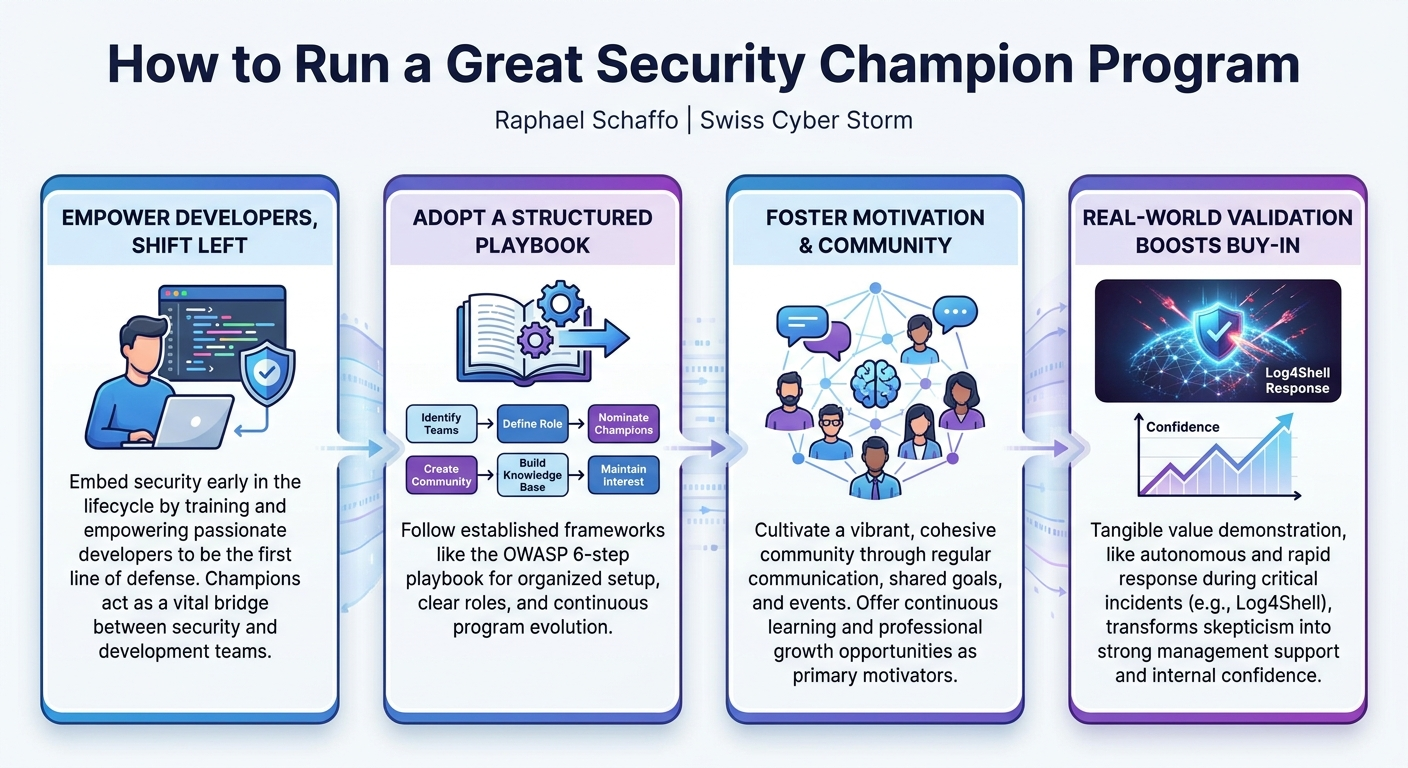
Secondly, Swiss Post did not "reinvent the wheel," instead adopting and adapting a six-step playbook derived from OWASP:
- Identify the teams: Understand the organizational structure to strategically place champions.
- Define the role: Clearly articulate responsibilities and expectations for champions.
- Nominate the security champions: Select individuals with potential and motivation.
- Create a living community: Foster communication and collaboration among champions.
- Build a knowledge base: Ensure champions have access to necessary information and training.
- Maintain interest: Continuously motivate champions and provide growth opportunities.
This playbook provided a robust framework for the program's initial setup and ongoing evolution.
Thirdly, the talk revealed six core principles, which Schaffo independently identified before discovering their alignment with the OWASP Security Champion Manifesto. These principles are the bedrock of Swiss Post's success:
- Find motivated people: Passionate individuals are easier to train and empower, akin to a candle needing only a spark.
- Start with a clear vision (and adapt it): A well-defined program direction is essential, but it must be flexible enough to evolve with changing company needs, much like adapting holiday plans for unexpected weather.
- Secure management support: Trust from management empowers champions to perform, drawing a parallel to how public support can turn an underdog team into a formidable competitor.
- Create a community: A strong sense of belonging, fostered through communication channels, shared goals, and events (like a program logo and T-shirts), is vital for champion engagement and identity.
- Promote knowledge sharing: Ensuring that expertise is disseminated throughout the community prevents single points of failure and elevates collective capability, like a baker sharing their best croissant recipe.
- Reward responsibilities: Beyond monetary compensation, providing opportunities for professional growth, participation in events (e.g., Hack in Paris), and increased responsibility acts as a powerful motivator and form of appreciation.
Finally, a pivotal finding was the program's validation during the Log4Shell vulnerability in December 2021. This incident served as a real-world stress test, demonstrating the tangible value of the Security Champion program. Champions, acting proactively and autonomously before official company-wide communications, identified affected applications and deployed fixes, showcasing their critical role in rapid incident response and their intrinsic value to the company's security posture. This event significantly boosted confidence in the program among previously skeptical stakeholders.
Technical Deep Dive
▶ Watch: Swiss Post Manifesto: Find motivated people (20:00)
The "technical deep dive" in the context of a Security Champion program focuses not on code or network protocols, but on the architectural design and operational methodology of the program itself. Swiss Post's approach exemplifies a well-engineered program structure, continuously refined through iterative development cycles.
The program's foundation was laid using the OWASP 6-step playbook, adapted to Swiss Post's environment:
- Identify Teams: A clear diagram of all existing IT teams allowed Swiss Post to strategically determine where Security Champions would be most impactful.
- Define the Role: This involved precise articulation of a Security Champion's responsibilities, emphasizing their role as a bridge between development and security teams. Crucially, it was established as a 10-20% role, allowing champions to remain primarily developers, thus maintaining their practical understanding of development challenges.
- Nominate Champions: This phase involved actively seeking out motivated individuals within development teams who showed an aptitude or passion for security.
- Create a Living Community: Communication channels were established, and regular meetings were scheduled. This was a critical step in fostering a sense of belonging and shared purpose.
- Build a Knowledge Base: Ensuring champions had access to up-to-date security information, training materials, and best practices was vital. This included internal documentation and leveraging external resources like OWASP.
- Maintain Interest: This ongoing step involved continuous engagement, offering new learning opportunities, and recognizing contributions to prevent stagnation.
The timeline of Swiss Post's program illustrates its iterative evolution:
- 2019: Initial discussions and the development of a detailed proposal by a solution architect. This proposal included an analysis of benefits, challenges, costs, goals, timeline, and the initial Playbook. Management approval was secured by the end of February 2020.
- 2020: The definition refinement phase involved all Swiss Post security teams to fine-tune the Playbook. Recruitment began in May, resulting in a core team of 10 Security Champions by June. An embedded core team guided the champions, maintaining close contact with the CISO to ensure strategic alignment. Bi-weekly, two-hour meetings focused on presentations about OWASP Top 10 vulnerabilities and other relevant security topics, fostering collective knowledge growth. Goals included personal training, community promotion, and adherence to the Playbook, starting with bug bounty case analysis and improving the toolchain for secure development and DevSecOps.
- 2021: The program grew to 20 Security Champions. A significant focus was placed on gaining visibility, aided by the CISO's active promotion. Continuous training was provided for both new and existing champions. Champions were integrated into the annual Security Day, allowing them to interact with and understand the work of other security teams (red team, blue team, VA team). A monthly slot on an internal presentation platform (reaching 150-250 participants) was secured, significantly boosting security awareness across the company. The first dedicated Security Champion Day was organized to further strengthen community bonds.
- 2022: The program expanded to 30 Security Champions. Goals included enhancing the champions' voice within the organization, improving the DevSecOps toolchain, implementing threat modeling, and promoting coding best practices through an internal "hacker guide." Champions participated in external events like Hack in Paris, fostering professional development and external networking. Closer collaboration with Vulnerability Assessment (VA) and Enterprise Operations (EO) teams was established.
- 2023: Continued collaboration with EO teams was prioritized. A company reorganization introduced clusters, necessitating champions to work directly within these new structures. The program faced a challenge with declining champion motivation due to a perceived lack of new training opportunities. In response, a comprehensive list of diverse training options was developed. The rapid growth in champion numbers (driven by a management push for one champion per cluster) led to the automation of the onboarding process and significant improvements in documentation, ensuring scalability and efficiency. The role of the Security Champion also evolved to align with the changing needs and vision of the company.
The Swiss Post Manifesto, comprising the six key principles, forms the philosophical and operational backbone of the program:
- Motivated People: Emphasizes recruiting individuals with an inherent passion for security, who can be "sparked" rather than "filled" with knowledge.
- Clear Vision & Adaptability: Stresses the importance of a well-defined program vision that is regularly reviewed and adapted to changing organizational needs and threats.
- Secure Management Support: Highlights that management's trust and visible support are crucial for champion confidence and program legitimacy.
- Create a Community: Focuses on fostering a strong, cohesive identity through shared goals, communication, regular events, and symbolic elements like a program logo and branded apparel.
- Promote Knowledge Sharing: Advocates for mechanisms to ensure that knowledge gained by individual champions is disseminated across the entire community, preventing knowledge silos.
- Reward Responsibilities: Underscores that professional growth opportunities, recognition, and increased responsibility are often more valuable motivators than purely monetary rewards.
This detailed, iterative approach, guided by established principles and continuously adapted to organizational realities, forms the technical architecture of Swiss Post's successful Security Champion program.
Demo / Proof of Concept
▶ Watch: Gaining management support (hockey analogy) (22:00)
While Raphael Schaffo's presentation did not include a live technical demonstration or a traditional proof of concept (PoC) of a specific exploit or tool, the entire talk serves as a macro-level proof of concept for the effectiveness of a well-implemented Security Champion program. The most compelling evidence of the program's tangible value and operational success came during the Log4Shell vulnerability crisis in December 2021.
Schaffo vividly recounts how, on December 9th, a Friday, when official company-wide communications were yet to be issued due to the late hour, Swiss Post's Security Champions took proactive action. They independently monitored security announcements, identified the critical Log4Shell vulnerability, recognized its potential impact on Swiss Post applications, and, crucially, took the initiative to implement fixes. By the end of that day, applications were already being patched and deployed to production, days before a formal response from the central security team could be fully coordinated.
This incident was a watershed moment. It demonstrated that the Security Champions were not merely passive recipients of training but empowered, proactive agents capable of autonomous decision-making and rapid incident response. It showcased their ability to:
- Monitor and interpret threat intelligence relevant to their specific development contexts.
- Identify affected systems within their purview.
- Propose and implement immediate fixes, effectively "shifting left" incident response to the development teams themselves.
- Take ownership and responsibility without explicit directives.
Schaffo notes that this event was critical in convincing previously skeptical business and management stakeholders of the program's immense value. It transformed abstract concepts of "shift left" and "developer empowerment" into concrete, measurable security outcomes, making the Log4Shell response the ultimate, real-world proof of concept for Swiss Post's Security Champion program.
Defensive Implications
▶ Watch: Q&A: Appreciation crucial for champion motivation (28:50)
The Swiss Post Security Champion program offers profound defensive implications for any organization striving to enhance its cybersecurity posture in a scalable and sustainable manner. The core message is clear: empower your developers to be your first line of defense.
- Shift Left Effectively: Defenders should recognize that traditional security gatekeeping models are no longer sufficient. Implementing a Security Champion program is a direct mechanism to shift security left, embedding security considerations and expertise directly into the design, development, and deployment phases. This proactive approach reduces the likelihood of vulnerabilities making it into production and significantly lowers the cost of remediation.
- Leverage OWASP Guidance: Organizations should start by consulting and adapting the OWASP Security Champion Guide and the 6-step playbook (Identify Teams, Define Role, Nominate, Create Community, Knowledge Base, Maintain Interest). This provides a proven, structured framework rather than attempting to build a program from scratch.
- Prioritize Motivation and Community: Simply mandating participation is insufficient. Defenders must actively seek out motivated individuals who show a genuine interest in security. Furthermore, fostering a strong community among champions through regular meetings, shared platforms, events, and even symbolic gestures (like team logos or apparel) is crucial for sustained engagement and knowledge sharing.
- Secure Management Buy-in: Without explicit management support, a champion program is likely to falter. Defenders must articulate the program's benefits (e.g., reduced vulnerabilities, faster incident response, increased security awareness) in business terms, as Swiss Post did with its initial proposal, to secure the necessary resources and trust.
- Provide Continuous Learning and Growth: To maintain interest and expertise, a comprehensive and evolving training curriculum is essential. This includes not only foundational security knowledge (e.g., OWASP Top 10) but also advanced topics like threat modeling and DevSecOps toolchain improvements. Offering opportunities for external events (e.g., security conferences, hackathons like Hack in Paris) serves as a powerful reward and skill-building mechanism.
- Automate and Document: As the program scales, manual processes become bottlenecks. Defenders should invest in automating onboarding processes and ensuring robust documentation to streamline operations and reduce administrative overhead.
- Embrace Real-World Validation: Incidents like Log4Shell are not just crises; they are opportunities to demonstrate the tangible value of a Security Champion program. Defenders should highlight how champions contribute to faster detection, response, and remediation, using such events to build internal confidence and secure further investment.
- Integrate with Existing Security Teams: Champions should not operate in a vacuum. Foster strong collaboration with other security functions (red team, blue team, VA team, EO team) through joint meetings and initiatives. This ensures champions are well-informed and that the broader security strategy is cohesive.
By adopting these principles, organizations can move beyond a reactive security posture to one where security is a shared responsibility, deeply ingrained in the development culture, ultimately creating a more resilient and secure environment.
Key Takeaways
- Empower Developers: Security Champion programs are crucial for shifting security left by empowering developers to embed security practices directly into the development lifecycle.
- Structured Approach is Key: Leverage established frameworks like the OWASP 6-step playbook for program setup and continuous evolution, ensuring clear roles, community building, and knowledge sharing.
- Motivation and Community Drive Success: Recruit individuals passionate about security and foster a strong, visible community among them through regular communication, shared goals, and events.
- Management Support is Non-Negotiable: Secure executive buy-in and continuous management trust, as this empowers champions and validates the program's importance within the organization.
- Continuous Learning and Rewards: Provide ongoing training, professional development opportunities (e.g., external conferences like Hack in Paris), and recognition as primary motivators, beyond just monetary compensation.
- Real-World Validation Builds Confidence: Critical incidents like Log4Shell can serve as powerful demonstrations of a program's value, turning skepticism into strong internal support by showcasing rapid, autonomous incident response.
About the Speaker(s)
Raphael Schaffo is an IT Software Engineer and Security Champion at Swiss Post, where he has been working for over seven years. For more than four years, he has been actively involved on the security side, playing a pivotal role in the establishment and growth of Swiss Post's successful Security Champion program. Schaffo is 29 years old and resides in Switzerland. Beyond his professional role, he has a strong passion for ethical hacking, a hobby that clearly informs his dedication to cybersecurity within his organization. His unique perspective as both a developer and a security advocate provides invaluable insights into bridging the gap between development and security teams.
Reviews
Dr. Zero (Offensive Security Researcher) — SOLID
Swiss Post rolled out the OWASP Security Champion playbook, and it actually worked. The Log4Shell anecdote alone validates the entire multi-year effort. Their developers were patching production before the central security team even woke up. It is not a new framework, but it is a rare honest look at the friction of keeping a champion program alive over four years.
Heather Calloway (CISO) — SOLID
If your application security program is failing to scale, this talk provides a credible blueprint for delegating the load. It details how Swiss Post built a security champions program that actually survived contact with the business, complete with the protected time allocations required to make it functional.