Closing Keynote: The Human OS: U Can't Tech This
Yanya Viskovich
Swiss Cyber Storm 2023 · Day 1 · Arena
Overview
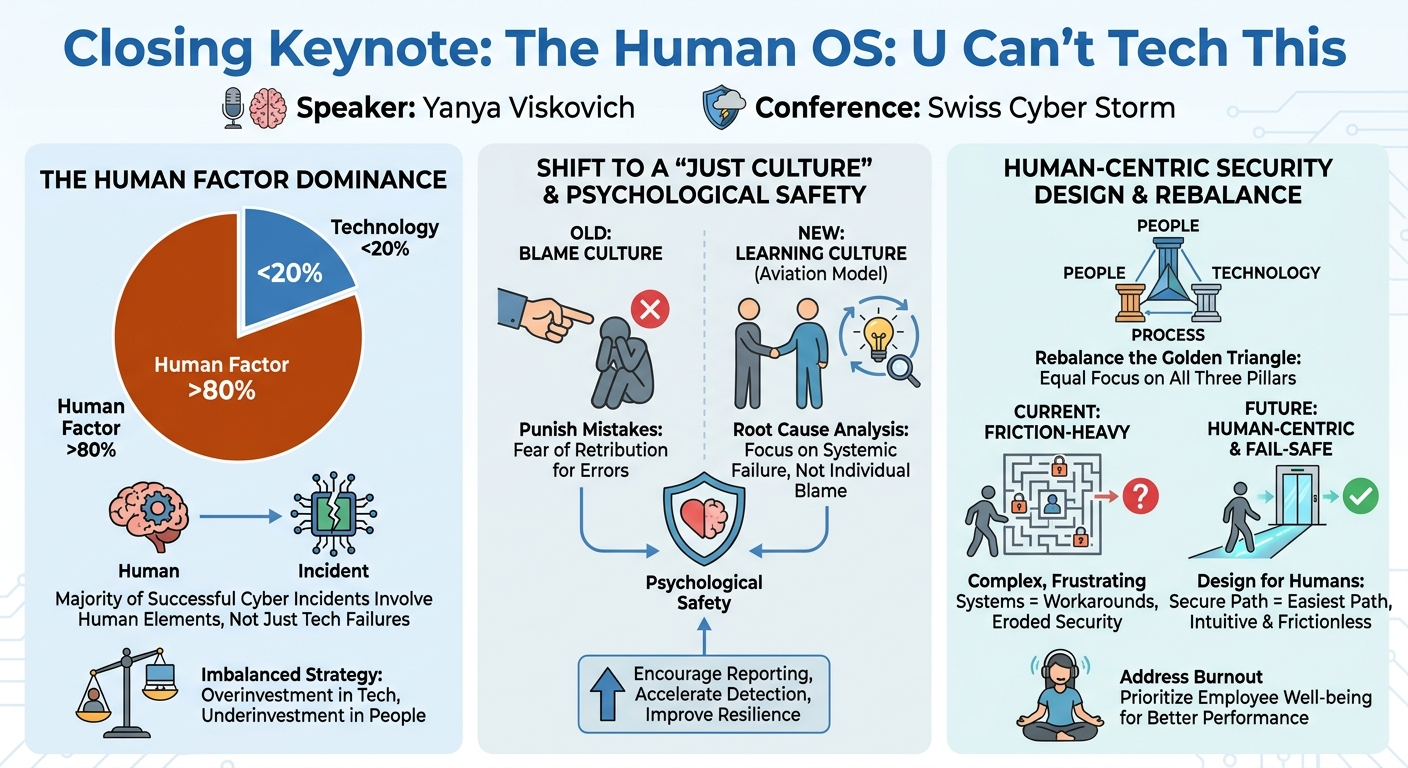
In her compelling closing keynote at Swiss Cyber Storm, Yanya Viskovich presented a stark re-evaluation of modern cybersecurity strategies, arguing that the industry's disproportionate focus on technology has overlooked the most critical and pervasive vulnerability: the human element. Titled "The Human OS: U Can't Tech This," Viskovich challenged the prevailing notion that technological solutions alone can secure our digital systems, asserting that over 80% of successful cyber incidents involve human factors. Her talk served as a powerful call to action for cybersecurity leaders to rebalance their approach, integrating human-centric design, psychological safety, and a "just culture" into their security programs.
Key moments
- 0:00 Introduction: The inevitability of human error
- 4:15 "To err is human": Learning from healthcare safety
- 9:50 80% of cyber attacks involve the human factor
- 11:45 Technology isn't a panacea; rebalancing the Golden Triangle
- 14:15 Aviation's safety-critical, human-centric approach: A cyber model
- 22:30 Colonial Pipeline: A simple human error, not zero-day
- 31:00 Q&A: Balancing no-blame culture with accountability
- 34:00 Q&A: Practicalities of training hours for security teams
Closing Keynote: The Human OS: U Can't Tech This
Speakers: Yanya Viskovich
Conference: Swiss Cyber Storm
YouTube: https://www.youtube.com/watch?v=3fCK4ekoPlg
Overview
In her compelling closing keynote at Swiss Cyber Storm, Yanya Viskovich presented a stark re-evaluation of modern cybersecurity strategies, arguing that the industry's disproportionate focus on technology has overlooked the most critical and pervasive vulnerability: the human element. Titled "The Human OS: U Can't Tech This," Viskovich challenged the prevailing notion that technological solutions alone can secure our digital systems, asserting that over 80% of successful cyber incidents involve human factors. Her talk served as a powerful call to action for cybersecurity leaders to rebalance their approach, integrating human-centric design, psychological safety, and a "just culture" into their security programs.
Viskovich, drawing on her extensive 17-year career spanning cybercrime prosecution, data protection for the United Nations and the Red Cross, and advising organizations on human cyber risk, delivered a critical analysis of the industry's current trajectory. She posited that despite exponential advancements in cybersecurity technology, the overall security landscape has not improved, with attack surfaces expanding and threats evolving. The core message resonated deeply: while we continuously upgrade our "computer OS," we often neglect the "human OS," which operates on principles far more complex than lines of code.
The significance of Viskovich's message cannot be overstated. As organizations grapple with escalating cyber threats, CISO burnout, and a persistent talent shortage, her insights offer a vital shift in perspective. By advocating for a "safety critical approach" inspired by the aviation industry, she provided a tangible framework for building more resilient systems and cultures. The talk underscored that true cybersecurity resilience hinges not just on robust technology, but fundamentally on understanding, designing for, and empowering the humans within the system.
Background
▶ Watch: Introduction: The inevitability of human error (0:00)
The evolution of cybersecurity has largely been characterized by a relentless pursuit of technological defenses. From firewalls and antivirus software to advanced threat detection and AI-driven analytics, the industry's investment has overwhelmingly skewed towards sophisticated technical solutions. This trajectory was significantly influenced by early thought leaders like American cryptographer Bruce Schneier, who popularized the People, Process, Technology (PPT) framework in the late 1990s. Initially, Schneier championed this "Golden Triangle" as a balanced approach to security, recognizing the interconnectedness of human behavior, operational procedures, and technical controls. However, Viskovich highlighted a critical pivot in Schneier's later perspective, where he revised his stance in 2013, advocating for "less in the way of people in process and more technology," pushing for greater automation due to the increasing complexity of the IT security world.
This shift, Viskovich argued, has been largely heeded by organizations, leading to a dangerous imbalance. Today's security strategies continue to disproportionately weight investments in technology, often automating previously manual processes with minimal focus on the human element—other than condescendingly referring to employees as "users" or, worse, "the weakest link in the chain." This damaging phrase, ironically, can also be attributed to Schneier from his earlier writings. This technology-centric approach has fostered an environment where software is seen as a panacea, despite mounting evidence that the security landscape has become more complex, attack surfaces have expanded, and new technologies are continuously weaponized by cybercriminals.
The problem's roots are not new. Viskovich drew parallels to the medical field, referencing Alexander Pope's famous line "To err is human" and the US Institutes of Medicine's 1999 report on patient safety. This report revealed over 100,000 preventable deaths annually in hospitals, highlighting systemic failures rather than individual blame. Just as fatigue, stress, and systemic flaws contribute to medical errors, Viskovich argued that overconfidence, tunnel vision, bias, prejudice, inconsistency, and fear similarly drive human error in cybersecurity. The digital transformation spurred by events like COVID-19, while necessary, has often created fear and friction-causing processes, leading to workarounds that erode security culture and increase the propensity for mistakes. The core challenge, therefore, lies in acknowledging that as long as humans design, operate, and interact with systems, error is inevitable, and current security strategies are failing to adequately address this fundamental reality.
Key Findings
▶ Watch: 80% of cyber attacks involve the human factor (9:50)
Yanya Viskovich's keynote illuminated several critical findings that challenge conventional cybersecurity wisdom, advocating for a profound shift in perspective.
Firstly, a central finding is the disproportionate investment in technology at the expense of people and processes. Despite Bruce Schneier's early advocacy for a balanced People, Process, Technology (PPT) framework, Viskovich noted that his later leanings towards automation have been over-adopted, resulting in a "Golden Triangle" that is "less equilateral, more obtuse." This imbalance persists even though over 80% of all successful cyber incidents involve the human factor, demonstrating a fundamental disconnect between investment strategy and actual threat vectors.
Secondly, the talk highlighted the detrimental impact of the "weakest link" narrative. Referring to employees as mere "users" or "the weakest link" is not only condescending but also counterproductive. It fosters a culture of blame rather than learning, discouraging individuals from reporting errors or concerns, which in turn delays critical improvements and exacerbates vulnerabilities.
Thirdly, Viskovich emphasized the vital role of psychological safety. Drawing on research by organizational psychologists like Amy Edmonson, particularly in healthcare, she explained that environments where individuals feel safe to speak up, share concerns, and report errors without fear of retribution lead to improved safety and outcomes. Conversely, a lack of psychological safety causes issues to be hidden, delaying crucial improvements and increasing risk. This concept is directly applicable to cybersecurity, where the fear of punishment for clicking a phishing link, for instance, can prevent timely incident reporting and remediation.
Fourthly, the presentation underscored how human physiological and psychological states directly impact security posture. Viskovich pointed out that stress, fatigue, overwhelm, frustration, multitasking, and fear significantly increase human error rates. The digital transformation initiatives, while essential, often create change-induced fear, making people more prone to mistakes. Friction-causing security processes further exacerbate this by encouraging workarounds, which subsequently erode the security culture and create new vulnerabilities.
Finally, a powerful overarching finding was the applicability of the aviation industry's "safety critical approach" and "just culture" model to cybersecurity. Viskovich argued that aviation's remarkable safety record is not solely due to technology but stems from a human-centric approach that designs systems for human interaction, acknowledges inevitable human error, and fosters a learning-based system rather than a blame-based one. This model, characterized by rigorous training, psychological safety, and systemic root cause analysis, offers a proven blueprint for transforming cybersecurity resilience.
Technical Deep Dive
▶ Watch: Aviation's safety-critical, human-centric approach: A cyber model (14:15)
While Yanya Viskovich's talk was not a deep dive into specific code exploits or network protocols, it presented a profound "technical deep dive" into the engineering of human-centric security systems and the methodologies required to manage human cyber risk. This involves a critical examination of system design, organizational architecture, and the cognitive science behind human interaction with technology.
Viskovich initiated this deep dive by revisiting Bruce Schneier's People, Process, Technology (PPT) framework. Originally conceived as an equilateral "Golden Triangle," ensuring balance across these three pillars for robust security, Schneier himself later advocated for a rebalancing towards technology and automation. Viskovich argued that organizations have disproportionately heeded this revised advice, leading to an "obtuse" triangle where technology dominates. This creates a fundamental flaw: if over 80% of successful cyber incidents involve human factors, then an imbalanced focus on technology alone is inherently insufficient. The "technical" challenge, therefore, is not merely to build better technology, but to better integrate and optimize the human and process elements within the overall security architecture.
The core of Viskovich's technical argument lies in adopting a "safety critical approach", a methodology perfected by the aviation industry. This approach is intrinsically human-centric, recognizing that human capabilities and limitations must be central to system design. Key "technical" elements of this approach, translated to cybersecurity, include:
- Human Factors Engineering in Design: In aviation, cockpits are designed for the human eye, with significantly reduced instruments and optimized user interfaces. This minimizes information overload and cognitive burden, leading to fewer errors. In cybersecurity, this translates to designing user-friendly security tools and processes that are intuitive and minimize friction. Viskovich emphasized that "humans are like water; we find the easiest course," meaning security systems must be designed to make the secure path the easiest path, rather than creating complex, frustrating processes that invite workarounds.
- Layered Defense in Depth: Just as surgical protocols involve multiple safety measures to prevent mistakes (e.g., marking the correct limb, cross-referencing notes, parental consent), aviation employs multiple layers of safety nets. This concept, already familiar in cybersecurity as defense in depth, must be applied not just to technical controls but also to human-process interactions. For example, a system might have technical controls (MFA), but the "human layer" requires training on its importance, and the "process layer" mandates its enforcement and regular checks.
- Crew Resource Management (CRM) and Communication Protocols: Aviation emphasizes effective communication and teamwork among flight crews, acknowledging that human errors can occur and providing training to address them under pressure. For cybersecurity, this means rigorous cyber crisis simulations and tabletop exercises that test communication channels, roles, and responsibilities during an incident. This "technical" practice identifies breakdowns in human-to-human communication and process adherence before a real crisis.
- Rigorous Human Factors Training: Pilots undergo extensive training in error identification, mitigation, and understanding their own human limitations. This includes specific training in human factors. Viskovich proposed that cybersecurity professionals and employees alike need similar training to recognize how normal aspects of being human (stress, fatigue, cognitive biases) increase the attack surface. This is a "technical" skill that involves understanding psychology and applying it to security.
- Systemic Root Cause Analysis ("Just Culture"): Captain Sully Sullenberger's advocacy for moving "beyond blaming pilots" to a "learning based system" is central. This "just culture" involves rigorous lessons learned processes that identify probable causes and contributing factors, making recommendations to prevent recurrence. This is a technical approach to incident response that focuses on systemic failures rather than individual culpability for honest mistakes. For instance, punishing an employee for clicking a phishing link without understanding why they clicked it (e.g., fatigue, poor UI, sophisticated lure) misses the opportunity for systemic improvement.
A compelling "technical" example Viskovich provided was the Colonial Pipeline attack. This was not a sophisticated zero-day exploit but a simple human error: a former employee's credential, found on the dark web, was still active because HR forgot to notify IT for deactivation. Crucially, multi-factor authentication (MFA) had not been enabled, and a process that "could have been automated was not." This incident, which brought the US economy within three days of a halt, perfectly illustrated how a seemingly minor human-process failure, compounded by a lack of basic technical controls (MFA) and automation, could have catastrophic "technical" consequences.
Viskovich also touched upon regulatory and industry movements that support this shift. She referenced NIST Special Publications (e.g., 800-series, related to crisis resilience teams) which advocate for managing fatigue and providing rest for SOC teams. She also mentioned ISO standards and the NIS2 directive in the UK, which are beginning to mandate certain training requirements and considerations for the well-being and performance of cybersecurity professionals, recognizing that burnout (with Gartner predicting 25% of security leaders leaving by 2025 due to stress) directly impacts human performance and, by extension, technical security.
In essence, the "technical deep dive" of Viskovich's talk is about applying engineering principles, cognitive science, and proven safety methodologies from other high-risk industries to construct a more resilient cybersecurity architecture that accounts for the inherent complexities and vulnerabilities of the human operating system.
Demo / Proof of Concept
▶ Watch: Colonial Pipeline: A simple human error, not zero-day (22:30)
The keynote "The Human OS: U Can't Tech This" did not feature a live technical demonstration or a traditional proof of concept. Instead, Yanya Viskovich built her case by drawing upon real-world incidents, historical analogies, and established scientific research from other safety-critical industries. The "proof" for her arguments was derived from the demonstrable failures of technology-first approaches in high-stakes scenarios and the proven successes of human-centric methodologies in fields like aviation and healthcare.
For instance, the Colonial Pipeline attack served as a powerful real-world "proof of concept" for the catastrophic impact of human and process failures, even without sophisticated technical exploits. Viskovich detailed how a stolen credential from a former employee, combined with the lack of MFA and an unautomated deactivation process, led to a critical infrastructure breach. This example vividly illustrated how the "human OS" can be exploited when not adequately secured and managed. Similarly, the historical context of patient safety in hospitals and the remarkable safety record of the aviation industry, particularly the "Miracle on the Hudson" involving Captain Sully Sullenberger, served as compelling evidence for the efficacy of human-centric safety critical approaches and "just cultures" in mitigating risk and improving outcomes.
Defensive Implications
▶ Watch: Q&A: Practicalities of training hours for security teams (34:00)
Yanya Viskovich's talk provides a comprehensive blueprint for cybersecurity defenders, urging a fundamental paradigm shift from a technology-first approach to one that deeply integrates human factors. The defensive implications are actionable and span strategic, cultural, and operational levels.
Firstly, defenders must prioritize the creation of a "Just Culture". This involves moving away from blaming individuals for honest mistakes, such as accidentally clicking a phishing link, towards a system that focuses on root cause analysis of incidents. Organizations should foster psychological safety, encouraging employees to speak up and report errors or concerns without fear of punishment or retribution. Security leaders can lead by example, openly admitting their own mistakes and failures to build trust and encourage transparency. Legal and HR departments should be engaged to remove punitive measures for failing security awareness tests and to enshrine "speak up" policies in codes of business conduct, ensuring employees are treated favorably when they report issues. This shift is crucial for reducing the average 297-day dwell time for data breaches, as early reporting can significantly accelerate detection and remediation.
Secondly, the industry must adopt human factors training akin to that in aviation. Pilots are trained to recognize their own human limitations and how various factors (stress, fatigue) impact their performance. Cybersecurity professionals, particularly SOC teams and CISOs, need similar training to understand how normal human traits like overconfidence, bias, and inconsistency increase the attack surface. This training should extend to all employees, helping them recognize how their emotional states and cognitive biases can make them vulnerable to social engineering attacks.
Thirdly, proactive preparedness through simulations is paramount. Defenders should regularly conduct cyber crisis simulations and tabletop exercises to practice contingencies, identify communication breakdowns, and refine processes in high-pressure situations. This allows teams to understand where their "human OS" falters before a real-world incident occurs, building collective resilience.
Fourthly, there's a critical need to design security for humans, not in spite of them. This means deploying and designing software, systems, and processes that are as frictionless and easy as possible. Viskovich emphasized that "humans are like water; we find the easiest course." If security measures are cumbersome, employees will inevitably seek workarounds, eroding security posture. This involves user interface (UI) design, intuitive access controls, and minimizing complex, multi-step authentication where simpler alternatives suffice, always balancing security with usability. The goal should be to shift from "foolproof" systems to "fail-safe" ones, acknowledging that human error is inevitable and designing systems to accommodate it gracefully.
Fifthly, addressing employee well-being is a direct defensive measure. Viskovich highlighted the alarming Gartner prediction that by 2025, 25% of cybersecurity leaders will leave the profession due to stress and burnout. The intense hours, constant threat landscape, and high-stakes nature of the job contribute to fatigue, which directly increases error rates. Organizations must implement policies that ensure adequate rest requirements for SOC teams and CISOs, provide support during incidents (e.g., food, shelter, rotation), and generally prioritize mental health. This aligns with NIST special procedures and emerging ISO standards for security professional well-being.
Finally, defenders must rebalance the People, Process, Technology (PPT) framework. This means advocating for equal attention and investment across all three pillars. Instead of solely focusing on technology, organizations should invest in behavioral economics, psychology, and communication expertise to better understand human performance in security. By combining effective user training and awareness with supportive organizational cultures and robust technical defenses, while designing technology with human limitations in mind, organizations can significantly enhance their overall cyber resilience.
Key Takeaways
- Human Factor Dominates: Over 80% of successful cyber incidents involve human elements, highlighting a critical imbalance in current technology-heavy security strategies.
- Shift from Blame to Learning: Adopting a "Just Culture," inspired by the aviation industry, is essential. This means focusing on root cause analysis of incidents rather than punishing individuals for honest mistakes, fostering psychological safety for error reporting.
- Embrace Human Factors Engineering: Security systems, processes, and tools must be designed with human capabilities and limitations in mind, making the secure path the easiest and most intuitive one, and shifting from "foolproof" to "fail-safe" designs.
- Prioritize Psychological Safety and Well-being: Creating environments where employees feel safe to report concerns and errors without retribution, combined with addressing CISO and SOC team burnout, is crucial for improving incident response and overall resilience.
- Rebalance the "Golden Triangle": Cybersecurity strategies must re-establish an equilateral balance between People, Process, and Technology, investing equally in understanding human behavior, streamlining security processes, and deploying robust technical defenses.
- Learn from Other Industries: The aviation and healthcare sectors offer proven models for managing risk and achieving high safety standards through human-centric design, rigorous training, simulations, and a commitment to continuous learning from errors.
About the Speaker(s)
Yanya Viskovich is a distinguished expert in cybersecurity, data protection, and data ethics, boasting a 17-year career with diverse experience across multiple sectors. She began her career in Australia, prosecuting cyber criminals and working on dark web investigations with law enforcement agencies. After six years at the bar, she transitioned to international organizations, serving the United Nations where she developed crisis contingency plans, the UN's first data protection policy, and anti-fraud programs. Her expertise also extends to the International Committee of the Red Cross and developing data protection programs for large multinational corporations in engineering and technology. Today, Yanya specializes in advising organizations, CISOs, and boards on managing human cyber risk. She is also a recognized TEDx speaker, demonstrating her ability to articulate complex security challenges in an engaging and impactful manner.
Reviews
Dr. Zero (Offensive Security Researcher) — WEAK
My issue with this keynote is that we have been dragging aviation's 'just culture' onto stages to solve phishing since 2012. It is a perfectly delivered TED talk that offers absolutely zero new mechanics for a CISO trying to actually secure an enterprise tomorrow.
Heather Calloway (CISO) — SOLID
A competent argument for shifting security culture from punitive compliance to psychological safety, drawing heavily on aviation's 'just culture' model. It correctly identifies that our technology-first bias ignores the reality of human error, though it leans on familiar analogies rather than new institutional mechanics.