Social Engineering: Targeting Key Individuals, Profiling, and Weaponizing Psychology
Christina Lekati (Psychologist)
Swiss Cyber Storm 2023 · Day 1 · Arena
Overview
In an era where cyber defenses often focus heavily on technical safeguards, Christina Lekati, a psychologist and social engineer, delivered a compelling talk at Swiss Cyber Storm, challenging the prevailing notion that cybersecurity is solely a technical problem. Her presentation, "Social Engineering: Targeting Key Individuals, Profiling, and Weaponizing Psychology," meticulously dissects the evolving landscape of sophisticated, targeted social engineering attacks. Lekati argues that traditional advice, such as simply telling employees "not to click on links," is fundamentally flawed because it ignores the complexities of human behavior and the psychological underpinnings that attackers increasingly exploit.
Key moments
- 1:45 Targeted attacks on key individuals explained
- 3:00 Marcela Flores: long-term social engineering case
- 5:45 How attackers weaponize psychology and human needs
- 12:30 Who are high-value targets and why they're valuable
- 19:20 Five steps to assess high-value target vulnerability
- 22:15 Macro and micro defensive strategies and training
- 29:00 Characteristics of effective security training
Social Engineering: Targeting Key Individuals, Profiling, and Weaponizing Psychology
Speakers: Christina Lekati, Psychologist
Conference: Swiss Cyber Storm
YouTube: https://www.youtube.com/watch?v=_qbJvjsRAPo
Overview
In an era where cyber defenses often focus heavily on technical safeguards, Christina Lekati, a psychologist and social engineer, delivered a compelling talk at Swiss Cyber Storm, challenging the prevailing notion that cybersecurity is solely a technical problem. Her presentation, "Social Engineering: Targeting Key Individuals, Profiling, and Weaponizing Psychology," meticulously dissects the evolving landscape of sophisticated, targeted social engineering attacks. Lekati argues that traditional advice, such as simply telling employees "not to click on links," is fundamentally flawed because it ignores the complexities of human behavior and the psychological underpinnings that attackers increasingly exploit.
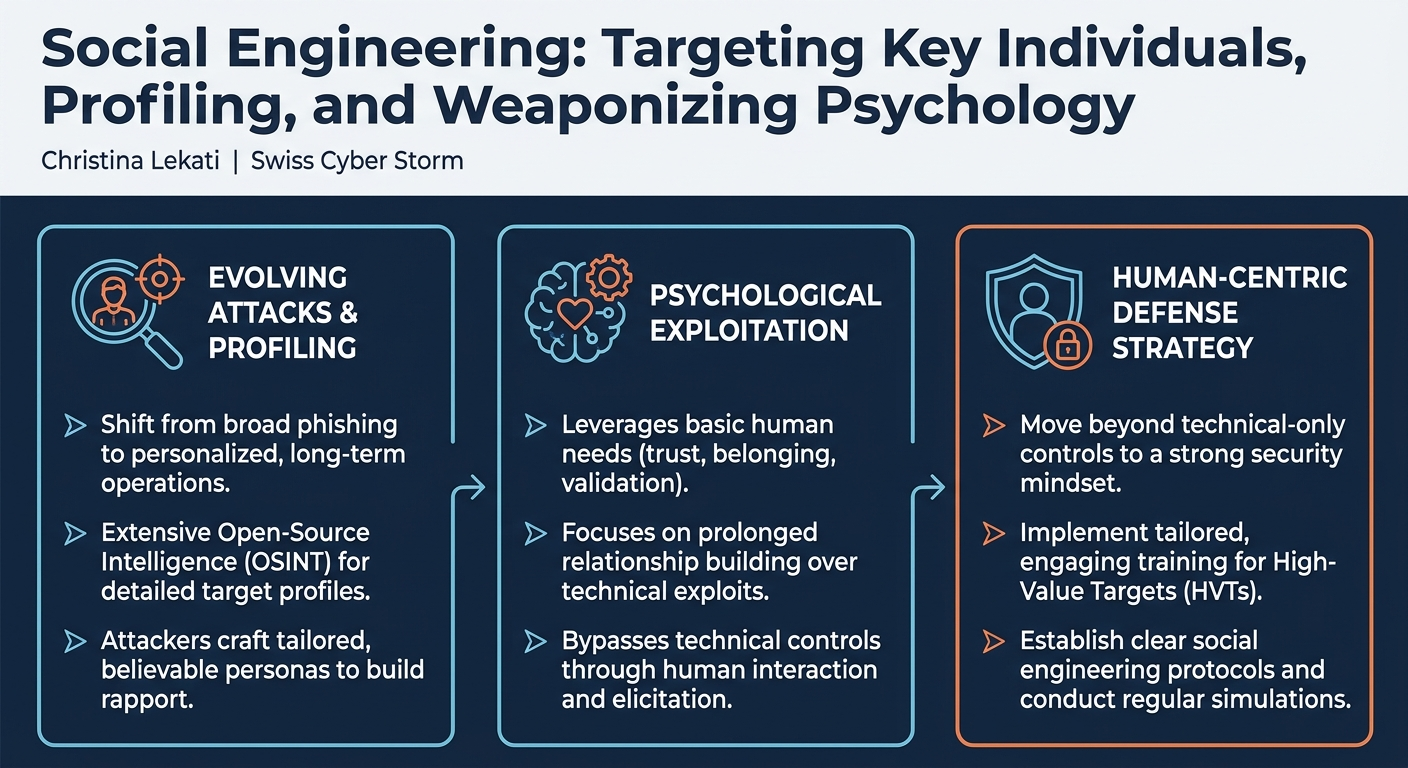
The core of Lekati's discussion revolves around the alarming trend of threat actors moving beyond broad, unsophisticated phishing campaigns to highly personalized, long-term operations. These advanced attacks target high-value individuals within an organization, often outside the corporate security perimeter and through their private, personal channels. By weaponizing human psychology and exploiting basic human needs, attackers can compromise individuals in ways that technical controls cannot prevent, ultimately leading to significant corporate breaches. This talk serves as a critical wake-up call, emphasizing the urgent need for a more nuanced, human-centric approach to cybersecurity that acknowledges and addresses the psychological vulnerabilities inherent in every organization.
Background
▶ Watch: Targeted attacks on key individuals explained (1:45)
For too long, the cybersecurity industry has primarily focused on technical solutions to technical problems, inadvertently creating a significant blind spot: the human element. Lekati highlights that while firewalls, antivirus software, and intrusion detection systems are essential, they are ultimately ineffective if the individuals operating within an organization become the primary vector of attack. The historical approach to user education, often characterized by generic "security awareness" training that simply lists rules like "don't click suspicious links," has proven largely ineffective because it fails to account for how humans actually process information, build trust, and make decisions under pressure.
The problem is exacerbated by the evolution of threat actors. While phishing attacks remain prevalent, Lekati observes a clear shift towards more elaborate and persistent campaigns. These modern social engineering operations leverage extensive open-source intelligence (OSINT) for reconnaissance, enabling attackers to craft highly tailored and personalized approaches. Crucially, these attacks are no longer about quick, opportunistic exploits but rather long-term engagements designed to build rapport and trust. This sophisticated methodology exploits fundamental human psychological needs, such as the need to belong, feel heard, understood, and important – concepts rooted in Maslow's Hierarchy of Needs. This strategic manipulation renders traditional, technical-centric defenses largely irrelevant, as the compromise occurs through human interaction, often in private contexts, before any technical system is even directly engaged.
Key Findings
▶ Watch: How attackers weaponize psychology and human needs (5:45)
Christina Lekati's presentation unveils several critical findings regarding the contemporary landscape of social engineering, underscoring its sophistication and the profound implications for organizational security.
Firstly, the talk highlights the shift from opportunistic, volume-based attacks to highly targeted, long-term social engineering operations. These campaigns are characterized by extensive reconnaissance, meticulous persona building, and a patient, multi-stage approach to compromise. A prime example, dissected in detail, is the Marcela Flores case. This publicly reported incident involved a social media persona targeting individuals in the aerospace defense industry. Marcela Flores spent nearly a year (2019-2020) establishing connections and observing a contractor before initiating contact. The relationship then developed over eight months, involving personal conversations, shared interests, escalating communication platforms (emails, private chats), and even flirting, before the final exploitation. This prolonged engagement was not about exploiting quick triggers like authority or urgency, but rather deep-seated human needs for belonging, validation, and personal connection.
Secondly, Lekati emphasizes the significant return on investment (ROI) for threat actors employing these elaborate methods. Through such relationships, attackers can achieve a multitude of objectives:
- Elicitation of sensitive information: Prolonged conversations are ideal for subtly extracting valuable data.
- Credential harvesting campaigns: Trust established over months can lead to individuals willingly divulging login details.
- Malware deployment: As seen in the Marcela Flores case, a trusted contact can easily persuade a target to click a malicious link, leading to the download of sophisticated malware like Lampyro, designed for persistence, reconnaissance, and exfiltration.
- Recruitment as an insider threat: If a target is identified as disgruntled or vulnerable, the relationship can be leveraged to recruit them as an unwitting or willing insider.
- Support for long-term espionage operations: These contacts can become valuable assets for ongoing intelligence gathering.
Thirdly, the talk identifies specific categories of high-value targets (HVTs) that are disproportionately susceptible to these attacks. While the C-suite, public figures, and executive teams are obvious targets due to their access and authority, Lekati stresses that individuals with high-level access to sensitive information or those working on critical projects (e.g., developers, scientists with proprietary knowledge) are often overlooked but equally vulnerable. These individuals possess invaluable intellectual property, company strategies, and privileged access that technical measures alone cannot protect if the human element is compromised. The speaker cites recent warnings from MI5 and Germany's BFV, highlighting state-sponsored espionage campaigns targeting professionals on platforms like LinkedIn to extract sensitive technological and research information, particularly in countries at the cutting edge of innovation, such as Switzerland. This confirms that the methods observed in cases like Marcela Flores are not isolated incidents but represent a pervasive and growing threat model, used by sophisticated state-sponsored actors like Charming Kitten and various cybercriminal organizations.
Technical Deep Dive
▶ Watch: Who are high-value targets and why they're valuable (12:30)
The effectiveness of advanced social engineering hinges on a sophisticated, multi-stage methodology that meticulously exploits human vulnerabilities. Lekati details this process, beginning with reconnaissance and profiling, moving through persona creation and relationship building, and culminating in subtle yet potent elicitation techniques and eventual exploitation.
The initial phase involves extensive open-source intelligence (OSINT) gathering. Threat actors meticulously scour public sources – social media profiles (LinkedIn, Facebook, Instagram), company websites, news articles, interviews, and public databases – to construct a comprehensive "threat and vulnerability profile" of their intended target. This profile includes details about their professional role, personal interests, family, hobbies, opinions, and even their emotional disposition. The goal is to identify potential human triggers – vulnerabilities that can be leveraged, such as a need for validation, a desire for career advancement, or specific personal interests.
Once a target profile is established, attackers create a fake persona that is highly tailored to the victim's interests and perceived needs. This persona, like "Marcela Flores" with her interest in the aerospace defense industry, is designed to appear authentic and appealing to the target. The attacker then initiates contact, often through professional networking sites or social media, starting with a comfortable, seemingly innocuous conversation. The relationship is then gradually escalated, moving from public platforms to more private communication channels like email, private chat applications, and even video calls. This prolonged relationship building phase, which can span many months, is crucial for establishing deep trust and rapport, making the target more susceptible to manipulation. Flirting, shared personal stories, and expressions of empathy are common tactics to solidify this emotional bond.
A key technical aspect of the exploitation phase is elicitation. This is defined as an effort where seemingly innocent, everyday conversation is subtly blended with specific, risky questions designed to extract sensitive information about individuals, their work, and their colleagues. Lekati provides examples:
- Flattery: "You’re the only one who can help me with advice about this technology; are you using it? I want to know about it." This plays on a person's desire to feel competent and important.
- Commiseration: "Terrible day at work? You can tell me what happened with your manager; I know, I’ve had horrible experiences as well." This exploits shared negative experiences to encourage disclosure.
Elicitation is particularly insidious because it does not involve direct interrogation but rather leverages natural human conversational patterns to gain intelligence without raising suspicion.
Lekati also outlines a five-step process for assessing an individual's vulnerability to these sophisticated attacks, which is crucial for internal defense strategies:
- Criticality: Evaluate the individual's position, importance, and privileges within the organization. Are they a single point of compromise for critical projects?
- Recognizability: Assess how easily identifiable they are by a threat actor (e.g., public role, active online presence).
- Accessibility: Determine if a threat actor could easily engage with them online and escalate a relationship.
- Vulnerability: Profile their online exposure and assess the accuracy of their public persona. Is there a determined threat actor who would invest the resources to compromise them?
- Target Level of Knowledge and Sophistication: Crucially, can the individual identify suspicious behavior or strange questions, and are they empowered to say "no" or deflect the request? This step highlights the individual's psychological resilience and training against such attacks.
The ultimate goal of this deep dive is to illustrate that the "technical" part of these attacks is often the final, almost incidental step (e.g., sending a malicious link), while the true technical mastery lies in the psychological engineering leading up to it.
Demo / Proof of Concept
▶ Watch: Macro and micro defensive strategies and training (22:15)
While Christina Lekati's presentation did not feature a live, interactive software demonstration, the Marcela Flores case study served as a detailed, real-world "proof of concept" for the sophisticated social engineering methodologies she described. This publicly reported incident, sourced from Proofpoint, meticulously illustrated every stage of a long-term, psychologically manipulative attack, providing concrete evidence of its effectiveness and the tactics employed.
The "demonstration" began with the creation of the Marcela Flores persona, a seemingly innocuous social media profile with a specific interest in the aerospace defense industry. This established the initial reconnaissance phase, where Marcela connected with a contractor but remained dormant for almost a full year (late 2019 to November 2020), passively observing and building credibility.
The core of the "demo" then showcased the relationship building and psychological manipulation phases. In November 2020, Marcela initiated contact, leveraging the isolation of the COVID-19 pandemic to foster a deeper connection. Over eight months, the interaction escalated from social media to emails and private chat applications, incorporating personal conversations, shared interests, and even romantic overtures (flirting, pictures, videos, "winky faces"). This prolonged engagement successfully exploited the target's basic human needs for social connection, validation, and importance, cementing a strong sense of trust.
Finally, the "demo" culminated in the exploitation. After months of cultivating this relationship, Marcela sent an email containing a link to a Google Drive document, disguised as a survey about nutritional habits and pandemic experiences – a pretext carefully aligned with their prior conversations. The email instructed the target to "press enable editing to see the full page" and ended with a friendly "cheers and the winky face." Believing he was helping a trusted acquaintance, the individual clicked the link and enabled editing, resulting in the download of the Lampyro malware. This malware was designed to establish persistence, perform reconnaissance, and exfiltrate sensitive information, leading to a significant corporate compromise originating from a seemingly private, personal interaction.
This detailed walkthrough of the Marcela Flores case effectively served as a compelling demonstration, illustrating how a threat actor can weaponize psychology, patience, and meticulous profiling to bypass traditional security measures and achieve a high-value compromise through the human element.
Defensive Implications
▶ Watch: Characteristics of effective security training (29:00)
Defending against sophisticated social engineering requires a fundamental shift in organizational security strategy, moving beyond purely technical controls to embrace a holistic, human-centric approach. Christina Lekati outlines both macro and micro-level defensive implications.
On a macro, organizational level, several key actions are imperative:
- Reinforce a Security Mindset: This is the "Alpha and Omega." Security must be ingrained in the corporate culture, understood as a collective responsibility, not solely the domain of the IT department. This involves leveraging group dynamics and starting with the C-suite, as their behavior sets the tone for the rest of the organization.
- Provide Good Quality Training: Generic, slide-flipping training is ineffective. Training must be actively engaging, relatable, tailored to the specific threats and daily realities of the employees, and interactive. It should build new neural pathways, creating automatic "triggers" for suspicious activity. Incorporating findings from internal OSINT vulnerability assessments can make training particularly resonant, demonstrating how specific employee online behavior creates risks.
- Implement Social Engineering Protocols: Organizations need clear, defined protocols for dealing with suspicious phone calls, unexpected requests, and emerging threats like AI-driven voice cloning or deepfakes. Employees must know how to respond, not just what to avoid.
- Run Exercises and Simulations: Regular, realistic social engineering simulations (e.g., targeted phishing, vishing attempts) help employees experience attacks in practice, reinforcing training and identifying areas for improvement.
- Minimize Employee Decision-Making & Principle of Least Privilege: Where possible, design systems and processes that reduce the opportunities for human error. Adhering to the principle of least privilege ensures that individuals only have the access necessary for their roles, limiting the potential damage if they are compromised.
For high-value targets (HVTs), a more specific, tailored approach is essential:
- Tailored Training for HVTs and Their Assistants: Given their heightened risk profile and access, HVTs require specialized training that addresses their unique vulnerabilities. Crucially, their assistants, who often have similar levels of access, must also be included.
- Elicitation Techniques Training: Lekati highlights that training on how to recognize and deflect elicitation techniques is missing in 9 out of 10 organizations. HVTs must understand how seemingly innocent conversations can be used to extract sensitive information and learn practical deflection strategies.
- Private Life Safety Measures: HVTs need education on how to curate their online presence in their private lives. They must understand how attackers use publicly available information (from social media, interviews, etc.) to build profiles and identify vulnerabilities, and how to manage their digital footprint to minimize exposure.
- Conduct Vulnerability Assessments: Perform specific vulnerability assessments for HVTs, similar to the five-step process outlined in the technical deep dive. Educate them on their personal risk profile to foster greater awareness and understanding.
- Adherence to DCSA Guidelines: The Defense Counterintelligence and Security Agency (DCSA) provides clear guidelines that should be integrated into HVT training:
- Know what information should not be shared.
- Be suspicious of people who seek that information.
- Do not tell people any information they are not authorized to know.
Lekati stresses that common excuses like "I thought something was off but didn't know how to respond" or "I didn't think I could be a target" are clear indicators of a lacking security mindset and inadequate training. The ultimate goal is not to control employees' private lives but to empower them with the knowledge and skills to identify threats, understand their implications, and respond appropriately. Organizations have a responsibility to make sure their people know what the threat is, how to identify it, and how to respond, thereby equipping them to make informed decisions and protect themselves and the organization.
Key Takeaways
- Evolution of Social Engineering: Attacks have progressed far beyond simple, mass-scale phishing emails to sophisticated, long-term, and highly personalized campaigns that weaponize human psychology and exploit basic human needs.
- Psychological Manipulation is Key: Threat actors are increasingly leveraging concepts like Maslow's Hierarchy of Needs (e.g., need to belong, feel important) to build deep trust and rapport over months, making targets susceptible to manipulation that bypasses technical controls.
- High-Value Targets are at Risk: C-suite executives, public figures, and especially individuals working on sensitive projects with high-level access are prime targets. These attacks often occur through private channels and personal online interactions, making traditional corporate security perimeters irrelevant.
- Comprehensive Reconnaissance and Elicitation: Attackers conduct extensive OSINT to build detailed vulnerability profiles, create tailored personas, and then use subtle elicitation techniques in seemingly innocent conversations to extract sensitive information.
- Defense Requires a Human-Centric Shift: Effective defense demands a strong, organization-wide security mindset, tailored and engaging training (especially on elicitation techniques), robust social engineering protocols, and regular simulations. It's crucial to empower individuals to recognize and resist these advanced threats in both their professional and private lives.
- AI and Deepfakes Intensify the Threat: The emergence of AI-driven deepfakes and voice cloning is poised to dramatically escalate the sophistication of social engineering, making it even harder for individuals to discern authenticity and trust established connections.
About the Speaker(s)
Christina Lekati is a distinguished psychologist and social engineer who brings a unique, human-centric perspective to the field of cybersecurity. With extensive experience in both defensive and offensive security projects involving social engineering, she has a profound understanding of the psychological vulnerabilities that threat actors exploit. Christina currently serves as a trainer and consultant for Cyber SKM Bea, based in Zurich, where her work focuses on securing the "human perimeter" of cybersecurity. She is also recognized as one of the lead investigators for high-value target and corporate vulnerability assessments, leveraging advanced open-source intelligence (OSINT) techniques. Prior to this, she was a dedicated member of the OSINT Curious project, further solidifying her expertise in intelligence gathering and analysis. Her background allows her to bridge the gap between human behavior and technical security, offering invaluable insights into how organizations can better protect themselves against sophisticated, psychologically-driven attacks.
Reviews
Dr. Zero (Offensive Security Researcher) — SOLID
A competent but entirely unsurprising breakdown of how state actors do long-term grooming, using the 2021 Marcela Flores campaign as a prop. It's fine for the awareness track, but if you've read a single threat intel report on Iranian APTs in the last five years, you already know this playbook.
Heather Calloway (CISO) — SOLID
A solid, psychologically grounded breakdown of long-term social engineering against high-value targets. Worth watching for your insider risk team, though the defensive recommendations lean too heavily on awareness training over systemic technical controls.