Help! I Have Data Center Nightmares
Stefan Lüders (CERN)
Swiss Cyber Storm 2023 · Day 1 · Arena
Overview
In his talk "Help! I Have Data Center Nightmares" at Swiss Cyber Storm, Stefan Lüders, the Head of Computer Security at CERN, delivered a candid and thought-provoking presentation that resonated deeply with anyone grappling with the complexities of modern IT infrastructure. Lüders, a seasoned veteran with two decades in the field, painted a stark picture of the escalating challenges in securing data centers that have evolved far beyond their simple origins. Far from offering solutions, he presented a litany of problems, articulating the growing chasm between traditional security principles and the demands of contemporary, agile, and cloud-integrated environments.
Key moments
- 2:40 The Death of Simplicity: Complex Data Center Stacks
- 8:30 Hypervisors Bridge Networks, Creating Inherent Vulnerabilities
- 10:40 Ransomware is Inevitable: Exposing Critical Services
- 15:00 Self-Hosted Services: Nightmare of Startup Dependencies
- 16:40 Cloud Computing: The Real Nightmare of Integration
- 19:00 Uncontrolled Software Supply Chain and External Dependencies
- 25:00 Coping with Complexity: Layered Security & Zero Trust
Help! I Have Data Center Nightmares
Speakers: Stefan Lüders, Head of Computer Security, CERN
Conference: Swiss Cyber Storm
YouTube: https://www.youtube.com/watch?v=FavkmTYeKo8
Overview
In his talk "Help! I Have Data Center Nightmares" at Swiss Cyber Storm, Stefan Lüders, the Head of Computer Security at CERN, delivered a candid and thought-provoking presentation that resonated deeply with anyone grappling with the complexities of modern IT infrastructure. Lüders, a seasoned veteran with two decades in the field, painted a stark picture of the escalating challenges in securing data centers that have evolved far beyond their simple origins. Far from offering solutions, he presented a litany of problems, articulating the growing chasm between traditional security principles and the demands of contemporary, agile, and cloud-integrated environments.
The core of Lüders' "nightmares" stems from the fundamental conflict between security, convenience, and cost – a dilemma he encapsulated as the "convenient, cheap, secure: pick two" mantra. He argued that the relentless pursuit of elasticity, scalability, and cost-efficiency has led to an unprecedented level of complexity, rendering established security practices like defense-in-depth and Keep It Simple, Stupid (KISS) increasingly difficult, if not impossible, to implement effectively. This talk serves as a critical reflection on the state of enterprise security, highlighting the systemic issues faced by large organizations that must balance cutting-edge research and operational demands with robust cybersecurity.
Why does this matter? Lüders' experiences at CERN, a global scientific research organization operating at the forefront of technology, are a microcosm of the struggles faced by countless enterprises worldwide. As organizations embrace virtualization, containerization, hybrid cloud models, and agile development, they inherit a labyrinth of interconnected systems and dependencies. His "nightmares" are a universal warning, urging the security community to acknowledge the profound impact of this complexity on our ability to defend against ever-evolving threats and to seek new paradigms for securing these intricate digital ecosystems.
Background
▶ Watch: The Death of Simplicity: Complex Data Center Stacks (2:40)
For decades, the foundation of computer security at institutions like CERN rested on two seemingly immutable mantras: defense-in-depth and KISS (Keep It Simple, Stupid). In the past, data centers were characterized by a straightforward architecture. Lüders described this as the "toaster" model: physical hardware running a basic BIOS, an operating system, and a single application on top. These systems, particularly those managing critical infrastructure like CERN's particle accelerators, were often physically isolated, operating on dedicated networks. Data analysis for experiments, involving thousands of PCs, also resided in separate, self-contained computer centers. This simplicity meant rudimentary BIOSes that were hard to alter, and if changes were needed, physical presence was required to flash the ROM. Security was relatively manageable because the attack surface was limited, and segmentation was inherent.
However, the landscape began to shift dramatically with the advent of new technological demands. The need for agility, elasticity, business continuity, disaster recovery, load balancing, Big Data analytics, machine learning, and eventually cloud computing rendered the simple "toaster" model obsolete. Modern data centers had to centralize resources, support diverse user communities (from industrial controls to experimental physicists running web pages), and scale on demand. The amount of data exploded, with CERN reaching the one exabyte limit of storage in September of the talk year. This evolution led to an explosion in complexity, fundamentally challenging the KISS principle.
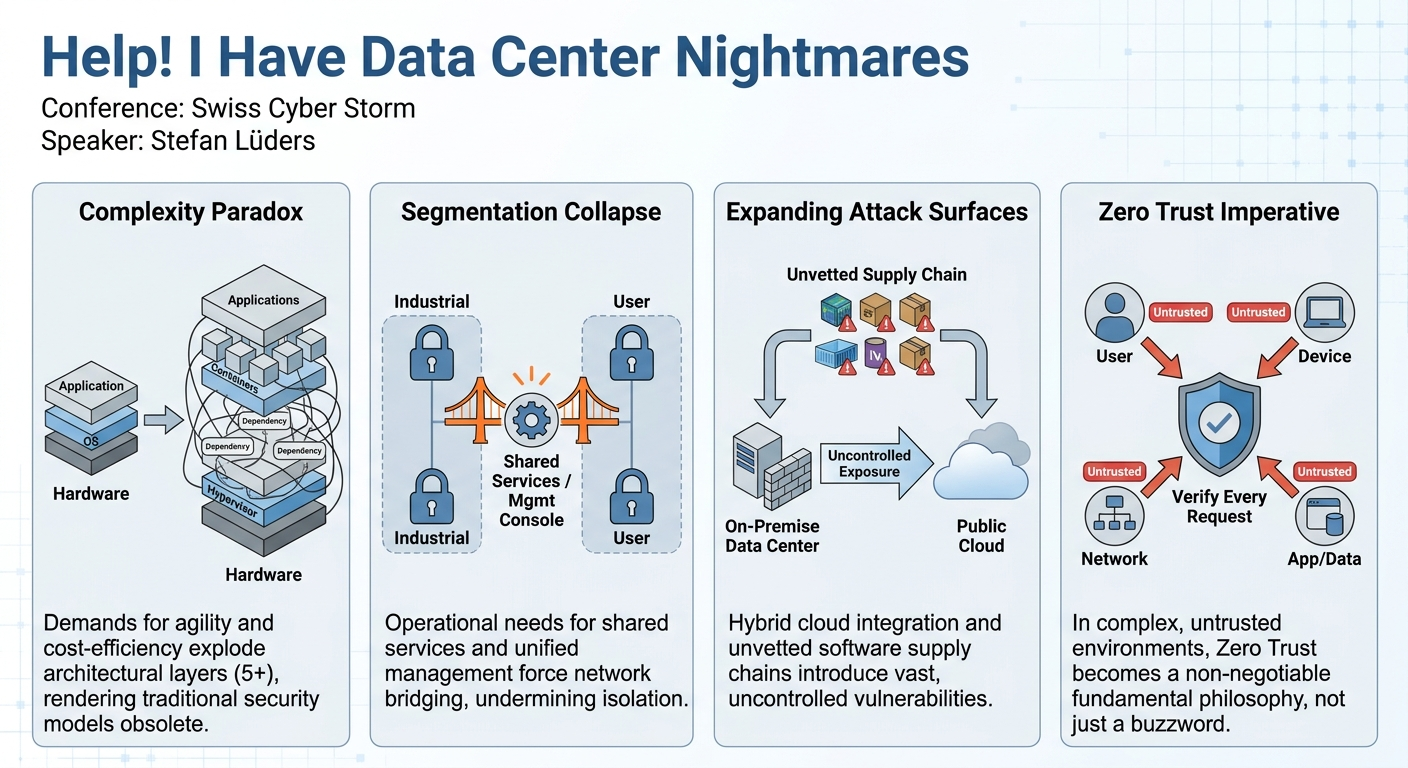
The straightforward three-layer stack morphed into a multi-layered behemoth: physical hardware (now with full-blown operating systems and complex BMC/IPMI), a hypervisor, virtual machines (VMs), containers, and then the applications within them. This five-layer (or more) stack introduced new attack surfaces and interdependencies. Furthermore, the "third mantra" of computer security emerged: "convenient, cheap, secure – pick two." Lüders lamented that security often loses out in this equation, as it doesn't offer immediate tangible benefits until a crisis hits. This constant pressure to prioritize convenience and cost over robust security has systematically undermined the ability to maintain defense-in-depth, creating the "circular nightmares" that now plague data center operators.
Key Findings
▶ Watch: Ransomware is Inevitable: Exposing Critical Services (10:40)
Stefan Lüders' talk unveiled a series of critical findings that illuminate the profound security challenges in modern, complex data center environments:
- Explosive Architectural Complexity: The traditional, simple three-layer computing stack (hardware, OS, application) has evolved into a five-plus-layer labyrinth incorporating hardware, host OS, hypervisors, virtual machines, containers, and applications. This exponential increase in layers and interdependencies creates a vast and intricate attack surface that is difficult to secure holistically.
- Forced Network Bridging and Segmentation Collapse: The operational imperative for agility, elasticity, and centralized management (e.g., shared DHCP, NTP, DNS) inevitably leads to the bridging of logically separate networks (management, provisioning, user, industrial control). Administrators' desire for a single console, coupled with application requirements to expose services across different zones, systematically undermines traditional network segmentation.
- Hypervisor as a Single Point of Failure: Hypervisors, while enabling elasticity, become critical points of vulnerability. If compromised, they can effectively bridge all virtual networks and applications running on them. Lüders cited the impact of Spectre and Meltdown vulnerabilities, which forced CERN to take 70,000 servers offline for 48 hours for patching.
- Circular Dependencies in Self-Hosted Infrastructure: Essential data center services like Single Sign-On (SSO), LDAP, Active Directory, Puppet, Ansible, databases, and storage systems are frequently self-hosted within the same virtualized infrastructure they are meant to manage. This creates inherent startup loops and complex interdependencies that make disaster recovery and even routine reboots incredibly challenging and prone to failure.
- Hybrid Cloud as an Uncontrolled Expansion of Attack Surface: Integrating on-premise data centers with public cloud providers (e.g., AWS, Azure, Google, Oracle) necessitates opening vast network ranges (often Class B networks), leading to a significant loss of visibility and control. Organizations become exposed to vulnerabilities originating from other tenants or shared cloud infrastructure, as evidenced by incidents involving Okta and ServiceNow that directly impacted CERN.
- Pervasive Software Supply Chain Risk: The agile development paradigm, where developers (even physicists at CERN) routinely pull in unvetted containers from public repositories (e.g., Docker Hub) or third-party libraries via package managers like npm and PyPI, introduces an uncontrolled influx of potentially malicious or vulnerable code into production systems. This creates a constant struggle to understand and mitigate software supply chain attacks.
- The Inevitability of Zero Trust: Given the inherent inability to trust any single component or maintain clear perimeters in such complex, interconnected environments, Lüders concluded that Zero Trust is no longer a marketing buzzword but a fundamental, unavoidable security philosophy. Every element must be distrusted and continuously verified.
Technical Deep Dive
▶ Watch: Self-Hosted Services: Nightmare of Startup Dependencies (15:00)
The fundamental shift described by Stefan Lüders is from a simple, isolated "toaster" stack to a highly virtualized, interconnected, and often cloud-integrated architecture.
In the past, CERN's accelerators and data analysis systems ran on a straightforward stack: physical hardware (like "pizza box PCs"), a rudimentary BIOS (often unalterable remotely), a single operating system, and the application directly on top. Control systems operated on physically separate networks, ensuring robust isolation. Data analysis was handled by "PC farms" in their own data centers.
Today, this has been entirely transformed. The modern stack involves:
- Hardware: Still physical servers, but now running a full-blown OS and equipped with sophisticated Baseboard Management Controllers (BMCs) like IPMI for remote management. Patching these BMCs and BIOS firmware (from vendors like Supermicro, Dell, HP) is a significant challenge, often taking "months" to receive and deploy updates.
- Hypervisor: A critical layer (e.g., VMware ESXi, KVM, Hyper-V) that allows for multiple virtual machines to run on a single physical host, enabling elasticity and efficient resource utilization.
- Virtual Machines (VMs): Full virtualized instances of operating systems, each running its own applications. CERN manages "60,000 virtual machines" in its largest computer center, which spans "12,000 enclosures."
- Containers: Lightweight, isolated environments (e.g., Docker, Kubernetes) that package applications and their dependencies, offering even greater agility and portability than VMs. Applications are deployed within these containers.
This multi-layered stack immediately complicates traditional security. The hypervisor itself, while a boon for resource management, introduces a new attack surface. Lüders highlighted the impact of CPU vulnerabilities like Spectre and Meltdown, which affect the underlying hardware and hypervisor, potentially allowing guest VMs to access data from other VMs or the host. Addressing these required taking "70,000 servers into sleep" for "48 hours" across multiple patching cycles (2019, 2022).
The network architecture, once easily segmented, has become a quagmire of compromises. Ideally, CERN would have four-fold network separation:
- Management Network: For hardware control (BIOS, IPMI).
- Provisioning Network: For deploying VMs and containers.
- User/Internet Network: For general user access, web services, and external connectivity.
- Industrial Control Network: For critical infrastructure.
However, the "pick two" mantra makes physical separation prohibitively expensive. Instead, organizations rely on Virtual LANs (VLANs) and Software-Defined Networks (SDNs). Even these are often bridged for operational convenience. Core services like DHCP, NTP, and DNS are difficult to quadruple, leading to centralized, shared infrastructure that inherently bridges networks. For example, an electronic logbook for accelerator events needs to be accessible from both the industrial network and user offices, forcing a bridge. Firewalls are deployed, but as examples like the Bessie 2 accelerator in Berlin and the ALMA observatory in Chile experiencing ransomware attacks demonstrate, they are not foolproof.
Administrative convenience further exacerbates bridging. Administrators demand a single console to manage hardware, provision systems, and access the internet, inadvertently creating network pathways. Remote access for administrators (e.g., working from home) further extends the trusted perimeter. Even multi-factor authentication (MFA) has seen "fuckups" in the past, as noted in the talk, indicating it's not a silver bullet.
Provisioning and monitoring systems like Puppet, Chef, Ansible, Docker, and Kubernetes are essential for managing this complex environment. These tools, along with their associated databases and storage systems, are typically connected to the provisioning network. Crucially, critical infrastructure such as Single Sign-On (SSO), LDAP, Active Directory, and the provisioning tools themselves are often "self-hosted on the same bare metal, on the same virtual machines, and it's same containers." This creates a fragile ecosystem where a power loss or failure requires a meticulously planned and tested startup sequence, as dependencies (e.g., SSO needs AD, AD needs a database, database needs storage, all of which might be on VMs that aren't yet up) create "inherent loops."
The integration of cloud computing introduces the next level of nightmare. Connecting CERN's on-premise infrastructure to public clouds like Amazon, Azure, Google, and Oracle requires opening vast swathes of network space. Lüders highlighted the challenge of opening "Class B networks" for services like Exchange Online or Teams, without knowing what other, potentially malicious, traffic might traverse those shared cloud segments. Recent incidents, such as the Okta breach (October 20th, 2023, where "hacker stole access token from OCTA support unit" and a prior incident involving "10,000 logins") and the compromise of ServiceNow (a "cloud service hosted outside CERN"), underscore the extended attack surface and loss of control inherent in hybrid cloud models.
Finally, the software supply chain presents a constant threat. CERN's "15,000 physicists" are de facto programmers, developing control systems, machine learning models, and web pages. They routinely reuse external software, downloading containers from public registries or pulling libraries via package managers like npm and PyPI. This introduces unvetted code into the production pipeline. Lüders mentioned SBOM (Software Bill of Materials) as a potential mitigation, alongside SAST (Static Application Security Testing) and DAST (Dynamic Application Security Testing) tools integrated into GitLab for code analysis. He also noted tools like Harbor for container curation, but acknowledged the difficulty in telling end-users about vulnerabilities they can't fix, especially when legacy code requires specific, outdated components like "Python 2.7."
Demo / Proof of Concept
▶ Watch: Uncontrolled Software Supply Chain and External Dependencies (19:00)
Stefan Lüders' talk focused on articulating the pervasive challenges of modern data center security rather than demonstrating a specific exploit or proof-of-concept. His presentation was a high-level, yet deeply technical, exploration of the systemic issues arising from architectural complexity and operational demands.
Defensive Implications
▶ Watch: Coping with Complexity: Layered Security & Zero Trust (25:00)
Stefan Lüders' "nightmares" offer a stark assessment of the current state of data center security, presenting critical defensive implications for any organization navigating similar complexities:
- Embrace and Implement Zero Trust: This is no longer a buzzword but a fundamental necessity. Defenders must assume compromise and distrust every component, user, and network segment, both internal and external. This requires granular access controls, continuous authentication and authorization, micro-segmentation, and strong identity management across all layers of the stack.
- Prioritize Software Supply Chain Security: Implement rigorous policies and technical controls for all external software dependencies. This includes mandatory use of Software Bill of Materials (SBOMs), automated vulnerability scanning (using SAST and DAST tools in CI/CD pipelines, like CERN does with GitLab), and the use of curated, trusted repositories for containers (e.g., Harbor) and libraries. Organizations must understand the provenance and security posture of every component entering their environment.
- Redefine Network Segmentation: While physical network separation remains ideal but often impractical, defenders must push for the strongest possible logical segmentation within VLANs and SDNs. Critical management planes (for hardware, hypervisors, and provisioning) must be isolated as much as possible, with strict ingress/egress filtering. The necessity of network bridging for services must be meticulously documented, justified, and secured with robust controls like next-generation firewalls and intrusion detection systems.
- Fortify the Management Plane: The hypervisor, BMCs/IPMI, and provisioning systems (Puppet, Ansible, Kubernetes) are critical targets. They must be secured with the highest levels of authentication (MFA), authorization (least privilege), and patching diligence. The complexities of hardware firmware updates need to be actively managed with vendors, demanding faster patch cycles.
- Architect for Resilience and Recoverability: Given the circular dependencies of self-hosted critical infrastructure (SSO, AD, databases), meticulous planning for startup and shutdown sequences is crucial for business continuity and disaster recovery. This involves documenting every dependency, thoroughly testing DR plans, and potentially designing for out-of-band recovery mechanisms for core services.
- Demand Transparency and Control in Hybrid Cloud: When integrating with public clouds, organizations must advocate for greater visibility into shared network segments and robust security assurances from cloud providers. Implement strong cloud security posture management (CSPM) and cloud workload protection (CWPP) solutions to monitor and secure cloud environments. Limit the scope of network access (avoiding broad "Class B network" openings) wherever possible.
- Address Legacy Systems Strategically: Legacy code and systems that cannot be easily updated or replaced must be identified, isolated, and protected with compensating controls. This might involve containerizing legacy applications, placing them behind application firewalls, or implementing strict network access policies to minimize their exposure.
- Invest in Security Operations and Automation: A strong Security Operations Center (SOC) with robust Intrusion Detection Systems (IDS), centralized patching, and comprehensive monitoring (including code monitoring) is non-negotiable. Automation in patching, vulnerability management, and incident response can help cope with the scale and speed of modern data centers.
Key Takeaways
- Complexity is the New Norm: Modern data centers, driven by demands for agility and elasticity, have exploded in complexity, making traditional security mantras like KISS and simple defense-in-depth largely obsolete.
- Security vs. Convenience/Cost Dilemma: The "convenient, cheap, secure — pick two" paradigm often forces organizations to compromise on security, leading to inherent vulnerabilities and "nightmares" for security professionals.
- Bridging Undermines Segmentation: The operational necessity for shared services and administrative convenience inevitably leads to network bridging, eroding the effectiveness of traditional segmentation and creating interconnected attack paths.
- Hybrid Cloud Expands the Attack Surface: Integrating with public cloud services introduces significant new risks, including loss of visibility, uncontrolled network exposure, and reliance on the security posture of third-party providers.
- Software Supply Chain is a Critical Vulnerability: The widespread reuse of external containers and libraries in agile development pipelines introduces pervasive and hard-to-manage software supply chain risks.
- Zero Trust is an Imperative: Given the inability to trust any single component or maintain clear perimeters in complex, interconnected environments, Zero Trust has become a non-negotiable security philosophy.
About the Speaker(s)
Stefan Lüders is the Head of Computer Security at CERN, the European Organization for Nuclear Research. With over 20 years of experience in the field, he is a seasoned expert in managing the intricate security challenges of large-scale, cutting-edge IT infrastructures. A regular and well-regarded speaker at conferences like Swiss Cyber Storm, Lüders is known for his candid and pragmatic insights into real-world security problems, often presenting the difficulties faced by organizations rather than offering easy solutions. His role at CERN places him at the forefront of securing systems critical to global scientific research, from industrial controls for particle accelerators to vast data analysis grids and cloud integrations.
Reviews
Dr. Zero (Offensive Security Researcher) — SOLID
Stefan Lüders gets on stage and bleeds about why modern multi-layer infrastructure is fundamentally undefendable. There are no zero-days here, just a brutally honest operational baseline of what happens when you stack hypervisors, containers, and circular Active Directory dependencies.
Heather Calloway (CISO) — STRONG ACCEPT
Lüders delivers an unsentimental, operator-level diagnosis of why enterprise security architecture is collapsing under its own weight. This is a mandatory reality check for any leadership team that still believes they have clean network segmentation or reliable disaster recovery in a hybrid cloud environment.