How to deal with the inevitable chaos of the cloud: on humans and reality.
Edzo Botjes
Swiss Cyber Storm 2023 · Day 1 · Scenario
Overview
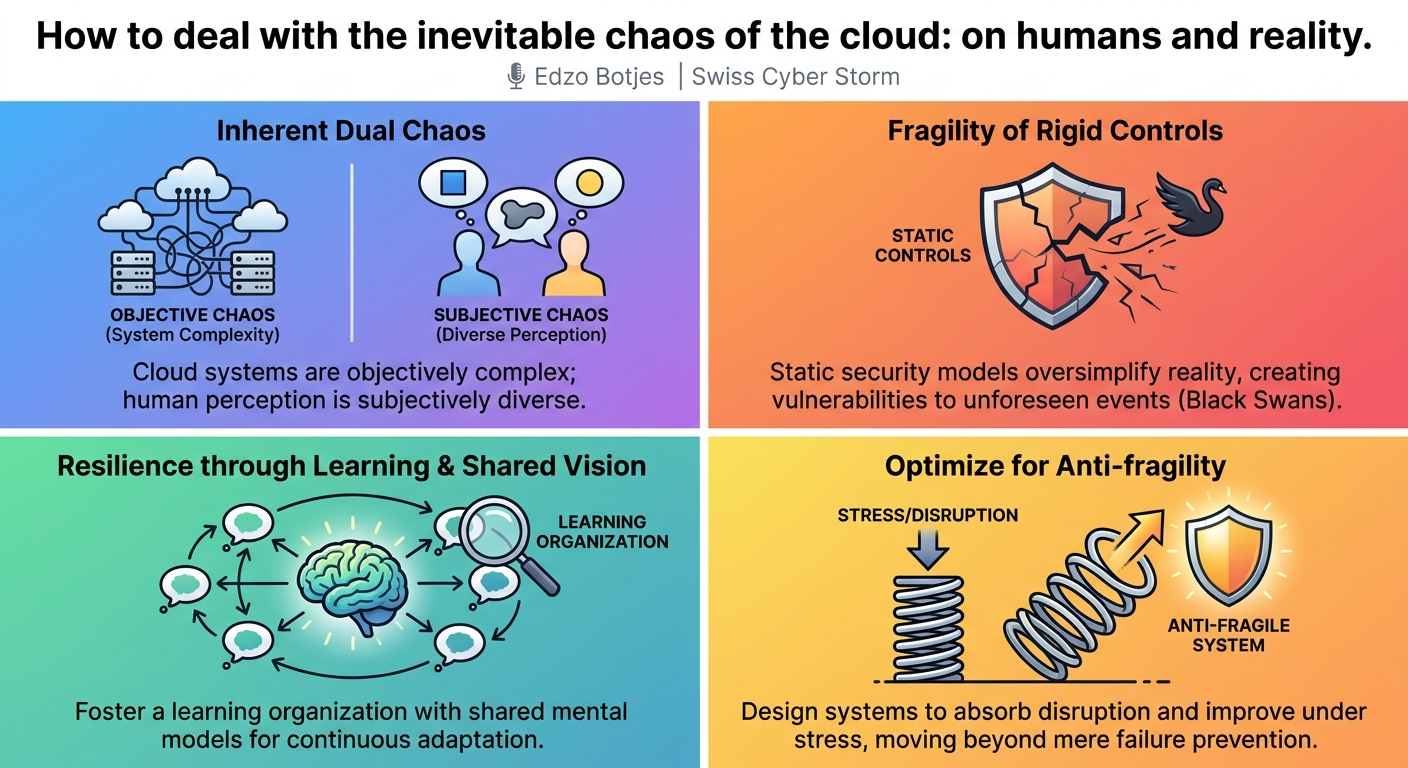
In his Swiss Cyber Storm talk, "How to deal with the inevitable chaos of the cloud: on humans and reality," Edzo Botjes presents a compelling argument that the fundamental nature of reality, and by extension, complex IT systems like the cloud, is inherently chaotic. Drawing on over three decades of experience in IT, including a deep dive into cloud and product security, Botjes challenges conventional security wisdom that often seeks to impose rigid order on an unruly world. His presentation transcends typical technical discussions, instead focusing on the philosophical underpinnings of complexity, human perception, and organizational learning as critical elements for building resilient and anti-fragile systems.
Key moments
- 0:00 Introduction and the speaker's unique perspective
- 4:30 Objective vs. Subjective Chaos: The core problem
- 9:30 Mind creates reality: Visual examples of perception
- 14:00 Learning organization: 5 disciplines with football example
- 17:00 Embracing inevitable chaos: Key takeaways and call to action
- 19:00 Q&A: Anti-fragility vs. dampening chaos
- 22:00 Q&A: Why hyperscalers differ in security
- 25:00 Q&A: Sales KPIs versus engineering reality
How to deal with the inevitable chaos of the cloud: on humans and reality.
Speakers: Edzo Botjes
Conference: Swiss Cyber Storm
YouTube: https://www.youtube.com/watch?v=Og7IKtn2YiY
Overview
In his Swiss Cyber Storm talk, "How to deal with the inevitable chaos of the cloud: on humans and reality," Edzo Botjes presents a compelling argument that the fundamental nature of reality, and by extension, complex IT systems like the cloud, is inherently chaotic. Drawing on over three decades of experience in IT, including a deep dive into cloud and product security, Botjes challenges conventional security wisdom that often seeks to impose rigid order on an unruly world. His presentation transcends typical technical discussions, instead focusing on the philosophical underpinnings of complexity, human perception, and organizational learning as critical elements for building resilient and anti-fragile systems.
Botjes posits that our attempts to simplify and control reality, while necessary for initial understanding, ultimately create vulnerabilities. He introduces the concepts of "objective chaos" – the inherent non-determinism of interconnected systems – and "subjective chaos" – the diverse and often conflicting interpretations humans have of the same reality. This dual perspective is crucial for understanding why traditional security controls frequently fall short in dynamic cloud environments. The talk emphasizes that true resilience comes not from eliminating chaos, but from embracing it and building learning organizations capable of continuous adaptation.
The significance of Botjes' message lies in its reframing of the security challenge. Rather than viewing security as a static set of technical configurations or compliance checklists, he advocates for a human-centric approach rooted in shared understanding, continuous feedback, and adaptive learning. This perspective is particularly vital in the context of rapidly evolving cloud infrastructures, where constant innovation and interconnectedness amplify complexity. By shifting the focus from perfect control to intelligent adaptation, Botjes offers a powerful framework for navigating the inherent "chaos of the cloud" and fostering genuine anti-fragility within organizations.
Background
▶ Watch: Introduction and the speaker's unique perspective (0:00)
Edzo Botjes frames the core problem of managing complex systems, particularly in cloud security, through a deeply personal lens. His journey into understanding chaos began with his experiences with dyslexia and eczema, which, as he explains, made the world appear inherently chaotic and difficult to process linearly. This personal struggle led him to seek "hacks" to make sense of reality, initially exploring left-brain, analytical approaches with "nerds" and theories. He quickly encountered the scientific acknowledgement of chaos in systems, citing the double pendulum as a classic example of a non-deterministic system and referencing the butterfly effect in weather prediction. These insights from physics and mathematics solidified his understanding that even the objective world is chaotic.
However, Botjes realized that objective chaos was only half the story. His exploration then shifted to the "right side of his mind," focusing on stories, theories, and human interpretation. Here, he discovered the concept of the Black Swan – the idea that our simplified narratives of reality invariably miss crucial details, leading to inherent fragility and vulnerability. This led to his fundamental premise: "On the left side, we create the vulnerable reality [objective chaos, by connecting stuff]; on the right side, we [through our subjective interpretation] are vulnerable for reality."
To further illustrate the pervasive nature of subjective chaos, Botjes delves into philosophical and psychological examples. He references Plato's Allegory of the Cave, where humans perceive only reflections of reality, interpreting them through their own mental models. This ancient wisdom, he argues, directly applies to modern perceptions of technology and security. He provides a vivid modern example: the viral blue/white dress illusion, demonstrating how the same objective image can be perceived with entirely different colors by different individuals. He even shows a static image that appears to move to most people, underscoring how our minds actively create color, movement, and even time. These examples highlight that "there is not a right or wrong in this case," but rather different, equally valid interpretations. This subjective interpretation directly impacts how individuals within an organization understand and implement security controls, leading to a "large amount of implementations" for any given model or architecture. This inherent divergence in understanding, Botjes argues, is why "what we write down, draw, it does make sense later" but is interpreted differently by everyone.
The problem, therefore, is not just the objective complexity of cloud environments, but the compounding effect of diverse human interpretations on top of that complexity. Organizations, driven by the desire to innovate and meet consumer demands, constantly introduce new services and connections, inadvertently creating more complexity and chaos. This reality, as evidenced by numerous data leaks from even "really smart companies" like Microsoft or incidents involving secure file transmission services like MoveIt, demonstrates that even the best intentions and engineering cannot fully contain the chaos. The challenge, then, is not to eliminate chaos – which is impossible – but to understand and adapt to its inevitable presence.
Key Findings
▶ Watch: Mind creates reality: Visual examples of perception (9:30)
Botjes' central and most critical finding is that reality, particularly in complex systems like cloud environments, is fundamentally chaotic, both objectively and subjectively. This chaos is not a bug to be fixed, but an inherent feature to be embraced. Our traditional approaches to security, which often strive for deterministic control and simplified models, are inherently fragile because they fail to account for this dual nature of chaos.
He identifies several key facets of this finding:
- Objective Chaos is Inevitable: The interconnectedness of modern IT systems, especially in the cloud, creates non-deterministic systems. As organizations constantly innovate and integrate new services, they continuously generate complexity. This objective chaos leads to situations where even highly competent teams at major companies experience significant security incidents, not due to a lack of knowledge or skill, but because of the sheer complexity they operate within.
- Subjective Chaos Shapes Our Reality: Humans do not perceive reality directly but interpret it through mental models. This leads to diverse and often conflicting understandings of the same information, be it a visual illusion or an architectural diagram. This subjective chaos means that even well-documented controls or architectures are interpreted differently by each individual, leading to varied implementations and expectations. This inherent divergence makes achieving a truly unified security posture incredibly challenging.
- Simplification Breeds Fragility: Our attempts to simplify complex systems and narratives, while necessary for communication and initial understanding, inherently omit details. This "Black Swan" effect means there's always something not accounted for, making our systems vulnerable and fragile to unforeseen events.
- The Illusion of Control: The belief that we can fully control or eliminate chaos is a dangerous illusion. Security efforts focused solely on rigid controls without accounting for human interpretation and the dynamic nature of systems are destined to fail or be outmaneuvered by reality.
- The Path to Resilience is through Learning and Adaptation: Given the inevitability of chaos, true resilience and anti-fragility come from fostering a learning organization. This means moving beyond static controls to dynamic processes that encourage continuous feedback, shared understanding, and adaptation. The emphasis shifts from predicting and preventing every possible failure to rapidly learning from incidents and evolving.
Ultimately, Botjes' key finding is a call to fundamental paradigm shift: accept chaos, understand its dual nature, and build human-centric systems and organizations designed to learn and adapt within that chaos, rather than fruitlessly fighting against it.
Technical Deep Dive
▶ Watch: Embracing inevitable chaos: Key takeaways and call to action (17:00)
While Edzo Botjes' talk does not delve into specific code snippets, protocols, or CVEs, it provides a profound technical deep dive into the architectural, organizational, and cognitive challenges inherent in designing and securing complex cloud systems. The "technical" aspect here is less about implementation details and more about the fundamental principles that govern how we conceive, build, and secure these systems, acknowledging the human element as an inextricable part of the technical landscape.
Botjes illustrates how the inherent chaos of reality directly impacts Enterprise Architecture and the design of security controls. He presents a model where an architect designs a system, which is then "consumed by the audience" – the developers, operators, and other stakeholders. Critically, each individual "interprets this at your current situation in a different way." This leads to a "large amount of implementations" of the same model, because "everybody reads it in a different way." This divergence is a core architectural challenge: what is drawn or written down is not necessarily what is understood or implemented. This highlights a fundamental flaw in traditional, document-heavy architectural approaches that assume universal interpretation.
To address this, Botjes introduces a framework for building a learning organization, drawing heavily from Peter Senge's "The Fifth Discipline." This framework is not merely theoretical but is presented as a practical, human-centric approach to managing technical complexity and fostering resilience. The five disciplines, which Botjes relates to his personal experience in American football, are:
- Personal Mastery: This involves individuals continuously clarifying and deepening their personal vision, focusing their energies, developing patience, and seeing reality objectively. In a technical context, this translates to developing deep expertise and muscle memory, akin to rigorous training in sports. Botjes emphasizes it's about individual commitment to excellence and understanding.
- Shared Vision: This is about building a shared picture of the future that fosters genuine commitment and enrollment rather than mere compliance. For technical teams, this means moving beyond individual interpretations of requirements to a collective understanding of "what do we want to achieve?" Botjes' American football anecdote perfectly illustrates this: the team's shared vision to protect the quarterback was motivated by the simple, relatable goal of getting a barbecue from him. This "gimmick" aligns individual actions towards a collective outcome, even if the underlying rationale is unconventional.
- Team Learning: This discipline focuses on the capacity of a team to think together, to harness the energy of diverse perspectives, and to develop collective intelligence. It involves "talking a lot to each other" about how to approach problems and understanding different viewpoints. In a technical setting, this means collaborative design, code reviews, and incident response discussions where diverse mental models are openly discussed and reconciled.
- Mental Models: These are deeply ingrained assumptions, generalizations, or even pictures or images that influence how we understand the world and take action. Botjes highlights that we need to be aware of our own mental models and, more importantly, "talk to each other" to understand the mental models of others. This is crucial for security, as different teams (e.g., developers, operations, security) often operate with vastly different mental models of risk, functionality, and priorities.
- Systems Thinking: This is the integrating discipline, the one that makes sense of the others. It's a conceptual framework that makes patterns clearer and helps us see how to change them effectively. It means understanding that "everything is connected" and that actions in one part of the system have ripple effects throughout. For cloud architectures, this means understanding the intricate dependencies between microservices, APIs, and shared infrastructure, and recognizing that seemingly isolated changes can lead to systemic chaos if not considered holistically.
Botjes explicitly links smart microservices and monolithic structures to the concept of chaos, noting that "more interfaces without state checks" inevitably lead to chaos. He challenges the perception that "documentation doesn't mean anything" or "does mean anything," stating that it's all about perception and understanding stakeholders. The architectural implication is that simply breaking down a monolith into microservices doesn't inherently reduce complexity; if not managed with a deep understanding of interdependencies and shared mental models, it can amplify chaos. The goal is not merely to optimize for efficiency, but to "optimize for stress" – to build systems and organizations that can learn and adapt when things inevitably go wrong. This anti-fragile approach is the true technical deep dive into effective cloud security.
Demo / Proof of Concept
▶ Watch: Q&A: Anti-fragility vs. dampening chaos (19:00)
While Edzo Botjes' talk did not feature a traditional technical demonstration of a exploit, tool, or secure system, it effectively employed conceptual demonstrations to illustrate the core principles of subjective chaos and human perception. These visual proofs of concept were integral to building the audience's understanding of why traditional, objective-focused security approaches are insufficient.
Specifically, Botjes used the following examples:
- The Blue/White Dress Illusion: This widely known internet phenomenon served as a powerful, immediate example of how the human mind can interpret the exact same objective visual data (as confirmed by RGB color picker analysis) in completely different ways. For some, the dress appeared blue and black, while for others, it was white and gold. This directly demonstrated how "your mind is playing tricks on you" and highlighted the existence of subjective reality.
- Static Image Appearing to Move: Botjes presented a static, two-dimensional image that, for most viewers, appeared to have subtle, flowing movement. He noted that focusing on a single point or placing a cursor on it would make the movement stop. This further underscored how our minds actively "create movement" and interpret visual information beyond its objective properties.
These demonstrations served as crucial proofs of concept for the talk's central argument: if humans can so profoundly disagree on the objective reality of a simple image, how much more divergence can be expected when interpreting complex cloud architectures, security policies, or incident reports? They visually reinforced the idea that human perception and mental models are not merely peripheral to security, but are fundamental drivers of how systems are understood, built, and defended. They effectively paved the way for the audience to accept the premise of "subjective chaos" before moving into the solutions proposed for a learning organization.
Defensive Implications
▶ Watch: Q&A: Sales KPIs versus engineering reality (25:00)
Edzo Botjes' talk offers profound defensive implications for security practitioners, shifting the focus from an unattainable ideal of perfect control to a pragmatic embrace of chaos and continuous learning. Defenders must recognize that the cloud's inherent complexity and the diverse human interpretations of that complexity make traditional, rigid security controls inherently fragile.
Here are the key defensive implications:
- Embrace Chaos, Don't Fight It: The first step is acknowledging that chaos is inevitable, not a failure. Instead of trying to eliminate all complexity or impose absolute order, security teams should focus on building systems and processes that are anti-fragile – designed to thrive and learn from disruption. This means moving beyond a purely preventative mindset to one that incorporates resilience, rapid detection, and adaptive response.
- Prioritize Shared Mental Models and Communication: Given the pervasive nature of subjective chaos, security teams must actively work to foster shared mental models across the organization. This involves:
- Explicit Communication: Don't assume that documentation or diagrams are interpreted uniformly. Engage in active dialogue to validate understanding.
- Cross-functional Collaboration: Break down silos between security, development, and operations. Encourage team learning through joint design sessions, threat modeling, and incident debriefs.
- Relatable Vision: Translate complex security goals into simple, relatable shared visions that resonate with different teams, much like Botjes' American football analogy.
- Shift from Static Controls to Dynamic Learning: Rigid, top-down security controls are insufficient in dynamic cloud environments. Defenders should:
- Focus on Behavior over Controls: Instead of solely focusing on technical controls, understand the behaviors that drive security outcomes. Encourage secure coding practices and operational discipline through education and feedback loops.
- Implement Continuous Feedback Loops: Establish mechanisms for constant validation and learning. This includes regular security testing, post-mortems (or "team drinks" as Botjes humorously puts it) for both successes and failures, and iterative refinement of security measures.
- Optimize for Stress: Design systems to handle and learn from incidents, rather than just trying to prevent them. This involves robust incident response playbooks, chaos engineering, and regular drills to build organizational muscle memory.
- Understand Stakeholder Perception: Security measures must align with business value. Defenders need to be acutely aware of "who your stakeholders are" and "what you're doing," making security explicit and understandable in their context. A security control that cripples business operations, no matter how technically sound, will be circumvented or ignored.
- Reorganize for Agility in Large Enterprises: For large, complex organizations (hyperscalers included), Botjes suggests that true change might require reorganization. This implies decentralizing decision-making and empowering teams with the mandate to act quickly during incidents without needing to "topple the whole building." The traditional command-and-control structure, especially when sales KPIs drive top-down mandates that conflict with engineering realities, creates fragility. Defenders should advocate for organizational structures that support agility and distributed responsibility.
- Focus on "How People Discover" rather than "What People Should Do": Instead of dictating precise actions, security leaders should facilitate an environment where teams discover the best security practices for their specific context. This aligns with the principles of a learning organization, fostering intrinsic motivation and ownership over security outcomes.
In essence, defensive strategies must evolve from a static, rule-based paradigm to a dynamic, human-centric one that acknowledges and leverages the inherent chaos of the cloud to build adaptable, resilient, and anti-fragile security postures.
Key Takeaways
- Reality is Inherently Chaotic (Objectively and Subjectively): Modern cloud environments are complex, non-deterministic systems (objective chaos). Compounding this, human perception and mental models lead to diverse, often conflicting interpretations of reality, even for simple phenomena (subjective chaos).
- Traditional Controls Create Fragility: Attempts to simplify reality or impose rigid, static controls on dynamic, chaotic systems inevitably lead to vulnerabilities because they fail to account for unforeseen events (Black Swans) and varied human interpretations.
- Shared Vision is Paramount for Collective Action: Effective security requires more than just technical controls; it demands a shared vision and shared mental models across an organization. This alignment of understanding and purpose drives coherent action and resilience, even if the underlying motivation is a simple, relatable goal.
- Embrace a Learning Organization Culture: The key to navigating chaos is to become a learning organization. This involves continuous personal mastery, fostering team learning, understanding diverse mental models, and applying systems thinking to adapt and evolve, rather than trying to perfectly predict or prevent every failure.
- Optimize for Stress, Not Just Efficiency: Instead of solely optimizing for efficiency or trying to eliminate all risk, organizations should optimize for stress. This means building systems and processes that can absorb, learn from, and even benefit from disruptions, leading to anti-fragility.
- Focus on Human Behavior and Facilitation: Security leaders should shift from dictating "what people should do" to facilitating "how people discover" effective security practices. This approach, grounded in understanding human behavior and fostering communication, is more effective in building resilient systems than rigid, top-down mandates.
About the Speaker(s)
Edzo Botjes is a highly experienced and insightful professional with over 30 years in the IT industry. His career spans more than 40 companies since 2005, providing him with a unique perspective on recurring patterns and challenges within organizations. Currently, he works for two of the most innovative companies in the Netherlands, specializing in cloud security and product security.
Beyond his professional consulting roles, Botjes is deeply committed to education and research. He teaches Enterprise Architecture students at an applied university, guiding them through their Master's Theses. Furthermore, he is pursuing a PhD focused on information security and the learning organization, reflecting his academic interest in how human and organizational dynamics impact security outcomes. His specialization in anti-fragility underscores his belief in systems that can thrive on disorder rather than merely resisting it. His personal experiences with dyslexia and eczema have profoundly shaped his unique perspective on understanding and coping with the inherent chaos of reality, which he eloquently applies to the complex world of cloud security.
Reviews
Dr. Zero (Offensive Security Researcher) — HARD PASS
Botjes spent an hour at a cyber conference explaining Plato's Cave and the blue/white dress illusion to tell us the cloud is complicated. This isn't a security talk; it's a freshman philosophy seminar wearing a cloud trench coat. If you are looking for actionable signal on how to secure your infrastructure, you won't find it here.
Heather Calloway (CISO) — SOLID
A philosophical look at why rigid security controls fail in complex cloud environments, rooted in organizational learning theories. It correctly diagnoses that cloud complexity is fundamentally a human alignment problem, though it leans heavily on abstraction. Worth sending to your enterprise architects, but you won't get a new board metric out of it.