Bug Hunters’ Perspectives on the Challenges and Benefits of the Bug Bounty Ecosystem
Omer Akgul (PhD student · University of Maryland)
Swiss Cyber Storm 2023 · Day 1 · Scenario
Overview
This article delves into the insights presented by Omer Akgul, a PhD student at the University of Maryland, during his talk at Swiss Cyber Storm. Akgul presented an award-winning paper, recognized with the Distinguished Paper Award at the prestigious USENIX Security (yck) conference, titled "Bug Hunters’ Perspectives on the Challenges and Benefits of the Bug Bounty Ecosystem." The presentation unpacks the intricate world of bug bounty programs from the perspective of the bug hunters themselves—the individuals at the forefront of vulnerability discovery.
Key moments
- 3:07 Why research bug hunters' challenges and benefits
- 7:00 Monetary rewards, learning, and flexibility motivate hunters
- 9:00 Mentorship, publicly disclosed bugs, and writeups aid learning
- 11:57 Scope, tech familiarity, and bounty table influence program choice
- 14:15 Responsiveness, disagreements, and duplicate reports are top challenges
- 17:50 Challenges lead to hunters quitting, unacknowledged fixes, and black market thoughts
- 19:25 Stakeholders must improve communication, mediation, and legal protections
Bug Hunters’ Perspectives on the Challenges and Benefits of the Bug Bounty Ecosystem
Speakers: Omer Akgul, PhD student, University of Maryland
Conference: Swiss Cyber Storm
YouTube: https://www.youtube.com/watch?v=wYN_r4TgU54
Overview
This article delves into the insights presented by Omer Akgul, a PhD student at the University of Maryland, during his talk at Swiss Cyber Storm. Akgul presented an award-winning paper, recognized with the Distinguished Paper Award at the prestigious USENIX Security (yck) conference, titled "Bug Hunters’ Perspectives on the Challenges and Benefits of the Bug Bounty Ecosystem." The presentation unpacks the intricate world of bug bounty programs from the perspective of the bug hunters themselves—the individuals at the forefront of vulnerability discovery.
The talk highlights a critical gap in existing research: while the benefits of bug bounties for organizations are well-documented, the experiences, motivations, and challenges faced by the hunters performing the actual work have received comparatively little attention. Akgul’s research addresses this oversight, providing a comprehensive, data-driven understanding of what drives hackers, how they select programs, the obstacles they encounter, and what utilities they value in bug bounty platforms. This perspective is vital not only for improving the bug bounty ecosystem but also for addressing the broader cybersecurity workforce shortage by fostering a more sustainable and attractive environment for security researchers.
Background
▶ Watch: Why research bug hunters' challenges and benefits (3:07)
Bug bounty programs have rapidly become a cornerstone of modern cybersecurity strategy. Characterized as crowdsourced vulnerability discovery systems, these programs incentivize independent security researchers, or bug hunters, to find and report security flaws in an organization's products or services. In return, hunters receive compensation or recognition, operating under legal safe harbor agreements that protect them from legal action as long as they adhere to the program’s rules. Major bug bounty platforms like HackerOne and Bugcrowd act as intermediaries, connecting hunters with organizations and standardizing communication and reporting processes.
From an organizational standpoint, bug bounties offer compelling advantages. They are often significantly cheaper to run than maintaining an in-house red team, providing access to a diverse pool of specialized skills and testing methodologies that extend beyond traditional internal audits. The impact is undeniable, with over 400,000 vulnerabilities publicly reported through these programs to date, alongside countless others discovered in private programs. For companies, bug bounties represent an efficient and effective way to bolster their security posture.
Despite these clear benefits for companies, the ecosystem's long-term health hinges on the well-being and continued engagement of its hunters. Prior to this research, there was a noticeable dearth of studies focusing on the hunter's experience. Akgul and his collaborators sought to fill this void by exploring four high-level questions:
- What are the benefits of participating in bug bounty programs?
- What factors influence hunters' choices between different programs?
- What challenges do hunters face within this ecosystem?
- Which platform utilities are considered most useful?
The research aimed to identify not just what these factors were, but which ones were most important, to prioritize areas for improvement. To achieve this, a multi-pronged research approach was employed. It began with a free-listing study where hackers openly listed factors relevant to the four high-level questions. The resulting raw data was then subjected to qualitative coding to categorize and formalize the diverse responses. This led to a factor rating study, where a larger group of hackers quantitatively rated the importance of each identified factor, allowing for statistical analysis. Finally, in-depth interviews with 24 hackers provided rich, qualitative insights into the underlying reasons and nuances behind their ratings and experiences. The participant pool was geographically diverse, spanning continents, and represented a wide range of experience levels and engagement, from part-time hobbyists to full-time hunters, aligning well with industry reports and suggesting the generalizability of the findings.
Key Findings
▶ Watch: Mentorship, publicly disclosed bugs, and writeups aid learning (9:00)
The research unveiled several critical insights into the motivations, decision-making processes, and frustrations of bug hunters, providing a holistic view of their role in the ecosystem.
Motivations and Benefits:
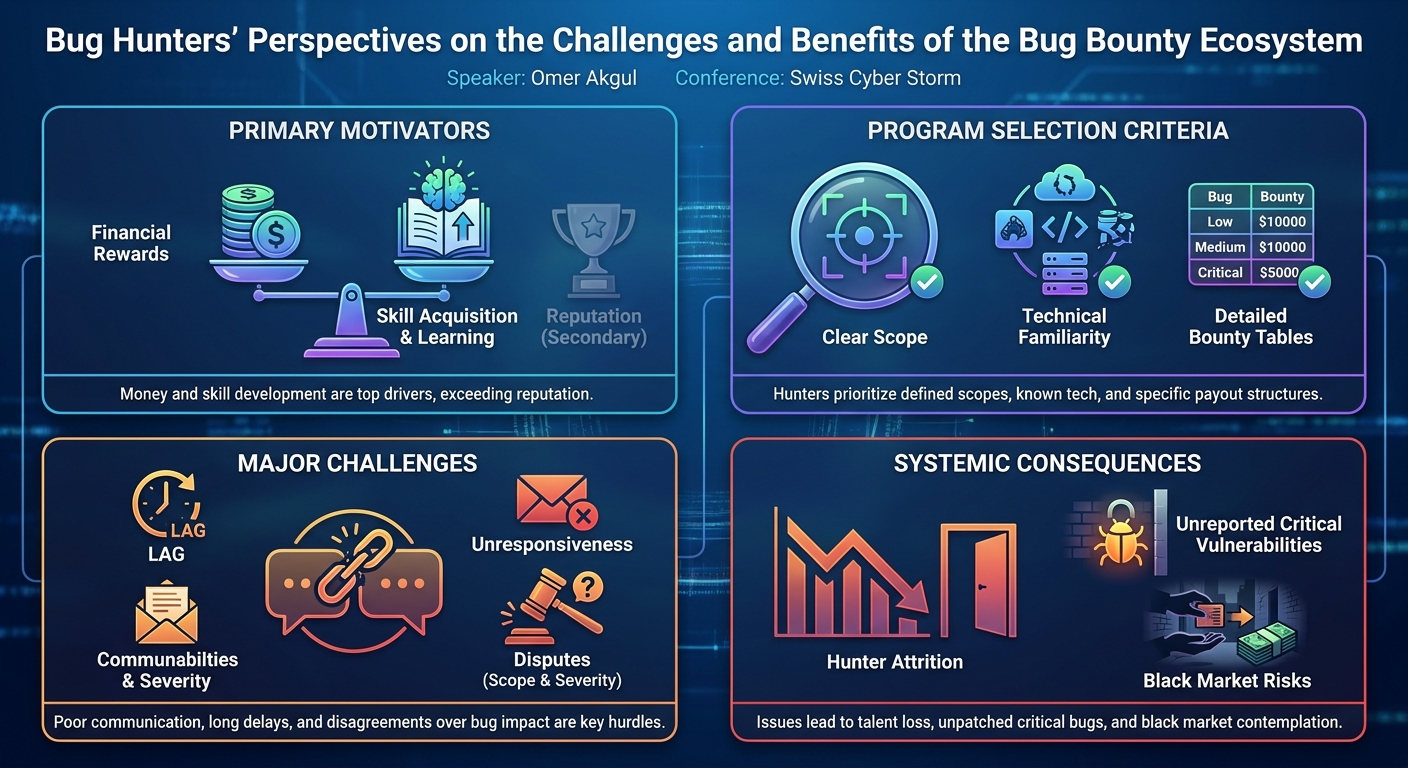
Unsurprisingly, monetary rewards emerged as the top motivator for engaging in bug bounties. However, a close second was learning and improving skills, highlighting a significant intrinsic drive among hunters to enhance their capabilities and become better security researchers. Other important benefits included the fun and challenge of finding vulnerabilities, the legal safe harbor provided by programs (which protects them from legal repercussions), and the flexibility of working on their own terms. Interestingly, reputation scoring—the public recognition and clout associated with finding bugs—was found to be less important than initially anticipated, challenging a common assumption about hacker motivations.
Learning and Skill Development:
Given the importance of learning, the study probed how hunters acquire and refine their skills. Practice through active participation was paramount. Beyond individual effort, mentorship played a crucial role, demonstrating a surprising collaborative spirit within a highly competitive field. Hunters often help each each other, share knowledge, and contribute to the community through blog posts and write-ups. Publicly disclosed bugs were identified as a vital resource, allowing hunters to study real-world vulnerabilities, understand attack surfaces, and identify common exploitation techniques. These disclosures also serve as a form of "advertisement" for programs, signaling potential opportunities to other hackers. Write-ups and blog posts, while similar to disclosures, offered the added benefit of revealing the hacker's thought process and methodology, providing deeper learning opportunities. In contrast, platform-provided learning resources were generally deemed less effective, particularly for more experienced hunters.
Program Selection Factors:
When choosing which program to engage with, hackers prioritize several key aspects:
- Scope: This defines what assets and functionalities are permissible targets. A clear, well-defined scope is crucial, often tied to technical familiarity; hunters prefer programs involving technologies they are proficient in or wish to learn.
- Rewards: While monetary rewards are a general motivator, the bounty table—which details payouts based on vulnerability criticality—is a more nuanced and critical factor. Hunters assess whether a program's payout structure aligns with their skill set and preferred type of bug hunting (e.g., rapid discovery of low-severity bugs vs. deep dives for critical exploits).
- Legal Safe Harbor: Hunters compare programs to secure the strongest legal guarantees, underscoring the ongoing concern about potential legal ramifications.
Useful Platform Utilities:
Bug bounty platforms serve as essential infrastructure, and hunters value specific utilities:
- Ease of payment and ease of reporting: These fundamental functionalities were overwhelmingly ranked as the most important, emphasizing the need for frictionless financial transactions and standardized submission processes.
- Viewing disclosed vulnerabilities: Access to this information is critical for learning and intelligence gathering.
- Program directory: The ability to browse and compare various programs in one centralized location was surprisingly ranked as the fifth most important feature, reinforcing the platform's role in aggregation.
Challenges and Disputes:
The research highlighted significant systemic issues, primarily revolving around communication and dispute resolution:
- Responsiveness: This was by far the top challenge. Hunters frequently experience long delays in acknowledgment, feedback, payment, or bug fixes, leading to immense frustration.
- Dissatisfaction with responses: Disagreements over vulnerability severity or impact often lead to disputes, with hunters feeling their reports are unfairly downgraded.
- Duplicates: Reports of bugs that have already been submitted (but not yet fixed or disclosed) result in uncompensated effort for the hunter.
- Scoping issues: The "gray area" of scope definition, particularly concerning third-party dependencies or unexpected attack vectors, frequently leads to disputes. A notable example cited was a company initially deeming SQL injection out of scope, only to be exploited later and then retrospectively paying the hunter.
- Mediation: When disputes escalate, platforms offer mediation, but hunters often perceive this process as one-sided, favoring the program over the hunter.
Consequences of Challenges:
These persistent issues have severe consequences for the ecosystem:
- Hunter attrition: Talented and experienced hunters may quit or be deplatformed, exacerbating the cybersecurity talent shortage.
- Unacknowledged/stolen bugs: Hunters accuse companies of fixing reported vulnerabilities without acknowledgment or payment, leading to distrust.
- Unreported critical vulnerabilities: A highly concerning finding was that hunters sometimes choose not to report critical bugs due to fear of disputes, legal action, or the perceived impact being too large, leaving severe vulnerabilities unaddressed.
- Black market contemplation: Some hunters, facing frustrating and unrewarding experiences, contemplate selling vulnerabilities on the black market, highlighting a fundamental breakdown in trust and incentive alignment within the legal ecosystem.
Technical Deep Dive
▶ Watch: Scope, tech familiarity, and bounty table influence program choice (11:57)
While the talk focuses on social science research rather than specific exploit techniques or code, the "technical deep dive" in this context refers to the rigorous methodology employed and the granular details within the findings that inform the technical aspects of bug bounty operations and hacker behavior.
The research's strength lies in its multi-pronged methodological approach, designed to capture both breadth and depth of hunter perspectives. The initial free-listing study served as a qualitative data collection phase, where participants provided open-ended responses to the four high-level research questions. This unstructured input was crucial for identifying the full spectrum of factors relevant to hunters, without imposing pre-conceived notions. The subsequent qualitative coding involved a formal labeling process to systematically categorize these messy, diverse responses into a structured set of factors. This process is technically rigorous, ensuring that subjective qualitative data is transformed into a manageable, analyzable dataset.
The factor rating study then introduced a quantitative dimension. By asking a larger cohort of hackers to rate the importance of each identified factor, the researchers could apply statistical analysis to determine the relative significance of each element. This allowed for the ranking of factors, such as "monetary rewards" being top, followed closely by "learning and improving skills," and the surprising finding that "reputation scoring" was not a primary motivator. This quantitative rigor provides a robust foundation for the claims made about hunter priorities.
Finally, the in-depth interviews with 24 hackers provided the rich, contextual data necessary to understand why certain factors were important and the nuances behind the quantitative ratings. For instance, while "rewards" is a broad category, interviews revealed the critical importance of the bounty table. This table, which specifies payouts based on the criticality of a vulnerability (e.g., low, medium, high, critical), is a technical artifact that directly influences a hacker's strategy. A hunter skilled in automating checks for low-hanging fruit like certain XSS variants might prioritize programs with good baseline payouts, while a hunter dedicated to chaining complex vulnerabilities for a remote code execution (RCE) would focus on programs offering substantial critical-severity bounties. This detail speaks to the technical specialization within the bug hunting community.
The concept of scope also has significant technical implications. Hunters often seek programs where the in-scope assets align with their technical familiarity (e.g., GraphQL, JavaScript, AWS services). This isn't just a preference but a strategic decision to maximize their chances of finding vulnerabilities within a known technology stack or to gain experience in a new one. The "gray area" of scope, particularly concerning third-party libraries or dependencies, highlights a technical disconnect between how a hacker perceives an attack surface and how a program owner defines their responsibility. If a critical vulnerability is found in a third-party component heavily relied upon by an in-scope application, the hacker sees it as a direct vulnerability in the product, even if the program owner argues it's outside their immediate development responsibility. This technical nuance is a frequent source of dispute.
Furthermore, the role of publicly disclosed bugs and write-ups in learning is a technical intelligence-gathering process. Hunters use these resources to:
- Map attack surfaces: Understanding what types of vulnerabilities have been found in similar technologies or by the same company provides clues about potential weaknesses.
- Identify common exploitation patterns: Learning from successful past exploits allows hunters to apply similar techniques to new targets.
- Gauge program maturity and response: The availability and quality of disclosures can signal how a program handles reports and values transparency.
The talk implicitly touches upon various vulnerability classes (e.g., SQL injection, XSS, RCE), emphasizing that their perceived impact and associated bounty can vary significantly based on the business context of the target application. An XSS on a high-value financial platform like PayPal, enabling unauthorized payments, would command a significantly higher bounty than an XSS on a less critical informational site, even though both are technically the same vulnerability class. This highlights the complex interplay between technical severity and business impact in the bug bounty landscape.
Finally, the discussion on communication pitfalls—such as unacknowledged bugs and the contemplation of black market sales—underscores a breakdown in the technical and ethical contract between hunters and programs. When a hunter expends significant technical effort to discover a critical flaw, only to face unresponsiveness or accusations of "out of scope" findings, it erodes trust and incentivizes them to consider less ethical avenues where their technical skills might be more immediately and reliably rewarded. This is a critical technical risk for organizations, as it means potentially severe vulnerabilities remain unfixed or are exploited maliciously.
Demo / Proof of Concept
▶ Watch: Challenges lead to hunters quitting, unacknowledged fixes, and black market t... (17:50)
As this talk presented the findings and analysis of a comprehensive research study on the bug bounty ecosystem, it did not include a live technical demonstration or proof-of-concept of an exploit or a tool. Instead, the presentation relied on illustrative screenshots and textual examples drawn directly from the research data. These visual aids included examples of actual bug reports highlighting communication issues, definitions of program scope, and fragments of bounty tables. These served to contextualize the challenges and benefits discussed, providing concrete examples of the phenomena observed in the bug bounty space.
Defensive Implications
▶ Watch: Stakeholders must improve communication, mediation, and legal protections (19:25)
The findings of this research provide crucial insights for organizations running or considering bug bounty programs, bug bounty platforms, and even policymakers, to foster a more effective and sustainable cybersecurity ecosystem.
For Bug Bounty Programs (Organizations):
- Prioritize Communication: The most critical takeaway is the need for vastly improved communication. Programs must strive for timely acknowledgment of reports, provide regular updates on status (even if just a "still working on it" ping), and ensure prompt payments and bug fixes. Addressing communication pitfalls directly reduces hunter frustration and builds trust.
- Clarify and Expand Scope: Ambiguous or overly restrictive scopes are a major source of disputes. Programs should clearly define what is in scope, explicitly address third-party dependencies (e.g., libraries, APIs), and consider broadening scope to critical components. A well-defined, reasonably broad scope attracts more diverse and skilled hunters.
- Investigate Increased Rewards & Scope Thoughtfully: While higher rewards and broader scope can attract more talent and findings, organizations must realistically assess their internal capacity to handle the increased volume of reports. This requires adequate triage teams, developer resources for fixes, and infrastructure to manage the workflow, preventing backlogs that lead to communication failures.
- Ensure Fair Dispute Resolution: Programs should work with platforms to ensure that dispute resolution processes are perceived as fair and unbiased. A perceived one-sided mediation process erodes trust and can lead to hunter attrition.
- Acknowledge All Valid Findings: To combat accusations of "stolen bugs," programs must have clear processes for acknowledging and, where appropriate, compensating for all valid vulnerabilities, even if they were previously reported but not yet fixed.
For Bug Bounty Platforms:
- Reform Mediation: Platforms have a crucial role in mediating disputes. They must actively work to address the perception of bias and ensure that their mediation processes are genuinely fair and transparent to both hunters and programs. The viability of the ecosystem depends on trust in these neutral arbiters.
- Enhance Learning Resources: While experienced hackers may not heavily rely on platform resources, there's room for improvement, particularly for newer hackers. Platforms should invest in developing effective learning resources grounded in pedagogical science, potentially incorporating insights from successful write-ups and disclosed bugs to guide skill development.
- Maintain Robust Utility: Continue to prioritize and enhance core utilities such as ease of payment, ease of reporting, a comprehensive program directory, and accessible disclosed vulnerability views. These foundational features are highly valued by hunters.
For Policy Makers:
- Incentivize Program Creation: Governments and regulatory bodies can play a role in bolstering the cybersecurity workforce by providing grants or incentives for organizations to launch or expand bug bounty programs. This increases the opportunities for hunters and contributes to overall digital security.
- Strengthen Legal Safe Harbor: Current legal safe harbor provisions are often contractual. Policymakers should explore creating stronger, more standardized legal protections for good-faith security researchers, potentially through legislation that explicitly clarifies safe harbor beyond corporate agreements. This would reduce hunters' fear of legal repercussions, encouraging them to report critical vulnerabilities without hesitation.
By addressing these implications, the bug bounty ecosystem can evolve into a more robust, trustworthy, and efficient mechanism for enhancing global cybersecurity, retaining talent, and ensuring critical vulnerabilities are reported and remediated.
Key Takeaways
- Hunter Perspective is Crucial: While bug bounty programs significantly benefit companies, understanding and improving the experience of bug hunters is paramount for the ecosystem's long-term health and for addressing the cybersecurity workforce shortage.
- Motivators: Money & Learning: Monetary rewards are primary, but continuous learning and skill improvement are almost equally strong motivators for hunters; surprisingly, reputation holds less sway.
- Program Choice Hinges on Specifics: Hunters select programs based on clearly defined scope, their technical familiarity with targeted technologies, and the detailed structure of the bounty table, which outlines payouts based on vulnerability criticality.
- Communication is the Biggest Hurdle: The most significant challenges faced by hunters are communication-related, including unresponsiveness from programs, disputes over severity, vague scoping, and perceived unfair mediation processes.
- Serious Consequences of Systemic Issues: These challenges lead to experienced hunters quitting, accusations of "stolen" bugs, and critically, a reluctance among some hunters to report even high-severity vulnerabilities due to fear of disputes or legal action, or even contemplating black market sales.
- Collective Responsibility for Improvement: A multi-stakeholder approach involving bug bounty programs, bug bounty platforms, the hunters themselves, and policymakers is essential to address these systemic issues and create a more transparent, fair, and effective bug bounty ecosystem.
About the Speaker(s)
Omer Akgul is a PhD student at the University of Maryland, currently on his way to Carnegie Mellon University for a postdoctoral position. He is the lead author of the paper "Bug Hunters’ Perspectives on the Challenges and Benefits of the Bug Bounty Ecosystem," which received the prestigious Distinguished Paper Award at the USENIX Security (yck) conference. His research focuses on understanding and improving the human aspects of cybersecurity, particularly within the bug bounty space. He collaborated with Taha, Amitash, Yen, Michelle, Darren, and Aaron on this significant work.
Reviews
Dr. Zero (Offensive Security Researcher) — SOLID
Omer Akgul's USENIX-winning research puts rigorous academic data behind what every bug hunter has known for a decade: platform mediation is broken and vendors ghost you. It's a highly competent sociological study of the bug bounty ecosystem that fills a slot nicely, even if it won't surprise anyone who has actually submitted a bug.
Heather Calloway (CISO) — STRONG ACCEPT
An empirical look at why bug bounty programs fail from the researcher's side of the table. A necessary reality check for any leadership team that views crowdsourced security as a low-overhead replacement for internal application testing.