Secure-by-Design: How do you Design with a Security Mindset for the User?
Christine Bejerasco (Chief Information Security Officer · WithSecure)
Swiss Cyber Storm 2023 · Day 1 · Scenario
Overview
In her compelling talk at Swiss Cyber Storm, Christine Bejerasco, Chief Information Security Officer at WithSecure, challenged one of the most pervasive and frustrating statements in cybersecurity: "humans are the weakest link." With over two decades of experience in the industry, Bejerasco argued that this perception often stems not from inherent human fallibility, but from a fundamental failure in how technology is designed and how it interacts with human behavior and daily life. The talk served as a critical introspection into the industry's past, present, and future, advocating for a secure-by-design approach that prioritizes understanding the "misuser" as much as the "user."
Key moments
- 0:00 Challenging 'humans are the weakest link'
- 3:00 Living in an always-on, complex digital world
- 10:30 Lesson: Threats always follow new technology
- 11:00 Improving security: Passwords, patching, and sandboxing
- 18:00 Empowering people through tailored cyber awareness
- 21:00 Technology's crucial role in Secure by Design
- 24:30 Q&A: Involving business in threat modeling
Secure-by-Design: How do you Design with a Security Mindset for the User?
Speakers: Christine Bejerasco, Chief Information Security Officer, WithSecure
Conference: Swiss Cyber Storm
YouTube: https://www.youtube.com/watch?v=_vPF3bUqa1M
Overview
In her compelling talk at Swiss Cyber Storm, Christine Bejerasco, Chief Information Security Officer at WithSecure, challenged one of the most pervasive and frustrating statements in cybersecurity: "humans are the weakest link." With over two decades of experience in the industry, Bejerasco argued that this perception often stems not from inherent human fallibility, but from a fundamental failure in how technology is designed and how it interacts with human behavior and daily life. The talk served as a critical introspection into the industry's past, present, and future, advocating for a secure-by-design approach that prioritizes understanding the "misuser" as much as the "user."
Bejerasco posited that the complexity inherent in modern technology, particularly for generations who have never known a simpler digital world, creates an environment ripe for security vulnerabilities. Instead of blaming users, she urged the cybersecurity community, as builders of these technologies, to learn from historical oversights and proactively integrate security into the design process. This paradigm shift, from reactive patching to proactive design, is crucial for building a more resilient digital future, especially as concepts like the metaverse and advanced AI continue to blur the lines between our physical and digital realities.
The core message of Bejerasco’s presentation was an emphatic call to action: rather than accepting human weakness as a given, we must empower individuals by designing systems that align with their natural behaviors and cognitive processes. This involves not only technical solutions but also a rethinking of organizational processes and security awareness programs, making them contextually relevant and genuinely empowering. By adopting a security mindset from conception, the industry can collectively build a future where technology serves humanity securely, without turning its users into its weakest point.
Background
▶ Watch: Challenging 'humans are the weakest link' (0:00)
Bejerasco began by tracing the evolution of technology, highlighting how each significant advancement, while designed for user convenience and productivity, inadvertently created new avenues for exploitation due to a lack of foresight regarding potential misuse. She contrasted the early days of computing, where data moved "at the speed of humanity" via physical drives, with today's hyper-connected, always-online world. This transition, driven by the desire for speed and accessibility, introduced unforeseen complexities.
Early examples included America Online (AOL), which democratized internet access but also, arguably, gave birth to the first phishing attempts targeting credit card information. The advent of macros in applications like Word revolutionized document automation but also opened the door for macro viruses, as designers failed to anticipate malicious code being embedded within seemingly innocuous files. Similarly, the widespread adoption of Hotmail made email accessible to the masses, but quickly led to mass-mailing worms that leveraged its global reach for rapid malware propagation.
The talk further illuminated how foundational technologies like open-source code – a massive driver of innovation – became a target. Attackers learned to compromise open-source libraries, effectively poisoning the well for countless organizations that integrated them. The NotPetya attack in 2017, which leveraged a compromised software update mechanism to spread malware, served as a stark example of supply chain vulnerabilities. Wi-Fi brought wireless freedom but also introduced new attack surfaces, leading to the realization that network-connected devices could be weaponized. The Mirai botnet in 2016 demonstrated the devastating potential of overlooked IoT devices (like cameras) to launch massive Distributed Denial of Service (DDoS) attacks, taking down major services like Twitter, Spotify, and Netflix. Even mobile operating systems like Symbian, which enabled app customization, quickly saw the rise of malware as apps, spreading rapidly via permissive open networks like Bluetooth. In each case, the underlying issue was a design philosophy that focused solely on utility, neglecting the inherent risk of malicious actors exploiting new functionalities.
Key Findings
▶ Watch: Lesson: Threats always follow new technology (10:30)
The historical review presented by Bejerasco underscored two fundamental findings. Firstly, threats will always follow technology. Whenever a new technological capability is introduced, and designers focus exclusively on its intended use without considering potential misuse, vulnerabilities inevitably emerge. This reactive cycle means that security is often an afterthought, bolted on to address problems that could have been prevented at the design stage. The industry repeatedly learns this lesson, yet the pattern persists with each new wave of innovation.
Secondly, the industry has demonstrated a capacity to learn and rectify misuse. Over time, security practitioners and developers have refined their approaches, moving beyond simple fixes to implementing more robust, design-oriented solutions. This evolution represents a crucial shift from merely patching vulnerabilities to fundamentally rethinking how humans interact with technology. Examples of this learning curve include improving password practices, deprecating insecure legacy technologies, and enhancing operating system security.
Bejerasco highlighted that this ongoing learning process is vital for raising the bar against attackers. By understanding human behavior, both benevolent and malicious, designers can create systems that are inherently more resilient. The realization that security is not just about technical controls but also about psychology and user experience has driven advancements that make exploitation significantly harder and more expensive for threat actors. The ultimate goal, as she articulated, is to embed security into the very fabric of design, making it an intrinsic characteristic rather than an external addition.
Technical Deep Dive
▶ Watch: Improving security: Passwords, patching, and sandboxing (11:00)
The talk detailed several technical advancements and strategies that exemplify the shift towards secure-by-design principles, making systems inherently more resilient against attacks.
One significant area of improvement has been password security. Moving beyond simple password policies, modern systems now provide real-time feedback during password creation, guiding users toward stronger combinations. Many platforms enforce minimum complexity requirements, making brute-force attacks significantly harder and more costly to execute. This proactive feedback mechanism directly addresses a common human tendency to choose weak, memorable passwords, embedding security into the user interaction itself.
Another critical step was the industry's collective decision to deprecate insecure legacy technologies. Bejerasco specifically cited Flash Player, a once-ubiquitous browser plugin that became a major source of vulnerabilities. Despite its long-standing popularity, major browsers ultimately ceased supporting Flash, effectively eliminating an entire class of exploits. This decision highlights the power of platform providers to enforce security by removing outdated and dangerous components, even when users are "in love" with them. The speaker noted that browser vulnerabilities, particularly those enabling remote code execution (RCE) without user interaction, are extremely valuable on exploit acquisition platforms, costing anywhere from $100,000 to $500,000 USD. Their high cost and short shelf-life (due to rapid patching) mean typical threat actors are less likely to burn such exploits, raising the bar for attackers.
On mobile platforms, Android's evolution demonstrated a secure-by-design approach. Earlier Android versions were susceptible to overlay attacks, where malicious banking trojans would obscure legitimate apps to steal credentials. With Android Q, Google implemented changes that made such overlays much harder, forcing threat actors to resort to social engineering users into activating accessibility services – a significantly more complex and less effective attack vector. This OS-level change fundamentally altered the attack landscape for mobile malware.
Bejerasco also championed Single Sign-On (SSO) as a paradigm shift in identity and access management. Instead of users managing hundreds of disparate credentials, SSO consolidates authentication through a trusted identity provider. This not only simplifies the user experience but also drastically improves security posture. When an employee leaves an organization, their access to numerous services can be revoked instantly by disabling a single account, eliminating the "insane" manual effort for IT teams to chase down and deactivate hundreds of individual accounts. While Identity and Access Management (IAM) providers themselves can be targets, vulnerabilities found in these critical systems are typically patched very quickly, further enhancing overall security.
Modern operating systems, particularly mobile ones like Android and iOS, have significantly advanced security through application sandboxing. This technology isolates applications from each other and from critical system resources, limiting the "blast radius" of an attack. If one application is compromised, the damage is contained, preventing it from affecting other apps or the core OS. Bejerasco noted that no-click RCE vulnerabilities in iOS or Android are exceptionally rare and command prices up to $2 million USD on exploit acquisition platforms like Zerodium, indicating their extreme difficulty to develop and the high level of security provided by sandboxing.
Finally, encryption at rest, exemplified by solutions like BitLocker, was presented as a crucial secure-by-design feature. In the past, disposing of devices required physically wiping drives with magnets to prevent data recovery. Today, full disk encryption ensures that if a device is lost, stolen, or reaches its end-of-life, the data remains inaccessible without the correct decryption key. This eliminates a significant vector for data breaches, making it "much, much harder to exploit" data from physical media. These examples collectively illustrate how integrating security considerations from the ground up can fundamentally alter the risk landscape, moving beyond reactive measures to proactive resilience.
Demo / Proof of Concept
▶ Watch: Technology's crucial role in Secure by Design (21:00)
This talk was primarily a conceptual and analytical presentation, focusing on historical context, strategic insights, and defensive implications, rather than a live demonstration or proof-of-concept of a specific technology or attack. Bejerasco leveraged real-world examples and industry trends to illustrate her points.
Defensive Implications
▶ Watch: Q&A: Involving business in threat modeling (24:30)
Bejerasco provided actionable insights for organizations looking to adopt a secure-by-design philosophy, emphasizing that security is a collective responsibility extending beyond traditional IT and development teams.
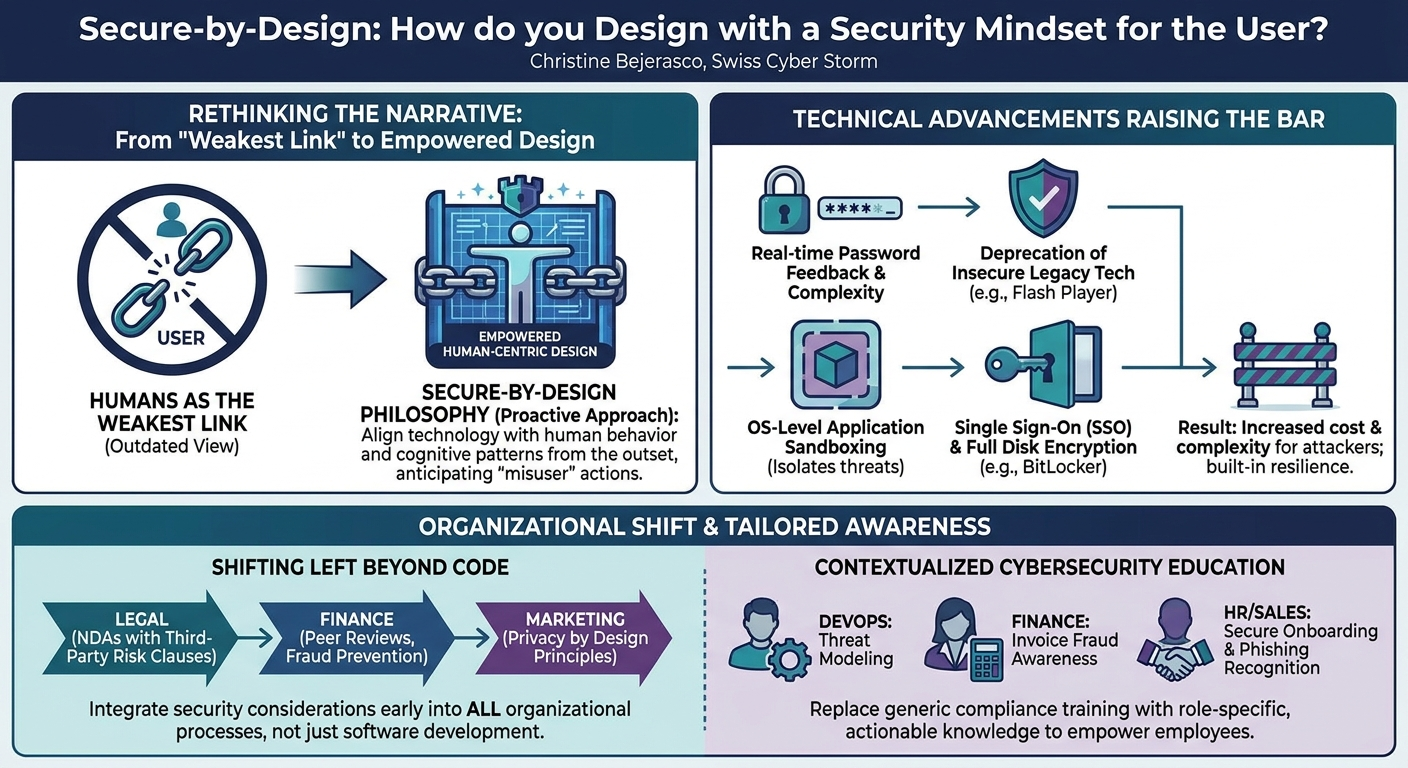
1. Empowering People Through Tailored Awareness:
The speaker critiqued the common, compliance-driven approach to cybersecurity awareness, where generic programs are rolled out merely to "check a box." She advocated for quality over quantity in training, focusing on "leveling up" individuals in the weakest areas of the organization.
- DevOps Teams: Need specific threat modeling training to understand how attackers view their code, rather than just general security principles.
- Finance Teams: Handling invoices and third-party payments, they are constantly exposed to third-party risk. Their training should focus on invoice fraud, peer review processes for payments, and access control specific to financial transactions. Bejerasco shared a successful example of running a "jewelry store heist" threat modeling workshop with finance teams, which led them to identify practical improvements like peer reviews for payments.
- HR Teams: Responsible for vetting employees, they require training on secure onboarding and offboarding processes.
- Sales Teams: Regularly communicate with external parties via email, making them targets for phishing and business email compromise. Training should focus on identifying and reporting suspicious communications.
By tailoring training to specific roles and their daily workflows, organizations can make awareness programs genuinely effective, transforming employees from perceived "weakest links" into robust defenses.
2. Shifting Left Beyond Software Development:
The concept of "shifting left" – integrating security earlier in the development lifecycle – should extend beyond the Software Development Life Cycle (SDLC) to all organizational processes.
- Legal Teams: Security considerations can be integrated into legal contracts. For example, a mutual Non-Disclosure Agreement (NDA) can include a statement on third-party risk management, embedding security into the very beginning of a business relationship.
- Finance Processes: Beyond training, finance departments can embed security controls into their workflows, such as mandatory peer reviews for new vendor payments to prevent fraud.
- Marketing Teams: When building websites or campaigns, marketing should adhere to privacy by design principles from the outset, ensuring data protection and compliance are integral to their creations.
3. Leveraging Technology to Aid Humans:
Recognizing that humans often operate on "autopilot" and may neglect tasks they perceive as tedious or secondary, technology can be deployed to enforce security measures and reduce human error.
- Automated Information Classification: For Data Loss Prevention (DLP) systems to be effective, documents often need to be classified (e.g., confidential, internal). While policies exist, employees may not consistently apply labels. Technology can provide auto-labeling capabilities, automatically classifying documents based on content or context. This "raises the bar" by ensuring consistent application of security policies without relying solely on manual effort.
By implementing these defensive strategies – focusing on quality, tailored awareness, extending "shifting left" to all business functions, and intelligently leveraging technology – organizations can move towards a truly secure-by-design posture, empowering their people and processes against evolving threats.
Key Takeaways
- Rethink the "Weakest Link" Narrative: Humans are not inherently the weakest link; rather, poorly designed technologies and processes make them vulnerable. The focus should shift from blaming users to designing systems that align with human behavior and cognitive patterns.
- Security Must Be Designed In, Not Bolted On: Historical examples demonstrate that neglecting potential misuse during design inevitably leads to vulnerabilities. Proactive, secure-by-design principles are crucial for building resilient systems from the ground up.
- Leverage Technical Advancements to Raise the Bar: Innovations like robust password feedback, the deprecation of insecure technologies (e.g., Flash), enhanced OS-level protections (e.g., Android Q's overlay fix, application sandboxing), SSO, and encryption at rest (e.g., BitLocker) significantly increase the cost and complexity for attackers.
- Tailor Security Awareness and Training: Generic, compliance-driven training is ineffective. Organizations must provide role-specific, contextualized cybersecurity education (e.g., threat modeling for DevOps, fraud awareness for finance) to genuinely empower employees.
- Extend "Shifting Left" Beyond Code: The principle of integrating security early should apply to all organizational processes, including legal contracts (e.g., NDAs with third-party risk clauses), finance workflows, and marketing initiatives (e.g., privacy by design).
- Automate Security to Mitigate Human Error: Technology can compensate for human oversight or disinterest in security tasks. Tools like auto-labeling for document classification can ensure consistent application of security policies, augmenting human efforts.
About the Speaker(s)
Christine Bejerasco is the Chief Information Security Officer (CISO) at WithSecure, the B2B arm of what was formerly F-Secure. With over 20 years of experience in the cybersecurity industry, Bejerasco has witnessed firsthand the evolution of technology and its associated security challenges. Her expertise lies in understanding the interplay between human behavior and technological design, advocating for a security philosophy that empowers users rather than blaming them. Her insights are shaped by a deep understanding of both the technical and human aspects of cybersecurity, making her a compelling voice for secure-by-design principles.
Reviews
Dr. Zero (Offensive Security Researcher) — WEAK
Bejerasco spends an hour debunking the 'humans are the weakest link' cliché, which might have been a revelation in 2014. The rest is a Wikipedia-level recap of old malware and a checklist of basic IT hygiene disguised as 'secure-by-design' strategy. If your organization still needs a keynote to convince you to use SSO and deprecate Flash, you don't need a conference, you need a time machine.
Heather Calloway (CISO) — SOLID
Bejerasco’s core premise—that we need to stop blaming users and start building systems that anticipate them—is correct, even if it's a familiar refrain. The real value isn't the technical recap, but her framework for shifting security left into non-technical departments like Legal and Finance, which provides a solid baseline for process-level defense.