One size fits all was yesterday - efficient awareness made @SBB
Jörg Jungblut (Responsible for Cyber Security and Information Security · SBB), Markus Günther (Security Consultant · Tim)
Swiss Cyber Storm 2023 · Day 1 · Panorama
Overview
In an era where cybersecurity threats are increasingly sophisticated, the effectiveness of traditional, "one size fits all" security awareness training is critically questioned. Jörg Jungblut, Responsible for Cyber Security and Information Security at SBB, and Markus Günther, Security Consultant at Tim, tackle this pervasive challenge in their Swiss Cyber Storm talk. They share SBB's transformative journey from a compliance-driven, generic awareness program to a decentralized, highly efficient, and tailored approach designed to genuinely reduce human risk.
Key moments
- 0:00 Introduction: The 'one size fits all' problem
- 6:00 Limitations of compliance-focused awareness and SANS model
- 8:00 SBB's unique scale and diverse awareness challenges
- 15:00 Shifting to decentralized, leadership-driven awareness
- 17:00 Six essential elements for decentralized awareness program
- 26:00 Q&A: Program investment, leadership engagement, and content
One size fits all was yesterday - efficient awareness made @SBB
Speakers: Jörg Jungblut (Responsible for Cyber Security and Information Security, SBB); Markus Günther (Security Consultant, Tim)
Conference: Swiss Cyber Storm
YouTube: https://www.youtube.com/watch?v=d6CzK69yeLE
Overview
In an era where cybersecurity threats are increasingly sophisticated, the effectiveness of traditional, "one size fits all" security awareness training is critically questioned. Jörg Jungblut, Responsible for Cyber Security and Information Security at SBB, and Markus Günther, Security Consultant at Tim, tackle this pervasive challenge in their Swiss Cyber Storm talk. They share SBB's transformative journey from a compliance-driven, generic awareness program to a decentralized, highly efficient, and tailored approach designed to genuinely reduce human risk.
The core premise of their presentation is that just as ill-fitting clothes or gloves are useless, so too is a security awareness concept that doesn't resonate with its audience. SBB, as Switzerland's critical national railway infrastructure, faces immense and complex security challenges, making effective awareness paramount. This talk is not about a universal solution but rather an inspiring case study of how a large, diverse organization can move beyond mere checkboxes to foster a robust security culture by empowering its leadership and tailoring information to specific professional contexts.
Their insights are particularly relevant for organizations struggling with engagement in security awareness, those facing diverse workforces, or entities operating in highly regulated and critical environments. By detailing SBB’s strategic shift, Jungblut and Günther demonstrate how a significant investment in understanding human factors and leadership involvement can yield a more resilient and secure operational landscape.
Background
▶ Watch: Introduction: The 'one size fits all' problem (0:00)
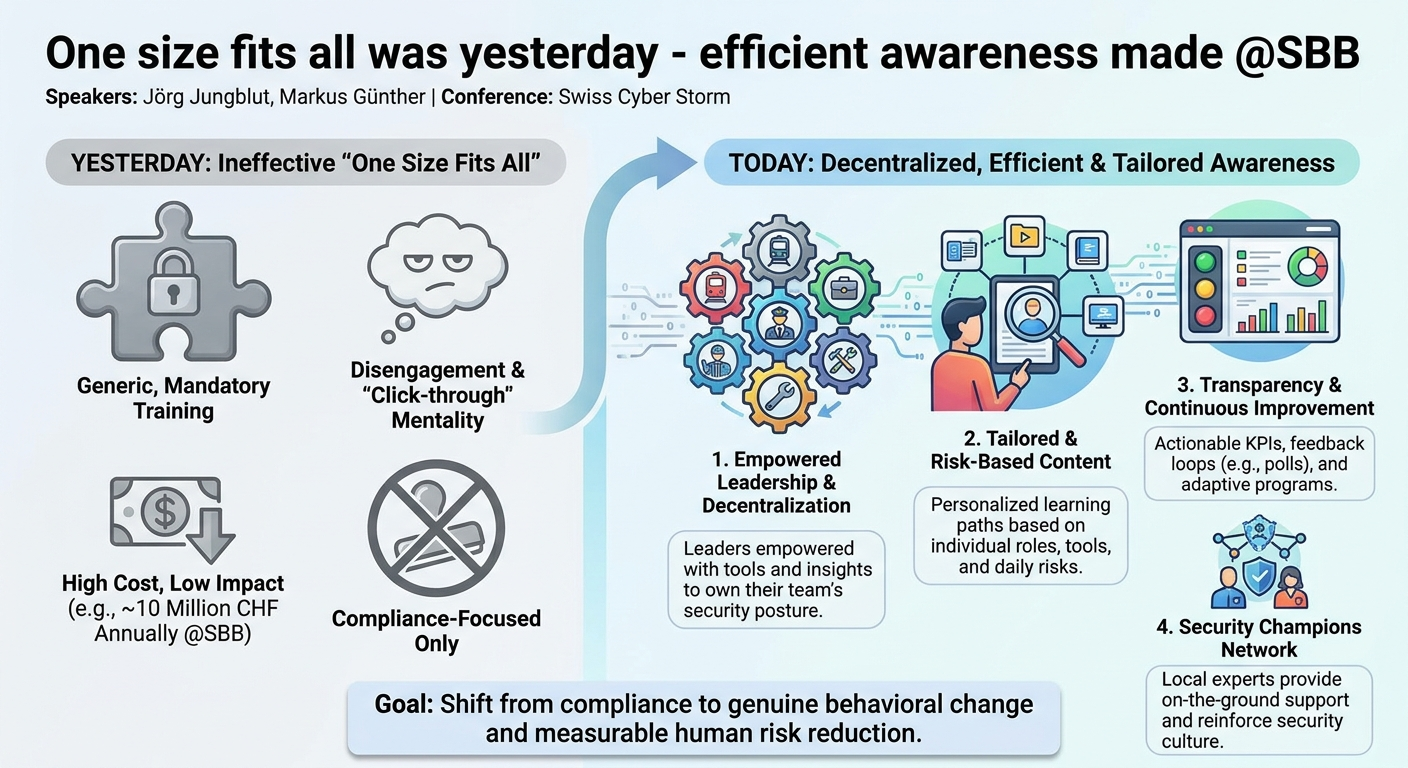
The speakers begin by highlighting the common pitfalls of traditional security awareness programs. Often, these programs manifest as annual, mandatory training sessions, primarily driven by regulatory requirements. Employees frequently perceive them as repetitive and boring, leading to a "click-through" mentality where the primary goal is merely to complete the audit requirement rather than internalize the information. This approach, while economically efficient and easy for compliance tracking (e.g., measuring completion rates), fundamentally fails to address the underlying goal of reducing actual risk.
Jungblut and Günther reference the SANS Security Awareness Maturity Model, pointing out that most organizations operating with a "one size fits all" approach remain at a "compliance focused" stage (typically Stage 2). This stage measures only whether training is completed, neglecting the more critical aspects of behavioral change, cultural impact, and actual risk reduction. Peter Drucker's adage, "If you can't measure it, you cannot control it," underscores this deficiency; merely counting completions offers no insight into security posture improvement.
SBB's operational context amplifies these challenges significantly. As a critical infrastructure provider, moving approximately 1 million people per day in Switzerland, any IT system hiccup due to a cyber incident could paralyze the nation. The organization boasts a workforce of approximately 33,000 internal employees and up to 10,000 external employees, spanning an astonishing 150 different professions. This includes office managers, IT specialists, and those in "orange," such as train operators and maintenance personnel, whose risk profiles and information needs are vastly different. With operations spread across at least 50 locations and managing assets up to 100 years of age (highlighting significant legacy system challenges in train operations), a generic awareness message is inherently ineffective.
Furthermore, SBB faces an increasing burden of regulatory requirements. Beyond the classic ISO 27001, they must adhere to IEC 62443 (for industrial control systems), the upcoming Cyber Resilience Act, and specific directives like the "cybersecurity for Railways" handbook. These regulations mandate security measures and training, but the cost and efficacy of delivering these across such a diverse and critical environment became a major problem statement. The traditional centralized approach, attempting to cover all risks either superficially (short but unhelpful) or deeply (resulting in a 2-4 hour mandatory training), was unsustainable. The latter, for nearly 50,000 people annually, was calculated to cost around 40 personal years or approximately 10 million Swiss Francs per year—a tremendous, prohibitive expense for a compliance-only benefit. This stark reality drove SBB to abandon the "one size fits all" model and seek a fundamentally new approach.
Key Findings
▶ Watch: SBB's unique scale and diverse awareness challenges (8:00)
The central discovery and contribution of SBB's journey, as presented by Jungblut and Günther, is the profound ineffectiveness and unsustainability of the traditional "one size fits all" security awareness model, especially for large, complex, and critical organizations. Their key finding is that such an approach, while seemingly simple for compliance, leads to disengagement, wasted resources, and ultimately, a failure to mitigate actual human-factor risks.
To counter this, SBB pioneered a decentralized security awareness program. This paradigm shift moves away from a top-down, central command structure, instead distributing responsibility and empowering line managers and team leaders. The core idea is that those closest to the operational risks and the daily work of employees are best positioned to identify relevant threats and deliver targeted, impactful awareness content. This approach transforms security awareness from a generic, annual chore into an integrated, context-specific leadership function.
Their journey underscores that true security culture change requires:
- Leadership Buy-in and Empowerment: Shifting awareness responsibility to leaders, providing them with the tools and knowledge to act.
- Tailored Content: Delivering information that is directly relevant to an individual's role, risks, and daily tasks.
- Transparency and Measurable Insights: Providing leaders with dashboards and KPIs to understand their team's security posture and identify areas for improvement.
- Local Expertise: Leveraging Security Champions to provide on-the-ground support and specialized knowledge.
- Continuous Improvement: Recognizing that security awareness is an ongoing process that must adapt to evolving threats and organizational needs.
This strategic pivot allows SBB to move beyond merely checking compliance boxes, aiming instead for genuine behavioral change and a measurable reduction in human-related security incidents, thereby elevating their security culture maturity.
Technical Deep Dive
▶ Watch: Shifting to decentralized, leadership-driven awareness (15:00)
SBB's transition to a decentralized awareness model is underpinned by a meticulously designed "three-part tool" and "six essential elements" that fundamentally restructure how security awareness is managed and delivered. The previous centralized approach was deemed too costly and ineffective; it either provided superficial coverage for all risks or deep dives that were too long and irrelevant for many, costing 40 personal years or 10 million CHF annually.
The new decentralized approach delegates awareness as a leadership function. This means empowering team and division leaders to identify what is necessary for their specific teams, understand the risks associated with their processes, and then select and facilitate appropriate training.
The three-part tool for line managers allows them to:
- Identify risks: Understand the specific threats pertinent to their team's operations.
- Assess organizational performance: Gain insights into their team's current security posture.
- Invite and assign training nuggets: Select and distribute targeted, relevant awareness content.
This framework is supported by six essential elements:
- Leadership Awareness: This is the foundational element. Instead of merely sending out a slide deck, SBB engaged directly with every leader. Over the past two years, they talked to thousands of people, including approximately 1,500 leaders within their two main divisions. The goal was not just to inform but to actively listen, asking leaders about their team's risk situation, past incidents, and concerns. This proactive engagement built a "nice backbone" of support, fostering trust and ensuring leaders felt ownership and were prepared to back the program. Without this executive and managerial buy-in, any awareness program focusing on employees is highly vulnerable to failure.
- Transparency (Dashboard): To enable leaders to take responsibility, SBB developed a central dashboard accessible to all leadership. This dashboard provides key performance indicators (KPIs) related to security awareness and posture. It uses intuitive traffic lights to indicate whether a team's situation is "okay" or if specific actions are required. The dashboard also provides interpretation guidance, helping leaders understand the data and make informed decisions about their next steps. While the specific PowerBI capabilities are mentioned for data interpretation, the emphasis is on making complex security data actionable and understandable for non-security experts.
- Content Hub: A critical issue in many organizations is scattered and outdated awareness material. SBB addressed this by creating a single, centralized repository for all available awareness content. This Content Hub includes every e-learning module, poster, service description, training program, and consultancy offering. The content is actively managed, with expiry dates requiring regular refreshers to ensure it remains up-to-date and of high quality. This solves the common problem of "where is that content from five years ago?" and ensures relevance. The talk mentions utilizing Microsoft Sway and other Office 365 tools for e-learning content delivery, but the principle is tool-agnostic: aggregate, manage, and make accessible.
- Risk Check Tool: This innovative tool is open to every employee, not just leadership. It operates by asking employees about their daily work – the tools they use, the people they interact with, and their communication methods. Based on this input, the tool generates a personalized risk profile and advises specific training modules or content from the Content Hub to cover those identified risks. The speakers candidly admit, "I still have no idea how to measure that [risk reduction] right now," highlighting the ongoing journey. However, the tool ensures that identified risks are covered by tailored information, even if direct quantitative measurement of risk reduction is still evolving.
- Security Champions: Recognizing that leaders cannot be cyber security experts, SBB implemented a Security Champions program. This three-step program trains selected employees with enhanced security knowledge, enabling them to act as local points of contact and support within their teams. They assist leadership, answer questions that might otherwise go to the central security team, and provide on-the-ground expertise, extending the reach and effectiveness of the awareness program. This distributed knowledge network is crucial for a geographically and professionally diverse organization.
- Continuous Improvement: SBB views its awareness program not as a finished product but as a perpetually evolving system. This element emphasizes ongoing feedback loops, such as regular leadership exchanges to gather concerns and insights. They also conduct security culture polls across their employee base (a third of employees were polled) to gain insights into overall sentiment and identify new needs (e.g., handling USBs, using malicious mail buttons). This iterative process, akin to a PDCA (Plan-Do-Check-Act) cycle, ensures the program continuously adapts to new threats, technologies, and workforce demographics, preventing stagnation and maintaining relevance.
In essence, SBB's technical deep dive reveals a sophisticated ecosystem of interconnected tools and processes designed to decentralize responsibility, personalize content, and foster a proactive security culture rather than just enforcing compliance.
Demo / Proof of Concept
▶ Watch: Six essential elements for decentralized awareness program (17:00)
While the talk did not feature a live, interactive technical demonstration in the traditional sense, Jungblut and Günther effectively presented SBB's implemented solutions as a working "proof of concept" for their decentralized awareness strategy. They described the practical application and functionality of the core components of their new program, illustrating how these tools are actively deployed within SBB.
The Transparency Dashboard serves as a key demonstrative element. The speakers explained its accessibility to leadership, its use of traffic lights to provide immediate visual cues on security posture, and its ability to present KPIs with interpretation guidance. This dashboard is not merely a concept but an operational tool providing leaders with actionable insights into their team's security status.
Similarly, the Content Hub was described as a fully functional, centralized repository. This system, managing all awareness materials (e-learning, posters, services, etc.) and ensuring their active lifecycle management and expiration, stands as a testament to their efforts to consolidate and maintain high-quality, relevant content. The mention of Microsoft Sway and Office 365 tools indicates the practical platforms used for content delivery.
Furthermore, the Risk Check Tool was detailed as an employee-facing application that dynamically generates personalized risk profiles and recommends specific training. Its availability to "every employee" and its function in advising tailored content based on individual work patterns highlights a practical, deployed solution for personalized awareness.
The speakers also referenced the ongoing security culture poll conducted across "a third of our employees" as a method of gathering empirical feedback and measuring the program's impact, which further underscores the practical, data-driven nature of their approach. This poll, along with continuous leadership exchanges, forms the feedback loop for their "continuous improvement" element.
Thus, while not a live code or tool demo, the presentation served as a comprehensive walkthrough of a real-world, implemented, and evolving security awareness ecosystem, demonstrating SBB's commitment to and the functional existence of their decentralized model.
Defensive Implications
▶ Watch: Q&A: Program investment, leadership engagement, and content (26:00)
The SBB talk offers profound defensive implications for any organization grappling with effective security awareness. The most critical takeaway is the imperative to move beyond a compliance-focused approach to one that genuinely aims for behavioral change and risk reduction. Defenders should recognize that generic, mandatory training is largely ineffective in fostering a robust security culture.
Key defensive strategies derived from SBB's model include:
- Decentralize and Empower Leadership: Shift the responsibility for security awareness from a central security team to line managers and team leaders. Equip these leaders with the necessary tools, information, and support to understand and address the specific risks relevant to their teams. This creates a distributed network of "security owners" rather than a single bottleneck. SBB's investment in talking to 1,500 leaders underscores the importance of this foundational engagement.
- Tailor Content to Context: Abandon the "one size fits all" mentality. Develop and deliver awareness content that is highly relevant to specific job roles, departments, and operational contexts (e.g., office workers vs. train operators, IT vs. OT environments). Tools like SBB's Risk Check Tool can help identify individual risk profiles and recommend personalized learning paths.
- Provide Transparency and Actionable Insights: Implement dashboards and reporting mechanisms that provide leaders with clear, digestible KPIs on their team's security posture. The use of traffic lights and interpretive guidance, as demonstrated by SBB, helps non-security experts understand where action is needed, fostering proactive risk management at the team level.
- Establish a Centralized Content Hub: Combat content sprawl and outdated materials by creating a single, actively managed repository for all security awareness resources. This ensures that leaders and employees can easily find and access high-quality, up-to-date information, streamlining content distribution and reducing confusion. Content should expire and require refreshing to maintain relevance.
- Cultivate Security Champions: Build a network of Security Champions within various teams and departments. These individuals, equipped with enhanced security knowledge through structured programs, can serve as local points of contact, provide peer support, and assist leaders in implementing awareness initiatives. This extends the reach and effectiveness of the central security team.
- Embrace Continuous Improvement: Security awareness is not a one-time project but an ongoing process. Implement feedback loops, such as regular leadership exchanges and employee security culture polls, to gather insights, identify new needs, and adapt the program to evolving threats and organizational changes. This iterative approach, mirroring a PDCA cycle, ensures the program remains relevant and impactful over time.
By adopting these strategies, organizations can move beyond mere compliance to build a truly resilient security culture where employees are actively engaged, informed, and empowered to make secure decisions, ultimately reducing the human factor risk in their defensive posture.
Key Takeaways
- "One size fits all" security awareness is ineffective and unsustainable: Generic, compliance-driven training fails to engage employees, address specific risks, and achieve behavioral change, leading to significant wasted resources (e.g., 10 million CHF annually for SBB's old model).
- Decentralization and leadership empowerment are crucial: Shifting responsibility for security awareness to line managers and team leaders, supported by clear tools and information, ensures relevance and fosters a sense of ownership at the operational level.
- Tailored, risk-based content drives engagement: Delivering security information that is directly applicable to an individual's role, tools, and daily tasks significantly increases its impact and leads to better risk coverage, as demonstrated by SBB's Risk Check Tool.
- Transparency and accessible tools are vital for accountability: Providing leaders with dashboards displaying clear KPIs and actionable insights (e.g., traffic lights) empowers them to monitor their team's security posture and take proactive steps.
- Security Champions extend reach and provide local expertise: A network of trained Security Champions offers on-the-ground support, answers questions, and reinforces security messages, bridging the gap between central security teams and diverse workforces.
- Security awareness is a journey of continuous improvement: The program must be dynamic, incorporating regular feedback from leaders and employees (e.g., cultural polls) and adapting to new threats and organizational changes, rather than being a static, annual event.
About the Speaker(s)
Jörg Jungblut is the Responsible for Cyber Security and Information Security at SBB, a role he has held for two years. His expertise lies in navigating the complex security landscape of critical public transportation infrastructure.
Markus Günther is a Security Consultant at Tim in Zurich. Together, Jörg and Markus share a deep passion for addressing the human factor and human risks within the realm of security awareness, driving innovative solutions to these pervasive challenges.
Reviews
Dr. Zero (Offensive Security Researcher) — SOLID
SBB realized their mandatory awareness training was burning 10 million Swiss Francs a year for zero reduction in risk, so they blew up the centralized model. The solution they built is a standard security champions playbook, but their brutal honesty about the financial cost of compliance theater makes this a very useful case study.
Heather Calloway (CISO) — STRONG ACCEPT
Jungblut and Günther dismantle the standard compliance-driven awareness model and replace it with decentralized line-management accountability. By putting a hard 10 million CHF price tag on wasted mandatory training hours at SBB, they elevate awareness from an HR chore to a CFO-level operational risk discussion.