What Designing a Cyber Ontology for Agents Taught Us About Governance
David Chismon (Chief Security Architect · The UK National Cyber Security Centre)
[un]prompted II 2026 — The AI Security Practitioner Conference · Day 2 · Stage 1
Overview
In this insightful talk from [un]prompted II, David Chismon, Chief Security Architect at the UK National Cyber Security Centre (NCSC), delves into the ambitious project of designing a cyber ontology to enable agentic defense. The central question he seeks to answer is whether traditional governance, risk, and compliance (GRC) approaches are fundamentally flawed in the face of increasingly autonomous cyber threats. Chismon highlights a critical disconnect: while offensive security problems are technical, defensive problems are often political – bogged down by change boards and risk sign-offs. This talk presents a compelling vision for transforming probabilistic, human-centric security decisions into deterministic, calculable outcomes, paving the way for truly automated and explainable defensive actions.
Key moments
- 2:10 Making defensive decisions deterministic with graphs
- 3:17 Understanding ontologies for modeling the cyber world
- 6:15 Defining 'interface' as a scalable ontology unit
- 9:36 Model discovers new attack paths and guidance gaps
- 10:55 Challenging traditional authentication factors with properties
- 13:17 Introducing the three orders of security controls
- 14:15 Attackers want first-order controls, organizations third
- 20:09 Prioritizing controls: air gaps are surprisingly effective
What Designing a Cyber Ontology for Agents Taught Us About Governance
Speakers: David Chismon, Chief Security Architect, The UK National Cyber Security Centre
Conference: [un]prompted II
YouTube: https://www.youtube.com/watch?v=uvgc0qHZRyY
Overview
In this insightful talk from [un]prompted II, David Chismon, Chief Security Architect at the UK National Cyber Security Centre (NCSC), delves into the ambitious project of designing a cyber ontology to enable agentic defense. The central question he seeks to answer is whether traditional governance, risk, and compliance (GRC) approaches are fundamentally flawed in the face of increasingly autonomous cyber threats. Chismon highlights a critical disconnect: while offensive security problems are technical, defensive problems are often political – bogged down by change boards and risk sign-offs. This talk presents a compelling vision for transforming probabilistic, human-centric security decisions into deterministic, calculable outcomes, paving the way for truly automated and explainable defensive actions.
Chismon's work is directly tied to the NCSC's Cyber Shield initiative, a national-scale ecosystem for agentic defense. As the lead architect, he recognized that for agents to take effective defensive actions, the underlying security decisions needed to be rooted in a precise, machine-readable understanding of the cyber domain. This led to the development of a custom ontology – a structured framework for modeling the cyber world – which in turn revealed profound insights into the nature of controls, vulnerabilities, and the inherent weaknesses of current GRC practices. The implications extend beyond agentic systems, offering a fresh perspective for all organizations striving to build more resilient and defensible cyber environments.
Background
▶ Watch: Making defensive decisions deterministic with graphs (2:10)
The genesis of this work stems from a fundamental challenge articulated by Halvar Flake: "offensive problems are technical... but defensive problems are political." In the context of automated agentic defense, where autonomous agents are expected to make and execute defensive actions, this political dimension becomes a critical blocker. Chismon’s core research question is: "how could we make a defensive security decision be deterministic rather than probabilistic?" Instead of relying on an LLM to "guess" which vulnerability to patch, the goal is to calculate the optimal answer, much like querying a graph database. Achieving this requires a robust model of the world that can be computed upon – precisely the role of an ontology.
Chismon clarifies the concept of an ontology by contrasting it with a taxonomy. A taxonomy categorizes topics into buckets, ideally being MECE (mutually exclusive, collectively exhaustive) and hierarchical. An ontology, however, is a "3D graph version" of this, serving as the schema that defines a graph database. It allows for defining relationships between entities, much like classes and objects (e.g., "Dave is a person"). When an ontology is populated with knowledge, it becomes a knowledge graph, and a model of a specific organization or network within this framework is termed a world model.
The NCSC team reviewed existing ontologies but found each was designed for a slightly different problem, rendering them unsuitable for their specific goal of enabling deterministic defensive decisions. This necessitated the creation of a custom ontology. The process involved bringing together NCSC experts from research, incident response, and risk to articulate their understanding of threat paths and defensive decisions. The team then pushed to describe this world using the "absolute minimal grammar," focusing on the smallest number of classes. This collaborative effort immediately surfaced challenges in defining core concepts like "vulnerability" and "software" in a precise, MECE manner suitable for graph instantiation. Crucially, a satisfactory definition for "security" itself, meeting their strict requirements, remains elusive.
To validate and refine their ontology, Chismon employed agent workflows. Agents were tasked with taking existing cybersecurity datasets – such as MITRE ATT&CK, the Australian Signals Directorate (ASD) hardening guides, and incident data – and expressing subsets of this information within the nascent ontology. If the graph couldn't describe a particular scenario, the ontology was iteratively flexed and refined. This process proved more challenging than anticipated, partly due to Large Language Models (LLMs)' eagerness to provide an answer, often forcing data into ill-fitting schemas or inventing new categories. To combat this, a critical practice emerged: maintaining an explicit modeling decisions.md log. This document records every design choice, allowing agent workflows to flag potential violations of past decisions, thereby maintaining clarity and consistency in the evolving ontology.
Key Findings
▶ Watch: Defining 'interface' as a scalable ontology unit (6:15)
The development and application of the NCSC's cyber ontology yielded several significant findings, challenging conventional wisdom and offering new avenues for defensive security:
- The "Interface" as a Core Concept: A highly scalable and critical unit in the ontology is the interface, defined as a throuple: "what you can talk to a thing," "what permission set you have on the thing," and "what that thing lets you do." This abstract concept proved versatile, capable of describing software on a port or even internal components within a binary.
- Vulnerability as an Unintended Interface: Building on the interface concept, a vulnerability is precisely defined as "an interface that isn't intended." This aligns closely with Halvar Flake's "weird machines" concept, which posits that systems have an intended finite state machine but also possess other, unintended capabilities that attackers exploit. The goal of defense, therefore, is to minimize the difference between the intended and actual system states.
- Realistic Simulated Networks and Attack Modeling: The team probabilistically generated large-scale simulated networks, some with up to 100,000 nodes and users, incorporating realistic statistical skews (e.g., 20% of users reusing passwords across services). Attack paths were modeled not with static graph queries but by mimicking an attacker's iterative enumeration process: starting from an attacker node, identifying reachable networks, available permissions, and executable actions, then repeating until no new paths are discovered. This approach proved remarkably efficient, scaling well even on a laptop.
- Automated Discovery of Novel Attack Paths: A compelling validation of the ontology's utility was its ability to derive attack paths it hadn't been explicitly taught. Examples include:
- Identifying that a browser stores credentials as cookies on the host, which another process on the same host could access and replay.
- Modeling drive-by downloads as the combination of a browser accessing internet content, writing a file, and a user on that host executing that file.
- Identification of Gaps in Existing Guidance: The modeling process uncovered a significant flaw in NCSC's own guidance regarding Privileged Access Workstations (PAWs). When PAWs were modeled into various networks, they consistently failed to stop attack paths. Investigation revealed that in every case, an alternative, non-PAW route to critical assets or sensitive data existed (e.g., missing patches, unauthorized data backups). This led to a crucial update in guidance, emphasizing that PAWs must be the only route to sensitive assets.
- Re-evaluating Authentication: From Factors to Properties: The traditional notion of authentication "factors" (something you have, know, or are) proved difficult to model meaningfully within the graph. Instead, the team proposes breaking authentication down into properties of a credential: whether it's destination-bound, host-bound, unguessable, and encrypted in transit. This shift offers a more precise and actionable way to analyze credential security.
- The Three Orders of Controls (R Theory): Perhaps the most profound finding is the classification of controls into three orders:
- First Order Controls: Directly affect a transition in the graph (e.g., patching a system removes an interface). These are the only controls attackers care about.
- Second Order Controls: Help enforce or attest to first-order controls (e.g., vulnerability scanning identifies unpatched systems).
- Third Order Controls: Do not appear in the graph; these are policies or compliance statements (e.g., a patching policy). Organizations often focus disproportionately on these.
Chismon argues that organizations, driven by compliance, start with third-order controls, often failing to translate them into effective first-order actions unless they experience a breach. Conversely, agent swarms are observed to focus on first-order issues like misconfigurations and replayable credentials, not just N-day exploits. This suggests a need to rebalance security efforts towards first and second-order controls.
- Control Enforcing Controls: The concept of control enforcing controls suggests an architecture where access is granted only if an agent or workload can prove the presence of other required controls (e.g., conditional access policies). This represents a sophisticated approach to automated governance.
Technical Deep Dive
▶ Watch: Challenging traditional authentication factors with properties (10:55)
The technical foundation of Chismon's work lies in the rigorous application of ontology engineering to the cyber domain. An ontology in this context is not merely a classification scheme but a formal, machine-interpretable representation of knowledge within a specific domain. It defines the types of entities (classes), their properties, and the relationships between them, essentially providing the schema for a graph database. This allows for the creation of a knowledge graph – a collection of interconnected facts – which, when applied to a specific environment, becomes a world model.
The NCSC's custom ontology focuses on a minimal grammar to describe the cyber world. A central construct is the interface, a throuple consisting of:
- What you can talk to a thing: The target of interaction (e.g., a port, a specific function, a file).
- What permission set you have on the thing: The authorized access level (e.g., read, write, execute, admin).
- What that thing lets you do: The capabilities exposed by the interface given the permissions (e.g., send data, run a command, modify a configuration).
This abstraction is powerful because it's highly scalable. It can model high-level interactions like a network connection to a service on a TCP port, or drill down to describe internal components within a binary and the interactions between them. A vulnerability is then precisely defined as an unintended interface – a capability that the system exposes but was not designed or desired to. This directly links to Halvar Flake's "weird machines" concept, where attacks exploit the gap between a system's intended finite state machine and its actual, often broader, range of behaviors.
To test the ontology, the team generated simulated networks of varying complexity, up to 100,000 nodes and users. These networks were not arbitrary but probabilistically constructed to reflect real-world distributions and behaviors. For instance, if statistics indicate 20% of users reuse passwords, the simulated network would include users exhibiting this characteristic, making the models more realistic for threat analysis.
Attack path modeling was a critical technical component. Initially, simple Cypher queries (a graph query language) were attempted but quickly proved inefficient for complex attack chains. The solution was to emulate an attacker's methodology:
- Initial State: Start from an attacker node with defined capabilities.
- Enumeration: Identify all directly reachable network segments, available permissions, and executable actions from the current state.
- Collection: Gather all new information (new nodes, new permissions, new execution capabilities) discovered.
- Iteration: Use the newly collected information to expand the attacker's reach and capabilities, repeating steps 2 and 3 until no further new paths or states can be discovered.
This iterative, graph traversal algorithm proved "super efficient" and scaled effectively on a laptop, even for very complex networks. Its effectiveness was demonstrated by its ability to derive novel attack paths without explicit pre-programming. For example, it identified that a browser storing a credential as a cookie on a host could be accessed and replayed by another process on the same host. Similarly, it modeled a drive-by download by combining the browser's ability to access internet content, write a file, and a user's ability to execute a file on that host.
The re-evaluation of authentication also represents a significant technical shift. Instead of modeling vague "factors" (something you have, something you know), the ontology focuses on credential properties:
- Destination-bound: Can the credential only be used with a specific service or resource?
- Host-bound: Is the credential tied to a specific device, preventing its use elsewhere?
- Unguessable: Is the credential sufficiently complex to resist brute-force attacks?
- Encrypted in transit: Is the credential protected during transmission?
- (Asymmetric?): Chismon noted this property is still under investigation for its necessity if others are met.
This approach allows for a more granular and machine-interpretable analysis of credential security within the graph.
Finally, the R Theory of Controls provides a structured framework for understanding the impact of defensive measures. First-order controls (e.g., patching, removing an unintended interface) directly modify the graph by altering transitions or removing nodes/edges that attackers exploit. Second-order controls (e.g., vulnerability scanners, asset registers) provide information or enforcement for first-order controls. Third-order controls (e.g., policies, compliance statements) exist outside the graph's operational logic, focusing on human processes rather than direct system state. This distinction is crucial for understanding why organizations might spend "millions on security but the security's terrible" – they are often investing in third-order controls that have little direct impact on attack paths.
The talk briefly touched upon ablation studies as a method to quantify control effectiveness. By simulating attack paths and then systematically removing "links" (representing controls) one at a time, the team could measure the impact of each control on the overall cost of an attack or the number of blocked paths. This technique, applied to the simulated networks, surprisingly (or perhaps unsurprisingly, given NCSC's mission) revealed that air gaps were the most effective control.
Demo / Proof of Concept
▶ Watch: Introducing the three orders of security controls (13:17)
While a live, interactive demonstration was not a core component of this presentation, the talk extensively detailed the methodology and results of the NCSC's modeling and simulation efforts, which collectively serve as a robust proof of concept for the cyber ontology approach.
Chismon described the creation of probabilistically generated simulated networks of significant scale, some reaching up to 100,000 nodes and users. These were not abstract models but incorporated realistic behavioral skews, such as 20% of users reusing passwords, making them representative of real-world enterprise environments. The core proof of concept lay in the attack path enumeration algorithm, which, operating on these complex networks, efficiently discovered all possible attack vectors.
The most compelling demonstration of the ontology's power was its ability to autonomously derive attack paths that it had not been explicitly programmed to find. Examples provided included:
- The discovery of how a browser's storage of credentials as cookies on a host could be exploited by another local process.
- The detailed modeling of a drive-by download attack, linking internet access, file writing, and user execution capabilities.
Furthermore, the practical application of the ontology directly led to the identification of a critical gap in NCSC's own guidance regarding Privileged Access Workstations (PAWs). The fact that the modeling revealed PAWs were often ineffective due to alternative attack routes, and that this led to an immediate revision of official guidance, stands as a real-world validation of the methodology's utility. These outcomes, achieved through the systematic application of the ontology and graph-based analysis, effectively demonstrated the feasibility and significant benefits of this novel approach to understanding and defending cyber systems.
Defensive Implications
▶ Watch: Prioritizing controls: air gaps are surprisingly effective (20:09)
The insights gleaned from designing a cyber ontology for agents carry profound implications for how defenders should approach cybersecurity, particularly in the realm of governance, risk, and compliance.
- Re-evaluate GRC Focus: The most critical implication is the need to fundamentally rethink governance, risk, and compliance (GRC). Chismon argues that current GRC is often "all wrong," disproportionately focusing on third-order controls (policies, statements) that attackers completely ignore. Defenders must shift their primary focus to first-order controls – those direct technical actions (e.g., patching, secure configurations, removing unintended interfaces) that actually change the graph and block attack paths. Compliance schemes should evolve to prioritize verifiable second-order controls (e.g., vulnerability scans, asset registers) over policy documents.
- Prioritize First-Order Controls: Security engineering efforts should concentrate on implementing and maintaining first-order controls. This involves actively identifying and removing unintended interfaces, ensuring systems are patched, and enforcing configurations that directly mitigate known attack techniques. An "ideal security effort" would see staff primarily working on first-order controls, supported by robust second-order controls for monitoring and identifying gaps, with only a "minimum viable" investment in third-order compliance.
- Holistic PAW Implementation: The discovery of PAW bypasses highlights the necessity of a holistic security architecture. Defenders must ensure that Privileged Access Workstations (PAWs) are not just implemented, but are the exclusive conduits to sensitive assets. Comprehensive modeling can reveal often-overlooked alternative routes (e.g., unpatched systems, insecure backups) that undermine even well-designed individual controls.
- Modernize Authentication Modeling: The call to move from "factors" to credential properties for authentication analysis is a crucial shift. Defenders should evaluate authentication mechanisms based on whether credentials are destination-bound, host-bound, unguessable, and encrypted in transit. This granular approach offers a more accurate assessment of an authentication scheme's resilience against modern attack techniques like credential theft and replay.
- Embrace Ontologies and Knowledge Graphs: Organizations should explore building their own world models using ontologies and knowledge graphs. This provides a deterministic, calculable representation of their environment, enabling a deeper understanding of attack surfaces, potential pathways, and the true impact of defensive measures. This capability is vital for making data-driven security decisions and moving away from probabilistic guesswork.
- Design for Deterministic Security Decisions: The ultimate goal is to enable explainable, deterministic security decisions. By modeling the world in a computable graph, defenders can "run the maths" to understand why a particular action is recommended, rather than relying on opaque AI models. This transparency builds trust and allows for rigorous validation of automated defense systems.
- Leverage Agentic Capabilities for Defense: While agents are currently exploiting misconfigurations, defenders can harness agentic capabilities for their own benefit. Designing architectures with "control enforcing controls" – where agents or workloads only gain access if they can prove the presence of other necessary controls – represents a powerful paradigm for automated, dynamic security enforcement.
- Quantify Control Effectiveness with Ablation: Techniques like ablation studies (removing controls in the graph to measure their impact) offer a powerful way to quantify the effectiveness of different security measures. This can help prioritize investments, identifying which controls yield the greatest reduction in attack paths or increase in attacker cost. The finding that air gaps were the most effective control, even without prompting, underscores the value of such analytical approaches.
- Focus on Misconfigurations and Capabilities: The observation that agent swarms primarily target misconfigurations and existing capabilities (like replayable credentials) rather than novel N-day exploits reinforces the need for rigorous configuration management and a deep understanding of system functionalities. Defenders should prioritize reducing the attack surface presented by unintended system behaviors and over-provisioned access.
Key Takeaways
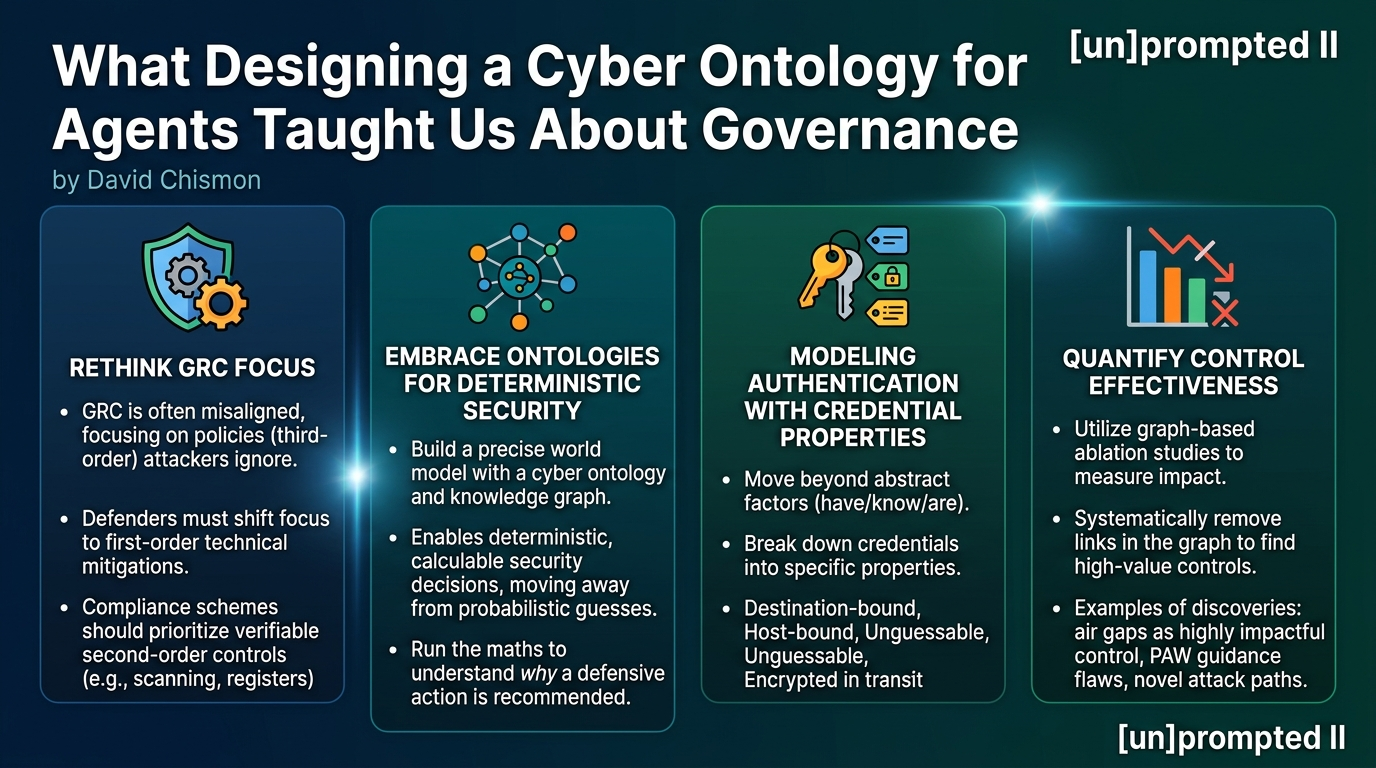
- Rethink GRC: Traditional governance, risk, and compliance (GRC) models are often misaligned with actual threat realities, focusing too heavily on third-order controls (policies) that attackers ignore. A shift towards verifiable first-order controls (direct technical mitigations) is crucial.
- Embrace Ontologies for Deterministic Security: Building a cyber ontology and populating it into a knowledge graph enables the creation of a precise world model, allowing for deterministic, calculable security decisions rather than probabilistic guesses.
- The "Interface" Concept is Key: Defining an interface as a throuple (what you talk to, permissions, what it lets you do) provides a scalable and powerful way to model system behavior, and a vulnerability as an "unintended interface."
- Authentication Needs Re-evaluation: Move beyond abstract "authentication factors" (something you have/know/are) to model specific credential properties (e.g., destination-bound, host-bound, unguessable, encrypted in transit) for more accurate security analysis.
- Automated Analysis Reveals Gaps: Agent-driven analysis of the ontology can autonomously discover novel attack paths (e.g., browser cookie exploitation, drive-by downloads) and reveal critical flaws in existing security guidance (e.g., PAW bypasses).
- Prioritize Controls Based on Impact: Utilize graph-based ablation studies to quantify the effectiveness of controls, prioritizing those that most significantly reduce attack paths or increase attacker cost (e.g., air gaps were found to be highly impactful).
About the Speaker(s)
David Chismon serves as the Chief Security Architect at the UK National Cyber Security Centre (NCSC), an organization that blends functions similar to the US's CISA, NSA's Cyber Security Directorate, and elements of the FBI's cyber operations. Part of GCHQ, the UK's Signal Intelligence Agency, NCSC's mission is to make the UK the safest place to live and work online. Chismon describes himself as a "lover of asymmetry," drawn to problems where adversaries hold inherent advantages, yet defenders must still find a way to win, primarily by "designing the battlefield." He is the lead architect for the NCSC's ambitious Cyber Shield initiative, aimed at building a national-scale ecosystem for agentic defense. His work focuses on transforming the political nature of defensive security into deterministic, calculable outcomes.
Reviews
→ Top-rated talks at [un]prompted II 2026 — The AI Security Practitioner Conference
All talks from [un]prompted II 2026 — The AI Security Practitioner Conference