The Emperor's New Clothes: Location Data and the Promise of Anonymization
Aaron Alva (Moderator · Federal Trade Commission), Brandi M. Bennett (Panelist), Jennifer King (Panelist · Stanford University Institute for Human-Centered Artificial Intelligence), Beryl Lipton (Panelist · Electronic Frontier Foundation)
USENIX Enigma Conference 2023 · Day 1 · Grand Ballroom
Overview
In "The Emperor's New Clothes: Location Data and the Promise of Anonymization," a distinguished panel at USENIX Enigma dissects the pervasive collection, commercial exploitation, and inherent risks associated with precise location data. Moderated by Aaron Alva of the Federal Trade Commission, the discussion features Brandi M. Bennett, a private practice attorney with extensive in-house experience in data privacy; Dr. Jennifer King from the Stanford Institute for Human-Centered Artificial Intelligence, focusing on consumer privacy; and Beryl Lipton, an investigative researcher with the Electronic Frontier Foundation, specializing in police surveillance. The talk critically examines the widespread belief that location data can be effectively anonymized, exposing this notion as a dangerous fallacy that undermines individual privacy and poses significant societal and national security threats.
Key moments
- 0:00 Panel Introduction: Location Data's Hot Topic
- 3:07 Pervasive Location Data Collection: Phones are 'Leaky'
- 7:30 Commercial Uses: Car Data, Health, Cross-Device Tracking
- 15:00 Location Data Weaponized: Post-Dobbs and Personal Exposure
- 22:00 Anonymization is a Myth: Easy Re-identification
- 34:10 'Consent is a Fiction': Flaws in Current Privacy Policies
- 39:00 Vision for Data Ecosystem: Data Trusts, Licensing, Divestiture
- 48:30 Most Powerful Solution: Federal BIPA for Location Data
The Emperor's New Clothes: Location Data and the Promise of Anonymization
Speakers: Aaron Alva (Moderator, Technologist, Federal Trade Commission); Brandi M. Bennett (Panelist, Private Practice Attorney); Jennifer King (Panelist, Privacy and Data Policy Fellow, Stanford University Institute for Human-Centered Artificial Intelligence); Beryl Lipton (Panelist, Investigative Researcher, Electronic Frontier Foundation)
Conference: USENIX Enigma
YouTube: https://www.youtube.com/watch?v=_IvPS4o7b-w
Overview
In "The Emperor's New Clothes: Location Data and the Promise of Anonymization," a distinguished panel at USENIX Enigma dissects the pervasive collection, commercial exploitation, and inherent risks associated with precise location data. Moderated by Aaron Alva of the Federal Trade Commission, the discussion features Brandi M. Bennett, a private practice attorney with extensive in-house experience in data privacy; Dr. Jennifer King from the Stanford Institute for Human-Centered Artificial Intelligence, focusing on consumer privacy; and Beryl Lipton, an investigative researcher with the Electronic Frontier Foundation, specializing in police surveillance. The talk critically examines the widespread belief that location data can be effectively anonymized, exposing this notion as a dangerous fallacy that undermines individual privacy and poses significant societal and national security threats.
The panel highlights how seemingly innocuous data collection, often initiated through routine app usage, is systematically aggregated, enriched, and sold, revealing intimate details about individuals' lives. They argue that current "anonymization" techniques are largely ineffective, as data brokers and other entities can easily re-identify individuals by combining location trails with publicly available information or other data sets. This aggregation transforms individual data points into comprehensive profiles, leading to a "weaponization" of location data with far-reaching implications, from targeted advertising to law enforcement surveillance and political opposition research.
The discussion emphasizes the urgent need for robust regulatory frameworks that move beyond the current "notice and consent" model, which the panelists argue is a "fiction" in practice. They advocate for systemic changes that prioritize individual control over data, impose strict limits on data retention and sharing, and introduce severe financial penalties for misuse. The talk serves as a critical call to action for technologists, policymakers, and consumers alike to recognize the true value and vulnerability of location data, challenging the industry's narrative of anonymization and demanding accountability for its profound impact on civil liberties and democratic processes.
Background
▶ Watch: Panel Introduction: Location Data's Hot Topic (0:00)
The ubiquitous nature of smartphones and connected devices has led to an unprecedented explosion in the collection of precise location data. This data, as defined by the panel, encompasses information derived from GPS, Wi-Fi signal triangulation (via BSSIDs from access points), Bluetooth, cell tower triangulation, and even IP addresses when devices are on a data plan. Jennifer King notes that modern smartphones, regardless of operating system (iOS or Android), are "extremely leaky by design" regarding their capacity to track users. While older Android phones offered a prominent location toggle, current interfaces often bury these controls, creating a "false sense of security" for consumers who believe they can easily opt out.
Brandi Bennett, drawing from her experience in ad tech and analytics, elaborates on the diverse and often opaque methods of collection and use. Beyond obvious applications like mapping, location data is harvested by seemingly benign apps like weather applications, smart cars (which sell data to insurance carriers), and even online gambling platforms (for regulatory compliance). Companies employ technologies such as beacon technology in retail spaces and geofencing around specific venues to pinpoint exact locations. This data is then used not just for immediate service delivery but also for cross-device tracking, marrying real-world movements with online behavior and home device usage (e.g., TV viewing habits associated with an IP address).
The problem's roots lie in the economic model of the internet, heavily reliant on advertising funded by personal data. Data brokers emerged to aggregate and monetize this information, creating a vast, unregulated market. Historically, consumers were led to believe that this data primarily fueled shopping ads, a "trade-off" many were willing to make. However, the panel argues that this perception has drastically shifted. The sheer volume and granularity of collected location data, combined with long retention periods (often "indefinitely"), allow for the creation of incredibly detailed personal profiles. These profiles can reveal sensitive information such as home and work addresses, daily routines, family presence (dropping kids at school), health status (frequent hospital visits), and even shopping intentions (visiting multiple car dealerships). This aggregation transforms individual data points into powerful, potentially compromising insights, setting the stage for the risks discussed in the talk.
Key Findings
▶ Watch: Commercial Uses: Car Data, Health, Cross-Device Tracking (7:30)
The central and most critical finding of the panel is that the concept of anonymization for precise location data is largely a myth, akin to "The Emperor's New Clothes" – a widely accepted but ultimately false premise. The panelists consistently argue that any attempts to anonymize location data through methods like truncating journey start/end points, hashing, or using synonymous IDs are easily circumvented. Brandi Bennett states unequivocally, "I have yet to see anything that can really truly anonymize any of this data," highlighting the ease of probabilistic data matching and unraveling synonymous IDs.
Jennifer King emphasizes that re-identification is consistently demonstrated in academic papers, primarily due to three factors: the duration of data collection, the length of data retention, and the capacity to combine location data with outside information. This combination allows for the creation of unique "fingerprints" of movement that can be linked back to individuals. For instance, Brandi Bennett explains how a device's GPS coordinates resting at a specific address can be combined with public records (deeds, DMV data) to deterministically identify an individual.
The panel reveals a significant shift in the perceived risks of location data: from mere "shopping ads" to its potential weaponization. This transformation is underscored by several vivid examples:
- Post-Dobbs Decision: The overturning of Roe v. Wade has made location data a tool for investigating and prosecuting individuals seeking abortion care in states where it is criminalized. Brandi Bennett recounts a Minnesota Department of Transportation committee discussion where she stunned members by pointing out how urban planning data could be used to track individuals traveling from red states to blue states for abortion services.
- Targeted Outing and Harassment: Jennifer King cites the case of a Catholic priest whose location data was purchased to expose his visits to gay bars, highlighting how data can be used to publicize private aspects of life, even if one considers themselves "law-abiding."
- National Security Risks: Brandi Bennett references past exposes by the New York Times concerning military personnel's Strava and Fitbit data, which inadvertently mapped out military bases. Similar tracking has been observed from sensitive government locations like Langley (CIA headquarters) and the Supreme Court.
- Political Opposition Research: Beryl Lipton and Jennifer King detail how "dark money groups" and political campaigns use geofencing and location data to identify and track individuals attending rallies, school board meetings, or even those assisting immigrants, turning data into a tool for opposition research and potential harassment.
Furthermore, the panel exposes how government entities circumvent existing legal protections. Beryl Lipton describes companies like Fog Data Science and Ventel marketing to law enforcement by claiming the data sold contains "no personally identifiable information" (PII) because it's not linked to a name or phone number. However, law enforcement acknowledges that if they are "any good at our jobs, we're going to be able to figure out who these people are." This creates a loophole where the Fourth Amendment's protections against unreasonable searches are bypassed, as police can access vast troves of data without warrants, often under the guise of "100% opt-in consent" which the panelists deem a "fiction."
Finally, the panel highlights the collective nature of the problem: even individuals who diligently manage their own privacy settings are vulnerable because their location can be triangulated based on the data of those around them. This "collective societal level problem" underscores the inadequacy of individual solutions and the urgent need for systemic change.
Technical Deep Dive
▶ Watch: Anonymization is a Myth: Easy Re-identification (22:00)
The collection of precise location data is far more intricate and pervasive than many consumers realize, extending beyond simple GPS signals. The panel meticulously details the various technical vectors through which this information is harvested:
- GPS (Global Positioning System): This is the most direct and precise method, providing real-time geographical coordinates. While users can often toggle GPS on or off, Jennifer King notes that on iOS, this control is "five screens down," making it an annoying experience and less likely to be routinely managed by users.
- Wi-Fi Triangulation: Devices constantly scan for nearby Wi-Fi access points. By collecting BSSIDs (Basic Service Set Identifiers) from these access points and knowing their approximate physical locations, companies can triangulate a device's position with high accuracy, even without connecting to the network.
- Bluetooth: Similar to Wi-Fi, Bluetooth signals from nearby devices or beacons (small transmitters often deployed in retail environments, shopping malls, or venues like Madison Square Garden) can be used to determine proximity and, over time, track movement within a localized area.
- Cell Tower Triangulation: Mobile network operators inherently know a device's location by triangulating its signal strength across multiple cell towers. This data, often retained by carriers, can also be accessed or sold.
- IP Address: When a device is connected to a data plan or Wi-Fi network, its IP address can provide a coarse geographical location, which can be refined with other data.
- Vehicle Telemetry: Modern cars are "computers" that continuously collect geolocation data. This data, used for internal vehicle functions and connected services, is increasingly sold by manufacturers (e.g., Ford) to third parties like insurance carriers, creating a new, often opaque, stream of location information.
- Geofencing: This technique defines virtual geographical boundaries. Apps or systems can detect when a device enters or exits a geofenced area, triggering specific actions or logging the event. This is used by gambling apps for regulatory compliance or by political campaigns to track attendance at rallies.
The panel's core technical assertion revolves around the failure of anonymization. Companies claim to anonymize data using methods such as:
- Truncation: Removing the first and last segments of a journey (e.g., first five minutes of start, last five minutes of end) to obscure precise origin and destination. Brandi Bennett dismisses this, arguing that advertisers still want to know if a user visited a specific "Starbucks 123 on Main Street," which requires the endpoint.
- Hashing: Applying a cryptographic hash function to identifiers to create a seemingly anonymous, fixed-length string.
- Synonymous IDs: Replacing direct identifiers with pseudonymous or temporary IDs.
However, these techniques are routinely defeated. The panel explains why:
- Probabilistic Data Matching: Even with truncated or hashed data, unique movement patterns over time can be statistically matched to known patterns, making re-identification highly probable.
- Aggregation and Enrichment: Data brokers excel at combining seemingly disparate datasets. A "hashed ID" from one source can be linked to another dataset containing partial identifying information, or even to publicly available records.
- Cross-Device Tracking: Techniques are employed to link a user's activity across multiple devices (e.g., phone, tablet, smart TV) by associating them with a common IP address or other persistent identifiers. This creates a more comprehensive profile, making individual device anonymization ineffective.
- Public Records Integration: As Brandi Bennett highlights, the most straightforward method of re-identification is combining location data with public records. For example, a device's persistent location at a residential address, when combined with property deeds (public record) or DMV data (often sold by state DMVs), can deterministically link the device to a named individual.
- Data Broker Ecosystem: The unregulated nature of data brokers means there are "no guard rails" to prevent companies from buying "anonymized" data and then purchasing additional data to re-identify individuals. Beryl Lipton notes that companies like Fog Data Science market to law enforcement by claiming "no personally identifiable information" is sold, even though law enforcement implicitly understands they can easily figure out who the individuals are.
The Kochava case, mentioned by Aaron Alva and Brandi Bennett, exemplifies the legal challenges against the unfair sale of sensitive location data by data brokers. While details were not discussed due to ongoing litigation, the case underscores the FTC's recognition of the severe risks posed by this data ecosystem. The technical reality is that location data, especially when collected persistently and aggregated, reveals deeply personal information, and current anonymization practices are insufficient to protect against re-identification and subsequent misuse.
Demo / Proof of Concept
▶ Watch: 'Consent is a Fiction': Flaws in Current Privacy Policies (34:10)
This panel discussion focused on the theoretical and practical implications of location data collection and anonymization, rather than featuring a live demonstration or proof of concept. The panelists shared their expertise and research findings through anecdotal evidence and real-world examples to illustrate the pervasive nature of the problem and the ineffectiveness of current "anonymization" techniques.
Defensive Implications
▶ Watch: Most Powerful Solution: Federal BIPA for Location Data (48:30)
The pervasive and easily re-identifiable nature of location data presents a formidable challenge for individuals, organizations, and governments. The panel outlines a range of defensive implications, from limited individual actions to sweeping systemic and regulatory reforms.
For Individuals (Limited Efficacy):
- GPS Toggle: Jennifer King suggests turning off GPS on smartphones when not actively in use, acknowledging it's a "very small thing" that removes some data from circulation, but often inconveniently buried in settings.
- Bluetooth/Wi-Fi Disablement: Similarly, disabling Bluetooth in public spaces is a privacy hygiene measure, but again, cumbersome and not foolproof given other collection methods.
- "Dumb Phones": As a drastic measure, Brandi Bennett notes she bought her 13-year-old a "dumb phone," which significantly reduces tracking capabilities. However, this is largely impractical for most adults in a connected world.
The consensus is that individual actions, while helpful, are ultimately insufficient against a "collective societal level problem."
For Organizations and Policymakers (Systemic Change Needed):
The panel argues for a multi-pronged approach to regulatory reform and systemic changes:
- Federal Privacy Law (ADPA): Jennifer King advocates for a comprehensive federal privacy law, such as the proposed American Data Privacy and Protection Act (ADPA), to establish national standards for data collection, use, and retention.
- Stricter Data Retention Limits: A critical intervention would be imposing "really strict limits on how long data is kept," perhaps on the scale of "hours, days, or a week," rather than the current practice of indefinite retention. This would drastically reduce the ability to build long-term profiles.
- Explicit Consumer Choice & Control:
- Real Consent: Brandi Bennett asserts that current "notice and consent" models (privacy policies) are a "fiction" because consumers, like her mother, do not understand what they are consenting to. Regulations must mandate clear, explicit choices.
- Apple's Ad Tracking Transparency (ATT): Jennifer King highlights the success of Apple's ATT measure, which gave users a clear "Do you want to be tracked?" choice, resulting in "extremely huge uptake" for opting out. This demonstrates that consumers do care when given a real, easy-to-understand choice.
- Data Intermediaries/Trusts: Jennifer King proposes a shift towards models where individuals are "stewards of our own data," potentially through data intermediaries or data trusts. These entities would manage data on behalf of individuals, enabling them to license their data for specific uses under clear conditions, fundamentally altering the data ecosystem.
- Disincentivizing Profit & Data Divestiture:
- Significant Fines: Brandi Bennett argues for fines that are not merely a "cost of doing business" (e.g., a $5 billion fine for a company making $100 billion a quarter). Penalties must be substantial enough to truly "discourage profits" from privacy-invasive practices.
- Data Divestiture: Jennifer King suggests that government regulators might need to "tell a company they had to divest their data as part of an anti-monopoly measure," viewing this as a "big kick" to fundamentally change the data ecosystem.
- Government Access Controls:
- Limit Government Purchase: Brandi Bennett emphasizes the need to prevent government agencies from simply buying sensitive data from brokers and to restrict inter-departmental sharing.
- Fourth Amendment is Not For Sale Act: Beryl Lipton supports this proposed federal bill, which aims to close loopholes that allow government agencies to circumvent Fourth Amendment protections by purchasing data that would otherwise require a warrant.
- State-Level Actions: Lipton notes that states like California are passing laws to prevent the sharing of information with other states for abortion prosecutions, demonstrating that state-level actions can provide some specific protections.
- Federal BIPA for Location Data: Brandi Bennett proposes a federal equivalent to the Illinois Biometric Information Protection Act (BIPA) specifically for location data. BIPA's effectiveness stems from its provision for class action litigation, making the "cost of litigation skyrocket" for companies that misuse biometric data. A similar federal law for location data, with strong enforcement and financial teeth, would compel companies to be "more responsible."
Ultimately, the panelists conclude that addressing the location data crisis requires confronting the underlying economics of the internet, which is heavily built on advertising fueled by personal data. Without fundamental shifts in regulation, enforcement, and the data ecosystem itself, the "fiction" of anonymization will continue to enable the weaponization of personal location data, impacting civil liberties, national security, and international business relations.
Key Takeaways
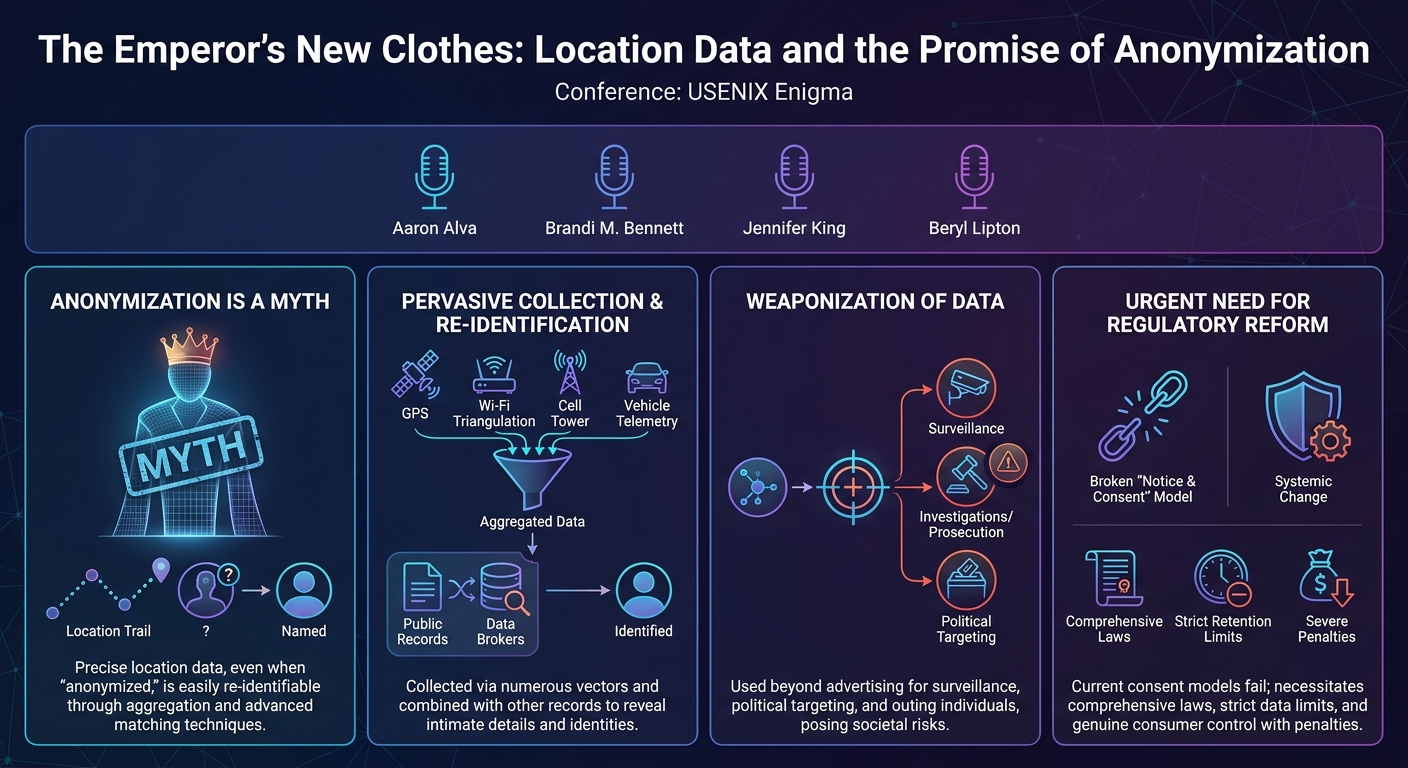
- Anonymization is a Myth: Precise location data, even when seemingly anonymized, is easily re-identifiable through aggregation, combination with public records, and advanced data matching techniques.
- Pervasive Collection & Monetization: Location data is collected through numerous vectors (GPS, Wi-Fi, Bluetooth, car telemetry) by a vast, unregulated ecosystem of apps, devices, and data brokers, often without genuine consumer understanding or consent.
- Weaponization of Data: What was once perceived as harmless data for ads has become a tool for surveillance, political targeting, outing individuals, and aiding law enforcement investigations, particularly in sensitive areas like abortion access and immigration.
- Inadequate Individual Controls: While personal privacy hygiene (e.g., turning off GPS) is helpful, it is insufficient to combat the systemic and collective nature of location data collection and misuse.
- Urgent Need for Regulatory Reform: Current "notice and consent" models are ineffective. Comprehensive federal laws, strict data retention limits, genuine consumer choice mechanisms (like Apple's ATT), and severe financial penalties are crucial.
- Systemic Economic Shift: Addressing the problem requires challenging the underlying economics of the internet, which is heavily reliant on personal data for advertising, and exploring models like data trusts or data divestiture.
About the Speaker(s)
- Aaron Alva: A technologist at the Federal Trade Commission (FTC), Alva moderated the panel, guiding the discussion on the technical and regulatory landscape of location data.
- Brandi M. Bennett: A private practice attorney with 15 years of in-house experience, including nearly a decade in data privacy. She has worked with various data types, from geolocation to biometric, and is knowledgeable in both U.S. and international law, having direct experience in the ad tech and analytics space.
- Dr. Jennifer King: A Privacy and Data Policy Fellow at the Stanford Institute for Human-Centered Artificial Intelligence (HAI). Her research focuses on the intersection of human-computer interaction (HCI) and consumer privacy, particularly in understanding how consumers perceive and interact with data collection.
- Beryl Lipton: An investigative researcher with the Electronic Frontier Foundation (EFF), where her work centers on police surveillance and government transparency, providing a critical perspective on how government entities access and utilize location data.
Reviews
Dr. Zero (Offensive Security Researcher) — SOLID
Another panel confirming what anyone with a pulse has known since 2015: 'anonymized telemetry' is a marketing lie. It's a highly competent policy rundown of how data brokers defeat hashing and truncation, but if you already track this space, you aren't learning anything new.
Heather Calloway (CISO) — SOLID
This panel strips away the comforting legal fiction that location data can be effectively anonymized. It is required viewing for your privacy, legal, and product teams. If your company collects this telemetry, or if you manage a high-target executive fleet, this discussion maps exactly where your regulatory and physical exposures lie.