Working on the Frontlines: Privacy and Security with Vulnerable Populations
Sarah Aoun
USENIX Enigma Conference 2023 · Day 1 · Grand Ballroom
Overview
In this compelling talk from USENIX Enigma, Sarah Aoun, a seasoned security expert, sheds light on the critical yet often misunderstood intersection of privacy, security, and human rights. Aoun’s presentation, "Working on the Frontlines: Privacy and Security with Vulnerable Populations," challenges the prevailing "one-size-fits-all" approach to digital security advice, arguing that such generalized guidance is not only ignorant but potentially life-threatening for highly targeted individuals and communities globally. Drawing from a decade of experience in high-risk environments, Aoun underscores the profound disconnect between security solutions designed in Western contexts and the complex realities faced by human rights defenders, journalists, and activists in oppressive regimes or conflict zones.
Key moments
- 0:00 Initial security workshop with Yemeni refugees
- 3:50 Danger of one-size-fits-all security advice
- 6:30 Digital attacks intersect with real-world physical violence
- 8:30 Egypt case: device seizure and suspicious apps
- 13:50 Afghanistan case: disastrous 'parachuting in' security training
- 17:50 Revisiting Yemeni story: lessons learned on context
- 20:00 Designing from the margins: the Grindr icon example
Working on the Frontlines: Privacy and Security with Vulnerable Populations
Speakers: Sarah Aoun
Conference: USENIX Enigma
YouTube: https://www.youtube.com/watch?v=rJgRinpgsYs
Overview
In this compelling talk from USENIX Enigma, Sarah Aoun, a seasoned security expert, sheds light on the critical yet often misunderstood intersection of privacy, security, and human rights. Aoun’s presentation, "Working on the Frontlines: Privacy and Security with Vulnerable Populations," challenges the prevailing "one-size-fits-all" approach to digital security advice, arguing that such generalized guidance is not only ignorant but potentially life-threatening for highly targeted individuals and communities globally. Drawing from a decade of experience in high-risk environments, Aoun underscores the profound disconnect between security solutions designed in Western contexts and the complex realities faced by human rights defenders, journalists, and activists in oppressive regimes or conflict zones.
Aoun articulates a crucial message: effective security and privacy measures must be deeply rooted in context, co-designed with the affected communities, and centered on harm reduction. She illustrates this through poignant real-world examples, from device seizures in Egypt to organizational security challenges in Afghanistan, demonstrating how standard security recommendations can backfire with severe consequences, including physical violence, imprisonment, or loss of critical data. The talk serves as a vital call to action for security professionals to adopt a more humble, empathetic, and context-aware methodology, emphasizing the urgent need to "design from the margins" to truly safeguard those most at risk.
The significance of Aoun's work lies in its direct impact on protecting fundamental human rights in an increasingly surveilled and digital world. By highlighting the unique vulnerabilities and operational realities of populations facing state surveillance, censorship, and targeted attacks, her insights are indispensable for anyone involved in developing, deploying, or advising on security technologies. The talk not only exposes the deficiencies of conventional security wisdom but also charts a path forward for a more ethical and effective practice of public interest technology, fostering a global community dedicated to cyber justice and freedom.
Background
▶ Watch: Initial security workshop with Yemeni refugees (0:00)
Sarah Aoun's extensive background provides the foundation for her critical perspective on security and vulnerable populations. As a security expert dedicated to Civil Society organizations, non-profits, journalists, and human rights defenders, she has operated in some of the world's most volatile regions, including South America, East Asia, the Middle East, and the United States. Her experience spans the Iranian revolution, the conflict in Ukraine, and the situation in Myanmar, where she has provided crucial advice on data protection, operating during internet shutdowns, and the effective use of circumvention technology. Previously, Aoun served as the CTO and VP of Security at the Open Technology Fund (OTF), an organization instrumental in funding projects that counter censorship and surveillance, notably as an early backer of Signal and a primary funder of Tor. This role involved identifying emerging threats and advancing information security for high-risk individuals.
Aoun identifies a fundamental flaw in much of the conventional security advice: a one-size-fits-all approach. This methodology, often developed and tested in Western contexts, proves "ignorant" at best and "quite dangerous" at worst when applied to vulnerable populations. The core issue is a profound lack of context. For instance, while "use Signal, use Tor" is a common refrain, Aoun notes that in parts of the Middle East, Signal suffered from high latency, rendering it unreliable, and its mere presence on a device could lead to "serious trouble" or criminalization if discovered by authorities. This highlights how tools designed for privacy in one environment can become a liability in another.
Aoun specifically defines vulnerable populations in her work as human rights defenders, journalists, activists, and organizers. These groups face unique challenges that make robust security incredibly difficult:
- Independence and Lack of Organizational Protection: Many work as freelancers or independent operators, bearing the full burden of their own security without the resources or established practices of larger organizations.
- Under-resourced Organizations: Even when affiliated with organizations, these entities are often severely under-resourced in terms of personnel and finances, preventing investment in adequate privacy and security infrastructure.
- Digital Security Literacy: There is a widespread lack of digital security literacy, making it difficult for individuals to recognize attacks or understand how to implement effective defenses.
The stakes for these populations are exceptionally high, as digital attacks frequently intersect with real-world physical violence. Aoun references a project by Forensic Architecture, a research group from the University of London, which investigated patterns of incidents between physical and digital spheres. Their 2021 work demonstrated how infections of spyware, specifically Pegasus from NSO Group, were "entangled with real-world violence" and extended into the professional and personal networks of targeted journalists, organizers, and human rights activists. This entanglement underscores the severe, tangible consequences of digital insecurity.
The field itself is highly complex, encompassing a multitude of interconnected areas of expertise:
- Internet shutdowns and circumvention.
- State surveillance capabilities.
- Social media and online identity management.
- Organizational security for under-resourced groups.
- Reverse engineering phones targeted by nation-state actors.
- Travel security when crossing borders with sensitive information.
This intricate web of challenges necessitates a nuanced and deeply contextualized approach to security, moving far beyond generic advice to address the specific threats and operational realities of vulnerable populations.
Key Findings
▶ Watch: Digital attacks intersect with real-world physical violence (6:30)
Aoun’s talk distills several critical findings concerning privacy and security for vulnerable populations, challenging conventional wisdom and advocating for a radically different approach:
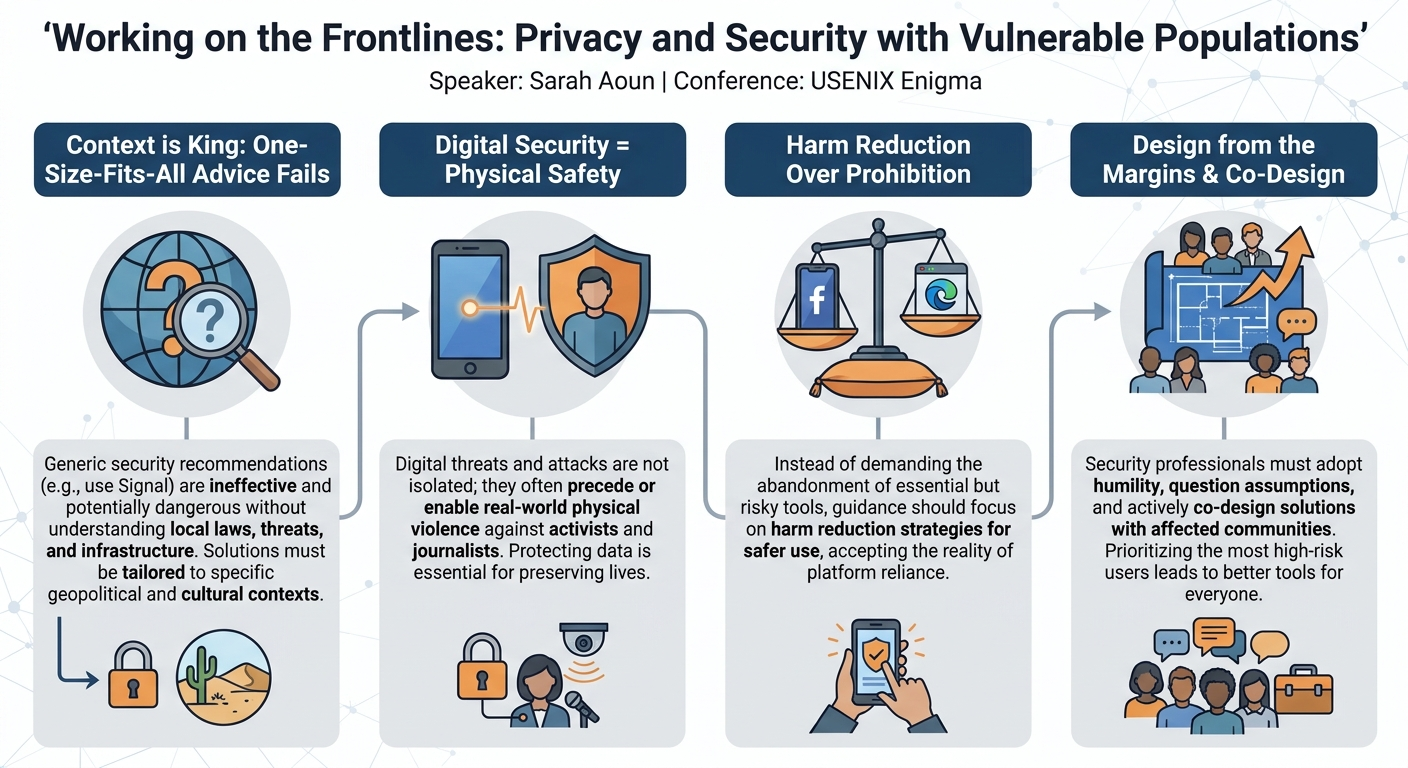
- Context is Paramount; One-Size-Fits-All Advice is Dangerous: The most significant finding is that security advice without deep contextual understanding is not just ineffective but actively harmful. Aoun's opening anecdote of security engineers advising Yemeni refugees on 2FA and password management, when their primary concern was human trafficking and many didn't even have email, perfectly illustrates this disconnect. Generic recommendations like "use Signal" can be dangerous in regions where the app is criminalized or unreliable due to latency.
- "Sanitized" Devices Can Be Suspicious: Counterintuitively, a device that is too "clean" can raise red flags for authorities or abusive partners. In Egypt, while having apps like Signal, VPNs, or Tor can lead to arrest, not having common social media apps like Facebook (which is ubiquitous in Egypt) can also be deemed suspicious. This highlights the need for a "security persona" that blends in rather than stands out.
- Infrastructure Realities Dictate Security Posture: Many vulnerable populations operate with severely limited technological resources. Aoun’s Afghanistan example revealed that an organization’s "IT setup" involved five employees sharing one old, unpatched device, often running pirated software like Microsoft Word with known vulnerabilities. This reality renders advice assuming individual devices, updated software, and stable internet entirely moot.
- Harm Reduction is Essential: Instead of absolute prohibitions (e.g., "don't use Facebook"), security guidance should focus on harm reduction. If a platform is essential for communication (like Facebook in many parts of the world), the advice should be on how to use it more safely or to mitigate risks, rather than demanding its abandonment, which could isolate users further.
- Design from the Margins: Aoun champions the concept of "designing from the margins," borrowing from researcher Afsaneh Rigot. This principle dictates that when building tools, developers must center and design for the most high-risk users, considering the worst-case scenarios in diverse, often oppressive, contexts. This approach ensures that technology serves the needs of historically marginalized and targeted individuals, rather than perpetuating their vulnerability.
- Digital and Physical Security are Inextricably Linked: The talk powerfully emphasizes that digital attacks are not isolated incidents but often precursors or enablers of physical violence. The Forensic Architecture project on Pegasus spyware demonstrated this entanglement, showing how digital infections directly correlated with real-world abuses against journalists and activists.
- Humility and Co-Design are Foundational: Security professionals must approach their work with humility, acknowledging what they don't know, and actively engaging with communities to understand their unique contexts. The concept of co-designing security advice—working with beneficiaries to create solutions that fit their reality—is presented as the only effective way forward.
These findings collectively call for a paradigm shift in how digital security is conceived and delivered to those who need it most, moving from a technical, top-down approach to one that is human-centered, contextual, and collaborative.
Technical Deep Dive
▶ Watch: Egypt case: device seizure and suspicious apps (8:30)
Sarah Aoun’s presentation, while not a traditional technical deep dive into specific exploits or code, provides profound insights into the real-world technical challenges and implications of security tools and practices for vulnerable populations. The "technical" aspect here lies in the operational realities, the vulnerabilities exploited by adversaries, and the often-unintended consequences of technology in high-stakes environments.
A core theme is the failure of Western-developed security applications when deployed without contextual understanding. Signal, often lauded for its end-to-end encryption, faced significant challenges in the Middle East. Aoun notes that its high latency made it "very very hard to rely on," leading to uncertainty about message delivery. More critically, in some regions, merely having Signal installed on a phone could be criminalized, leading to "serious trouble" if discovered by authorities. This illustrates how a tool designed for privacy can become a direct conduit to physical danger due to geopolitical realities.
Device seizure is a pervasive threat, especially in countries like Egypt. Here, the technical implications are dual-edged. Police routinely stop individuals and inspect their phones. Having applications deemed "suspicious" like Signal, a VPN, Tor, or an LGBT dating app like Grindr, can immediately lead to interrogation or jail time. This necessitates a technical understanding of app visibility and potential obfuscation. Conversely, Aoun highlights a counter-intuitive technical reality: not having ubiquitous apps like Facebook can also be suspicious, as "everyone has Facebook on their phone in Egypt." This implies a need for a "normal-looking" digital footprint, even if it means compromises.
The talk touches upon the technical capabilities of state actors, particularly in the context of satellite communication. Journalists and activists operating in conflict zones like Myanmar and Ukraine, facing internet shutdowns, might resort to satellite equipment. The technical questions posed include: "Can [the Russian government] triangulate my location?" and "Can I communicate safely with my colleagues?" This points to the need for technical expertise in understanding the metadata leakage of satellite systems, the geolocational accuracy of adversaries, and the secure configuration of satellite communication devices to minimize exposure.
Organizational security in under-resourced environments presents unique technical vulnerabilities. Aoun's experience in Afghanistan revealed a stark reality: approximately five employees sharing a single, old, un-updated device. These devices often ran pirated versions of Microsoft Word, which inherently carry "a lot of vulnerabilities." This technical environment is a prime target for exploitation, as unpatched software is a well-known vector for malware and data breaches. Furthermore, the lack of individual email addresses and shared device access complicates fundamental security practices like two-factor authentication (2FA) and password management. A previous "security training" that advised against Google and pushed for alternate services inadvertently led to mass account lockouts because users couldn't reset passwords without access to the new, unfamiliar email accounts – a technical failure rooted in poor contextual understanding.
The pervasive threat of spyware like Pegasus from NSO Group is a critical technical concern. Aoun references the Forensic Architecture project that mapped how digital infections from such spyware were "entangled with real-world violence," extending into the professional and personal spheres of targets. This underscores the sophisticated technical capabilities of state-sponsored actors to not only compromise devices but to leverage that access for physical harm and surveillance.
Finally, Aoun presents a powerful example of designing from the margins with a specific technical solution: the Grindr icon change. Recognizing that having Grindr on a phone in certain contexts (like Egypt) could lead to immediate arrest, researchers worked with Grindr to implement a feature that allows the app icon to be disguised, appearing as a "calculator or like a notepad." This seemingly minor technical alteration has profound implications for user safety, directly mitigating the risk of device seizure and subsequent prosecution. It demonstrates a practical application of threat modeling tailored to the most vulnerable users.
These examples collectively illustrate that the "technical deep dive" for vulnerable populations often involves understanding the interplay between geopolitical realities, adversary capabilities, user infrastructure limitations, and the nuanced application (or misapplication) of security technologies, far beyond mere code or protocol specifics.
Demo / Proof of Concept
▶ Watch: Revisiting Yemeni story: lessons learned on context (17:50)
While the talk did not feature a live technical demonstration or a specific proof of concept in the traditional sense of showcasing a new tool or an exploit, Sarah Aoun effectively illustrated her points through a series of compelling real-world case studies and examples. These narratives served as powerful "proofs of concept" for the dangers of decontextualized security advice and the effectiveness of community-informed approaches.
Aoun's opening story about the security workshop for Yemeni refugees in New York acted as an initial "anti-demo," highlighting how standard advice on passwords and 2FA completely missed the mark for a group primarily concerned with human trafficking and lacking basic digital literacy, let alone individual email accounts. This scenario demonstrated the critical failure of generic security education.
Subsequent examples further solidified her arguments:
- Egypt Device Seizure: This case served as a "demonstration" of the real-world implications of app visibility. The presence of apps like Signal, VPNs, Tor, or Grindr could lead to immediate detention, while the absence of Facebook could also raise suspicion. This illustrated the delicate balance between privacy and blending in, effectively demonstrating the "sanitized device" paradox.
- Afghanistan Organizational Security: This example highlighted the profound impact of infrastructure limitations. The scenario of five employees sharing one old, unpatched device running pirated software, and the subsequent account lockouts due to poorly implemented "alternate services" advice, served as a stark demonstration of how well-intentioned but ill-informed security interventions can cause more harm than good.
- Grindr Icon Change: This was the closest to a "proof of concept" for a defensive measure. Aoun described how, based on feedback from researchers, Grindr implemented a feature to disguise its app icon as a calculator or notepad. This practical, user-centric design change directly demonstrated how technical modifications, informed by the experiences of high-risk users, can offer tangible protection against device seizure and subsequent legal repercussions.
Through these vivid examples, Aoun provided a robust evidentiary basis for her arguments, making the case for contextualized, harm-reduction, and co-designed security strategies far more impactful than a purely technical demonstration might have been.
Defensive Implications
▶ Watch: Designing from the margins: the Grindr icon example (20:00)
Sarah Aoun's talk offers profound defensive implications for various stakeholders, from individual security practitioners to technology developers and human rights organizations. The core message is a call to fundamentally rethink how digital security is approached, moving away from universal solutions towards context-specific, human-centered strategies.
For security professionals and trainers, the primary defensive implication is to abandon the one-size-fits-all methodology. Instead, practitioners must:
- Prioritize Contextual Understanding: Before offering any advice, invest significant time in understanding the specific geopolitical, cultural, and technological context of the vulnerable population. This includes local laws regarding digital tools, common communication methods, and infrastructure limitations. Aoun's example of Signal's latency and criminalization in the Middle East is a stark reminder.
- Practice Humility and Co-Design: Acknowledge that external experts often lack full understanding. Engage directly with affected communities, listen to their concerns, and co-design security solutions that are practical and relevant to their lived realities. This means attending community-led workshops and asking questions, even on topics seemingly familiar.
- Embrace Harm Reduction: Instead of advocating for absolute prohibitions (e.g., "don't use Facebook"), focus on how individuals can use necessary but risky platforms more safely. This might involve adjusting privacy settings, understanding data collection, or using platforms for less sensitive communication.
- Question Assumptions: Challenge preconceived notions about users' digital literacy, access to technology, and existing IT infrastructure (e.g., assuming everyone has a personal, updated device or an email address). The Afghanistan case highlights the danger of such assumptions.
- Design from the Margins: When developing tools or advice, always consider the "worst case" scenario for the most high-risk users. This proactive threat modeling for the most vulnerable can lead to more robust and inclusive security features for everyone. The Grindr icon change is a prime example of such a defensive design choice.
For organizations supporting vulnerable populations, the defensive implications include:
- Tailored Training and Resources: Invest in security training that is specifically designed for the operational environment and technological capabilities of the beneficiaries. This means moving beyond generic cybersecurity modules.
- Infrastructure Investment: Recognize and address fundamental infrastructure gaps. This could mean providing updated, secure devices, assisting with secure communication setup, or supporting IT maintenance for under-resourced groups.
- Funding Context-Specific Research: Support organizations like the Open Technology Fund (OTF) that fund research and development of anti-censorship and anti-surveillance technologies specifically tailored for high-risk environments.
For technology developers and product teams, the defensive implications are equally critical:
- Global Threat Modeling: Incorporate global contexts and the needs of vulnerable populations into the design and threat modeling phases of product development. Consider how features might be abused or become liabilities in oppressive regimes.
- Build in Flexibility and Obfuscation: Where appropriate, integrate features that allow users to adapt tools to their specific risk environments, such as the ability to disguise app icons or customize privacy settings for different threat levels.
- Collaboration with Human Rights Experts: Actively seek feedback and collaborate with human rights organizations and public interest technologists to identify vulnerabilities and design solutions that genuinely protect the most targeted users.
Ultimately, the defensive strategy advocated by Aoun is a holistic one: moving from a purely technical mindset to an interdisciplinary approach that integrates anthropology, sociology, and human rights principles with robust security engineering. This ensures that defensive measures are not just technologically sound but also operationally viable and truly protective for those on the frontlines.
Key Takeaways
- Context is King: Effective digital security advice is deeply contextual; a "one-size-fits-all" approach is not only ineffective but can be actively dangerous for vulnerable populations.
- Digital Security = Physical Safety: Digital threats and attacks are often intertwined with real-world physical violence, making robust digital defenses a matter of life and death, as demonstrated by the Pegasus spyware cases.
- Harm Reduction Over Prohibition: Instead of telling vulnerable users to completely avoid essential but risky platforms (e.g., Facebook), security guidance should focus on harm reduction strategies to use these tools more safely.
- Design from the Margins: Technology developers and security professionals must prioritize designing tools and advice for the most high-risk users, considering worst-case scenarios in oppressive environments (e.g., the Grindr icon change).
- Humility and Co-Design: Security experts must approach their work with humility, question assumptions, and actively co-design solutions with the affected communities to ensure relevance and efficacy.
- The Public Interest Technology Field is Growing: There is a vital and expanding global community of cyber security professionals dedicated to protecting human rights and civil society, offering pathways for those interested in making a real-world impact.
About the Speaker(s)
Sarah Aoun is a distinguished security expert dedicated to advancing privacy and security for civil society organizations, non-profits, journalists, and human rights defenders globally. With a career spanning over a decade, she has worked extensively in high-risk environments across South America, East Asia, the Middle East, and the U.S., including during significant geopolitical events such as the revolution in Iran, the conflict in Ukraine, and situations in Myanmar. Aoun specializes in providing advice on protecting data and information, operating during internet shutdowns, and the effective use of circumvention technologies.
Notably, Sarah Aoun previously served as the CTO and VP of Security at the Open Technology Fund (OTF), an organization renowned for funding projects and technologies that counter censorship and surveillance, including being an early funder of Signal and a key supporter of Tor. In this role, she led efforts to identify and track emerging threats and to enhance information security for journalists, human rights defenders, and other high-risk individuals. Aoun describes her work as "giving advice with very serious consequences," underscoring her deep commitment to practical, impactful security solutions that directly safeguard human lives and freedoms.
Reviews
Dr. Zero (Offensive Security Researcher) — MUST SEE
Aoun drops a massive reality check on Western security engineers who think deploying Signal and YubiKeys solves human rights. This is a masterclass in high-stakes threat modeling where bad advice literally gets people jailed or killed. Mandatory viewing for anyone building privacy tech.
Heather Calloway (CISO) — SOLID
Aoun delivers a sharp critique of one-size-fits-all security policies that ignore the operational reality of the user. While focused on human rights defenders, the core lesson is mandatory for any corporate security team designing controls for employees in hostile environments. It proves that security mandates without operational context are just liabilities with a compliance stamp.