Technology Abuse Clinics for Survivors of Intimate Partner Violence
Lana Ramjit (Cornell Tech)
USENIX Enigma Conference 2023 · Day 1 · Grand Ballroom
Overview
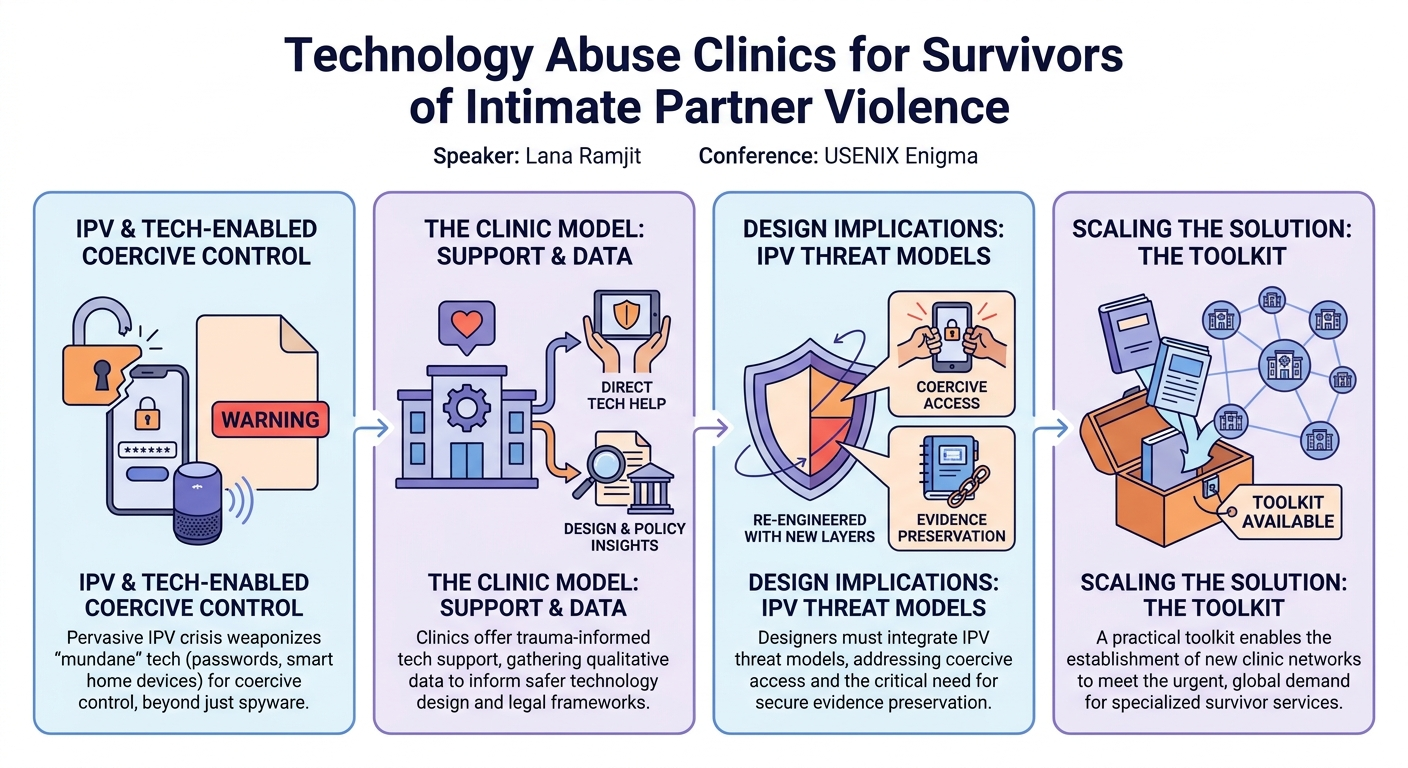
In this compelling talk from USENIX Enigma, Lana Ramjit of Cornell Tech introduces the critical concept of Technology Abuse Clinics, specialized centers designed to provide direct assistance to survivors of intimate partner violence (IPV) who are being harmed by technology. Ramjit highlights the pervasive and often insidious nature of tech-enabled abuse, which extends far beyond common perceptions of spyware to encompass a wide array of "mundane" digital interactions weaponized for coercive control. The presentation not only illuminates the devastating real-world consequences of such abuse but also offers a tangible solution: a toolkit for establishing and operating these vital clinics, aiming to foster a much-needed network of support systems.
Key moments
- 0:00 Introduction to technology abuse clinics and IPV context
- 1:20 Evolving definitions of IPV, recognizing technology's role
- 6:00 Why direct survivor tech support is essential
- 8:40 Specific examples of technology abuse and its impact
- 10:30 The devastating physical, financial, and psychological stakes
- 12:50 Introducing the Technology Abuse Clinic Toolkit for others
- 14:10 Three essential features of a technology abuse clinic
- 18:15 Call to action: start a clinic and resources
Technology Abuse Clinics for Survivors of Intimate Partner Violence
Speakers: Lana Ramjit, Cornell Tech
Conference: USENIX Enigma
YouTube: https://www.youtube.com/watch?v=IHUEWsGrIS4
Overview
In this compelling talk from USENIX Enigma, Lana Ramjit of Cornell Tech introduces the critical concept of Technology Abuse Clinics, specialized centers designed to provide direct assistance to survivors of intimate partner violence (IPV) who are being harmed by technology. Ramjit highlights the pervasive and often insidious nature of tech-enabled abuse, which extends far beyond common perceptions of spyware to encompass a wide array of "mundane" digital interactions weaponized for coercive control. The presentation not only illuminates the devastating real-world consequences of such abuse but also offers a tangible solution: a toolkit for establishing and operating these vital clinics, aiming to foster a much-needed network of support systems.
The core premise of Ramjit's argument is that understanding the full narrative of survivors' experiences is paramount. Rather than viewing technology abuse as isolated technical incidents, clinics offer a holistic approach, providing immediate technical help while simultaneously gathering invaluable qualitative data that can inform better technology design, public policy, and legal frameworks. This approach challenges conventional thinking in both the technology and advocacy sectors, emphasizing that direct engagement with survivors is not merely a service but a critical feedback loop for creating safer digital environments.
The talk underscores that IPV is a severe public health problem, with technology increasingly becoming a central vector for harm. By empowering individuals to establish and run technology abuse clinics, Ramjit seeks to scale an effective model that addresses the urgent demand for specialized support, bridging the gap between technological expertise and the nuanced needs of vulnerable populations. The initiative represents a significant step towards recognizing and effectively combating technology-facilitated coercive control.
Background
▶ Watch: Introduction to technology abuse clinics and IPV context (0:00)
Intimate Partner Violence (IPV) is recognized by the CDC as a pervasive public health crisis in the United States, impacting a significant portion of the population. Statistics reveal its alarming prevalence, with estimates indicating that one in four women and one in ten men experience severe violence from an intimate partner in their lifetimes. This crisis is disproportionately severe within already marginalized communities, where over half of Indigenous, Black, and bisexual women, as well as over half of transgender and non-binary individuals, report experiencing severe IPV.
The definition and understanding of IPV are crucial, and as Ramjit elucidates, they are often complex and politically charged. Historically, experts and advocates define IPV as a pattern of abusive behavior used by one partner to maintain power and control over another, encompassing physical, sexual, emotional, economic, and psychological means. This comprehensive understanding is known as coercive control, recognizing IPV not as isolated incidents but as a sustained, complex system underpinned by the threat of violence. This definition is vital for survivors, as it allows for a holistic response to diverse forms of abuse beyond just physical or sexual harm.
Ramjit illustrates the precariousness of this definition by tracing its evolution within a specific U.S. federal agency over five years. An initial, robust definition emphasizing coercive control was temporarily replaced by a narrower one that categorized IPV solely as "felony or misdemeanor crimes of violence." This shift had profound consequences, effectively stripping away the context of coercive behaviors like 24/7 monitoring, location tracking, social isolation, or financial draining, rendering them invisible within the legal framework of abuse. Critically, the definition later reverted closer to its original, comprehensive form, with a significant addition: the explicit recognition that coercive control can be technological. This acknowledgment was a major victory for advocates and researchers, confirming what has been known since the advent of technologies like caller ID and GPS—that digital tools are potent instruments for abusers to harm and track their victims, a reality only amplified by modern technological advancements.
The rationale behind detailing this definitional journey is profound: definitions dictate understanding, and understanding dictates response. When definitions fail to reflect the lived experiences of survivors, they have detrimental real-world consequences. Technology abuse clinics emerge as a powerful response to this challenge. They serve as crucial spaces where survivors can articulate their narratives of technology abuse directly to experts who possess the capacity to influence platform design, public policy, and legal frameworks. These clinics offer immediate, short-term technical assistance while simultaneously gathering rich qualitative data, ensuring that systemic changes are rooted in the authentic experiences of those most affected. This symbiotic relationship, Ramjit argues, cultivates better engineers, designers, and privacy and security experts by grounding their work in human reality.
Key Findings
▶ Watch: Why direct survivor tech support is essential (6:00)
The central discovery presented by Ramjit is the critical role and effectiveness of Technology Abuse Clinics in addressing the pervasive issue of technology-facilitated intimate partner violence. Through her work at The Clinic to End Tech Abuse in New York City, where she has assisted over 100 survivors, Ramjit reveals several key insights:
Firstly, the nature of technology abuse, while devastating, often involves seemingly mundane technical tasks. Contrary to public perception that often conjures images of sophisticated spyware, much of the assistance provided by clinics involves reviewing account settings, changing passwords, and examining login histories. This finding highlights a crucial disconnect: the simplicity of the technical action belies the profound complexity and threat it represents within a larger pattern of coercive control. The talk emphasizes that dismissing these "simple" tasks as unworthy of expert attention is a fundamental misunderstanding of IPV dynamics, akin to viewing IPV as an isolated incident rather than a continuous narrative of abuse.
Secondly, the narrative context of technical events is paramount. Ramjit powerfully illustrates this with an anecdote of a survivor whose partner forced a password, took their phone, and deleted their journal. While technically just data deletion, understanding the full story reveals a pattern of coercive access, evidence destruction, and psychological manipulation. This perspective allows for the development of more accurate threat models for intimate partner violence, which include unique considerations like coercive access (where an abuser forces access to a device or account) and the critical need for evidence preservation (as survivors often need digital records for legal protection, while simultaneously needing to secure their devices from further abuse).
Thirdly, the stakes of technology abuse are incredibly high, encompassing physical danger, severe financial and economic devastation, and profound psychological and emotional harm. Ramjit shares harrowing client stories: survivors spending exorbitant amounts to tear apart their cars searching for non-existent AirTags, being trapped in phone contracts owned by abusers who actively interfere with attempts to leave, or having all digital communication records erased over a decade-long relationship. The insidious nature of smart home device harassment (e.g., abusers remotely controlling AC, internet, or lights to assert surveillance while at work) and the loss of critical accounts for housing, healthcare, or business illustrate the widespread impact. Ramjit particularly stresses the psychological toll, where technology's ubiquitous and seemingly factual digital records, easily manipulated, lead survivors to question their own sanity, compounding the trauma of real-world threats.
Finally, despite the severity of the problem, technology abuse clinics prove to be highly effective and positive corrective experiences for survivors. Entry and exit interviews reveal that clients gain a better understanding of how technology can be used to harm them and how to enhance their safety. The most significant challenge identified is the overwhelming demand for these services; with only three known technology abuse clinics globally, their capacity to meet local needs, let alone national or global ones, is severely limited. This underscores the urgent need for a network of clinics that can share resources, experiences, and collectively advocate for policy changes, necessitating a practical toolkit to facilitate their establishment.
Technical Deep Dive
▶ Watch: The devastating physical, financial, and psychological stakes (10:30)
The technical deep dive into technology abuse, as illuminated by Ramjit, demonstrates how everyday technologies are weaponized within patterns of coercive control, often in ways that are overlooked by conventional security paradigms. The talk moves beyond the simplistic notion of "spyware" to reveal a more nuanced and pervasive landscape of digital harm.
A recurring theme is coercive access and data manipulation. Ramjit recounts a survivor's experience where an abuser physically took their phone, forced the password, and deleted a digital journal containing evidence of abuse. From a purely technical standpoint, this is a data deletion event. However, within the context of IPV, it becomes a sophisticated act of evidence destruction and digital gaslighting, making it harder for the survivor to prove their experience while simultaneously undermining their sense of reality. This highlights the need for platform designers to consider mechanisms for evidence preservation that are resilient against coercive access, perhaps through immutable logs or secure, independent backup options.
Digital surveillance extends beyond explicit tracking applications. One survivor, convinced by an alert, had mechanics tear apart her car searching for an AirTag that was never found. While potentially a false positive or a misidentification, the psychological impact of perceived surveillance, amplified by technological alerts, is a powerful tool for abusers to maintain control and instill paranoia. More directly, Ramjit detailed how an abuser used Bluetooth devices to harass a client still living with him. By remotely controlling smart home devices—turning on/off the air conditioning, internet, or lights—the abuser created a constant, unsettling presence, signaling "I see you" and asserting pervasive control, even from a distance. This demonstrates how networked domestic devices, designed for convenience, can be repurposed as instruments of constant, low-level harassment and surveillance.
Account control and identity erasure represent another critical technical vulnerability. Ramjit described clients unable to exit phone contracts owned by their abusers, with one harrowing instance where a phone company three-way dialed the abuser during the survivor's attempt to seek help. This illustrates a systemic vulnerability where shared accounts or lack of independent control over digital infrastructure can trap survivors. Furthermore, the complete digital erasure observed in one client's case, where an abuser meticulously removed all electronic communication records over a decade-long relationship, underscores the terrifying potential for abusers to erase a survivor's digital history and connection, impacting legal recourse and personal memory. This points to the need for robust data retention policies, independent account recovery mechanisms, and perhaps "digital wills" or trusted contacts for account access in abusive relationships.
The loss of critical digital accounts for public housing applications, healthcare, and personal businesses further emphasizes the economic and logistical devastation facilitated by tech abuse. These are not merely inconveniences but direct threats to a survivor's ability to rebuild their life, demonstrating how control over digital identity translates directly into control over fundamental life resources.
While the talk references existing research on a systematic analysis and taxonomy of technology abuse, Ramjit's focus is on illustrating these technical abuses through survivor narratives. These stories reveal that traditional security models, which often focus on external threats or individual device compromise, are insufficient. Instead, a more comprehensive approach must account for relational dynamics, the unique vulnerabilities arising from intimate relationships, and the ways in which technology interacts with legal systems and human behavior to facilitate coercive control. This necessitates designing systems that are resilient to internal threats, provide robust user control, and offer mechanisms for safe data management and evidence preservation in high-stakes, interpersonal contexts.
Demo / Proof of Concept
▶ Watch: Introducing the Technology Abuse Clinic Toolkit for others (12:50)
This talk did not feature a traditional technical demo or proof of concept in the sense of exploiting a vulnerability or showcasing a new security tool. Instead, the "proof of concept" presented was the very model of the Technology Abuse Clinic itself, along with the introduction of a toolkit designed to enable others to replicate and scale this model. The effectiveness of the clinic model is demonstrated through the positive outcomes reported by survivors and the overwhelming demand for its services.
Ramjit detailed that the existing clinics, including her own, The Clinic to End Tech Abuse in New York City, have proven that providing direct, trauma-informed technical assistance to survivors is not only feasible but profoundly impactful. The "proof" lies in the reported improvements in survivors' understanding of technology abuse and their ability to enhance their own safety.
The Technology Abuse Clinic Toolkit serves as the practical implementation guide for this proven concept. It is a distillation of collective advice and lessons learned from years of operating these clinics. The toolkit covers essential operational aspects, including:
- Recruiting and training staff: Ensuring that individuals are not only technically proficient but also equipped with the necessary trauma-informed care principles.
- Running client sessions: Providing practical guidance on how to conduct empathetic and effective consultations, prioritizing client safety and agency.
- Managing the "moving parts": Addressing the administrative and logistical challenges inherent in operating such a service.
Crucially, Ramjit emphasized what the toolkit is not: it is not a prescriptive, "best or only way" to run a clinic. Instead, it encourages innovation and adaptation. It acknowledges that IPV is not the sole relational dynamic that can make people vulnerable, inviting exploration of other contexts. It also suggests that diverse service models and funding structures are possible and encourages experimentation. This flexibility is a core tenet, recognizing that local communities have unique needs, cultural contexts, and technological landscapes that demand tailored approaches. The toolkit, therefore, is a foundational resource, providing the essential framework while fostering creative development in response to specific community requirements.
Defensive Implications
▶ Watch: Call to action: start a clinic and resources (18:15)
The insights from Lana Ramjit's talk carry profound defensive implications for various stakeholders, from technology designers to security professionals and policymakers. The overarching message is that defense against technology abuse requires a shift from purely technical vulnerability patching to a more holistic, human-centered approach that accounts for complex relational dynamics and trauma.
For technology designers and platform developers, the talk highlights the urgent need to integrate IPV-specific threat models into their design processes. This means proactively considering how features, even those seemingly innocuous, could be weaponized for coercive control. Key areas include:
- Account security and recovery: Designing systems where account ownership can be clearly established and transferred safely, especially in cases of shared devices or accounts. Recovery mechanisms for two-factor authentication must not inadvertently alert an abuser.
- Data control and privacy: Giving users granular control over their data, including robust deletion options, while also considering features that could aid in evidence preservation in a secure, non-discoverable way by an abuser.
- Notification systems: Carefully designing notifications for account changes, location sharing, or device access to ensure they do not inadvertently tip off an abuser about a survivor's attempts to secure themselves.
- Smart home and IoT devices: Recognizing the potential for these devices to become tools for surveillance and harassment. Designers must implement strong access controls, clear ownership delineation, and easy ways to revoke access without alerting previous users.
- Digital identity and communication: Ensuring that platforms facilitate the preservation of communication records while offering secure, private channels that are not easily monitored or erased by an abuser.
For security professionals and privacy experts, the talk underscores the importance of broadening their understanding of "security threats." The "mundane" technical issues—password resets, reviewing login histories, checking account settings—are not trivial but critical vectors for abuse. Defenders must:
- Adopt a trauma-informed approach: Understanding that technical advice must be delivered with empathy, recognizing the high stakes (physical danger, psychological harm) involved. This often means collaborating with social workers and IPV advocates.
- Provide practical, context-specific advice: Generic advice like "just use Signal" might not be appropriate or safe for a survivor whose abuser controls their phone contract or monitors all app installations. Solutions must be tailored to the survivor's unique threat model and living situation.
- Recognize pervasive surveillance: Be aware that abusers employ a wide range of tools, from AirTags to smart home devices, and can also engage in sophisticated digital erasure to hide their tracks.
- Support evidence preservation: Understand the legal needs of survivors and guide them on how to safely document and preserve digital evidence without compromising their immediate safety.
For policymakers and legal systems, the talk emphasizes the critical role of definitions and resource allocation:
- Refine IPV definitions: Ensure legal definitions of intimate partner violence explicitly recognize and address technological coercive control, reflecting the lived experiences of survivors.
- Support funding for clinics: Acknowledge the critical gap in services and fund the establishment and expansion of technology abuse clinics as essential infrastructure for survivor support.
- Legislative protections: Consider laws that protect survivors in digital contexts, such as enabling them to exit shared phone contracts without abuser consent or notification, or mandating data retention policies that prevent total digital erasure by abusers.
Ultimately, the defensive implications call for a multidisciplinary effort. Technology cannot be designed or secured in isolation from the human context in which it operates. By embracing survivor narratives and the expertise of IPV advocates, the security community can build more resilient, ethical, and truly protective digital environments.
Key Takeaways
- IPV is a Complex, Technologically-Enhanced Public Health Crisis: Intimate partner violence is a widespread problem, with technology increasingly serving as a potent tool for coercive control, often in seemingly "mundane" ways like password resets or account monitoring.
- Survivor Narratives are Crucial for Design and Policy: Understanding the full, often complex, stories behind technical incidents is essential for developing effective threat models, designing safer technology platforms, and crafting responsive public policy.
- Technology Abuse Clinics Provide Vital, Trauma-Informed Support: These clinics offer direct, expert technical assistance to survivors, providing both immediate help and a critical feedback loop for understanding the evolving landscape of tech-enabled abuse.
- The Demand for Clinics Far Outstrips Supply: With only a handful of known clinics globally, there is an urgent and unmet need for a broader network of such services to assist survivors in their local communities.
- A Toolkit Exists to Scale Solutions: A practical toolkit has been developed to guide individuals and organizations in establishing their own technology abuse clinics, emphasizing adaptability, trauma-informed care, and community-based approaches.
- Designers and Security Experts Must Adapt: Tech professionals must integrate IPV-specific threat models into their work, considering coercive access, evidence preservation, and the psychological impact of technology in abusive relationships, moving beyond traditional security paradigms.
About the Speaker(s)
Lana Ramjit is a researcher affiliated with Cornell Tech, specializing in the intersection of technology and intimate partner violence. She is the founder and operator of The Clinic to End Tech Abuse in New York City, a pioneering initiative that provides direct technical assistance to survivors. Through her extensive work, having collaborated with over 100 survivors, Ramjit has gained deep insights into the varied and often subtle ways technology is weaponized in abusive relationships. Her expertise is further solidified by her role in developing a comprehensive toolkit aimed at empowering others to establish similar technology abuse clinics, reflecting her commitment to scaling effective solutions and fostering a network of support for survivors globally. Her background, implicitly rooted in advanced computer science and design, allows her to bridge the gap between technical expertise and the urgent humanitarian needs of vulnerable populations.
Reviews
Dr. Zero (Offensive Security Researcher) — STRONG ACCEPT
Ramjit forces the industry to confront a threat model we consistently ignore: an adversary with persistent physical access, shared infrastructure, and zero ethical constraints. This isn't a zero-day drop; it's a brutal reality check on how smart home APIs and telecom account recovery flows are weaponized in intimate partner violence. Strong accept because she brings concrete data from over 100 cases and ships a usable toolkit instead of just admiring the problem.
Heather Calloway (CISO) — SOLID
Ramjit’s work is a necessary corrective for any security program that assumes a user is an autonomous, uncoerced agent. For platform companies, this is a product security mandate; for enterprise CISOs, it fundamentally alters how we handle executive protection and identity access management.