How Geopolitical Change Causes People to Become (More) Vulnerable
Lucy Simko (George Washington University)
USENIX Enigma Conference 2023 · Day 1 · Grand Ballroom
Overview
In this compelling talk from USENIX Enigma, Lucy Simko of George Washington University illuminates a critical, yet often overlooked, dimension of cybersecurity: how major geopolitical shifts fundamentally alter individuals' security and privacy postures, frequently rendering them more vulnerable. Simko argues that events like wars, forced migration, natural disasters, or global pandemics create destabilizing conditions that disrupt established threat models, force difficult trade-offs between immediate needs and digital safety, and expose the systemic inequities embedded within technology design.
Key moments
- 1:54 Amina's ATM PIN used as email password
- 3:17 Three factors increasing refugee security vulnerability
- 5:09 Social Security Number: incomplete threat models
- 8:10 Design misalignments: birthdays and security questions
- 11:00 Sudanese activists' manual message deletion strategy
- 15:30 Twitter's 2FA design misstep for Sudanese users
- 18:02 Three questions for designing for vulnerable populations
How Geopolitical Change Causes People to Become (More) Vulnerable
Speakers: Lucy Simko (George Washington University)
Conference: USENIX Enigma
YouTube: https://www.youtube.com/watch?v=5-53nj1mYrM
Overview
In this compelling talk from USENIX Enigma, Lucy Simko of George Washington University illuminates a critical, yet often overlooked, dimension of cybersecurity: how major geopolitical shifts fundamentally alter individuals' security and privacy postures, frequently rendering them more vulnerable. Simko argues that events like wars, forced migration, natural disasters, or global pandemics create destabilizing conditions that disrupt established threat models, force difficult trade-offs between immediate needs and digital safety, and expose the systemic inequities embedded within technology design.
The presentation opens with a poignant anecdote about Amina, a Somali refugee struggling to create an email account in the U.S. Amina's attempt to use her four-digit ATM PIN as an email password, coupled with her unfamiliarity with keyboards and mice, serves as a stark illustration of how cultural knowledge, technological literacy, and pressing life circumstances converge to create profound security risks. This story underscores the talk's central thesis: vulnerability is not merely a technical failing but a complex interplay of social, economic, cultural, and technological factors exacerbated by geopolitical upheaval.
Simko’s research transcends individual case studies, abstracting common threads across diverse populations affected by geopolitical change, including refugees, Sudanese activists during their 2019 revolution, and individuals navigating the COVID-19 pandemic and post-hurricane recovery. By identifying these shared vulnerabilities, the talk provides a powerful framework for understanding and addressing the security and privacy challenges faced by those undergoing profound life transitions, ultimately advocating for a more empathetic and equitable approach to technology design.
Background
▶ Watch: Amina's ATM PIN used as email password (1:54)
The problem addressed by Simko's talk arises from a fundamental mismatch between the design assumptions of modern technology and the lived realities of individuals experiencing significant geopolitical change. Technology is often built with a "default user" in mind—one who operates within stable social, economic, and political contexts, possesses a certain level of digital literacy, and shares common cultural norms regarding information and privacy. However, geopolitical events shatter these assumptions, plunging individuals into unfamiliar environments where these defaults no longer apply.
Simko defines geopolitical change as a phenomenon driven by massive political events, such as wars or widespread displacement, or by natural disasters that trigger significant policy shifts and government intervention. These events create a cascade of challenges that directly impact an individual's security and privacy. The speaker highlights three primary reasons why this problem exists:
- Vulnerable Position: Individuals undergoing geopolitical change, such as refugees, often find themselves in precarious social and financial situations. For instance, refugees in the U.S. may receive limited government support, creating immense pressure to secure employment quickly. This urgency can override security considerations when interacting with online systems.
- Incentive to Use Unfamiliar Technology: To navigate their new circumstances (e.g., applying for jobs, accessing services, connecting with support networks), these individuals are heavily incentivized to use digital technologies. However, these tools are frequently not built for someone with their specific cultural knowledge, language proficiencies, or prior technological experience. Amina's struggle with a keyboard and mouse, after years in refugee camps without computer access, is a prime example of this disconnect.
- Cultural and Systemic Misalignments: The digital world often assumes a universal cultural understanding that simply doesn't exist. Concepts like birthdates, legal names, or the purpose of a Social Security Number (SSN) carry different meanings or levels of importance across cultures. When these assumptions are encoded into security mechanisms (e.g., identity verification, authentication questions), they create barriers and disproportionately disadvantage populations whose experiences fall outside these norms.
Collectively, these factors create a fertile ground for increased vulnerability to security and privacy harms. The talk advocates for moving beyond studying individual vulnerable populations in isolation, instead seeking abstract common threads to better support diverse groups and design for a safer, more equitable world.
Key Findings
▶ Watch: Social Security Number: incomplete threat models (5:09)
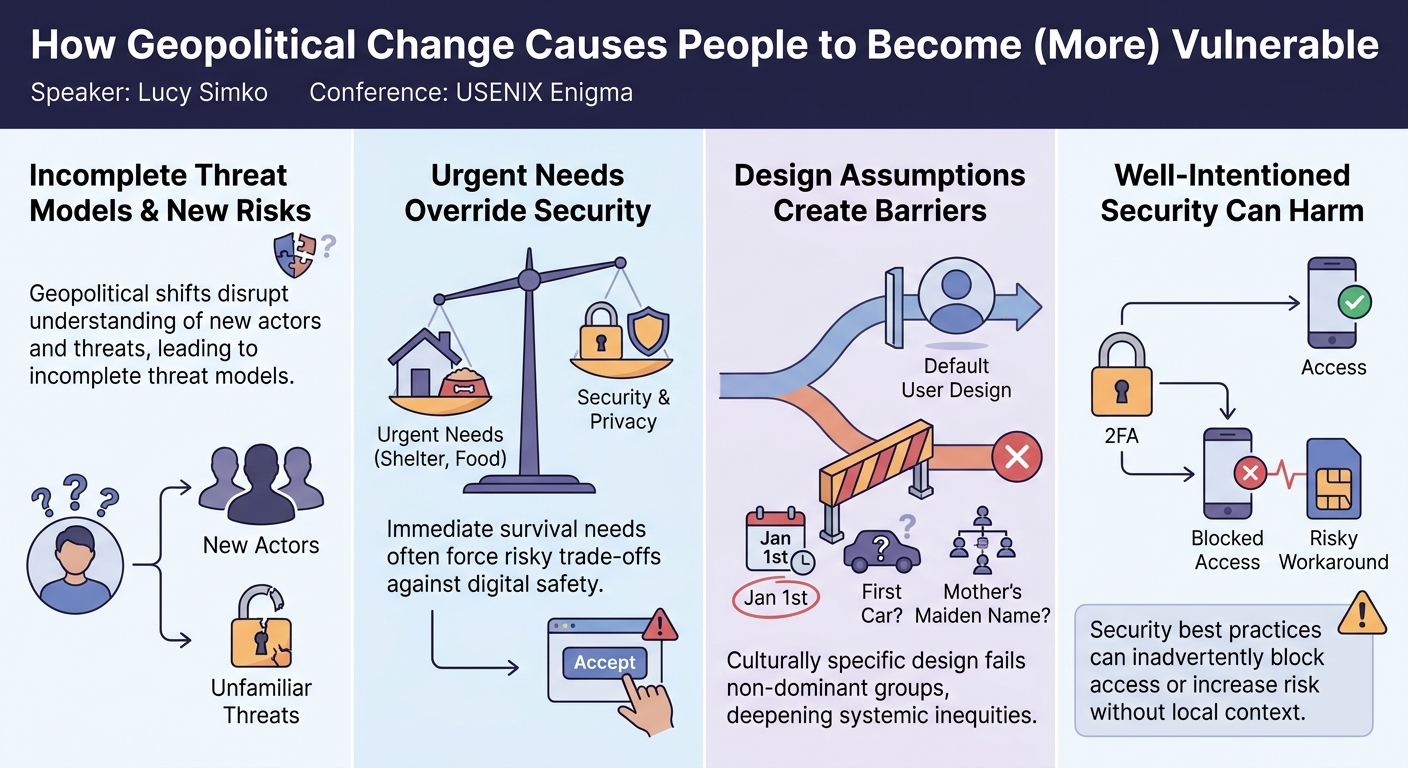
Simko's research identifies three interconnected core findings that explain how geopolitical change exacerbates security and privacy vulnerabilities, often represented as a conceptual framework of three "bubbles" in the presentation:
- Geopolitical Change Creates Destabilizing Conditions that Cause People's Threat Models to Become Incomplete: When individuals experience a massive life change, they encounter new actors, new threats, new assets to protect, and new technologies. In this transitional period, their understanding of who might target them, what information is valuable, and how to protect it is fundamentally disrupted and often incomplete. For example, refugees arriving in the U.S. are advised never to share their Social Security Number (SSN), a valid general rule. However, they soon learn that caseworkers, employers, and banks require it, creating a complex web of exceptions. This constant re-evaluation of trust and risk is overwhelming, especially when simultaneously learning a new language, navigating complex bureaucracies, and facing urgent needs.
- Other Needs Emerge, Forcing People to Prioritize or De-prioritize Security and Privacy: In times of crisis or significant transition, immediate survival needs—such as finding housing, securing employment, or ensuring physical safety—often take precedence over abstract security or privacy concerns. Individuals are forced into what one Somali woman described as a "gambling situation," where they must share personal information with social workers or case managers to access vital services, even if they feel uneasy about it. Their actions cannot align with their ideal threat model because other, more pressing needs dictate their choices. This trade-off is not a sign of carelessness but a rational response to their circumstances, often made with incomplete information, as seen with COVID-19 exposure notification apps where users weighed perceived health benefits against digital safety concerns.
- Design Misalignments Add Up, Becoming Systemic Inequities and Exacerbating Other Systemic Inequities: Technology design frequently embeds cultural assumptions that create barriers for those outside the dominant user base. These "design misalignments" accumulate, disproportionately affecting vulnerable populations. A classic example involves birthdates: many cultures do not track specific birth days, leading individuals to adopt January 1st as a legal birthday upon arrival in countries like the U.S. This seemingly minor detail can break authentication processes; Simko recounts a Somali man with a common name and a January 1st birthday who was falsely flagged for a violent assault during a rideshare background check, simply because the system couldn't differentiate between individuals with non-randomly distributed birthdays. Similarly, common security questions (e.g., "What is your mother's maiden name?" or "What was the make and model of your first car?") assume specific cultural practices (like changing names upon marriage) or life experiences (like owning a car), creating unnecessary hurdles for authentication and access. These misalignments are not isolated incidents but contribute to broader systemic inequities, making it harder for already vulnerable groups to securely access essential services.
These three findings demonstrate that vulnerability during geopolitical change is not a personal failing but a systemic issue rooted in the interplay of human needs, social context, and technology design.
Technical Deep Dive
▶ Watch: Design misalignments: birthdays and security questions (8:10)
While Simko's talk focuses heavily on human factors and societal implications, it meticulously details how specific technical implementations and design choices either fail or succeed in addressing the unique threat models of populations undergoing geopolitical change. The technical deep dive reveals how these misalignments manifest and their cascading consequences.
Incomplete Threat Models and Technical Challenges:
The core issue of incomplete threat models directly impacts how individuals interact with and secure technology. For refugees like Amina, the concept of a strong, unique password for an email account is alien, leading to the use of a simple, reused ATM PIN. This isn't a lack of intelligence but a lack of exposure to the specific threat landscape of online accounts. Similarly, the Social Security Number (SSN) in the U.S. represents a complex technical and bureaucratic challenge. While initially advised never to share it, new arrivals quickly learn that employers, banks, and government agencies require it. This creates a highly confusing and dangerous situation where distinguishing legitimate requests from phishing scams (e.g., "I'm your bank, give me your SSN") becomes nearly impossible, especially for those still learning English and navigating new bureaucratic systems. The technical solution for SSN protection (e.g., two-factor authentication for government services) doesn't resolve the fundamental confusion of who to trust with the number itself.
For Sudanese activists during the 2019 revolution, their threat model was in constant flux. Adversaries shifted from a dictator to a military junta, with the police always a threat. The technical challenge was securing communications against an unpredictable state actor known for seizing phones and inspecting messages. While encrypted messaging apps like Signal and Telegram offer features like disappearing messages, their effectiveness is limited by group adoption. As Simko points out, "if I download Signal but none of my friends do it actually doesn't matter because I still can't text them." This highlights a critical technical and social barrier: a technically superior security solution is useless if it's not widely adopted within the relevant social network. The activists, therefore, resorted to a non-technical, manual workaround: regimented manual deletion of SMS and WhatsApp messages, making do with the technology they had.
During the COVID-19 pandemic, the proposed exposure notification apps presented a different technical challenge. Many apps were designed using privacy-preserving protocols (e.g., decentralized Bluetooth-based systems like Apple/Google Exposure Notification API) that explicitly avoided location tracking. However, public understanding of these technical details was poor. Users often made decisions about downloading these apps based on misconceptions, directly contrasting perceived health benefits with a (often inaccurate) fear of digital safety compromise, particularly concerning location data misuse. The technical design aimed for privacy, but the user's incomplete understanding of that design led to mistrust and non-adoption.
Prioritization and Technical Trade-offs:
The necessity to prioritize immediate needs over security often forces users into technical compromises. Hurricane victims, for instance, face the technical reality of limited battery life and unreliable infrastructure (damaged cell towers, power outages). Their decision-making revolves around whether to use their phone for social connection and information gathering (e.g., checking social media, contacting friends) or to conserve battery for potential emergencies (e.g., calling 9-1-1). This is a direct technical trade-off imposed by environmental conditions, where the technical limitations of mobile devices and infrastructure force a difficult choice between different forms of safety and connection.
Design Misalignments and Systemic Inequities:
This is where technical design choices have the most profound and often unintended negative impact.
- Authentication based on Personal Data: The reliance on specific personal data points for identity verification and authentication often creates systemic inequities. The "January 1st birthday" issue is a prime example. Database systems and background check algorithms are designed to handle randomly distributed birthdates. When a specific population disproportionately shares a single birthdate, it breaks the system's ability to uniquely identify individuals, leading to false positives (e.g., the rideshare driver example) or denial of service. Similarly, security questions like "What is the make and model of your first car?" or "What was your mother's maiden name?" are technically simple validation checks. However, they rely on cultural assumptions (e.g., car ownership, specific naming conventions) that are not universal, creating arbitrary technical barriers for authentication.
- Twitter's Two-Factor Authentication (2FA) Rollout: A particularly illustrative technical misalignment occurred during the Sudanese Revolution. Twitter, aiming to improve security, globally enabled 2FA for its users. In principle, 2FA is a robust security control, requiring a second verification factor (like a code sent to a phone) in addition to a password. However, Sudan had been under international sanctions for years, which technically prevented Sudanese users from adding their local phone numbers to international services like Twitter for 2FA verification. This "generally good all-purpose security thing" had severe, cascading negative consequences. Sudanese activists relied heavily on Twitter for organizing protests and disseminating information via Direct Messages. Suddenly, a critical tool became inaccessible or significantly harder to use. Their technical workarounds included:
- Asking friends or family abroad to register their foreign phone numbers for 2FA, then manually relaying codes via other channels.
- Acquiring global SIM cards to obtain an international phone number while still physically in Sudan.
These workarounds, while technically functional, were burdensome and not universally accessible. Ironically, these methods might have increased their security by routing 2FA codes outside the Sudanese telecom network, but this was an unintended consequence, not Twitter's design intent. This case highlights how a technically sound security feature, deployed without cultural and geopolitical context, can inadvertently harm vulnerable populations.
In essence, the technical deep dive reveals that the problem isn't necessarily a lack of security technologies, but rather a profound lack of contextual awareness in their design and deployment, leading to solutions that are unusable, inaccessible, or even detrimental to those most in need of protection.
Demo / Proof of Concept
▶ Watch: Twitter's 2FA design misstep for Sudanese users (15:30)
This talk does not feature a traditional technical demonstration or a proof of concept. Instead, Lucy Simko presents findings from her qualitative research, drawing on interviews, surveys, and observational data from various vulnerable populations. The "proof" of her concepts lies in the compelling real-world anecdotes and systematic analysis of how geopolitical change affects security and privacy, rather than in a live software or hardware demonstration. The focus is on understanding human behavior and systemic design failures in response to external pressures.
Defensive Implications
▶ Watch: Three questions for designing for vulnerable populations (18:02)
The insights presented by Lucy Simko offer crucial defensive implications for security professionals, policymakers, product designers, and anyone involved in creating or deploying technology. The core message is that designing for a stable, homogenous user base is no longer sufficient; we must actively design for change and vulnerability.
- Rethink Threat Modeling: Traditional threat modeling often assumes a relatively stable user context. Defenders must adopt a more dynamic and empathetic approach, anticipating that users' threat models will be incomplete and constantly evolving during geopolitical change. This means:
- Providing Options: Instead of rigid security rules, offer users flexible options that allow them to adapt to their changing risk perceptions and urgent needs.
- Contextual Support: Provide security guidance that is highly contextual, culturally appropriate, and available in multiple languages, recognizing that a "good rule" can quickly acquire complex exceptions.
- Detecting Change (with Caution): While detecting that a user has undergone a significant life change could allow for tailored security interventions, Simko cautions that this is complex and potentially privacy-invasive. If pursued, it must be done with extreme care and transparency.
- Acknowledge and Design for Competing Needs: Security and privacy are not always a user's top priority, especially when basic needs like housing, food, or safety are at stake. Defenders must design systems that:
- Minimize Trade-offs: Explore ways to build security and privacy into the core functionality so that users don't have to actively de-prioritize them to achieve other goals. Can a system be both secure and facilitate job applications without requiring risky information sharing?
- Enable Safe Prioritization: If users must make trade-offs (e.g., sharing data for a service), ensure they have the tools and information to do so as safely and knowingly as possible, even if their information is incomplete. This includes clear, accessible information about data usage and privacy policies.
- Usability in Crisis: Design interfaces and processes that remain usable and intuitive even under extreme stress, limited resources (e.g., low battery, poor connectivity), or language barriers.
- Address Systemic Inequities in Design: Technology often inadvertently amplifies existing societal inequalities. Defenders need to proactively identify and mitigate these design misalignments:
- Challenge Assumptions: Critically examine all assumptions embedded in authentication, identity verification, and data collection processes. Are birthdates, names, or security questions universally applicable?
- Flexible Authentication: Move beyond rigid authentication methods that rely on culturally specific data points. Implement more flexible and inclusive authentication (e.g., diverse 2FA options, biometric alternatives where appropriate and secure, or identity verification processes that accommodate varied documentation).
- Avoid "One-Size-Fits-All" Security: Recognize that a security feature considered "best practice" in one context (like mandatory 2FA) can have devastating, cascading consequences for vulnerable populations in another. Conduct thorough impact assessments that consider diverse user groups, especially those in precarious geopolitical situations.
- Beyond Technology: Acknowledge that systemic inequities cannot be solved by technology alone. Design efforts must be complemented by policy changes, community engagement, and cross-sector collaboration to create a truly equitable and secure environment.
Ultimately, the defensive implication is a call for greater empathy, flexibility, and contextual awareness in cybersecurity. By understanding the human element and the profound impact of geopolitical change, we can move towards designing technologies that genuinely protect all users, especially those most vulnerable.
Key Takeaways
- Geopolitical change fundamentally destabilizes individuals' security and privacy postures, creating new vulnerabilities that existing technology designs often fail to address.
- Users' threat models become incomplete and constantly evolving during periods of crisis or transition, making it difficult for them to accurately assess risks and protect their assets.
- Urgent, non-security needs frequently force individuals to de-prioritize security and privacy, leading to difficult trade-offs that are rational responses to their circumstances, not signs of carelessness.
- Technology design often embeds cultural assumptions and biases, leading to "design misalignments" that disproportionately affect vulnerable populations and exacerbate systemic inequities (e.g., rigid authentication, culturally specific security questions).
- "Good" security practices, when deployed without contextual awareness, can have severe, cascading negative consequences for vulnerable groups (e.g., Twitter's 2FA rollout during the Sudanese Revolution).
- Designing for a safer and more equitable world requires empathy, flexibility, and a dynamic approach to security, anticipating change, offering adaptable solutions, and challenging universal assumptions in technology design.
About the Speaker(s)
Lucy Simko is a researcher at George Washington University, specializing in the intersection of security, privacy, design, and human factors. Her work deeply explores how technology impacts vulnerable populations, particularly those experiencing significant life changes due to geopolitical events. Her insights are often drawn from extensive qualitative research and direct engagement with communities, as exemplified by her volunteer work with refugees and recent immigrants in Seattle, which directly informed the foundational anecdote of this talk. Simko’s collaborative research efforts also extend to working with international colleagues, such as her co-author Allah from Sudan, to understand the unique challenges faced by activists in specific geopolitical contexts. Her research advocates for a more human-centered and context-aware approach to designing secure and private technologies.
Reviews
Dr. Zero (Offensive Security Researcher) — STRONG ACCEPT
Simko dismantles the Silicon Valley default threat model. She proves that our baseline security assumptions shatter the second they hit geopolitical friction, using Twitter's botched 2FA rollout in Sudan as the murder weapon. Mandatory viewing for product security architects who think everyone lives in Cupertino.
Heather Calloway (CISO) — SOLID
Simko delivers a sharp analysis of how baseline assumptions in identity and access management break down during global crises. This is required viewing for product security and IAM leaders. When we design authentication strictly for an idealized, stable user, real-world volatility turns our security controls into denial-of-service mechanisms.