Fireside Chat with Simson Garfinkel on Quantum Technologies
Joseph Lorenzo Hall (Moderator · Internet Society), Simson Garfinkel (Speaker)
USENIX Enigma Conference 2023 · Day 1 · Grand Ballroom
Overview
In this engaging fireside chat at USENIX Enigma, Simson Garfinkel, a distinguished fellow of the AAAS, ACM, and IEEE, joined by moderator Joseph Lorenzo Hall, delved into the complex and often misunderstood world of Quantum Technologies. The discussion was prompted by Garfinkel's recent Open Access book, "The Law and Policy for the Quantum Age," co-authored with Chris Hoofnagle. The talk aimed to demystify quantum concepts for a diverse audience, providing essential level-setting before tackling prevalent myths and facts surrounding quantum computing, cryptography, and sensing.
Key moments
- 0:00 Introduction: What is Quantum Technology?
- 4:00 Shor's and Grover's algorithms for cryptanalysis
- 12:00 Quantum Sensing: The real near-term impact
- 16:00 Myth 1: Large-scale quantum computers timeline
- 21:00 Myth 3: All encryption will be unscrambled
- 30:00 Workforce challenges in quantum technology
- 34:00 Post-Quantum Preparedness Act and NIST standardization
Fireside Chat with Simson Garfinkel on Quantum Technologies
Speakers: Joseph Lorenzo Hall (Moderator, Internet Society); Simson Garfinkel (Speaker)
Conference: USENIX Enigma
YouTube: https://www.youtube.com/watch?v=lAwcunm_LQY
Overview
In this engaging fireside chat at USENIX Enigma, Simson Garfinkel, a distinguished fellow of the AAAS, ACM, and IEEE, joined by moderator Joseph Lorenzo Hall, delved into the complex and often misunderstood world of Quantum Technologies. The discussion was prompted by Garfinkel's recent Open Access book, "The Law and Policy for the Quantum Age," co-authored with Chris Hoofnagle. The talk aimed to demystify quantum concepts for a diverse audience, providing essential level-setting before tackling prevalent myths and facts surrounding quantum computing, cryptography, and sensing.
Garfinkel and Hall navigated the landscape of quantum advancements, from the fundamental principles of superposition and entanglement to the practical implications for national security, industry, and everyday encryption. The conversation meticulously dissected the hype surrounding quantum breakthroughs, offering a grounded perspective on the near-term promises and long-term challenges. Crucially, the talk emphasized the distinction between various quantum domains, highlighting which areas are seeing immediate real-world impact versus those still decades away.
The session served as a critical reality check, challenging popular narratives about an impending "quantum apocalypse" for cybersecurity. Instead, it offered a nuanced view, focusing on the specific threats posed by algorithms like Shor's and Grover's, the limitations of current quantum hardware, and the strategic shifts necessary for both defenders and policymakers. It underscored the importance of informed discourse to prevent "quantum winters" and ensure that investments in this transformative field are guided by realistic expectations and clear strategic goals.
Background
▶ Watch: Introduction: What is Quantum Technology? (0:00)
The concept of harnessing quantum properties for computation dates back to Richard Feynman's visionary talk in 1981, where he proposed a computer based on quantum mechanics to simulate quantum interactions. This foundational idea laid the groundwork for Quantum Computing. However, the field truly captured widespread attention with the advent of two pivotal algorithms: Shor's algorithm and Grover's algorithm.
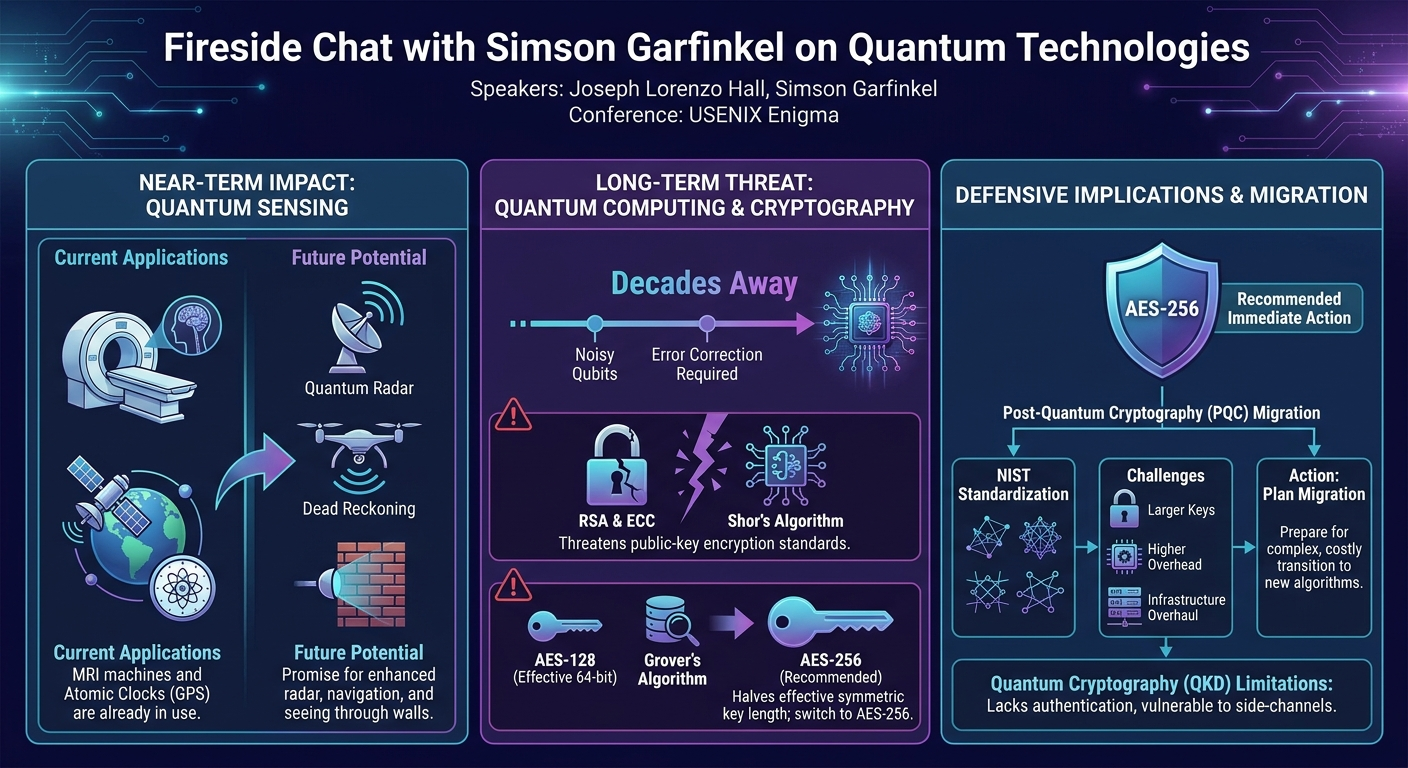
Shor's algorithm, developed by Peter Shor, demonstrated that a sufficiently powerful quantum computer could factor large numbers in polynomial time, a task that takes exponential time on classical computers. This capability directly threatens widely used public-key encryption standards such as RSA and Elliptic Curve Cryptography (ECC), which rely on the computational difficulty of factoring large numbers or solving discrete logarithm problems. The ability to efficiently factor integers would effectively render these cryptographic schemes insecure, potentially allowing adversaries to decrypt vast amounts of previously recorded encrypted data.
Grover's algorithm, on the other hand, offers a quadratic or square root speedup for searching unsorted databases or for finding a correct answer. In the context of cryptography, this means it could halve the effective key length of symmetric encryption algorithms like AES. For example, AES-128 could effectively become AES-64, and AES-256 could become AES-128. While a significant speedup, it doesn't break these algorithms in the same fundamental way Shor's algorithm breaks RSA, but it does necessitate a re-evaluation of recommended key lengths for long-term security.
The current state of quantum hardware is characterized by "noisy qubits." These qubits are highly susceptible to errors and decoherence, losing their superposition state quickly. To perform meaningful computations, particularly those requiring millions of operations, extensive quantum error correction is required. This necessity significantly inflates the number of physical qubits needed to realize a single "logical" qubit, pushing the timeline for cryptographically relevant quantum computers far into the future. Despite these challenges, the potential impact on cryptography has spurred significant research and development in both quantum hardware and Post-Quantum Cryptography (PQC), which aims to develop classical algorithms resistant to quantum attacks.
Key Findings
▶ Watch: Quantum Sensing: The real near-term impact (12:00)
The discussion highlighted several critical findings and debunked common myths about quantum technologies:
- Near-Term Promise Lies in Quantum Sensing and Simulation: While quantum computing for cryptanalysis is a distant prospect, the most immediate and impactful applications are in Quantum Sensing and Quantum Simulation. Quantum sensing is already prevalent in technologies like MRI machines (originally Nuclear Magnetic Resonance, NMR) and atomic clocks, which enable precise timekeeping essential for GPS. Future applications include highly accurate dead reckoning, enhanced radar (e.g., Quantum Radar for defeating stealth), and potentially seeing through walls. Quantum simulators are expected to revolutionize fields like physics and chemistry by modeling complex molecular interactions, accelerating drug discovery and material science. Optimization problems are also a promising area where quantum approaches could offer provable advantages over classical methods.
- Large-Scale Quantum Computers for Cryptanalysis Are Not Imminent: A significant myth dispelled was the idea that humankind is at the precipice of inventing large-scale quantum computers capable of breaking current encryption. Garfinkel clarified that "large-scale" in the context of cryptanalysis (e.g., cracking an RSA key) refers to machines with tens of millions of noisy qubits that can maintain superposition for extended periods (e.g., eight hours, as per Google's estimate). While quantum simulators with thousands of noisy qubits are closer to reality (within 3-5 years, according to National Academies reports), cryptographically relevant machines are still decades away, possibly on "geological time" scales, rather than being an immediate threat in our lifetimes.
- Quantum Computers Do Not "Try All Solutions at Once": Another pervasive myth is that quantum computers can explore the entire state space simultaneously to solve NP-hard problems, effectively trying all solutions at once. Garfinkel firmly stated this is incorrect. Quantum computers operate on principles of superposition and interference, leading to probabilistic outcomes, not a non-deterministic exploration of all possibilities. They offer speedups for specific types of problems but do not magically solve all intractable computational challenges.
- Encryption Will Not Be Unscrambled by a "Light Switch" Effect: The notion that quantum computing will instantly render all existing encryption useless was debunked. Even when powerful quantum computers emerge, cracking an encryption key would be a resource-intensive process, potentially taking hours per key. This implies significant challenges for adversaries in terms of prioritization, deconfliction, and targeting specific communications from a vast ocean of recorded data. The practical difficulty of cracking 64-bit encryption today, despite its theoretical weakness, illustrates that "breakable" does not mean "trivial" or "instantaneous."
- Quantum Cryptography Has Limitations: While Quantum Key Distribution (QKD) systems exist and offer mathematically provable security (based on current understanding of quantum physics) for generating shared, secret keys (effectively one-time pads), they are not invulnerable. Crucially, QKD systems do not provide authentication; they typically rely on classical cryptographic methods (like Diffie-Hellman or RSA) for authenticating the communication stream. This introduces a classical vulnerability that could be exploited by a future quantum computer. Furthermore, QKD systems are susceptible to side-channel attacks, and the National Security Agency (NSA) has stated they are not needed in the United States, suggesting that easier attack vectors (like implants) often bypass the need for direct cryptanalysis.
- No Single Nation Is Decisively "Ahead" in Quantum Technologies: The belief that the U.S. is definitively leading the global race in quantum technologies was challenged. Garfinkel highlighted that while U.S. companies like IBM, Google, and Microsoft have significant quantum programs, these are often multinational efforts. China, in contrast, has a dedicated national quantum program, and other countries may have unannounced initiatives. The global nature of scientific collaboration and talent means that no single nation holds an undisputed lead, underscoring the importance of international cooperation and talent acquisition.
Technical Deep Dive
▶ Watch: Myth 1: Large-scale quantum computers timeline (16:00)
The core of quantum computing lies in qubits, which differ fundamentally from classical bits. Unlike classical bits that can be either 0 or 1, qubits can exist in a superposition of both states simultaneously. This property, combined with entanglement (where the state of one qubit instantaneously influences another, regardless of distance), allows quantum computers to process information in ways classical computers cannot.
In a classical computer, the program and data reside in memory, and the CPU (Arithmetic Logic Unit) fetches data, performs operations using logic gates, and writes results back to memory. Quantum computers, however, operate differently: the qubits remain in a central "core," and a sequence of quantum gates (analogous to classical logic gates but operating on superpositions) are "played through" the qubits. This process is repeated thousands of times, and only then are the qubits measured, collapsing their superposition into a definite 0 or 1 state. The final result is a distribution of possible answers, not a single deterministic outcome.
Shor's algorithm leverages these quantum properties to factor large integers exponentially faster than any known classical algorithm. This capability directly undermines the security of RSA and Elliptic Curve Cryptography (ECC), which are the bedrock of much of today's secure communication, including SSL/TLS, digital signatures, and secure key exchange. The threat is not just to real-time communications but also to "harvest now, decrypt later" scenarios, where encrypted data is collected today in anticipation of future quantum decryption capabilities.
Grover's algorithm provides a quadratic speedup for search problems. For symmetric encryption like AES, this means an attacker could find the key faster. Specifically, for an n-bit AES key, Grover's algorithm reduces the effective security from 2^n operations to roughly 2^(n/2) operations. Thus, AES-128 effectively becomes AES-64, and AES-256 becomes AES-128. To maintain current security levels against a quantum adversary, the recommendation is to use AES-256, as even with Grover's speedup, AES-128 (effectively AES-64) would still be resistant for the "conceivable lifetime of humanity" with current classical resources, but AES-256 offers a stronger long-term posture.
The hardware challenges are immense. Current quantum machines possess "noisy qubits," meaning they are prone to errors and decoherence. To reliably crack an RSA key, Google's estimates suggest a machine would need 10 to 20 million noisy qubits that can be kept in superposition for approximately eight hours. IBM's roadmap for quantum computing involves building more noisy qubits, fewer less noisy qubits, and eventually connecting groups of qubits into larger systems. This underscores the need for sophisticated quantum error correction techniques, which themselves require a significant overhead of physical qubits for each logical qubit.
Quantum Networking represents another facet, enabling the connection of quantum computers and the sharing of entanglement. This can be conceptualized as "flying qubits" transmitting superposition between nodes. A specialized application of quantum networking is Quantum Cryptography (QKD), which has been operational since the early 2000s. QKD systems allow two parties to establish a shared secret key (a one-time pad) with security provable by the laws of quantum physics. However, QKD does not inherently provide authentication. Practical QKD implementations typically overlay classical authentication protocols (e.g., using Diffie-Hellman or RSA) to ensure the communicating parties are who they claim to be. This reliance on classical authentication means that the overall system's security can still be compromised by a quantum attack on the classical authentication layer, or by side-channel attacks on the QKD hardware itself.
Finally, Post-Quantum Cryptography (PQC) is a crucial defensive strategy. NIST is actively standardizing a suite of new public-key algorithms based on mathematical problems not susceptible to Shor's algorithm (i.e., not based on factoring, elliptic curves, or discrete logarithms). These include lattice-based, code-based, hash-based, and multivariate polynomial cryptosystems. While promising, these algorithms are generally less vetted than their classical predecessors (some NIST candidates have already been broken), and they tend to involve larger key sizes and higher computational overhead, posing significant challenges for implementation and widespread adoption across existing infrastructure.
Demo / Proof of Concept
▶ Watch: Workforce challenges in quantum technology (30:00)
This fireside chat was a high-level discussion and policy-focused presentation rather than a technical demonstration. As such, no specific demo or proof of concept was conducted during the talk. The speakers focused on explaining complex quantum concepts and their implications through discussion and analogy, drawing from the content of Garfinkel's book.
Defensive Implications
▶ Watch: Post-Quantum Preparedness Act and NIST standardization (34:00)
The insights from this discussion offer several critical defensive implications for individuals, organizations, and governments:
- Upgrade to AES-256 Immediately: Given Grover's algorithm's potential to halve the effective key length of symmetric encryption, the most immediate and actionable defensive measure is to ensure all symmetric encryption uses AES-256. While AES-128 is currently considered robust, moving to AES-256 incurs virtually no performance penalty today and provides a stronger posture against future quantum threats, effectively maintaining AES-128-level security even after Grover's algorithm becomes practical.
- Prepare for Post-Quantum Cryptography (PQC) Migration: The NIST standardization process for Post-Quantum Cryptography algorithms is well underway. Organizations, particularly government agencies (mandated by legislation like the Quantum Computing Cybersecurity Preparedness Act), must prepare for a massive cryptographic migration. This involves not only understanding the new algorithms but also anticipating the practical challenges:
- Increased Key Sizes: PQC algorithms often use significantly larger keys, impacting storage, transmission, and memory requirements.
- Higher Computational Overhead: PQC operations can be more computationally intensive, affecting performance on resource-constrained devices or high-volume traffic.
- Infrastructure Overhaul: Every system, from PIV cards and smart cards to secure communication protocols and software updates, will need to be updated to incorporate these new algorithms. This will be a costly and complex undertaking, requiring careful planning and execution.
- Re-evaluate Threat Models with Realistic Quantum Timelines: Defenders should avoid panic and base their strategies on realistic timelines for cryptographically relevant quantum computers. The "light switch" scenario where all encryption instantly breaks is a myth. Adversaries will still face significant resource constraints, prioritization challenges, and targeting problems even with powerful quantum machines. The "harvest now, decrypt later" threat is real for highly sensitive, long-lived data, but not every piece of encrypted communication will be targeted.
- Understand Quantum Cryptography's (QKD) Limitations: While QKD offers theoretically strong key exchange, defenders must be aware of its practical limitations. QKD systems do not provide authentication on their own, requiring classical methods that remain vulnerable to quantum attacks. Furthermore, QKD hardware can be susceptible to side-channel attacks. Therefore, QKD should not be seen as a panacea but rather as one tool in a broader cryptographic strategy, with a clear understanding of its integration challenges and dependencies.
- Focus on Holistic Security, Not Just Encryption: The talk reiterated that "it's much easier to go around the encryption." Attack vectors like implants on devices remain highly effective. Defenders must maintain a comprehensive security posture that includes strong endpoint security, network segmentation, robust access controls, and vigilant threat intelligence, rather than solely relying on cryptographic strength. A quantum-resistant encryption scheme is only as strong as the weakest link in the overall security chain.
- Address Workforce Challenges: The talent gap in quantum technologies is significant. Nations must address immigration policies to attract global talent and foster educational pipelines to develop a skilled workforce capable of understanding, implementing, and securing quantum-era systems. The complexity of programming quantum computers today will eventually be abstracted by higher-level languages and standardized instruction sets, but specialized expertise will remain crucial.
Key Takeaways
- Quantum Sensing is the Immediate Impact Area: Technologies like MRI and atomic clocks are already quantum sensing applications, with future advancements promising revolutionary capabilities (e.g., enhanced radar, dead reckoning).
- Cryptographically Relevant Quantum Computers Are Distant: Large-scale quantum computers capable of breaking current public-key encryption (RSA, ECC) are still decades away, requiring millions of stable qubits and significant engineering breakthroughs.
- Shor's and Grover's Algorithms Pose Future Threats: Shor's algorithm threatens RSA and ECC, while Grover's algorithm reduces the effective key strength of symmetric ciphers like AES (e.g., AES-128 becomes AES-64).
- Actionable Defense: Use AES-256 Now: To mitigate the threat from Grover's algorithm, immediate adoption of AES-256 for symmetric encryption is recommended, as it offers a strong defense with no current performance penalty.
- PQC Migration is Complex and Costly: The transition to NIST-standardized Post-Quantum Cryptography (PQC) will be a massive undertaking, involving larger keys, higher computational demands, and a complete overhaul of cryptographic infrastructure.
- Quantum Cryptography (QKD) Has Limitations: While QKD offers provably secure key exchange, it lacks inherent authentication and is vulnerable to side-channel attacks, making it part of a broader security strategy rather than a standalone solution.
About the Speaker(s)
Simson Garfinkel is a highly accomplished computer scientist and journalist, holding a PhD in Computer Science from MIT and a Master of Science in Journalism from Columbia University. He is a distinguished fellow of the American Association for the Advancement of Science (AAAS), the Association for Computing Machinery (ACM), and the Institute of Electrical and Electronics Engineers (IEEE). Garfinkel is known for his deep engagement with research ethics and has recently co-authored the book "The Law and Policy for the Quantum Age" with Chris Hoofnagle, which explores the societal and policy implications of quantum technologies.
Joseph Lorenzo Hall served as the moderator for this fireside chat. He is associated with the Internet Society, bringing his expertise to guide the discussion on the complex interplay of technology, policy, and societal impact in the quantum realm.
Reviews
Dr. Zero (Offensive Security Researcher) — SOLID
Garfinkel does the industry a massive favor here by taking a sledgehammer to the 'quantum apocalypse' vendor hype. It’s a grounded reality check that correctly identifies quantum sensing as the real near-term deal while pushing cryptographically relevant quantum computers back into the geological timescales where they belong. Mandatory viewing for any CISO currently being terrorized by quantum-marketing snake oil.
Heather Calloway (CISO) — SOLID
Boards read about the quantum apocalypse in the financial press and inevitably ask what we're doing about it. Garfinkel provides the exact script you need to walk them off the ledge while preparing for the very real, very expensive reality of cryptographic migration.