Secure Micropatching on the ISS
Henry Haswell (Research Engineer · Southwest Research Institute)
Aerospace Village @ DEF CON 31 · Day 1 · Aerospace Village
Overview
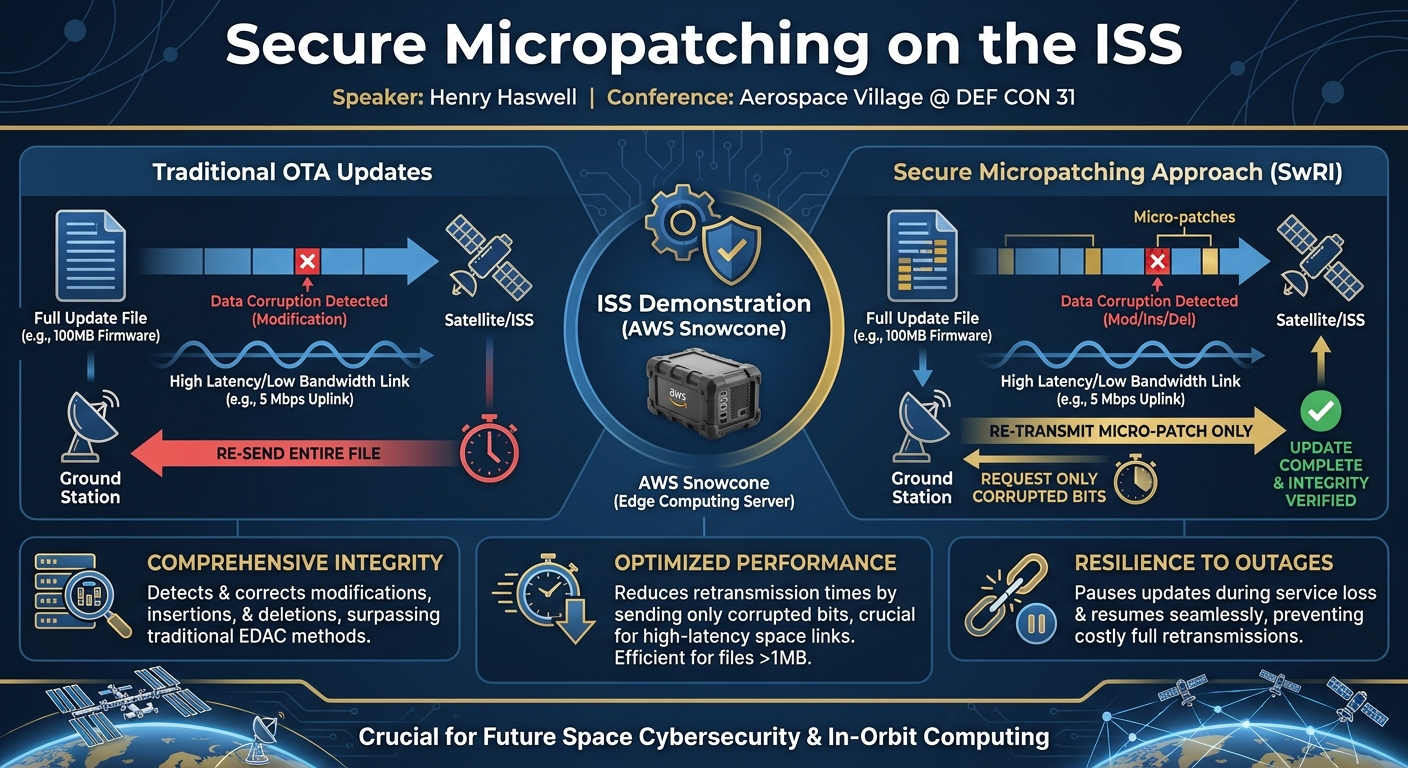
In an era where space assets are increasingly critical infrastructure and targets for cyberattacks, the ability to securely and reliably update software over-the-air (OTA) is paramount. Henry Haswell, a Research Engineer at Southwest Research Institute (SwRI), presented a groundbreaking talk at DEF CON 31's Aerospace Village, detailing SwRI's innovative approach to secure micropatching and its first known deployment on the International Space Station (ISS). This presentation highlights a significant leap forward in ensuring the integrity and resilience of software updates for spacecraft, addressing the unique challenges of high latency, limited bandwidth, and the harsh radiation environment of space.
Key moments
- 0:50 Challenges of over-the-air updates for satellites
- 3:30 Limitations of traditional error detection and correction
- 4:30 Secure micropatching: correcting diverse data corruption efficiently
- 6:00 Demonstrating secure micropatching on the International Space Station
- 11:00 Optimizing micropatching for high-latency space environments
- 15:00 Successful ISS demo: faster updates, resilient to outages
- 17:00 Q&A: Future deployment and commercial licensing model
Secure Micropatching on the ISS
Speakers: Henry Haswell, Research Engineer, Southwest Research Institute
Conference: Aerospace Village @ DEF CON 31
YouTube: https://www.youtube.com/watch?v=7t1KfVWaOL0
Overview
In an era where space assets are increasingly critical infrastructure and targets for cyberattacks, the ability to securely and reliably update software over-the-air (OTA) is paramount. Henry Haswell, a Research Engineer at Southwest Research Institute (SwRI), presented a groundbreaking talk at DEF CON 31's Aerospace Village, detailing SwRI's innovative approach to secure micropatching and its first known deployment on the International Space Station (ISS). This presentation highlights a significant leap forward in ensuring the integrity and resilience of software updates for spacecraft, addressing the unique challenges of high latency, limited bandwidth, and the harsh radiation environment of space.
Haswell's research demonstrates a novel method to protect against a broader range of data corruption—including modifications, insertions, and deletions—than traditional error correction techniques. By focusing on re-transmitting only corrupted bits rather than entire files, micropatching drastically reduces update times and enhances operational continuity, even in the face of intermittent network connectivity. This capability is not just an efficiency gain; it's a critical cybersecurity measure, minimizing the window of vulnerability for space systems and safeguarding against malicious actors seeking to alter satellite behavior.
The successful demonstration on an AWS Snowcone aboard the ISS serves as a powerful proof of concept, paving the way for more robust and secure OTA update mechanisms across the burgeoning space industry. As space-based computing and satellite constellations become more prevalent, the principles of secure micropatching will be indispensable for maintaining the integrity, availability, and confidentiality of these vital assets, ensuring they can be patched effectively without risking mission failure due to data corruption or cyber intrusion.
Background
▶ Watch: Challenges of over-the-air updates for satellites (0:50)
The evolution of software updates in space has come a long way from the early days of satellite operations where systems were programmed once and launched, with no expectation of post-deployment modification. While over-the-air (OTA) updates are now common on more recent satellites, they present significant challenges. Space assets typically have small windows of opportunity to communicate with ground stations, meaning failed or incomplete updates can lead to lengthy delays or, worse, system errors and mission compromise. The stakes are particularly high when considering the potential for malicious actors to inject corrupted or altered updates, as evidenced by recent conflicts where satellite internet services were targeted.
Traditional methods for ensuring data integrity during space communications include Cyclic Redundancy Checks (CRCs), which are standard in CCSDS (Consultative Committee for Space Data Systems) packets to verify data validity. For on-board data protection against phenomena like radiation-induced bit flips, Error Detection and Correction (EDAC) algorithms such as BCH codes and Reed-Solomon codes are commonly employed. These EDAC methods are effective at correcting bit modifications. However, they come with a significant limitation: the memory requirements on the space system increase proportionally with the size of the bit errors they need to correct. For large errors spanning several bytes, the computational and memory overhead can be substantial. More critically, these traditional EDAC methods are primarily designed to correct modifications to existing data; they do not inherently protect against the insertion or deletion of data, which could be exploited by sophisticated attackers or result from complex communication failures.
SwRI's prior work in secure micropatching for ground systems laid the foundation for this space-focused application. The core problem micropatching addresses is the need for a more comprehensive and efficient method to ensure data integrity during OTA updates, one that can detect and correct not just bit modifications, but also insertions and deletions. This capability is crucial in environments like space, where every minute of transmission time is valuable, and the potential for diverse forms of data corruption is high, whether from environmental factors or malicious intent. The goal is to reduce the retransmit time associated with correcting an update, moving beyond the inefficient practice of resending an entire file if even a small portion is corrupted.
Key Findings
▶ Watch: Secure micropatching: correcting diverse data corruption efficiently (4:30)
The research and demonstration of secure micropatching on the ISS yielded several critical findings that underscore its significance for space cybersecurity and operations:
- Comprehensive Data Integrity: Unlike traditional EDAC methods (e.g., Reed-Solomon) that primarily correct bit modifications, secure micropatching is designed to detect and correct a wider spectrum of data corruption, including insertions, deletions, and modifications of data. This provides a more robust defense against both accidental communication errors and sophisticated malicious tampering.
- Reduced Retransmission Time: A primary objective of micropatching is to drastically reduce the time required to correct a corrupted update. Instead of necessitating a full re-send of the entire update file, the system intelligently identifies and requests only the specific corrupted bits or packets to be retransmitted. This is particularly valuable in space environments characterized by limited communication windows and high latency.
- First ISS Micropatching Deployment: The project successfully executed the first known deployment of a micropatching solution on an asset aboard the International Space Station. This proof-of-concept validates the feasibility and effectiveness of the technology in a real-world, highly challenging space environment.
- Performance Gains for Larger Files: In the actual ISS demonstration, the micropatching script proved to be significantly faster in correcting updates for files larger than approximately 1 megabyte when compared to a Python implementation of a legacy EDAC script that relied on full re-sends. This highlights its efficiency for substantial firmware or data updates.
- Adaptive Algorithm for Smaller Files: Initial simulations revealed that for very small files (less than 1 megabyte), the overhead of multiple messages inherent in the original micropatching algorithm could make it slower than a full re-send in high-latency environments. To address this, SwRI developed a recursive algorithm specifically designed to reduce the number of messages required, thereby mitigating latency impacts and improving efficiency for smaller updates.
- Resilience to Loss of Service: A crucial finding from the ISS demo was the micropatching script's ability to handle multiple losses of service. In the highly intermittent network environment of the ISS (where service loss was expected approximately every 40 minutes), the micropatching system could pause an update during an outage and seamlessly resume from the exact point of interruption once connectivity was restored. This prevents the need to restart large file transfers from the beginning, a common and inefficient outcome with standard network protocols.
- Foundational for Future Space Computing: The successful demonstration on an AWS Snowcone—a compact edge computing server—validates the potential for secure micropatching to support future space-based computing models, such as Axiom Space's vision for in-orbit data servers and space-to-space communications.
Technical Deep Dive
▶ Watch: Demonstrating secure micropatching on the International Space Station (6:00)
The secure micropatching solution developed by SwRI represents a significant technical advancement over conventional error correction methods, specifically tailored for the demanding environment of space. Its core innovation lies in its ability to address a broader range of data corruption and its optimized approach to retransmission.
At a fundamental level, micropatching goes beyond typical EDAC (Error Detection and Correction) algorithms like BCH or Reed-Solomon. While EDAC primarily focuses on correcting existing bit modifications (e.g., a '0' flipping to a '1'), micropatching is engineered to detect and correct insertions, deletions, and modifications of data. This comprehensive capability is crucial for space systems, where data integrity can be compromised by various factors, from radiation-induced bit flips to sophisticated malicious injection or removal of packets during transmission. The underlying mechanism involves a more granular comparison between the intended and received data, pinpointing exact discrepancies beyond simple bit inversions.
The system's high-level architecture for the ISS demonstration involved two primary components: a space-based server and a ground station. The AWS Snowcone, a compact, ruggedized edge computing device, served as the space asset on the ISS. These devices, about the size of a shoebox, run an Amazon EC2 Linux instance and boast substantial storage (e.g., 14 terabytes of SSD in the model used), making them suitable for data-intensive applications even in remote environments. On the Snowcone, a "data protection code script" (the server-side of the micropatching solution) was responsible for preparing and sending a data file—which could be a firmware update or any binary file—down to Earth via telemetry.
On the ground, a conventional ground station (simulated by a laptop in early phases, then Axiom Space's ground station for the demo) ran the client-side of the micropatching script. This ground station's role was to receive the data, detect any perturbations (whether from RF interference, radiation, or a simulated malicious actor), and then communicate back to the Snowcone to identify and request only the specific corrupted bits or packets. This iterative process allows the ground station to reconstruct a perfectly corrected file without the need for a full re-transmission.
The research progressed through three distinct phases:
- Hardware-in-the-Loop (HIL) Test Environment: Initially, SwRI established a controlled test environment. An in-house AWS Snowcone acted as the space asset, connected to a lab laptop simulating the ground station. This setup allowed for rigorous testing of the client-server communication for the micropatching script, simulating expected latency and network transmission limitations of a ground-to-space link. The simulation revealed that in high-latency environments (compared to ground-to-ground communications), the message overhead of the micropatching script could be a bottleneck for very small files.
- Script Optimization for Space Environment: Based on HIL testing, modifications were made to the micropatching script to optimize its performance for the specific characteristics of the ISS network. This included addressing the latency bottleneck for smaller files.
- On-Orbit Demonstration on the ISS: The final phase involved deploying and running the optimized micropatching script on the AWS Snowcone aboard the ISS, validating its functionality and performance in a live space environment.
A crucial development during the optimization phase was the recursive algorithm. The initial micropatching approach, while efficient for large files, involved more messages than a full re-send. In high-latency environments (like the 800-millisecond round-trip latency to the ISS), this message overhead could make it slower for files smaller than 1 megabyte. The recursive algorithm was designed to significantly reduce the number of messages exchanged, thereby mitigating the impact of high latency and improving efficiency for smaller update files.
Another key technical advantage is the solution's inherent resilience to loss of service. The ISS network, by its nature, experiences intermittent connectivity, with an average loss of service every 40 minutes. Standard file transfer protocols would typically terminate and require a full restart of the file transfer upon reconnection. SwRI's micropatching script, however, was designed to simply pause the update during a loss of service and then seamlessly resume from the exact point of interruption once the connection was re-established. This capability dramatically improves the reliability of large file transfers in highly dynamic and intermittent communication environments.
Demo / Proof of Concept
▶ Watch: Successful ISS demo: faster updates, resilient to outages (15:00)
The culmination of SwRI's research was a successful on-orbit demonstration of secure micropatching on the International Space Station, conducted in partnership with Axiom Space. This real-world proof of concept validated the technology's efficacy in the challenging space environment.
The demonstration utilized an AWS Snowcone unit, which Axiom Space had riding along on the US side of the ISS. The Snowcone, acting as the space-based server, hosted the "data protection code script" (the server-side of the micropatching application). On the ground, Axiom Space's ground station served as the client, running the other side of the micropatching script. The setup involved an astronaut on the ISS powering up the Snowcone and initiating the space-side script, while Axiom staff on Earth managed the ground-side operations.
The network environment between the ISS and the ground station presented typical space communication challenges:
- Uplink Speed (Ground to ISS): Approximately 5 megabits per second (Mbps).
- Downlink Speed (ISS to Ground): Significantly slower, around 0.1 Mbps.
- Latency: A substantial 800 milliseconds for a round trip (ground to space and back). This means nearly a second delay for each message exchange.
- Loss of Service: Based on historical data, the network was expected to experience a loss of service approximately every 40 minutes, a prediction that proved accurate during the demonstration.
During the actual demo, SwRI tested a variety of file sizes. The results confirmed the earlier simulation findings and highlighted the practical benefits of micropatching:
- Performance for Larger Files: For files larger than approximately 1 megabyte, the micropatching script demonstrated superior performance, correcting updates faster than simply relying on a Python implementation of a legacy EDAC (Reed-Solomon) script that would necessitate a full re-send. This is a critical advantage for deploying substantial firmware updates or large datasets.
- Resilience to Intermittent Connectivity: A key success factor was the script's ability to handle multiple losses of service. When transferring larger files, such as a 100-megabyte file, the 5 Mbps uplink speed still meant transfer times could span across multiple connectivity outages. However, the micropatching system successfully paused the transfer during these outages and resumed precisely from where it left off once the connection was re-established. This prevented costly and time-consuming full restarts, ensuring the update could complete reliably despite an unstable link.
- Performance for Smaller Files: Consistent with the HIL simulation, for files smaller than 1 megabyte, the micropatching solution was not faster in terms of pure transfer time compared to a full re-send. This is due to the inherent message overhead in the micropatching process, even with the recursive algorithm's optimizations, when dealing with very small data payloads in a high-latency environment. However, even for smaller files, the benefits of enhanced security (protection against insertions/deletions) and resilience to loss of service still apply.
This demonstration marked the first known deployment of a micropatching solution on an ISS asset, validating its potential for securing current and future space-based systems, including space-to-space communications and the emerging paradigm of in-orbit data servers.
Defensive Implications
▶ Watch: Q&A: Future deployment and commercial licensing model (17:00)
The successful demonstration of secure micropatching on the ISS carries profound implications for the cybersecurity posture of current and future space assets. This technology offers a robust defensive capability against a spectrum of threats, both accidental and malicious, in an environment where traditional security practices are often inadequate or impractical.
- Enhanced Data Integrity and Authenticity: Micropatching provides a superior level of data integrity protection compared to conventional EDAC. By detecting and correcting not just bit modifications but also insertions and deletions, it closes critical vulnerabilities that could be exploited by sophisticated attackers. A malicious actor might attempt to inject malicious code segments or remove critical security checks from an update. Traditional EDAC would likely miss these, but micropatching's granular comparison mechanism would detect such tampering, ensuring that only the original, intended update is applied.
- Operational Resilience and Availability: The ability to seamlessly resume updates after a loss of service is a game-changer for space operations. Space-to-ground communication links are inherently intermittent, and the default behavior of restarting large file transfers from scratch upon reconnection is inefficient and can lead to significant mission downtime. Micropatching ensures that critical security patches and firmware updates can complete even in highly unstable network conditions, maintaining the availability of essential satellite services and reducing the risk of extended periods running vulnerable software.
- Reduced Attack Surface and Vulnerability Window: Faster and more reliable updates directly translate to a reduced window of vulnerability. When a critical vulnerability is discovered, the speed at which a patch can be deployed is paramount. By minimizing retransmission times and ensuring updates complete efficiently, micropatching allows defenders to apply security fixes more rapidly, thereby shrinking the window during which an attacker could exploit a known flaw.
- Optimized Bandwidth and Resource Utilization: Space communication links are a precious commodity, characterized by limited bandwidth (e.g., 0.1 Mbps downlink in the demo). Micropatching's focus on re-transmitting only the corrupted bits, rather than entire files, significantly reduces bandwidth consumption. This efficiency is not just an operational benefit but also a defensive one, as it frees up critical communication resources for other mission-essential tasks and reduces the overall "noise" on the network that could be used for covert exfiltration or command and control.
- Proactive Defense for Edge Computing in Space: As the space industry moves towards more in-orbit processing and edge computing (as exemplified by the AWS Snowcone and Axiom Space's vision), the need for secure and agile update mechanisms will only grow. Micropatching provides a proactive defense strategy for these emerging architectures, ensuring that distributed computing assets in space can remain secure and up-to-date without compromising their operational integrity or becoming new points of compromise.
- Foundation for Future Space Cybersecurity: This successful ISS deployment establishes a critical foundation for integrating advanced security features into the design and operation of future space systems. It demonstrates that sophisticated data integrity solutions can be practically implemented in space, encouraging further research and development in areas like secure boot, trusted execution environments, and cryptographic attestation for space-based platforms.
In essence, secure micropatching empowers space operators with a robust tool to defend against both the harsh realities of the space environment and the evolving tactics of cyber adversaries, ensuring the continued integrity and reliability of critical space infrastructure.
Key Takeaways
- Comprehensive Data Integrity: Secure micropatching provides advanced protection against data corruption, capable of detecting and correcting modifications, insertions, and deletions, which goes beyond the capabilities of traditional error detection and correction (EDAC) methods like Reed-Solomon.
- Optimized for Space Environments: The technology significantly reduces retransmission times by only sending corrupted bits, crucial for high-latency, low-bandwidth space communication links, and enhances security by ensuring the integrity of updates.
- Resilience to Network Intermittency: Micropatching enables over-the-air updates to pause during losses of service and resume seamlessly from the point of interruption, preventing costly full retransmissions and ensuring operational continuity for critical space assets.
- Performance Scalability: While optimized with a recursive algorithm for smaller files, micropatching demonstrated superior performance for files larger than 1 megabyte, making it ideal for substantial firmware updates in space.
- Validated on the ISS: The successful demonstration on an AWS Snowcone aboard the International Space Station marks the first known deployment of micropatching in space, proving its practical applicability and effectiveness in a real-world orbital environment.
- Crucial for Future Space Cybersecurity: This innovation is vital for securing the growing number of space assets, including future constellations and in-orbit edge computing platforms, by providing a robust mechanism for secure and reliable software updates.
About the Speaker(s)
Henry Haswell is a Research Engineer at Southwest Research Institute (SwRI). His professional focus lies primarily in Cyber-Physical System security and embedded software systems. Haswell is a familiar face at the Aerospace Village, having previously presented a vulnerability assessment of a satellite simulator at DEF CON 30. His work at SwRI contributes to securing critical systems, particularly in the challenging domain of space and aerospace.
Reviews
Dr. Zero (Offensive Security Researcher) — SOLID
Haswell built a stateful delta-patching protocol tuned for the 800ms latency of an ISS link, and actually got it running on an AWS Snowcone in orbit. It's basically rsync for space. Not a cryptographic breakthrough, but it solves a massive operational headache for satellite engineers.
Heather Calloway (CISO) — SOLID
This is a practical solution to a chronic operational technology problem: applying security patches over high-latency, intermittent networks. The research demonstrates a mechanism to push updates to edge devices without requiring full file retransmissions when connections drop. It is highly relevant for any organization managing remote or bandwidth-constrained fleets.