Moving Target Defense for Space Systems
Chris Jenkins (Cybersecurity Researcher · Sandia National Laboratories)
Aerospace Village @ DEF CON 31 · Day 1 · Aerospace Village
Overview
In an era where critical infrastructure and high-consequence systems are increasingly interconnected, the imperative for robust cyber resilience has never been greater. Chris Jenkins, a cyber security researcher at Sandia National Labs, presented a compelling talk at DEF CON 31's Aerospace Village on a novel Moving Target Defense (MTD) algorithm designed to mitigate data exfiltration, specifically targeting space systems. This two-year internal research and development project, a collaboration with Purdue University, addresses a critical gap in traditional MTD applications by focusing on real-time command and control (C2) networks, exemplified by the MIL-STD-1553 bus.
Key moments
- 0:00 Introduction to MTD for Space Systems
- 4:00 Explaining Moving Target Defense with analogy
- 7:30 Algorithm design: preventing address collisions
- 16:00 Quantitative results: MTD reduces data exfiltration
- 18:45 Purdue's ML attack and MTD's resilience
- 21:00 Future work and potential NIST standardization
- 22:50 Q&A: Impact of knowing the MTD algorithm
Moving Target Defense for Space Systems
Speakers: Chris Jenkins, Cybersecurity Researcher, Sandia National Laboratories
Conference: Aerospace Village @ DEF CON 31
YouTube: https://www.youtube.com/watch?v=zYbPevJZvWQ
Overview
In an era where critical infrastructure and high-consequence systems are increasingly interconnected, the imperative for robust cyber resilience has never been greater. Chris Jenkins, a cyber security researcher at Sandia National Labs, presented a compelling talk at DEF CON 31's Aerospace Village on a novel Moving Target Defense (MTD) algorithm designed to mitigate data exfiltration, specifically targeting space systems. This two-year internal research and development project, a collaboration with Purdue University, addresses a critical gap in traditional MTD applications by focusing on real-time command and control (C2) networks, exemplified by the MIL-STD-1553 bus.
Jenkins's work moves beyond conventional IP-based MTD strategies to tackle the unique challenges of embedded, resource-constrained environments prevalent in aerospace and defense. The core innovation lies in dynamically altering network addresses within an existing protocol without compromising mission reliability. The presentation not only detailed the algorithm's mechanics but also provided quantitative evidence of its effectiveness, demonstrating a significant reduction in an adversary's ability to exfiltrate data. This research is particularly vital as space assets become prime targets for sophisticated cyber threats, demanding proactive and adaptive defensive postures to ensure mission continuity and data integrity.
Background
▶ Watch: Introduction to MTD for Space Systems (0:00)
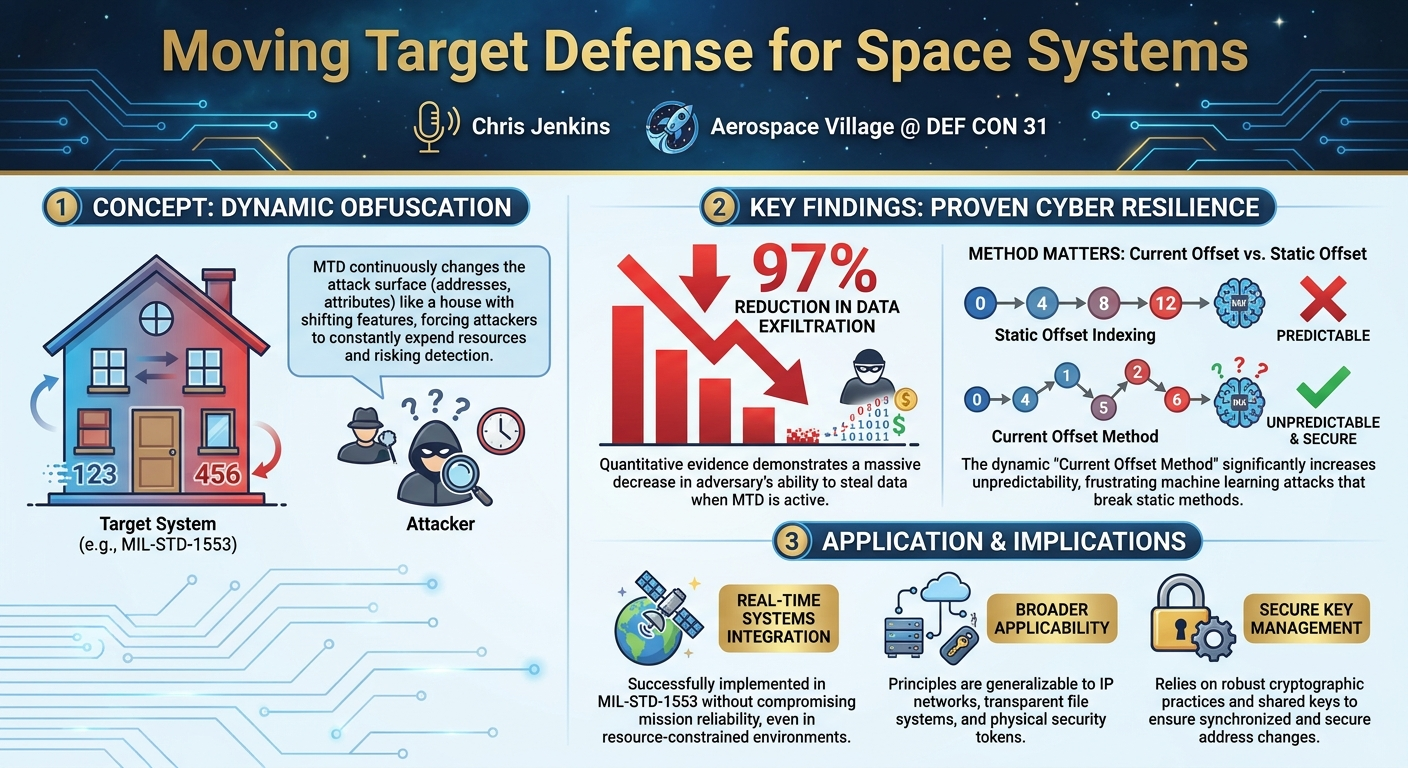
The concept of Moving Target Defense (MTD) centers on making an adversary's task of reconnaissance and exploitation significantly harder by continuously changing the attack surface. Jenkins eloquently illustrates this with an analogy: if an attacker tries to "case a house" by observing its address, color, and entry points, MTD is akin to that house constantly changing these attributes. This dynamic obfuscation forces attackers to expend more resources and time, increasing their risk of detection and reducing the likelihood of a successful exploit.
Historically, much of the MTD research has focused on IP-based networking and cloud computing environments, primarily addressing vulnerabilities in IP version 4. However, the systems that Sandia National Labs typically works on are "high consequence systems" – those where a cyber compromise could have severe, even catastrophic, real-world implications. These systems, often found in military, industrial control, and aerospace domains, operate under stringent Size, Weight, and Power (SWaP) constraints and rely on real-time communication protocols rather than standard IP networks. As these critical systems become more connected, they present an expanding attack surface that traditional MTD approaches often overlook.
Recognizing this gap, Jenkins and his team chose to apply MTD to MIL-STD-1553, a robust military standard serial data bus that has been in use since 1973. It is a cornerstone in military weapon systems and spacecraft, designed for command and control communication between a Bus Controller (BC) and up to 31 Remote Terminals (RTs), with a Bus Monitor (BM) acting as a flight recorder. The protocol's message structure includes a critical three-bit field for the Remote Terminal address (0-30), making it an ideal candidate for dynamic address manipulation. The challenge was to implement MTD in such a way that it would not "destroy the reliability" of this mission-critical protocol, while also providing quantitative evidence of improved cyber resilience, rather than merely qualitative assertions. This research explicitly does not rely on anomaly detection, a notoriously difficult problem in itself, though it could be used in conjunction with MTD.
Key Findings
▶ Watch: Algorithm design: preventing address collisions (7:30)
The core hypothesis underpinning this research is that "the integration of moving target defense with a real-time protocol can increase cyber resilience of platforms using that protocol." To validate this, the team addressed two fundamental research questions:
- How can MTD be implemented without compromising the inherent reliability of MIL-STD-1553?
- Can quantitative evidence be provided to demonstrate an actual improvement in cyber resilience?
The research successfully addressed both questions, yielding several key findings. Firstly, the developed MTD algorithm demonstrated that dynamic address changes could be integrated into MIL-STD-1553 without disrupting its operational integrity, even at a millisecond level. This was crucial for maintaining the real-time performance required by high-consequence systems.
Secondly, the team provided compelling quantitative data showcasing a significant enhancement in cyber resilience. Experiments revealed up to a 97% reduction in an adversary's ability to exfiltrate valuable data from a targeted node when MTD was active. This concrete metric provides strong evidence of the algorithm's practical utility in mitigating data theft.
A critical insight emerged from the analysis of the State Matrix and its indexing methods. While the size of the state matrix and the frequency of generating new matrices had minimal impact on unpredictability, the method of indexing into the matrix proved paramount. The Current Offset Method, which allows nodes to "move around the matrix a lot more," significantly enhanced unpredictability compared to the Static Offset Indexing Method. This finding was later corroborated by a machine learning attack orchestrated by Purdue University, which successfully broke the static method but failed against the current offset approach. This highlights the importance of dynamic, non-linear address transitions in frustrating advanced adversaries.
Finally, the project revealed the algorithm's broad applicability. Although initially developed for MIL-STD-1553, the underlying principles and mechanisms were found to be generalizable to "other applications," including IP networks, transparent file systems, and key rolling for physical security tokens. This suggests a versatile framework for MTD across diverse cyber-physical systems.
Technical Deep Dive
▶ Watch: Quantitative results: MTD reduces data exfiltration (16:00)
The technical core of Jenkins's MTD algorithm for MIL-STD-1553 revolves around two primary challenges: maintaining the underlying protocol's integrity and preventing address collisions when multiple devices are dynamically changing their addresses. The MIL-STD-1553 bus supports up to 31 Remote Terminals (RTs), whose addresses range from 0 to 30. The algorithm leverages a cryptographic primitive to generate a dynamic set of addresses, ensuring uniqueness and unpredictability.
The process begins with a shared key and a nonce (number used once). These inputs are fed into a Randomness Primitive, which, for the sake of brevity in the presentation, is treated as a single black box but involves several substeps. This primitive generates two key outputs:
- A randomized array of integers, representing new potential addresses. For a MIL-STD-1553 bus with 31 RTs, this array contains values between 0 and 30, ensuring all possible RT addresses are covered in a random order.
- A new 16-byte nonce, which is fed back into the Randomness Primitive for the next iteration.
By continuously iterating this process, the system effectively produces a 2D State Matrix. Each column of this matrix represents a randomized ordering of possible RT addresses. The critical feature is that "every column is a randomized ordering," which guarantees that "every single node is going to have a different address" at any given time, thereby preventing collisions.
The algorithm employs two distinct methods for indexing into this State Matrix to derive new addresses:
- Static Offset Indexing Method:
In this method, the Bus Controller (BC) sends out an index value. Each Remote Terminal (RT) uses this index and its current address to look up its new address in the State Matrix. For example, if the BC sends an index of '3', and an RT has a current address of '0', its new address might be '4'. If another RT has a current address of '4', its new address might be '24'. The "static offset" refers to the fact that for a given index, the offset (or new address) derived from a specific current address remains consistent across different updates. While simple, this method introduces a predictable one-to-one correlation between the current address, the index, and the next address, making it vulnerable to machine learning attacks.
- Current Offset Method:
This method enhances unpredictability by making the address transitions more dynamic. Similar to the static method, the BC sends an index. An RT with current address '0' and index '3' might get a new address of '4'. However, if a different index, say '1', comes out, the RT's new address from its new current address ('4') might be '5'. The key difference is that the "current offset" allows a particular node (and all nodes) to "move around the Matrix a lot more." This non-linear movement breaks the direct one-to-one correlation, making it significantly harder for an adversary to predict the next address, even if they observe the index and previous addresses.
To validate the algorithm's properties, the team analyzed the entropy and unpredictability metrics of the State Matrix. They generated matrices of different sizes (256 columns vs. 65,000 columns) and found that the size of the matrix did not significantly affect the entropy. This indicated that a smaller, more resource-efficient State Matrix could be used without compromising security. Furthermore, generating new State Matrices periodically also did not impact unpredictability. However, the analysis conclusively showed that the offset method (static vs. current) dramatically influenced the unpredictability metrics, confirming the theoretical advantage of the Current Offset Method.
This sophisticated approach ensures that the MTD algorithm not only provides dynamic address shifting but does so in a cryptographically sound and unpredictable manner, crucial for defending real-time, high-consequence systems.
Demo / Proof of Concept
▶ Watch: Future work and potential NIST standardization (21:00)
The practical validation of the MTD algorithm was conducted in two phases, leveraging real hardware and a scenario directly relevant to space systems: data exfiltration. The experiments were performed using an Alta DT device, a specialized hardware platform for MIL-STD-1553 bus simulation and analysis.
Phase 1: Functional Verification (Fibonacci Sequence)
The initial phase aimed to prove that the MTD algorithm could operate without disrupting the underlying MIL-STD-1553 communication. The team implemented a simple, computationally intensive task: calculating the 24th Fibonacci number. This calculation was performed both with and without MTD enabled. The goal was to demonstrate that despite the dynamic address changes, the bus controller and remote terminals could consistently communicate and complete the task. To generate sufficient data for analysis, the calculation of the 24th Fibonacci number was defined as a "generation," and experiments involved 50 to 5,000 generations. This phase successfully showed that MTD could be activated and deactivated, and addresses could be updated dynamically, while the system reliably continued its mission.
Phase 2: Data Exfiltration Mitigation
Building on the functional verification, Phase 2 directly addressed the core problem of data exfiltration. The experimental setup mirrored a realistic attack scenario:
- Host Node (BC): Acts as the Bus Controller.
- Participant Node (RT): A Remote Terminal that is the target of exfiltration.
- Listening Node (BM): A standard Bus Monitor.
- Xfill Node (Adversary BM): An adversary's Bus Monitor configured to listen only at a specific, targeted Remote Terminal address. The assumption was that the adversary knows the target device and the commands it wants to intercept.
The experiment proceeded as follows:
- MTD Start Command: The Bus Controller (BC) initiates the MTD process by sending an MTD start command containing a nonce. Both the BC and the Remote Terminals (RTs) are assumed to share a pre-distributed shared key.
- State Matrix Generation & Verification: Upon receiving the nonce, each RT uses the nonce and the shared key to independently generate its own State Matrix. It then calculates a 512-bit keyed Message Authentication Code (HMAC) over its internal state and sends this HMAC back to the BC. The BC performs the same calculation. If the HMACs match, the BC can guarantee that all participating RTs share the identical State Matrix, establishing a synchronized MTD state.
- Operation & MTD Update: The system then proceeds with its mission, continuously calculating the Fibonacci sequence. Periodically, the BC sends an MTD Update Command, which contains an index value. Both the BC and the RTs use this index to transition to a new, dynamically assigned address based on their shared State Matrix.
- Adversary's Role: The Xfill node (adversary) continuously attempts to capture data whenever the Participant Node (RT) communicates using the adversary's pre-selected target address.
The results were striking: the MTD implementation achieved a 97% reduction in the amount of valuable information exfiltrated by the adversary. The frequency of MTD updates directly correlated with resilience: more frequent updates led to higher resilience (less exfiltration).
The team also explored two adversary scenarios:
- Random Initial Address: The adversary starts listening at a randomly chosen address.
- Known Initial Address: The adversary knows and starts listening at the correct initial address of the target RT.
While the "Known Initial Address" scenario initially showed higher exfiltration (because the adversary immediately captures data), the researchers projected that over a longer experiment (e.g., 5,000 or 50,000 generations), the exfiltration rates for both scenarios would converge and remain significantly low due to the continuous address changes.
Finally, the talk highlighted a crucial collaboration with Purdue University, where Professor Bharat Bhargava's team was tasked with breaking the algorithm using machine learning. Purdue employed an LSTM (Long Short-Term Memory) model, varying the training set size and keeping a 20% test size.
- Against the Static Offset Indexing Method, the LSTM model successfully predicted the next address, achieving F1/MCC scores close to 1. This proved that the one-to-one correlation in the static method was a critical vulnerability.
- However, when the MTD algorithm was switched to the Current Offset Method (a single line change in the C++ code), the LSTM model failed to predict the next addresses. The "one-to-one correlation is not present in the current offset method," making it "a lot harder to predict the next address," validating the unpredictability metrics previously observed. This demonstrably proved the resilience of the Current Offset Method against sophisticated machine learning attacks, reinforcing its importance for practical deployment.
Defensive Implications
▶ Watch: Q&A: Impact of knowing the MTD algorithm (22:50)
The research presented by Chris Jenkins offers profound defensive implications for organizations operating high-consequence systems, particularly in aerospace and critical infrastructure. The primary takeaway for defenders is the urgent need to adopt Moving Target Defense (MTD) strategies for real-time, SWaP-constrained environments, moving beyond traditional IP-centric security models.
- Implement MTD for Real-Time Protocols: Organizations utilizing protocols like MIL-STD-1553 (and potentially SpaceWire, as noted in the Q&A) should explore integrating dynamic address shifting. This proactive approach fundamentally alters the attack surface, making it significantly more challenging for adversaries to maintain persistence or exfiltrate data. The demonstrated 97% reduction in exfiltration is a compelling quantitative argument for its adoption.
- Prioritize the Current Offset Method: The distinction between the Static Offset and Current Offset indexing methods is critical. Defenders must ensure that any MTD implementation utilizes the Current Offset Method to maximize unpredictability. The successful defeat of the Static Offset Method by an LSTM model, contrasted with the Current Offset Method's resilience, underscores this point. This method breaks predictable correlations, frustrating even advanced machine learning-based reconnaissance.
- Secure Key Management: The MTD algorithm relies on a shared key and nonces for generating the State Matrix and verifying synchronization via HMACs. Robust, secure key management practices are paramount. This includes secure key distribution, rotation, and protection of the shared key, as knowing the key would allow an adversary to predict address changes.
- Integration with Existing Security Measures: MTD should be viewed as an additional layer of defense, not a standalone solution. It can be used in conjunction with other security mechanisms like anomaly detection, encryption (as demonstrated with the IPV4 TCP port encryption example), and robust access controls to create a multi-layered defense-in-depth strategy.
- Proactive Standard Development: Jenkins highlighted the absence of a NIST standard for Moving Target Defense. Defenders should advocate for and contribute to the development of such standards. Standardized approaches would facilitate broader adoption and interoperability, ensuring best practices are followed across industries.
- Broad Applicability and Future Exploration: The generalizability of this MTD approach means defenders should consider its application beyond MIL-STD-1553. Potential areas include:
- IP networks: Enhancing existing encryption by dynamically changing keys per packet.
- Transparent file systems: Mitigating ransomware by dynamically altering file paths or storage locations.
- Rolling codes for key fobs: Improving physical security by dynamically changing authentication tokens.
By adopting these defensive strategies, organizations can significantly enhance the cyber resilience of their high-consequence systems, transforming them from static targets into dynamic, unpredictable environments that actively frustrate and deter adversaries.
Key Takeaways
- Moving Target Defense (MTD) is crucial for real-time, high-consequence systems: Traditional MTD for IP networks is insufficient; specialized approaches are needed for embedded, SWaP-constrained environments like MIL-STD-1553 in space systems.
- Quantitative evidence confirms MTD's effectiveness against data exfiltration: The algorithm achieved a 97% reduction in an adversary's ability to exfiltrate data from a target node, providing concrete proof of enhanced cyber resilience.
- The "Current Offset Method" is vital for unpredictability: Dynamically changing addresses using the Current Offset Method significantly increases unpredictability, effectively defeating machine learning-based attacks that successfully broke the simpler Static Offset Indexing Method.
- MTD can be integrated without sacrificing reliability: The research demonstrated that dynamic address changes can be implemented in a real-time protocol like MIL-STD-1553 without compromising mission-critical communication or performance.
- The MTD algorithm is generalizable beyond MIL-STD-1553: The underlying principles can be applied to other protocols and applications, including IP networks (e.g., dynamic keying for TCP ports), transparent file systems, and rolling codes for physical security tokens, offering a versatile defensive framework.
- Secure key management is fundamental: The algorithm's security relies on a shared key and nonces, necessitating robust cryptographic practices for key distribution, protection, and HMAC verification to ensure synchronized and secure address changes.
About the Speaker(s)
Chris Jenkins is a cyber security researcher at Sandia National Labs, a U.S. Department of Energy laboratory. His professional background includes experience at the CIA and a focus on high-performance computing (HPC), operational technology (OT), and serving as a cybersecurity consultant for various programs. Jenkins holds a Master's degree and pursued a PhD, with his academic journey including time at the University of Wisconsin-Madison. Beyond his research, he is dedicated to STEM outreach programs, encouraging youth interest in engineering and cybersecurity. His personal interests include Latin dancing and RV travel. This particular MTD research project represents a two-year internal research and development effort at Sandia, conducted in collaboration with Purdue University.
Reviews
Dr. Zero (Offensive Security Researcher) — SOLID
Jenkins brought actual hardware and real metrics to an Aerospace Village talk, which puts him above half the speakers there. But applying Moving Target Defense to a protocol with a 3-bit address space relies on a completely artificial threat model where the attacker politely refuses to just sniff the whole bus. It's solid national lab research that doesn't survive contact with an actual offensive operator.
Heather Calloway (CISO) — SOLID
This is deep R&D on Moving Target Defense for legacy military and aerospace serial buses. If you manufacture or operate space or defense systems, this is a material breakthrough for defeating data exfiltration on constrained hardware. For everyone else, it’s outside your immediate threat model, but it's exactly the kind of engineering rigor we need from national labs.