A Fireside Chat with the TSA Administrator
David Pekoske (Administrator · Transportation Security Administration), Steve Luczynski (Board Chairman · Aerospace Village)
Aerospace Village @ DEF CON 31 · Day 1 · Aerospace Village
Overview
At DEF CON 31's Aerospace Village, David Pekoske, the Administrator of the Transportation Security Administration (TSA), engaged in a candid fireside chat with Steve Luczynski, Board Chairman of the Aerospace Village. This unique appearance marked Administrator Pekoske's first time at DEF CON, signaling a significant shift in the agency's approach to cybersecurity and its relationship with the hacker community. The discussion extended far beyond the familiar blue-shirted airport screeners, delving into the TSA's expansive mandate across aviation, surface transportation (including pipelines and rail), and emerging space systems, with a particular emphasis on the critical and growing role of cybersecurity.
Key moments
- 2:54 Beyond aviation: TSA's broad security mission
- 4:54 TSA seeks hackers' expertise for cybersecurity
- 8:07 Coordinating cyber security with FAA, CISA, and FBI
- 14:26 Adopting performance-based cyber security regulation
- 17:15 Project Chariot: Testing realistic cyber attack scenarios
- 23:45 Advancing biometric identification and privacy
- 26:00 Future of AI in airport screening
- 28:20 Join TSA: Careers in national security
A Fireside Chat with the TSA Administrator
Speakers: David Pekoske (Administrator, Transportation Security Administration); Steve Luczynski (Board Chairman, Aerospace Village)
Conference: Aerospace Village @ DEF CON 31
YouTube: https://www.youtube.com/watch?v=Ial9GCPNSgs
Overview
At DEF CON 31's Aerospace Village, David Pekoske, the Administrator of the Transportation Security Administration (TSA), engaged in a candid fireside chat with Steve Luczynski, Board Chairman of the Aerospace Village. This unique appearance marked Administrator Pekoske's first time at DEF CON, signaling a significant shift in the agency's approach to cybersecurity and its relationship with the hacker community. The discussion extended far beyond the familiar blue-shirted airport screeners, delving into the TSA's expansive mandate across aviation, surface transportation (including pipelines and rail), and emerging space systems, with a particular emphasis on the critical and growing role of cybersecurity.
The core message of the talk was a direct appeal for collaboration and expertise from the cybersecurity community. Pekoske acknowledged the immense talent present at DEF CON and expressed the TSA's urgent need for external perspectives to define risks, validate security outcomes, and enhance the resilience of the nation's transportation infrastructure. This engagement underscored a proactive strategy by the TSA to bridge the traditional divide between government agencies and independent security researchers, recognizing that a truly robust defense requires diverse insights and innovative thinking to counter evolving threats.
The talk highlighted the agency's transition towards more agile, technology-driven security solutions, including advanced screening technologies, digital identity verification, and the adoption of open architecture principles. It also touched upon the complex challenges and opportunities presented by artificial intelligence in security operations. By participating in DEF CON, the TSA demonstrated a clear commitment to transparency, learning, and partnership, aiming to leverage collective intelligence to safeguard vital systems against increasingly sophisticated cyber and physical threats.
Background
▶ Watch: Beyond aviation: TSA's broad security mission (2:54)
The Transportation Security Administration (TSA) was established in the wake of the September 11, 2001, terrorist attacks, initially focusing predominantly on aviation security. However, Administrator Pekoske clarified that the agency's remit, as indicated by its full name, the Transportation Security Administration, extends significantly beyond air travel. Following 9/11, the security functions of various modal administrations within the Department of Transportation (DOT)—such as the Pipeline and Hazardous Materials Safety Administration (PHMSA) and the Federal Railroad Administration (FRA)—were consolidated under the TSA. This historical context explains the TSA's broad responsibilities, which include security for oil and natural gas pipelines, train systems, and mass transit, areas often overlooked by the public.
The agency's role in cybersecurity has dramatically expanded, particularly in the wake of the May 2021 ransomware attack on the East Coast pipeline, widely known as the Colonial Pipeline incident. This event served as a stark reminder of the vulnerability of critical infrastructure to cyber threats and catalyzed the TSA's move into cybersecurity regulation for surface transportation. Prior to this, many of these sectors were not directly regulated by the TSA for cyber security. The intelligence landscape, described by Pekoske as "significant, concerning, and consistently more concerning over time," is the primary driver behind these intensified efforts, leading to the issuance of emergency amendments to security plans.
The TSA operates within a complex ecosystem of government agencies, each with distinct but often overlapping responsibilities. For aviation and space cyber security, key partners include the Federal Aviation Administration (FAA) for safety, the Cybersecurity and Infrastructure Security Agency (CISA) for cross-sector expertise and incident reporting, and the Federal Bureau of Investigation (FBI) for investigations and victim notifications. Pekoske emphasized the importance of presenting a unified position to critical infrastructure owners and operators during incidents, citing the example where significant cyber incident reports, required by TSA regulations, are submitted directly to CISA, which then disseminates the information to all relevant agencies, ensuring coordination and reducing the burden on affected companies. This multi-agency coordination is crucial for effective incident response and information sharing across the critical infrastructure landscape.
Key Findings
▶ Watch: Coordinating cyber security with FAA, CISA, and FBI (8:07)
The talk revealed several key findings and strategic shifts within the TSA's approach to security:
- Shift to Performance-Based Cybersecurity Regulation: A significant departure from traditional, prescriptive regulation, the TSA is now implementing a performance-based regulation model for cybersecurity. This allows regulated entities flexibility in how they achieve security outcomes, rather than dictating specific technical solutions. This was a direct response to feedback from industries like pipelines, who argued that prescriptive measures might not always align with their operational realities or even lead to less effective security.
- Urgent Need for External Cybersecurity Expertise: Administrator Pekoske's presence at DEF CON underscored the TSA's critical need for the hacker community's expertise. The agency is actively seeking help to define realistic cyber security risk scenarios, prioritize threats, and validate the effectiveness of security measures, particularly for its outcome-based regulatory framework. This represents a proactive effort to leverage external talent in identifying vulnerabilities before adversaries do.
- Emphasis on Advanced Technology for Screening: The TSA is heavily investing in and deploying cutting-edge technologies to enhance passenger screening efficiency and accuracy while improving the passenger experience and privacy. This includes Credential Authentication Technology (CAT), integration with mobile driver's licenses (mDLs), and the broader implementation of biometric identification systems.
- Push for Open Architecture: To achieve greater agility and responsiveness to emerging threats, the TSA is advocating for open architecture principles in the development and procurement of its screening technologies. This aims to break vendor lock-in and enable faster, more flexible software updates and threat detection capabilities.
- Strategic Integration of Artificial Intelligence (AI): The agency recognizes the immense potential of AI to revolutionize screening processes, such as enabling remote, alarm-only image review for X-ray machines. However, it also acknowledges significant challenges, including the potential for AI spoofing, difficulties in deducing context, and the complexities of managing generative AI learning processes to ensure they align with security objectives.
Technical Deep Dive
▶ Watch: Project Chariot: Testing realistic cyber attack scenarios (17:15)
The TSA's technical initiatives span both cyber security regulation for critical infrastructure and advanced technological deployments in passenger screening.
Cybersecurity Regulation and Validation
Following the Colonial Pipeline incident, the TSA moved to establish robust cybersecurity regulations for surface transportation. Initially, these regulations were prescriptive, mirroring traditional government approaches. However, industry feedback highlighted the need for flexibility, leading to a pivot towards performance-based regulation. This model requires regulated entities to submit cyber security implementation plans detailing how they will achieve specific security outcomes. Once approved, these plans are followed by capability assessment plans, which objectively measure progress against the established outcomes.
A critical challenge in performance-based regulation is objectively determining if outcomes are being achieved. This is where the hacker community's expertise becomes invaluable. The TSA is soliciting assistance in:
- Prioritizing threats: Identifying which threats are most critical to address.
- Developing realistic scenarios: Creating practical, actionable scenarios that mimic real-world attack vectors. For instance, "If I wanted to hack into an aviation airport badging system, how would I do it?"
- Validating outcomes: Testing these scenarios with owners and operators to assess their preparedness and response capabilities.
To facilitate this, the TSA has launched Project Chariot (Critical Infrastructure Hardening Achieved through Risk Reduction in Information and Operational Technology). This collaborative project involves the Department of Homeland Security (DHS) Science and Technology Directorate, CISA, and the Pacific Northwest National Laboratory (PNNL), alongside modal agencies like FRA and PHMSA for rail and pipelines. Project Chariot aims to objectively prioritize risks and validate security measures, ensuring that the critical infrastructure can effectively prevent and respond to successful cyberattacks. The insights from the hacker community are sought to provide independent validation and fresh perspectives on attack methodologies.
Advanced Passenger Screening Technologies
The TSA is committed to embedding more technology into its screening checkpoints to enhance security, efficiency, and the passenger experience.
- Credential Authentication Technology (CAT): This technology automates the verification of physical driver's licenses and other IDs. Instead of a TSA officer manually inspecting an ID (a task made complex by 56 different state and territorial licenses and varying facial features over an 8-year license validity period), the CAT machine electronically validates the document's authenticity. This reduces human error, increases accuracy, and minimizes physical contact, especially relevant post-pandemic.
- Mobile Driver's Licenses (mDLs) and Digital IDs: Building on CAT, the TSA is integrating support for digital IDs stored in mobile wallets (Apple Wallet, Google Wallet, Samsung Wallet). This offers enhanced security through different transmission methods and significant privacy benefits. Passengers can see exactly which fields from their driver's license are being accessed by the TSA, dispelling concerns about data tracking (e.g., home addresses) and providing greater transparency. The ultimate goal is to move towards full digital and biometric identification.
- Biometric Identification: The TSA views biometrics as a superior method for identity verification. Its internal and DHS Science and Technology Directorate testing shows biometrics are "much more accurate than a human verification of identity" and "much more efficient." Critically, the TSA emphasizes passenger privacy: biometric data "stays right on that machine" and "is erased" as soon as the passenger leaves, never being stored or transmitted elsewhere. The agency is actively seeking expertise from the security community to ensure biometric systems are secure and do not disadvantage any demographic group.
- Open Architecture Principles: A major strategic objective is to develop and procure technology using open architecture principles. Currently, Original Equipment Manufacturers (OEMs) often control all software for complex machines like X-ray scanners. This creates vendor lock-in, slows down modifications, and hinders agility. Pekoske cited an example from 3-4 years ago when a threat stream emerged regarding large quantities of powders being brought onto aircraft. The response required passengers to manually remove powders from carry-on bags. With an open architecture, a simple software layer could have been added to existing technology for automated detection, providing a "much better way" to respond rapidly to evolving threats. Open architecture requirements in contracting vehicles are seen as crucial for future agility and responsiveness.
- Artificial Intelligence (AI) in X-ray Screening: The TSA envisions AI transforming X-ray screening. Currently, officers sit next to each machine, reviewing all 5.5 million X-ray images daily across the system. This is inefficient, as every image is presented with the same level of concern. The goal is to move officers to quiet, remote locations, allowing them to review images from any lane in the airport (or even adjacent airports) and, crucially, only review images that alarm. This would significantly improve efficiency and allow officers to pay "a lot more attention" to potential threats. However, Pekoske highlighted several challenges:
- Spoofing: AI systems can be tricked or bypassed.
- Context Deduction: AI struggles with contextual understanding ("all these things sort of ought to belong in this bag"), where a human can quickly deduce intent.
- Generative AI Learning: If generative AI is deployed, ensuring its learning process aligns with security objectives and is trackable is paramount, as "it might not be learning what we want it to learn." The TSA is seeking the community's help in addressing these complex AI security challenges.
Demo / Proof of Concept
▶ Watch: Advancing biometric identification and privacy (23:45)
This fireside chat was a high-level discussion and strategic overview rather than a technical demonstration. No specific tools, code, or proof-of-concept exploits were presented during the talk.
Defensive Implications
▶ Watch: Join TSA: Careers in national security (28:20)
The insights shared by Administrator Pekoske carry significant defensive implications for both critical infrastructure owners/operators and the broader cybersecurity community.
For critical infrastructure owners and operators (aviation, pipelines, rail, mass transit):
- Embrace Performance-Based Cybersecurity: Companies must adapt to the TSA's shift towards performance-based regulations. This requires developing robust cyber security implementation plans that align with specific outcomes and capability assessment plans to objectively demonstrate their effectiveness. A proactive approach to defining and measuring security posture is now paramount.
- Engage with Regulatory Bodies: The TSA's open call for collaboration means that regulated entities should actively participate in defining risk scenarios and validating security measures. Contributing to initiatives like Project Chariot can help shape regulations and ensure they are practical and effective.
- Invest in Modern Screening Technologies: For aviation stakeholders, the adoption of Credential Authentication Technology (CAT), support for mobile driver's licenses (mDLs), and the eventual transition to biometric identification systems are key. These technologies enhance security, improve efficiency, and offer privacy benefits, but require careful integration and ongoing security validation.
- Advocate for Open Architecture: Industry should push for open architecture principles in their technology procurement. This will foster innovation, reduce vendor lock-in, and enable more agile responses to emerging threats, ultimately leading to more resilient systems.
- Prepare for AI Integration: As AI becomes more prevalent in security operations, companies must understand its limitations and vulnerabilities, particularly regarding spoofing and contextual understanding. Developing strategies to secure AI systems and validate their learning processes will be crucial.
For the cybersecurity community and individual researchers:
- Opportunity for Impactful Contribution: The TSA is actively soliciting expertise in defining cyber risk scenarios, validating security outcomes, and securing advanced technologies (biometrics, AI). This presents a unique opportunity for hackers and security researchers to directly contribute to national security and critical infrastructure protection.
- Consider Government Service: Pekoske explicitly mentioned that the TSA is hiring, looking for cyber talent for both long-term careers and shorter stints (e.g., 2-3 years). This "back and forth" between government and the private sector is seen as mutually beneficial, offering security professionals a chance to work on meaningful national security problems.
- Focus Research on TSA's Challenges: Research into the security of biometric systems (ensuring accuracy and fairness across demographics), methods to spoof or secure AI in detection systems (especially generative AI), and practical implementations of open architecture in complex security hardware could directly address the TSA's stated needs.
- Build Trust and Collaboration: The TSA's presence at DEF CON is a deliberate effort to build trust. The community should reciprocate by engaging constructively, sharing insights responsibly, and helping to dispel stereotypes on both sides.
Key Takeaways
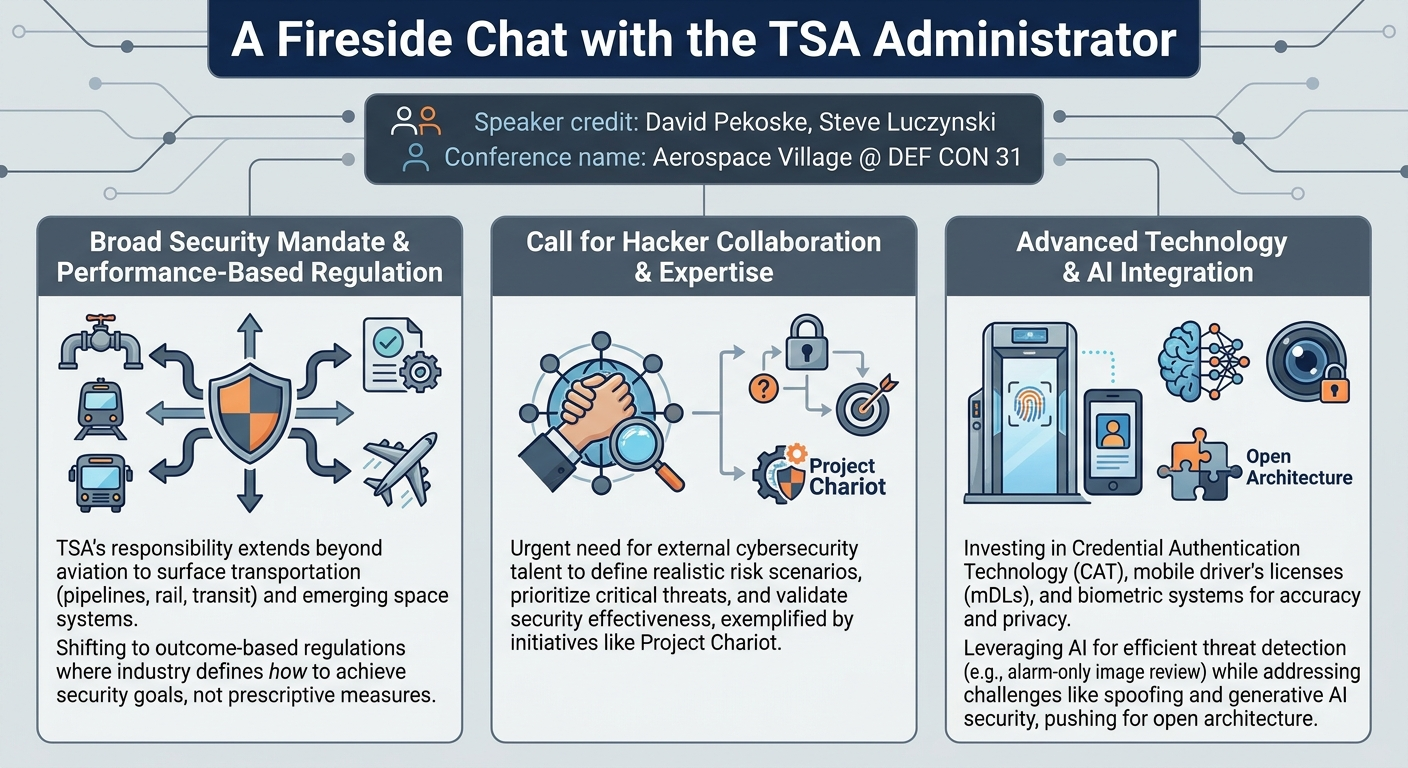
- TSA's Broad Scope: Beyond airport screening, the TSA secures pipelines, rail, mass transit, and emerging space systems, driven by evolving intelligence and cyber threats.
- Performance-Based Cybersecurity: The agency is shifting from prescriptive to outcome-based regulations, requiring industry to demonstrate how they achieve security goals, rather than what specific tools they use.
- Call for Hacker Expertise: The TSA urgently seeks external cybersecurity talent to help define realistic risk scenarios, prioritize threats, and validate the effectiveness of security measures, exemplified by Project Chariot.
- Technology-Driven Security: Significant investment in Credential Authentication Technology (CAT), mobile driver's licenses (mDLs), biometrics, and open architecture aims to enhance efficiency, accuracy, and privacy in screening.
- AI's Promise and Peril: While AI offers immense potential for efficient threat detection (e.g., alarm-only X-ray image review), challenges like spoofing, contextual understanding, and securing generative AI's learning process require community input.
- Opportunities for Collaboration: The TSA is actively recruiting cyber talent and encourages security researchers to engage with the agency to build more resilient transportation systems.
About the Speaker(s)
David Pekoske is the Administrator of the Transportation Security Administration (TSA), serving as the seventh individual in this role. Prior to his tenure at the TSA, Administrator Pekoske had a distinguished 33-year career in the United States Coast Guard, where he rose to become the 26th Vice Commandant. He leads an organization of 60,000 people, responsible for ensuring the security of the nation's transportation systems across aviation, surface, and space domains. His appearance at DEF CON underscored his commitment to fostering collaboration between government and the cybersecurity community.
Steve Luczynski is the Board Chairman for the Aerospace Village, a non-profit organization dedicated to exploring the security of aerospace systems. He moderated the fireside chat, providing context and facilitating the discussion with Administrator Pekoske, reflecting the Village's mission to bridge the gap between the hacker community and critical aerospace stakeholders.
Reviews
Dr. Zero (Offensive Security Researcher) — SOLID
Pekoske showing up to the Aerospace Village is a good optical move, and the pivot to performance-based regulation is a necessary step up from typical federal compliance theater. But underneath the policy updates, this is the standard 'please come work for the government' pitch we've heard at DEF CON for a decade.
Heather Calloway (CISO) — SOLID
The TSA Administrator outlines the agency's pivot from prescriptive checklists to performance-based cybersecurity regulation for critical infrastructure. If you operate in transportation, pipelines, or rail, compliance just shifted from implementing controls to proving those controls actually work against realistic threats.