Orbiting the White House: Cybersecurity as a Space Imperative
Tanya Simms (Director for Cyber Policy and Programs · Office of the National Cyber Director), Lauryn Williams (Senior Advisor, Strategy and Research · Office of the National Cyber Director)
Aerospace Village @ DEF CON 31 · Day 1 · Aerospace Village
Overview
In a compelling presentation at DEF CON 31's Aerospace Village, Tanya Simms and Lauryn Williams from the White House Office of the National Cyber Director (ONCD) delivered a critical message: securing the rapidly expanding space ecosystem is a national imperative. Their talk, "Orbiting the White House: Cybersecurity as a Space Imperative," illuminated the Biden-Harris Administration's strategic prioritization of space cybersecurity, articulating the urgent need to bridge existing policy gaps and foster unprecedented public-private collaboration. As the commercial space sector experiences exponential growth and nation-state adversaries increasingly target space assets, the ONCD is actively engaging with industry stakeholders to develop actionable, tailored cybersecurity policies.
Key moments
- 0:00 White House ONCD's focus on space cybersecurity
- 1:50 Biden-Harris National Cybersecurity Strategy and implementation plan
- 4:30 Current space cybersecurity policy: Space Policy Directive 5
- 6:40 Rapid commercial space growth and escalating cyber threats
- 12:00 Complex US government policy and standards landscape
- 20:50 ONCD's industry outreach and key takeaways
- 27:00 How to engage: RFIs on regulatory harmonization, open source
- 36:30 Space cybersecurity initiative as a model for other sectors
Orbiting the White House: Cybersecurity as a Space Imperative
Speakers: Tanya Simms, Director for Cyber Policy and Programs, Office of the National Cyber Director; Lauryn Williams, Senior Advisor, Strategy and Research, Office of the National Cyber Director
Conference: Aerospace Village @ DEF CON 31
YouTube: https://www.youtube.com/watch?v=stfNYT1rcCk
Overview
In a compelling presentation at DEF CON 31's Aerospace Village, Tanya Simms and Lauryn Williams from the White House Office of the National Cyber Director (ONCD) delivered a critical message: securing the rapidly expanding space ecosystem is a national imperative. Their talk, "Orbiting the White House: Cybersecurity as a Space Imperative," illuminated the Biden-Harris Administration's strategic prioritization of space cybersecurity, articulating the urgent need to bridge existing policy gaps and foster unprecedented public-private collaboration. As the commercial space sector experiences exponential growth and nation-state adversaries increasingly target space assets, the ONCD is actively engaging with industry stakeholders to develop actionable, tailored cybersecurity policies.
The speakers detailed the administration's overarching National Cybersecurity Strategy, released in March 2023, which sets a foundation for a defensible, resilient, and values-aligned digital ecosystem across five key pillars. Space cybersecurity is presented as a tangible challenge within this broader strategy, demanding a proactive approach to protect critical infrastructure, disrupt threat actors, and drive market-driven security. This talk was not merely an announcement of policy, but a transparent exposition of the ONCD's ongoing efforts to gather industry feedback, understand the unique challenges faced by space operators, and collectively chart a path forward for national and international space security.
The significance of this engagement cannot be overstated. With the White House actively seeking direct input from practitioners and executives, the presentation underscored a pivotal shift towards an "industry-first informed approach" in policy development. It highlighted the complexity of the current regulatory and standards landscape, the critical resourcing challenges, and the imperative for more effective information sharing to secure an domain vital to modern life, from GPS and communications to national security.
Background
▶ Watch: White House ONCD's focus on space cybersecurity (0:00)
The accelerating expansion of the space domain presents both immense opportunities and significant cybersecurity vulnerabilities. The speakers underscored that the Biden-Harris Administration views space cybersecurity as a core policy and strategy imperative, situated within the broader National Cybersecurity Strategy released in March 2023. This strategy outlines five pillars: defending critical infrastructure, disrupting threat actors, shaping market forces for security, investing in a resilient future, and leveraging international partnerships. The ONCD's objective is to translate these broad principles into tangible actions for securing space systems.
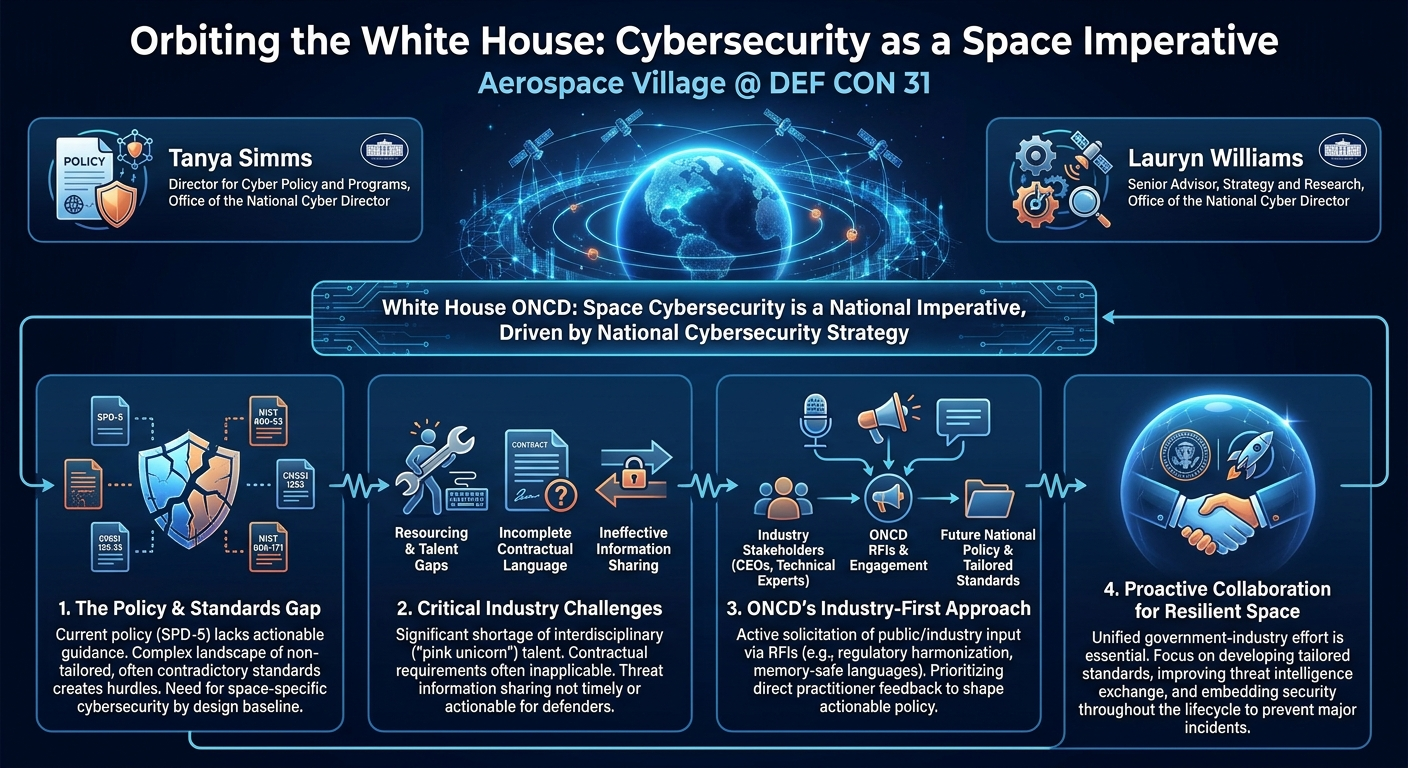
A key challenge highlighted is the inadequacy of current policy. Space Policy Directive 5 (SPD-5), issued in September 2020, remains the sole national policy for space system cybersecurity. While SPD-5 provides high-level principles such as risk-based cybersecurity engineering, integrated plans, leveraging best practices, public-private collaboration, and risk-managed system design, it conspicuously lacks specific, actionable guidelines for implementation by both government and private sector operators. This three-year-old policy, though foundational, has not kept pace with the rapid evolution of the space landscape.
The commercial space sector, in particular, has seen exponential growth, vastly outpacing traditional government and military space operations. Nation-state commercial and dual-purpose space fleets, for instance, grew by 70% between 2019 and 2021. Companies like SpaceX's Starlink are launching 50 assets per rocket, contributing to increasingly crowded low Earth orbit (LEO), medium Earth orbit (MEO), and geosynchronous orbit (GEO) environments. This proliferation is not just a physical congestion issue but also a significant cyber security concern. Approximately 60% of all active payloads are in LEO, making them highly interconnected and increasing the overall attack surface. The market for embedded systems, crucial for space assets, is projected to reach $7 billion annually, further expanding potential vulnerabilities.
This dynamic growth has not gone unnoticed by adversaries. The Office of the Director for National Intelligence (ODNI) and multiple US government advisories, including those from DHS CISA, routinely highlight increased focus from nation-state actors on using offensive cyber capabilities against space assets. These advisories point to commonly exploited vulnerabilities in widely used operating systems, underscoring the systemic risks.
Further complicating matters is the labyrinthine US government policy and standards landscape. The executive branch alone involves major players like the National Security Council (NSC), ONCD, National Space Council, Office of Science and Technology Policy (OSTP), and Office of Management and Budget (OMB), each owning a piece of policy development. Beyond these White House elements, over 30 federal agencies either operate or rely on space-based services. Relevant policies like Executive Order 14028 ("Improving the Nation’s Critical Infrastructure Cybersecurity") and Executive Order 13636 (directing NIST to develop the Cybersecurity Framework) provide general guidance but often lack space-specific tailoring.
The standards and guidelines landscape is equally, if not more, complex. While some NIST standards like SP 800-171 (for controlled unclassified information) and SP 800-53 (federal information systems) are broadly applicable, they are not specifically tailored to the unique space environment. Other directives, such as CNSSI 1253, involve a staggering 389 cybersecurity controls, compared to SP 800-53's 262 controls. The speakers noted that understanding this environment can require a "binder about this thick," diverting resources from actual risk mitigation to compliance interpretation. While NIST Interagency Report 8270 (NIST IR 8270) specifically applies the Cybersecurity Framework to satellite operations, it's an outlier in a field dominated by broad, non-specific requirements. This fragmented, often contradictory, and non-tailored policy and standards environment creates significant hurdles for industry, especially smaller companies, in effectively securing their space systems across ground, link, user, and space segments.
Key Findings
▶ Watch: Current space cybersecurity policy: Space Policy Directive 5 (4:30)
The core of the talk centered on the insights gathered by the ONCD team from an extensive "roadshow" of engagements with the space industry. These conversations, spanning from CEO-level forums to working-level technical expert sessions across California, Washington D.C., Kennedy Space Center, Colorado Springs, and international venues, revealed several critical findings that underscore the current state and challenges of space cybersecurity:
- Lack of Standardized "Cybersecurity by Design" Baseline: A prominent issue identified was the absence of a universally agreed-upon standard or baseline for integrating cybersecurity by design principles across the entire product lifecycle. Regardless of company size – small, medium, or large – there is no consistent set of opinions on which standards, guidelines, or best practices to follow. This creates a fragmented approach where each entity develops its own interpretation, hindering interoperability and collective security.
- Significant Resourcing Challenges: Industry stakeholders face substantial resourcing challenges, encompassing both monetary investment and, critically, human capital. The space community traditionally comprises aerospace engineers and, separately, cybersecurity or network engineers. There is a profound gap in bridging these two disciplines, creating a demand for "pink unicorns"—individuals with expertise in both rocket science and cybersecurity. Government agencies and private industry alike are struggling to find and recruit this specialized talent, making the development and implementation of robust security measures difficult. This workforce gap is so significant that it directly led to the ONCD's national cybersecurity workforce strategy.
- Incomplete or Inapplicable Contractual Language: Companies doing business with the government frequently encounter contractual language that includes cybersecurity requirements. However, these requirements are often found to be incomplete, limited in scope, or not genuinely applicable to the unique characteristics of space systems. This disconnect stems directly from the broader lack of tailored standards and guidelines for different segments of the space ecosystem, forcing companies to comply with generic or ill-fitting mandates that do not effectively enhance security for their specific space assets.
- Ineffective and Non-Actionable Information Sharing: A recurring concern raised by the private sector was the quality and utility of information sharing from the federal government. Industry partners reported that information received is not always actionable, often lacks contextual relevance, or is delayed to the point of being no longer useful. Furthermore, there's a perceived imbalance in the bidirectional flow of information, with industry often providing data without receiving sufficiently practical insights back from the government to address the threats they face. This hampers the ability of the private sector to proactively defend against evolving cyber threats to space assets.
These findings collectively paint a picture of an industry grappling with rapid technological advancement and escalating threats, while simultaneously navigating an immature and ill-suited policy and regulatory framework.
Technical Deep Dive
▶ Watch: Complex US government policy and standards landscape (12:00)
The technical challenges in space cybersecurity are intrinsically linked to the domain's unique architecture and rapid evolution. The exponential growth of satellite constellations, particularly in Low Earth Orbit (LEO), directly translates to a massively expanded attack surface. LEO satellites, comprising roughly 60% of all active payloads, are designed for high interconnectedness, which, while beneficial for performance, also increases the number of potential entry points for adversaries. The reliance on embedded systems within these satellites, a market projected to reach $7 billion annually, introduces another layer of complexity, as these systems often have constrained resources and unique update challenges.
Threat actors, especially nation-state actors like China and Russia, are increasingly employing sophisticated offensive cyber capabilities against space assets. These attacks often target routinely exported vulnerabilities in commonly used operating systems and software components, rather than bespoke exploits for space hardware. This highlights that many cyber risks to space systems are not entirely unique but rather extensions of conventional IT/OT (Information Technology/Operational Technology) security challenges applied to a novel environment.
The current policy and standards landscape, as detailed by the speakers, struggles to address these technical realities effectively. Space Policy Directive 5 (SPD-5) offers general principles like "risk-based cyber security engineering" but lacks the technical specificity needed for implementation. This contrasts with the detailed requirements found in general cybersecurity frameworks like Executive Order 14028, which mandates principles such as zero-trust architecture, encryption, and incident response planning for critical infrastructure – concepts that are vital but require careful adaptation for space.
The fragmentation of technical guidance is evident across various government standards:
- NIST SP 800-53: A comprehensive catalog of 262 security controls for federal information systems. While robust, its direct application to space systems without tailoring can be cumbersome and resource-intensive, particularly for commercial entities.
- NIST SP 800-171: Derived from SP 800-53, it specifies requirements for protecting Controlled Unclassified Information (CUI) in non-federal systems. This is relevant for many space companies collaborating with the government but still broadly focused.
- CNSSI 1253: A federal standard for national security systems, containing 389 controls. This presents an even greater compliance burden and potential for conflict with commercial standards, especially given the dual-use nature of many space technologies.
- NIST Interagency Report 8270 (NIST IR 8270): This report is a crucial step forward, as it specifically applies the NIST Cybersecurity Framework to satellite operations. It represents one of the few tailored resources, highlighting the need for more such specialized guidance for different space segments (ground, link, user, space).
A significant technical discussion point, and the subject of a recent ONCD Request for Information (RFI), revolved around memory-safe programming languages. The RFI, driven by the National Cybersecurity Strategy's focus on "shaping market forces" and guidance from agencies like NSA and CISA, aims to explore how to transition towards the use of memory-safe languages to reduce a significant class of vulnerabilities. While memory-safe languages can mitigate common exploits, the challenge lies in their adoption, especially for legacy space systems that are difficult or impossible to update, and the implications for new developments. The speakers acknowledged the ongoing debate, including the potential for exploitation even in memory-safe languages, underscoring the need for broad industry input.
Finally, the increasing reliance of space infrastructure on cloud services introduces another layer of technical complexity. Cloud is not a formally regulated sector in the US, yet many space companies leveraging cloud services may become regulated indirectly if they provide services to other critical infrastructure sectors. This creates regulatory overlap and ambiguity. The statistic that 65% of attacks against cloud services are due to misconfigurations underscores the need for clear guidance on secure cloud adoption within the space context. The technical deep dive reveals that securing space assets requires not just addressing novel threats, but also effectively adapting and implementing existing cybersecurity best practices within a complex, rapidly evolving, and uniquely constrained operational environment.
Demo / Proof of Concept
▶ Watch: ONCD's industry outreach and key takeaways (20:50)
Given that the presentation was delivered by White House policy advisors from the Office of the National Cyber Director, focused on strategy, policy, and industry engagement, there was no technical demonstration or proof of concept of a specific exploit or defensive tool. The talk's intent was to outline the administration's approach to space cybersecurity and solicit feedback from the community, rather than to showcase technical capabilities.
Defensive Implications
▶ Watch: Space cybersecurity initiative as a model for other sectors (36:30)
The insights shared by Tanya Simms and Lauryn Williams offer several critical defensive implications for both government and private sector stakeholders involved in the space ecosystem:
- Actively Engage with ONCD RFIs: The most immediate defensive action for industry is to respond to the ONCD's Requests for Information (RFIs). Specifically, the RFI on regulatory harmonization provides an opportunity to identify conflicting or redundant regulations impacting space companies, both domestically and internationally. The recently released RFI on open-source software and the adoption of memory-safe programming languages is crucial for shaping future federal guidance on software security, allowing industry to voice challenges related to legacy systems, development practices, and the feasibility of migration. These RFIs are direct channels to influence national policy.
- Advocate for Tailored, Actionable Standards: Defenders should actively push for the development of space-specific, actionable cybersecurity standards and guidelines. The current landscape is replete with broad, general IT security controls that are often ill-suited for the unique constraints and operational environment of space systems (ground, link, user, space segments). Leveraging existing work like NIST IR 8270 as a model, industry should collaborate with government to create a common, agreed-upon baseline for cybersecurity by design that is practical and effective for all company sizes.
- Improve Bidirectional Information Sharing: Both government and industry must work to enhance the quality, timeliness, and actionability of threat intelligence and defensive guidance. Industry needs to receive relevant, unclassified, and contextualized information from the government to better understand and mitigate threats. Conversely, industry should contribute anonymized insights into cyber incidents and vulnerabilities, fostering a more robust, collective defense posture.
- Prioritize Cybersecurity by Design and Resourcing: For private sector companies, embedding cybersecurity from the initial design phase of space systems is paramount, rather than treating it as an afterthought. This requires dedicated resourcing, both financially and in terms of human capital. Organizations should invest in training and recruiting individuals with interdisciplinary skills—bridging aerospace engineering and cybersecurity expertise—to address the identified "pink unicorn" workforce gap.
- Proactive Critical Infrastructure Designation: The discussion highlighted that space is not yet formally designated as a critical infrastructure sector in the US, unlike in some other nations (e.g., UK, EU). Defenders should advocate for this designation, not necessarily to impose immediate regulations, but to ensure that space assets receive appropriate prioritization, protection, and resource allocation before a catastrophic event forces the issue. This proactive stance aligns with the ONCD's goal of getting ahead of potential crises.
- Tailor Existing Frameworks, Don't Blindly Apply: While comprehensive frameworks like NIST SP 800-53 are valuable, the defensive strategy should emphasize tailoring these controls to specific space system threats and environments, rather than attempting a blanket application of thousands of generic controls. This approach optimizes resource allocation and ensures that security efforts are focused on the most relevant risks.
- Address Cloud Security for Space: Given the significant reliance on cloud services and the high incidence of misconfigurations leading to attacks (65%), space operators must prioritize secure cloud configurations and management. Clear guidance is needed on how existing cloud security best practices and potential regulations for other critical infrastructure sectors apply to space-related cloud deployments.
By actively participating in policy shaping, advocating for tailored standards, improving information exchange, and proactively investing in security throughout the lifecycle, the space community can collectively enhance its defensive capabilities against escalating cyber threats.
Key Takeaways
- Space Cybersecurity is a White House Imperative: The Biden-Harris Administration, through the ONCD, has made securing the rapidly growing space ecosystem a top policy and strategy priority, driven by the National Cybersecurity Strategy and increasing threats.
- Policy and Standards are Fragmented and Insufficient: Current national policy (SPD-5) provides high-level principles but lacks actionable guidance, while the broader US government policy and standards landscape is complex, often contradictory, and not adequately tailored to the unique technical challenges of space systems.
- Industry Faces Critical Challenges: Key findings from ONCD's outreach include a lack of standardized cybersecurity-by-design baselines, severe resourcing gaps (especially for interdisciplinary talent), incomplete or inapplicable contractual security requirements, and ineffective, non-actionable information sharing from the government.
- ONCD Actively Seeks Public and Industry Input: The White House is taking an unprecedented "industry-first informed approach," actively soliciting feedback through Requests for Information (RFIs) on critical issues like regulatory harmonization and the adoption of memory-safe programming languages to directly shape future national policy.
- Proactive Public-Private Collaboration is Essential: Securing space assets requires a unified, collaborative effort between government and private industry, focusing on developing tailored standards, improving threat intelligence exchange, and proactively addressing vulnerabilities to prevent major incidents rather than reacting to them.
- Space Needs Tailored Security Approaches: Generic cybersecurity frameworks are insufficient; the unique technical characteristics of space systems (e.g., LEO proliferation, embedded systems, cloud reliance) necessitate specific, adaptable security controls and a dedicated workforce strategy that bridges aerospace and cyber expertise.
About the Speaker(s)
Tanya Simms is the Director for Cyber Policy and Programs within the Office of the National Cyber Director (ONCD) at the White House. Her role focuses on national governance related to critical infrastructure policies and programs, with space being a key area of her responsibility. Simms plays a crucial role in translating the administration's broader cybersecurity strategy into actionable policies for vital sectors.
Lauryn Williams serves as a Senior Advisor for Strategy and Research within the Office of the National Cyber Director (ONCD) at the White House. Her work at the ONCD has a primary focus on space and cybersecurity, viewing it as a critical policy and strategy imperative. Williams actively contributes to developing and prioritizing strategies to address current and emerging threats to the space ecosystem.
Together, Simms and Williams represent the White House's commitment to engaging directly with the cybersecurity and space communities to inform and shape future national policy.
Reviews
Dr. Zero (Offensive Security Researcher) — SOLID
Normally, when the White House shows up to talk about a 'values-aligned digital ecosystem,' I head for the bar. But Simms and Williams brought real strategic signal: the ONCD knows current space cyber regulations are a fragmented, contradictory mess. It's a policy talk, not a zero-day drop, but if you build satellite hardware or bid on federal contracts, you need to know where the rulemaking is heading.
Heather Calloway (CISO) — SOLID
The ONCD is publicly admitting that generic federal cybersecurity standards are currently ill-suited for the commercial space sector. If your business touches aerospace, defense, or satellite communications, this is a clear signal that regulatory requirements are shifting and you have a brief window to shape them before they become procurement mandates.